|
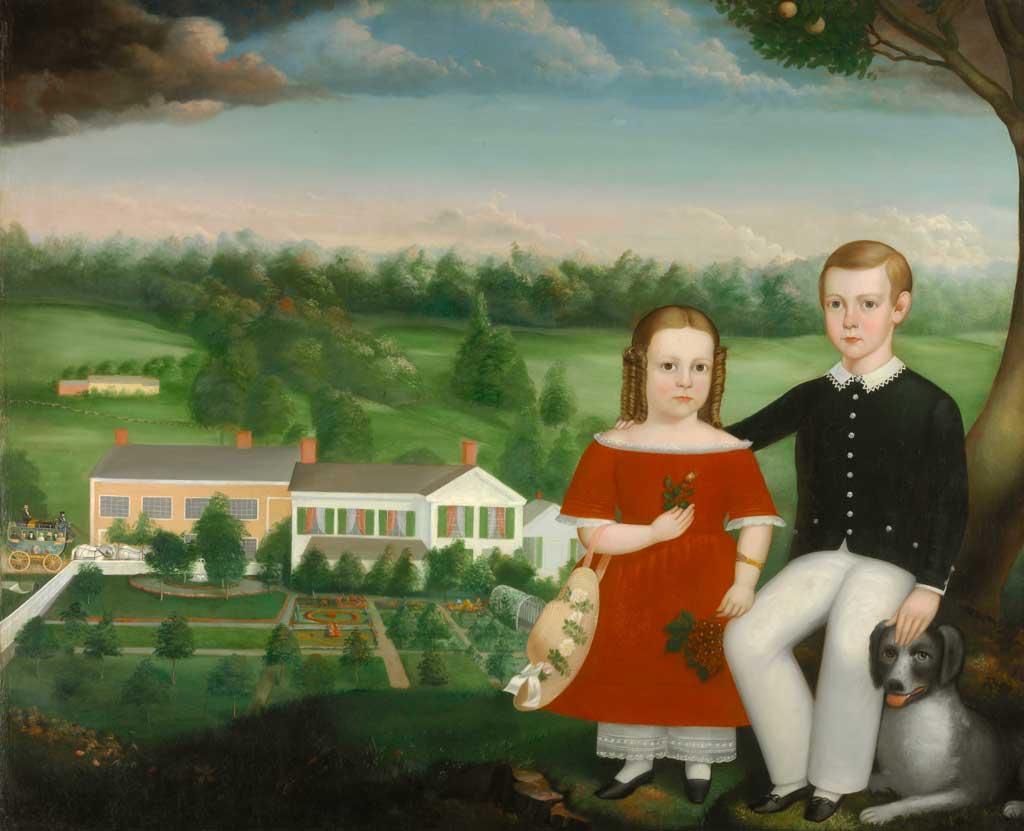
Calvin Balis (1817/18–63) was an American folk artist and itinerant portrait painter. We are not entirely sure how active he was because many works attributed to him are unsigned. He tended to sign the backing of his portraits which in many cases were replaced over time. We do not know much about him. He married Mary ???? and they had four children. We know thingy about his childhood and education. He does not seem to have had any academic training in art. Some of the portraits are rather awkward, especially the hands and feet. Most are well done. Some of his work had elaborate background and some nearly no background at all. He worked in upstate New York, primarily in Oneida County during the mid-19th century (mid-40s and 50s). We do not know of any portraits from the 1860s. The mid-19th century of course was just when photography appeared. Painted portraits had two advantages over photographs, both size and color. here is some evidence that Balis to some extent worked from Dags or Ambros. 【Sutherland】 Balis is notable for his large-sized oil portraits of children. He commonly added pets and props, often toys, and depicted them with indoor or landscape settings. We have archived a few of his portraitists. He did some with the home in the background, something not commonly done by artists and at a time photography was limited to the studio. The portrait of the Eastman children here are a good example (figure 1). The children are well dressed which is what you would except from a family with what looks like such a well-run, successful farm. This all provides interesting information for historians. As with most folk artists, the paintings may not have all the characteristics of fine art, but for fashion historians, the clothing is depicted perfectly and has the useful bonus of color. We see popular styles like dress for the girls. Wee don't see blouses and skirts. The boys' clothing is more varied. Younger boys might wear dresses. This confuses somed modern art historians who seem to think that children wearing dresses are girls. A good example is an >unidentified child in a blue dress and ringlets riding a hobby horse. Both boys and girls wore pantalttes. Kilt suits have not yet appeared. We see boys wearing tunics, jackets, and long pants. White pants were common. One surce suggests this was to lighten the composition. 【Sutherland】 We are not at all sure about that.
Calvin Balis (1817/18–63) was an American folk artist and itinerant portrait painter. We are not entirely sure how active he was because many works attributed to him are unsigned. He tended to sign the backing of his portraits which in many cases were replaced over time. We do not know much about him. He married Mary ???? and they had four children. We know thingy about his childhood and education. He does not seem to have had any academic training in art. He worked in upstate New York, primarily in Oneida County during the mid-19th century (mid-40s and 50s). We do not know of any portraits from the 1860s.
Some of the portraits are rather awkward, especially the hands and feet. Most are well done. Some of his work had elaborate background and some nearly no background at all. br>
The mid-19th century of course was just when photography appeared. Painted portraits had two advantages over photographs, both size and color. here is some evidence that Balis to some extent worked from Dags or Ambros. 【Sutherland】
Balis is notable for his large-sized oil portraits of children. He commonly added pets and props, often toys, and depicted them with indoor or landscape settings. We have archived a few of his portraitists. He did some with the home in the background, something not commonly done by artists and at a time photography was limited to the studio. As with most folk artists, the paintings may not have all the characteristics of fine art, but for fashion historians, the clothing is depicted perfectly and has the useful bonus of color. We see popular styles like dress for the girls. We don't see the girls wearing blouses and skirts--only dresses. The boys' clothing is more varied. Younger boys might wear dresses. This confuses somed modern art historians who seem to think that children wearing dresses are girls. Both boys and girls wore pantalttes. Kilt suits have not yet appeared. We see boys wearing tunics, jackets, and long pants. White pants were common. One surce suggests this was to lighten the composition. 【Sutherland】 We are not at all sure about that.
This painting is entitled 'The Nellis Children". They are from Sherburne, New York a town in central New York, west of Albany. We know nothing more about the family. We see four children and a pet dog in a landscape setting. We see the portrasit dated as 1840. We can not coinfirm that the dating comes from the painting. Many Balis paintings are dated on the back. That may be a little early for Balis, but we are not sure. The 1840s may be more accurate. While the dsatin is not confirmed, the style of the portrait clearly shows that it was a Calvin Balis work. We do not have the children's first name, but they are clearly two boys and possibly two girls, although we are unsure abut he younger child. Naive artists are very good at depicting clohing details, but very poor at depicting ages, but we would guess that the children were about 3-12 years of age The youngest child with the pooch may be a boy or girl. Yonger boys wore dresses just like their sisters. The dress loks the same as what the older girl is wearing, only a different color. There is a low necvkline wih decorative trim ar he necklines and sleeves. The boysare dressed similarly with white pants. Their tops are aifferent. The younger boy has akind of blousde top. It is burgandy with decorative trim at the neckline. The older boy has a black hacketwith brass buttons ands hold a broad-brimmed hat, perhaps a straw hat. The older girl wears a red dress with a low neckline with pantalettes.
The portrait of the Eastman children here are a good example (figure 1). The children are well dressed which is what you would except from a family with what looks like such a well-run, successful farm. This all provides interesting information for historians.T hese are the Eastman children, George and Emma, in update New York with the family dog. We suspect that they were related to the George Eastman who founded Kodak. We can see the family's wonderful farm and tidy garden in the background (August 1850). Notice the stagecoach passing through. This may have been a refreshment stop. The farm was eventually converted into an inn. Naive artists were good at depicting clothes, but poor at depicting age. But we know that the children were 4 and 6 years old at the time. Emma holds the chin strap of a decorated hat, probably a straw hat and has some kind of arm band. perhaps more likely a bracelet--probably gold. . She wears a bright red dress with a low neckline and frilly trim at the neckline and sleeves. She also has what look like expensive sheer, decorated pantalettes. George wears a collar buttoning suit jacket with brass buttons. This was a military style that became popular for school-age boys. There is a small white decorative collar and no neck wear. He wears white pants, popular forth younger boys. White pants was not very practical, but may have been in part a transition from pantalettes. They both have white socks and similar shoes. We are not sure if this as the case or Balis did not want to spend energy on the footwear. Emma had shoulder-length ringlets and George has a very modern hair cut, more trim than we tend to see in photograph.
This is a double portrait of the Howes children, Adelbert and Harriet, painted ( May 25, 1850). We are not sure how long in took Balis to paint a portrait. The definitive date may mean that they they were completed in a day. We are not sure about that. The date may mean when the portrait was completed. We doubt if at the mostthat the paining took more than a few days.
Adelbert was 7 years old and Harriet was 4 years old when their portrait was painted. The children were the grandchildren of Harriet Wales Smith and Anson Smith of Walesville, New York. Harriet has ringlet curls and wears a red dress wih a low neckline and some kind of sheer overlay. She also wears lacy pantalettes. She holds flowers in one hand. We are not sure whast is in the other hand. We are not entirely sure what the boy is wearing. We tought might be a frock coat, but it also looks somewhat like a tunic. It is the lack of va collar that is nusul for a boy. Rasther we aee the same decoirative edging that vthe girl has on her dress. This is something we do not see in the photographic record.
Younger boys like girls might wear dresses. This confuses somed modern art historians who seem to think that children wearing dresses are girls. A good example is an unidentified child in a blue dress and ringlets riding a hobby horse. We believe the child is more likely a boy. It is not because the dress is blue. Modern color conventions were not yet established in the 19th century. But it was very common for younger pre-school boys to wear desses. Thedress has a low neckline, common for younger children, both boys and girls. There is frilly trim at the neckline and sleeves. There is embridered decoration om the sleeves and skirt bottom. Dresses are not a good indicator of gender for this age group. Folk artists are very good at depicting clothing, but not the age of children, but the child was proably about 3-4 vears old. The same is true of ringlet curls. Both girls and younger boys might have tinglet curls. In this case the ringlts were done with double parts. This is a style we see for many boys, but less commonly for girls. It was primarily for pre-school boys, but some older boys also had this hair style. This all means that the child could have been either a boy or a girl. What tips the case for the child being a boy is a hobby horse. The photographic record very strongly suggests that hobby horses were primarily, but not exclusively for boys.
Sutherland, Cynythia. "The elusive C. Balis," The Clarion (Fall 1984), pp. 54-61.

Navigate the Boys' Historical Clothing Web Site:
[Return to the Main individual A-F artist alphabetical page]
[Return to the Main American artist page]
[Return to the Main American page]
[Introduction]
[Activities]
[Artists]
[Biographies]
[Chronology]
[Clothing styles]
[Countries]
[Girls]
[Bibliographies]
[Contributions]
[FAQs]
[Glossaries]
[Images]
[Links]
[Registration]
[Tools]
[Boys' Clothing Home]
Navigate the Boys' Historical Clothing artistic pages:
[Return to the Main artistic page]
[Chronologies]
[Individuals]
[National]
[Styles]