|
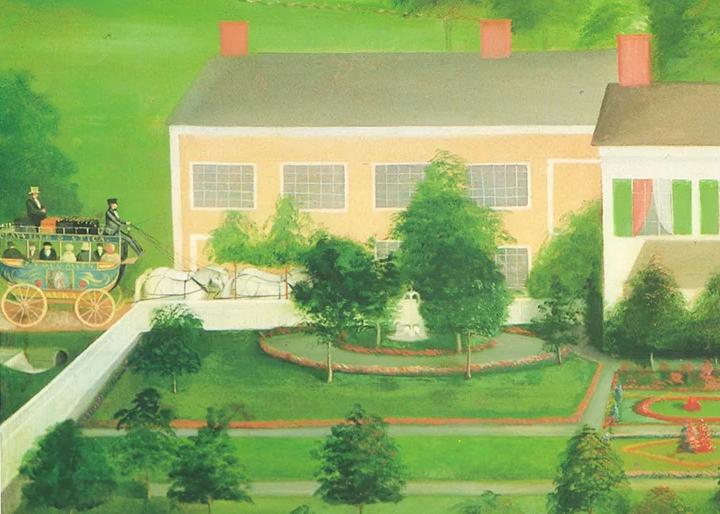
The horse continued to power land transport during the early years of the American Republic. This was the case for both people and goods. For people the primary conveyance was the stage coach. A stagecoach was four-wheeled public transport vehicle, primarily used to carry paying passengers and to a lesser degree small parcels. The name derives from being used to for journeys done in stages, meaning long enough that a change of horses was required. The standard design was the Concord stagecoach which first appeared (1827). It was both sturdy and comfortable (in contemporary terms). Leather strap braces created a rocking motion instead of being jolted up and down. The carriage had to be strongly sprung because the roads at the time were for the most part not improved. They were generally pulled by four horse teams. The stagecoach appears to have originated in Britain (17th century). They were standard in Europe railways were built (mid-19th century). They were adopted in Colonial America, but the road infrastructure was much less developed than in Europe. hey first appeared in the eastern United Sates, but routes were fairly limited. Anyone traveling any distance went by sea. After independence and America moved beyond the Appalachians, ocean travel was no limited and riverboats and barges became important for moving people.
The stage coach began to decline in the Eastern United States as the railroad appeared (1840s). The stage coach did not immediately disappear because some places were not served by rail. Winslow Homer provides a image of the final days of a stagecoach in the eastern United States (1869). And of course the railroad did not appear in the West until after the Civil War 1861-65). This began with the Transcontinental Railway (1869). Ocean and riverine transport for the most part was not available. Until the advent of the railroad land transport was by stagecoach. And in he American mind mind, the stageoach will forever be associated with the West with endless stories imortalized by Hollywood about desperados and wild Indians. This survived today bin out automiles where kids talk about 'riding shotgun'.
Land transport for goods was only feasible for the farmers by horse-drawn wagons bringing goods into nearby cities, commonly ports. Roads were rudimentary or non existent and farmers to get their goods to market relied heavily on rivers if if producers needed to move their produce any distance. The major problem was the Appalachians Mountains. Farmers west of the Appalachians (Pennsylvania, Ohio, Indiana, Ohio, and Kentucky) had no way of getting their low-value products (like grain) over the mountains to eastern markets. One solution was to convert the corn into high-value whiskey.. This led to the Whiskey Rebellion (1791-94). Geography was a great boon to America. The Mississippi River System provided transport for the vast area of the county west of the Appalachians to to he Rockies, This made New Orleans vital to he American economy. None other than a young Abraham Lincoln rafted a load of goods south down the Oho to the Mississippi and eventually New Orleans which Col. Andrew Jackson saved from the British (1815). Lincoln had to walk all the way back home. A major issue in American politics during the early-19th century was internal improvements, including roads and canals. The term was 'internal improvements' and Henry Clay of Kentucky became the great promoter under his American System. We see turn pikes, toll roads, and cord roads. Of all people, westerner Andre Jackson opposed Federal funds for Clay's American System. His primary objection was the corruption connected with government at the time. This was the great issue in ante-bellum politics until slavery came to dominate political discourse.

Navigate the Children in History Website:
[Return to the Main United States Economy: Transport Modes--Roads and Highways ]
[Return to the Main U.S. Economics Transport mode page]
[Return to the Main U.S. Economics Transport page]
[Return to the Main U.S. Economics page]
[Return to the Main Economics page]
[About Us]
[Introduction]
[Biographies]
[Chronology]
[Clothing]
[Disease and Health]
[Economics]
[Environmental issues]
[Feminism]
[Geography]
[History]
[Human Nature]
[Law]
[Nationalism]
[Presidents]
[Religion]
[Royalty]
[Science]
[Social Class]
[Bibliographies]
[Contributions]
[FAQs]
[Glossaries]
[Images]
[Index]
[Links]
[Registration]
[Tools]
[Children in History Home]