if">
if">
|
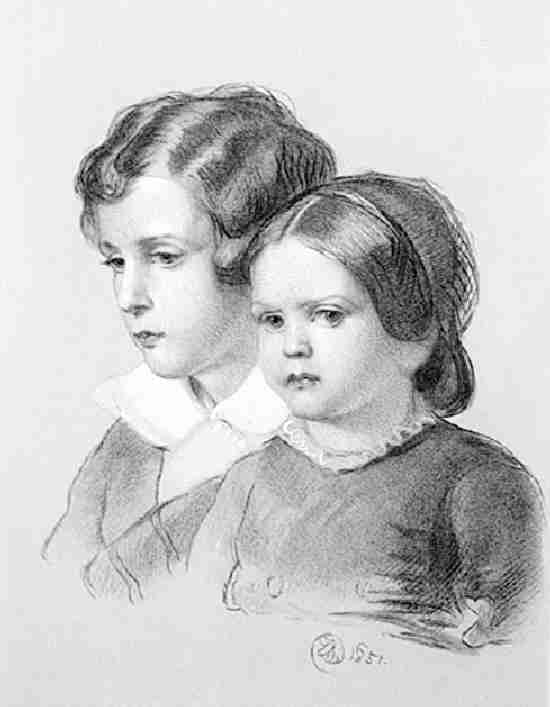
Edwin Landseer was an English artist notable for his paintings of animals. Landseer was born in London. His father was John Landseer ARA. John Landseer took a great interest in his children's education, any they developed considerable artistic talents. Not only did Edwin's brother Thomas became an artist, but so did sisters Jessica and Emma. It is Edwin, however, that is most noted. Edwin first exhibited at the Royal Academy in 1815. He was only 13 years old, one of the youngest artists ever to exhibit at the Royal Academy. He was elected ARA in 1826 and RA in 1831. He was knighted in 1850 and was awarded a gold medal at the Paris Exhibition of 1855. Landseer was elected President of the Royal Academy in 1866, but declined the honor. Many art historians consider him to be the best English animal painter. His best known portrait is surely "The Dying Stag" at the Tate. While known for his animal portrait, we note a charming portrait of a brother and sister. Many of Landseer's paintings were engraved by his brother Thomas Landseer. Landseer's paintings are like much Victorian work sentimental, even those of his animals. His sentimentality seems rather constrained, however, in the charming portrait of the brother and sister seen here. It looks to have been done in 1857. We do not know the names of the children. Unlike many of his animal paintings, this was engraved by F. Holl rather than his brother Thomas.Interestingly his most recognized work is not often attributed to him. He sculpted the massive lions in Trafalgar Square, London. Landseer did a particularly notable portrait of two brothers, Edward and Sydney Russel (1834). He was discussing with their parents how he should paint the boys when they rode past the window. This inspired Landsdeer to suggest painting them on horseback. The result was a very different work than the normally sedate way the chicken of wealthy families were normally painted. We don't see a detailed painting of the boys, but we get a very exciting scene--albeit it looks very dangerous for boys of that age.

Navigate the Boys' Historical Clothing artistic pages:
[Return to the Main English art page]
[Return to the Main artistic page]
[Return to the Main artistic G-L page]
[Chronologies][Individuals][National][Styles]
Navigate the Boys' Historical Clothing Web Site:
[Return to the Main English page]
[Return to the Main 1850s page]
[About Us]
[Introduction][Activities][Biographies][Chronology][Clothing styles][Countries][Girls][Theatricals]
[Bibliographies][Contributions][FAQs][Glossaries][Images][Index][Links][Registration][Tools]
[Main HBC Topic page]
[Boys' Historical Clothing Home]