|
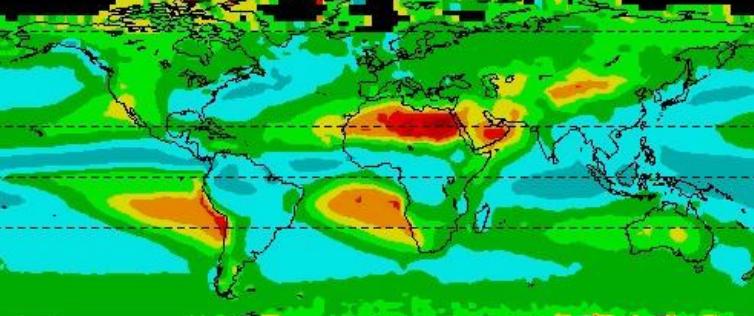
A consideration of the 10-40 Muslim box is important because the countries of the 10/40 Muslim band/box share one catastrophic feature. It is the global area most affected by climate change--meaning precipitation. The area today is suffering dangerously rising temperatures and severe water shortages reaching drought conditions. And next to oxygen in the air, water is the most imprtant substance necessary to sustain life. Population levels usually mirror areas when water vis abundant. Just look at Egypt. It is a large country. Nut except for h Bdouin, virtually the entire population is cramed into he Nile Vlley. Temperature is nother important factor. Both are related to majoir climstic factors. These factors change over time, but only very slowly. And right now the chnge is in the direction og mking the 10-40 Muslim box increasingly unlivable.
Tragically the area of the lowest world precipitation levels fits almost neatly into the Muslim 10-40 box. This is the area where agriculture was invented as part of he Neolithic Revolution (about 10,000 BP). A warm climate was at he time an asset. But rising the temperatures are now impacting precipitation and agriculture. Falling precipitation is the definition of disaster. And in most of these countries, agriculture continues to be a very important part of the modern economy. Much of 20-40 box is the Sahara Desert where very few people live, but the 10-40 box includes major Muslim majority countries, especially Egypt, Iran, Pakistan, and Turkey. It also includes important countries like Afghanistan, Algeria, Iraq, Morocco, Nigeria (slightly outside the box) Saudi Arabia, Syria, and many smaller countries including economically important oil states like the Gulf states. India within the 10-40 box is not a Muslim majority country, but has the world's second largest Muslim population. Temperature and precipitation are world-wide environmental conditions beyond the scope of mankind to control, but the countries in the band/box are doing next to nothings to adapt or mitigate to the dangerous environmental changes. In fact the Muslim countries to varying degrees are pursuing policies, actually making conditions worse. The only country seriously addressing the water issue is tiny Israel.
Temperatures are rising in the 10-40 Muslim box driven by globl warming. Some countries are approachin levels that actually threaten human life. Here the crisis is not as acute as precipitation, but it is a serious matter. Human life is threatened when the body's core temperature reaches about 109.4°F (43°C). A heat Index of 90°F or higher is the baseline threshold for increased caution, especially for vulnerable populations. Heat Index of 105°F to 115°F (41°C-46°C)) is considered the danger zone. Andwe are now seeing temperatures breaking 50°C in the Muslim 10-40 box. Prolonged exposure or physical activity without adequate cooling/hydration anove 40°C can quickly lead to heat exhaustion or heat stroke. Wet-bulb temperatures of 95°F (35°C) threaten human life. At this specific combination of heat and humidity, human sweat can no longer evaporate to cool the body. This is widely considered the critical limit of human survivability. Some countries in the Muslim 10-40 box have reported temperatures exceeding 50°C. While these are still record-braking outliers, he trend of highr temperrtures is clesar. The reports are becomig more common and in more countries wihin he Muslim !0-40 box. Ssouthern Iranian towns like Bostan (51.6 °C) and Ahvaz (50.8 °C) topped the world’s hottest places (July 2024). Temperatures in the UAE inched further closer to the 50°C (June 2026) ). With the highest temperature in the country reaching 49.8°C in Abu Dhabi's Al Dhafra region. 【Hussein】 This is observble in the increasing number of deaths reported by the Saudis in he annul Haj. And it is not only in the Persian Gulf area. Egypt is reporting record high temperaures. One press report tella us, "Egypt is witnessing an alarming increase in temperature, as the Egyptian Meteorological Authority warns of a more brutal summer this year. Aswan, a popular touristic destination in Egypt, saw its hottest temperature on record on June 7, reaching 50.9°C in the shade, The Guardian reported. The previous all-time highest temperature in the country was 50.3°C in 1961." 【Altantawy】 Andc even inthe western perifery of the Muslim 10-40 box here are temperature records being set. In an unprecedented occurrence, Morocco experienced a record-breaking temperature of 50.4°C (August 11, 2023). 【Zouiten】
The primary reason is that most of the Arabian Peninsula and North Africa lie within the global subtropical high-pressure belt creates a dome over the region. Within this dome, the air falls, warms up, and dries out. This falling vertical motion suppresses cloud formation and thus rainfall, creating very stable, dry conditions. Another very important factor is that the region is surrounded by seas — the Mediterranean Sea, the Red Sea, Arabian Gulf, and Arabian Sea — but the long distances inland limit the reach of moisture-laden winds. Atmosperic masses tend to lose moisture before reaching the interior, and the Indian Ocean monsoon system only reaches the southern fringes of the Arabian Peninsula. This is becuse the Indian Sub-continent blovks the Bay of Bebgal monsoons and the high pressure dome over the Levant and easterrn Middle East blocks the Arabian Sea monsdoonms. There are several other natural factors involved, including rain shadow effects and geological conditions. The only Muslim mjority country to benefit from Indian Ocean monsoon rains is Banladash which has a climate more like Southeast Asia than South Asia. Climate change, especially rising tempeatures is now making these conditions increasingly extreme, leading to severe water stress and major environmental challenges.
The primary reason for falling precipitation and riing tempratures in the Muslim 10-40 box is that most of the Arabian Peninsula and North Africa lie within the global subtropical high-pressure belt which create a dome over the region. The region straddles the Tropic of Cancer, where global wind patterns called Hadley Cells force hot, dry air to descend constantly from high altitudes. Within this dome, the air falls, warms up, and dries out. This falling vertical motion suppresses cloud formation and thus rainfall, creating very stable, dry conditions -- permanent high-pressure zones. This warm air compresses as it falls, clearing the sky of moisture and inhibiting cloud formation. The phenomenon prevents the formation of clouds and rain, locking the region into an arid state.
Another very important factor is that while the region is surrounded by seas (the Mediterranean Sea, the Red Sea, Arabian Gulf, and Arabian Sea), the long distances inland limit the reach of moisture-laden winds. Atmosperic masses tend to lose moisture before reaching the interior, and the Indian Ocean monsoon system only reaches the southern fringes of the Arabian Peninsula. This is becuse the Indian Sub-continent blovks the Bay of Bebgal monsoons and the high pressure dome over the Levant and easterrn Middle East blocks the Arabian Sea monsoonns.
There are several other natural factors involved, including the rain shadow effects. : Massive mountain ranges, like the Hijaz Mountains in western Arabia and the Zagros Mountains in Iran, act as giant physical walls. These montain barriers force incoming sea winds upward, causing them to dump all their moisture as rain on the coastal slopes before reaching inland plains.
Temperature and precipitation are related. With limited cloud formtion, few clouds shield the surface, meaning tht solar radiation is incredibly intense in the Muslim 10-40 box This means tht no only is precipitation limited, but that the minimal rain that manages to fall evaporates almost instantly back into the atmosphere before soaking into the prched soil.
Huge expanses of the Middle East are located far from moisture-rich oceans, leaving interior areas exposed primarily to moisture depleted, scorching desert winds. Actually many countries in the 10-40 box have voluninous reservoirs of fossil water lcated in deep confined aquafers. This water dates back earlier geological eras. It can be tapped through drilling, but recharges very slowly if at all. Ooce depleted can not be replaced in human life spans if at all. Not only this, but once the water is removed this can causes he area to collapse, many that it can never be replaced. And his causes sink holes to appear. One famous aquafer is the Persian Taurus-Zagros Aquifer System. It was accessed primarily through the qanat (or kariz), an ingenious underground tunnel system developed (around 1000 BC). Qanats tapped deep mountain aquifers, transporting cool, clean groundwater over miles using only gravity, preventing evaporation and sustaining civilizations in arid deserts. his was developed by ancient Persian engineers and not depleted over time. Since the Islamic Revolution (1979), the uncontrolled pumping has depeted the sydtem. Ther ganat is no longer functional. And Urann's riversystem has also been depleted throiugh irrational dam building and irrifation. So mych so that mjor cities including Tehran are rnning out of water. Ans sink holes are ppearing in the cities.
Climate change, especially rising tempeatures is now making these conditions increasingly extreme, leading to severe water stress and major environmental challenges. : Climate change is causing the Middle East to heat up at roughly twice the global average speed, leading to the worst multi-year droughts seen in centuries.
Altantawy, Salma. "Egypt hits all-time high temperatures," (June 12, 2024).
Hussein, Yasmin. "The NCM [National Centre of Meteorology] has earlier said that residents can expect a few months of intense heat, sometimes crossing 50°C in certain areas," Mi>Khaleej Times (June 24, 2026).
Zouiten, Sara. "Morocco records new heat record as temperature surpasses 50°C for first time," Morocco World News (August 12, 2023).

Navigate the Historic Boys' Clothing Web Site:
[Return to the Main Muslim 10-40 Box page]
[Return to the Main Islam page]
[Return to the Main Middle Eastern chronologies]
[Return to the Main climate page]
[Introduction]
[Activities]
[Art chronologies]
[Biographies]
[Chronologies]
[Clothing styles]
[Countries]
[Bibliographies]
[Contributions]
[FAQs]
[Glossaries]
[Images]
[Links]
[Registration]
[Tools]
[Boys' Clothing Home]