
Johannes Gutenberg and the Printing Press (c1450)
|
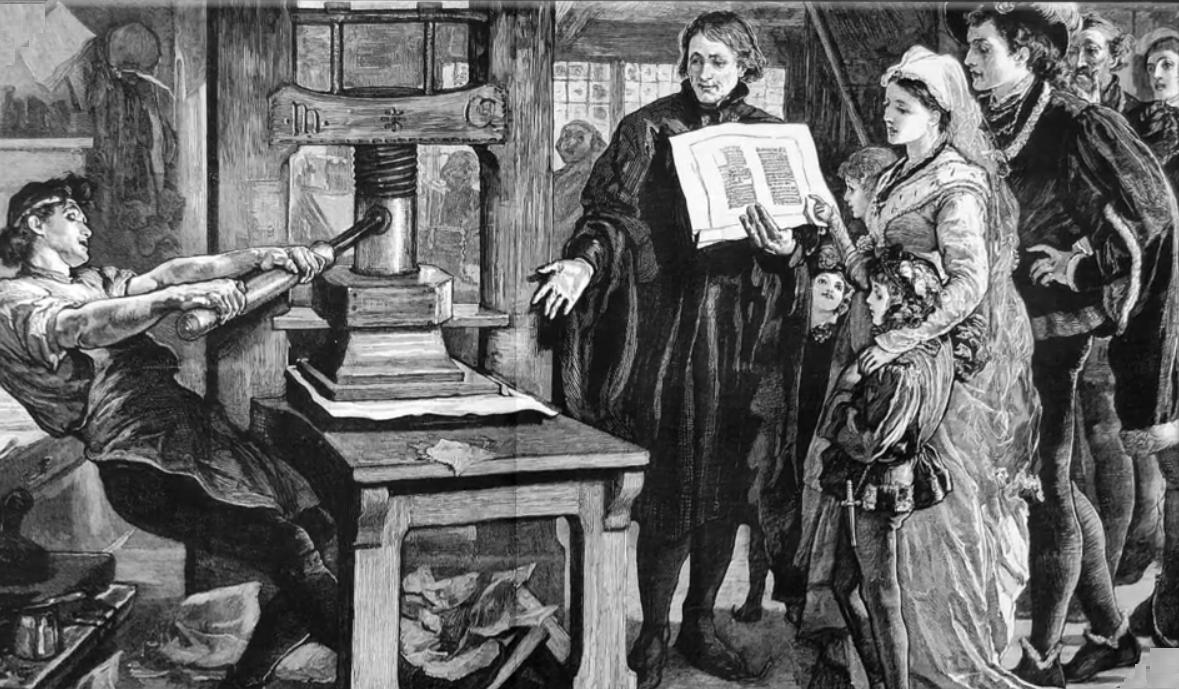
Johannes Gutenberg (c 1398-1468) He is celebrated as the the inventor of the printing press (c 1450). Next to nothing is know about his early life. He was son of a patrician of Mainz. He acquired skill in metalwork. Most of what we know about him comes from documents of financial transactions that have survived. He got into trouble with the powerful guilds and was exiled from Mainz. He moved to Strassburg (c1428/30. He worked in Strassburg for about a decade, involved with crafts such as gem cutting. He taught a number of pupils before retuning to Mainz. Gutenberg's invention of the printin press is not entirely accurate. More important than the actual press, was the moveable metal type letters. This meant that Gutenberg and the Europeans that followed him could and did print any thing. The result was an explosion of knowledge unparalleled in human history. This was arguably more important than the invention of writing. Because so few people were literate when writing was invented. By the 15th century literacy was increasing . And the with Protestant Reformation this increased exponentially. another issue is that it was the Chinese who invented the printing press and the Koreans who invented moveable type. Gutenberrg's work s far as we know was ndpendent of any Chinese precursors. And the European alphabets with a small number of lettos was perfecvtly adaptable to printing. Gutenberg's printing press was a major step toward modernity. One of the great often unaddressed questions of history, is why did China which has the printing press and moveable type, centuries before the Europeans, not lead mankind into modernity? Gutenberg seems to have adpted his printing press from wine and oil presses in common use in Europe at the time. Where he got the idea for moveable type from, we do not know. Gutenberg’s process would not have worked very well if he had not developed his own ink, devised to cling to metal rather than wood. What we do know is that his revolutionized printing, not only book making, but flyers and tracts. This in a very real way changed the worlds of idea. Ideas could now be exchanged over longer distances, but with a much larger audience than ever before.
Pope Alexander VI saw the danger in printing. Before Gutenberg, books and other material were laboriously copied by hand or made using woodblock printing. This was both time time consuming and expensive. Few people could afford a book With Gutenberg's printing press, books could be produced quickly--at least in relative terms at the time. This mean that they were much less expensive and uniformly produced. Every copy of a book was exactly all the others. In a world where scribal error could and did change meaning, this was a substantial improvement. Anyone with ideas could now publish heir idea. And anyone who could read and had a little disposable income could buy their works. This was not whsat he Church had cwanted. Pope Alexander VI saw the danger in printing,especially after it had spread cross Euroope. The Pope threatened excommunication for anyone who printed manuscripts without securng Church approval (1501). And a earth shattering event was not long in coming--the Protestant Reformation (1517). Jutas Pope Ju as Pope Alexander had feared. It is unlikely that the Reformation could have even taken place without Gutenberg's printing press.
Gutenberg thought that his printing press would make him a wealthy man, after his greatest achievement--his Bible (1456). But this was not to be. His major investor, Johann Fust (c1400-1466), called in his debt, seized the press, and had his adopted son, Peter Schoffer (c1425-1503 run the operation. Fust and Schoffer not only continued to print the Bible and other works, but attempted to take credit for Gutenberg's invention. Gutenberg died in poverty and anonymity.
Sources
CIH

Navigate the Children in History Web Site:
[Introduction]
[Biographies]
[Chronology]
[Climatology]
[Clothing]
[Disease and Health]
[Economics]
[Geography]
[History]
[Human Nature]
[Law]
[Nationalism]
[Presidents]
[Religion]
[Royalty]
[Science]
[Social Class]
[Bibliographies]
[Contributions]
[FAQs]
[Glossaries]
[Images]
[Links]
[Registration]
[Tools]
[Children in History Home]
Navigate the CIH chronological pages:
[Return to the Information: Writing, Paper, Printing, and Libraries]
[Return to the Main medieval century pages]
[Return to the Main chronology page]
[Return to theMain Medieval page]
[Return to theThe medieval era]
[The 6th century]
[The 7th century]
[The 8th century]
[The 9th century]
[The 10th century]
[The 11th Century]
[The 12th century]
[The 13th century]
[The 14th century]
[The 15th century]
[The 16th Century]
Created: 5:56 AM 4/5/2023
Last updated: 5:57 AM 4/5/2023