|
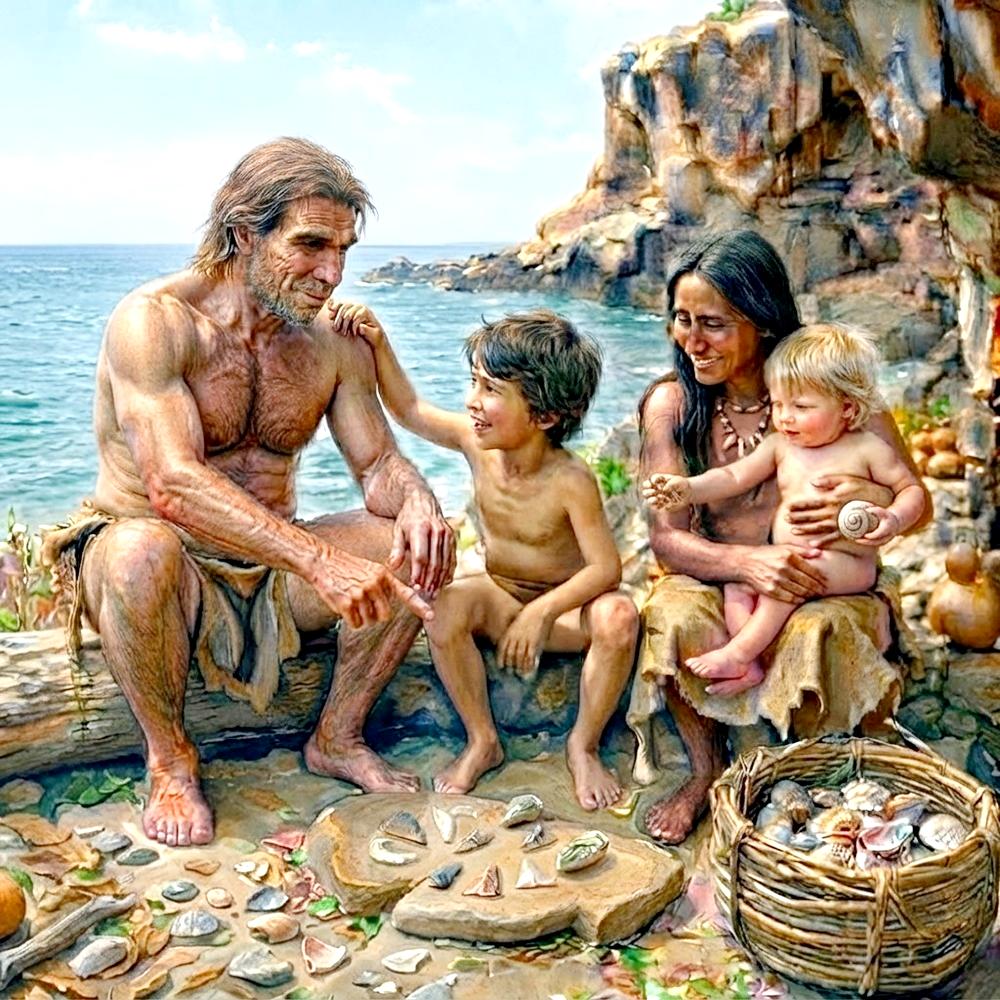
Greece may have the longest and richest archaeological record in Europe, The focus was of course on the marvels of ancient Greece, but this has included pre-history dating ten of thousands of years before the Greek Golden age. Given the migration out of humanoids out of Africa , Greece would have been where many of the small migrating bands first ventured into Europe. 【Runnels and Murray】 Greek pre-history began during the later era of the incredibly long Stone Age. The presence of humans in Greece is a a matter of conjecture (some 700,000-160,000 BP). The early presence of humans is based on the findings of stone tools at sites across Greece and Aegean islands (700,000-200,000 BP) The Petralona skull is the earliest actual fossil evidence. It is an early human skull found in a Thessaloniki (northern Greece close to Anatolia) cave complex (600,000-300,000 BP). It was probably Up-right Man (homo erectus or related H. heidelbergensis). The first humans of major importance were the the H. heidelbergensis descendants--the Neanderthals (H. neanderthalensis). Other artifacts discovered including tools and bones have also been uncovered in the Pindos mountains (northern Greece and southern Albania). Substantial areas of what is modern Greece were inhabited during the Paleolithic and Mesolithic eras. Humans probably reached Greece as a result of migration from Anatolia. The first area of Greece to be settled appears to be Thessaly. Apidima Cave in southern Greece is also important. Skulls discovered there are also early (about 170,000 BP). The species, however is a matter of conjecture. The Uluzzian people are one of the earliest known dispersal of modern man (H. sapiens) in Europe 43,000-39,000 BP. There are findings at three Greek caves (Kissoura, Kephalari, and Koloninista). The cave locations testify to the technological development. They were contemporaneous with the closing years of the Neanderthals. The early inhabitants of Greece are a probably mythological—people called the Pelasgians for which there is next to no information.
Primitive Greeks tribes known as the Pelasgian appeared (10,000-3,000 BC). They populated Thrace, Argos, Crete, and Halkidiki. We know little about them, but they are mentioned in the accounts of Homer, Herodotus, and Thucydides. We do know that agricultural technology from Mesopotamia began to reached Greece through Anatolia (About 9,000 BP). The agriculturists were faced with an invasion of a entirely new people, Indo-Europeans. The expanding Yamnaya swept into Europe on horses and with ox-drawn carts (3,000-2,800 BC). 【Bower】 In only about a century, the Anatolian farming population of northern Europe were gone, replaced by the Yamnaya Steppe population. Unlike northern Europe, where the Yamnaya people drastically altered the gene pool, in southern Europe, especially Greece the Yamnaya hit a 'genetic wall'. 【Kokkinidis】 Macedonia and northern Greece was a different matter. DNA studies across the Balkans (including Bronze Age samples from northern Greece and the broader Macedonian region) show that Western Steppe h erder (Yamnaya Steppe -related) ancestry became a major genetic component in the region on sharpo contrst Greece further south. 【Explore Your DNA】 Even so, Greek is an Indo-European language showing there was an important cultural impact. Soon after writing appeared and the glorious era of ancient Greece began.
Bower, Bruce. "How ancient herders rewrote northern Europeans’ genetic story, " SciemeNews (January 10, 2024). An international team of researchers describes these results, based on analyses of DNA from more than 1,600 ancient individuals.
Explore Your DNA. "Mancedonian DNA". Macedonian DNA
Kokkinidis, Tasos. "Greeks are descendants of the Mycenaeans: DNA Study Confirms Greek Reorter (October 8, 2026).
Runnels, Curtis and Priscilla M. Murray. Greece Before History:mAn Archaeological Companion and Guide (2002), 224p.

Navigate the Children in History Website:
[Return to the Main Greek history page]
[Return to the Main European history page]
[Introduction]
[Animals]
[Biographies]
[Chronology]
[Climatology]
[Clothing]
[Disease and Health]
[Economics]
[Ethnicity]
[Geography]
[History]
[Human Nature]
[Law]
[Nationalism]
[Presidents]
[Religion]
[Royalty]
[Science]
[Social Class]
[Bibliographies]
[Contributions]
[FAQs]
[Glossaries]
[Images]
[Links]
[Registration]
[Tools]
[Children in History Home]
Navigate the Boys' Historical Clothing Greek pages:
[Return to the Main Greek country page]
[Return to the Main country page]
[Greek choirs]
[Greek folk costumes]
[Greek movies]
[Greek royals]
[Greek schools]
[Greek youth groups]