|
Spain began building a colonial empire even before completing the Recoquista or unification (1492). The first overseas possession was the Canary Islands (beginning 1402) and it served as a template for the county's future imperial expansion. Spain was formed primarily by the fusion of Castile and Aragon after the marriage of Isabella and Ferdinand who ruled as joint sovereigns. Castile had no maritime tradition, but Aragon did along with a Mediterranean empire. Efforts to establish North African colonies was met with determined resistance by the Islamacized population. Efforts in the Indies beginning with Columbus' voyage (1492) met with far greater success. The fact that a Genoan navigator led the expedition attests to the limited maritime tradition of Castile. The Spanish proceeded to build one of the great world empires, the first truly global empire. Previous empires had been either regional or like the Mongol Empire a purely terrestrial territorial expansion. Spain established colonies on all continents except the Arctic and Antarctica. Great wealth from the Americas flowed into Spain, but it did not succeed in building a great world power. After a century of empire building and efforts to destroy the Reformation, Spain began along slow decline. This culminated in a bloody military campaign against French occupation and loss of most of its empire (early-19th century). The Spanish Empire (Imperio Español) comprised territories and colonies around the globe administered directly by the Spanish Crown. Spanish conquistadores, navigators,and priests founded colonies in the Americas, Africa, Asia and Oceania. This resulted from the Age of Discovery launched by the Portuguese. After Ferdinand and Isabella, Under the Spanish Habsburgs, Spain with the wealth flowing in from the new Empire became the superpower of the age with vast, political, military, and economic power. The Spanish overseas expansion began at roughly the same time as the Reformation (1517). Much of the strength of the empire was devoted to a costly and ultimately unsuccessful effort to stamp out Protestantism. The bullion flowing into Spain had massive economic consequences throughout Europe. The Spanish and Portuguese Empires were established at about the same time with at first little competition from their European rivals. This ushered in the modern global era (globalization in modern parlance) and the rise of Western dominance in global affairs. The Spanish empire Spain's territorial reach beyond Europe spanned five centuries, although it was sharply reduced with the American wars of independence (early-19th century). The last major possessions were lost as a result of the Spanish-American War (1898-99). The last African colonies were given independence (1975).
Spain began building a colonial empire even before completing the Reconquista or unification and discovery of the America, both occurring in the same year (1492). The first overseas possession was the Canary Islands (beginning 1402) and it served as a template for the county's future imperial expansion. Spain was formed primarily by the fusion of Castile and Aragon after the marriage of Isabella and Ferdinand who ruled as joint sovereigns. Castile had no maritime tradition, but Aragon did along with a Mediterranean empire. Efforts to establish North African colonies was met with determined resistance by the Islamacized population. The Portuguese led the way south along the coast of Africa and the Spanish soon followed. It is at this time that African slaves began to appear in numbers. The primary goal was to reach the East (India and China), but trading posts were established t deal in a range of goods, including gold, ivory, and slaves. Spain did not, however, attempt to conquer, Christianize, or settle Africa Sub-Saharan Africa. They do just than in what would become the first Spanish colony--the Canary Islands. The Canaries wold become the template for the vast empire that Spain would build.
The Empire that Spain would build resulted from the Age of Discovery launched by the Portuguese. The great European voyages of discovery of the 15th and 16th centuries were fundamentally economic enterprises. They were conducted by the European countries of the Atlantic coasts to establish direct trade contacts with China and the Spice Islands (Indonesia) that was being blocked by Byzantium/Venice and the Arabs. At the time, trade in silk, porcelain, and spices from the East carried over the Silk Road had to pass through Turkish, Arab, Byzantine, and Italian middleman, making them enormously expensive. The crusaders failed to break the Islamic wall separating still primitive Europe from the riches of the East. Circumventing the land Silk Road and the sea Spice Route would have profound economic consequences for Europe and the world. The balance of power would shift from Eastern to Western Europe and eventually to northern Europe. Two nations led the early explorations in the 15th century--Spain and Portugal. These two countries pioneered the sea routes that would lead Europeans to Asia and the Americas, but the Dutch, English, and French were to follow in the 16th century.
Efforts in the Indies beginning with Columbus' voyage (1492) met with far greater success. The fact that a Genoan navigator led the expedition attests to the limited maritime tradition of Castile. Columbus finally sailed west on his First Voyage under the banner of their most Catholic magesties Ferdinand and Isabel. Columbus sailed west into the Atlantic hoping to reach the Indies (1492-93). Columbus with his three ships first landed in the Bahamas and then proceeded south to Cuba and Hispaniola. He landed along the northern coast of Hispaniola (December 5, 1492). He called the Tainos he encountered "Indians", convinced that he had reached the Indies. He began the settlement of his discoveries on his Second Voyage (1493-95). Columbus of course had found America. It was not until his Third Voyage when he reached the South American continent that he began to realize, but never admitted. that he had found an entire new continent (1498-50). 【Bowden 】 Columbus despite his achievements was a controversial figure in his own era. He was extraordinarily brutal with the Native Americans on Hispaniola from who he demanded gold and then enslaved. Queen Isabella had ordered that he not enslave the indigenous population. He also brutally ruled over the Spanish colonists. He was a failure as a colonial administrator. He was in fact returned home from his Third Voyage in chains. His final Fourth Voyage ended in disaster and he almost perished on Jamaica where is ship wrecked (1502-04). He finally had to buy his passage home to Spain--a great humiliation
Ferdinand Magellan (1480?-1521) served in the forces of the Portuguese crown involved in military campaigns in India and the Spice Islands (1508-12). Magellan conceived of reaching the Spice Islands (Indonesia) via the Atlantic, but King Emanuel was uninterested, causing Magellan to renounce his Portuguese citizenship. Charles I of Spain (Charles V of the Holy Roman Empire) commissioned Magellan to find a passage through the Americas to the Spice Islands. Magellan sailed from Seville (1519) and explored the Plate estuary (1520) before crossing into the Pacific through the straits at the tip of South America now named for him. He claimed the Philippines for Spain, but was killed there (1521). One of his ships managed to return to Seville, completing the first circumnavigation of the world (1522).
The Conquistadores were the 16th-century Spanish and Portuguese adventurers and soldiers of fortune who in Columbus' wake conquered the Indian civilizations of New World from Mexico south to the Southern Cone. They are most notable for conquering the advanced native American empires of the Aztec, Maya, and Inca. Their conquests began in the Caribbean with Hispaniola and Cuba. These were, however, rather primitive groups with limited resources. On Cuba, the Spanish began receiving rumors of immensely wealthy Native American empires on the mainland. This was in part a desire of the Caribbean people to encourage the Spanish to move on and in part glimmers of information gleaned from trade contacts. The legend of the Conquistadores began with Hernán Cortés who led only 500 men with 16 horses conquered Mexico's powerful Aztec Empire with thousands of well-trained, but poorly armed warriors. A force from Mexico under Pedro de Alvarado subsequently conquered the Maya and other groups in Guatemala. Francisco Pizarro led an even smaller force into the hear of the Inca Empire, 180 men and 37 horses. His defeat of the Inca led to Spanish control of much of South America. A companion, Diego de Almagro, led another force south into Chile. Further more limited expeditions expanded Spanish rule over much of South and Central America and the establishment of the cast Spanish Empire. The Conquistadores were renowned for their bravery, they were also notorious for their avarice and brutality. Military success came with a combination of superior world view, weaponry, division among the Indo-Americans, and Europeans diseases which would devastate Native American populations. The Spanish monarchy both relied on the Conquistadores for acquiring vast colonial possessions, but at the same time feared that they commit treason and establish independent kingdoms.
The Spanish Empire, like the British Empire, which was to begin on a smaller scale a century later, involved Christianity. The established Catholic Church with the Spanish monarchs as their most devoted supporters was at the heart of the developing Spanish Empire. Religion played a minor role at Jamestown (1609), but at Plymouth (1620), it was at the heart of the foundation--but a very different kind of Christianity. Not only was the Plymouth colony found by Protestants--they were dissenting sect that was being suppressed by King James I who was laying the foundation of the established Church of England. In contrast, Catholic friars accompanied Columbus and the Spanish Conquistadores from the onset of empire. Thus while the British Empire was in part founded by settlers seeking to escape religious orthodoxy at home, a primary goal of the Spanish monarchs, especially Philip II, was to impose a religious orthodoxy. And Philip's Church was an unreformed, vigorous Catholic Church that was much less tolerant of descent than James' Church of England. The Church had the Inquisition to thoroughly imposed religious orthodoxy. The Catholic Church provided an all-embracing ideology for Spanish expansion. The Coquistadores were driven by a lust for gold, but the religious imperative was a very important part of Philip's motivation. At the beginning of the Empire, the supreme authority established on the island of Santo Domingo (the first important colony) with authority extending throughout the Caribbean, was vested in three Jeronymite priors (early-16th century). 【Thomas 】
The native Indo-American population were terribly abused by their new masters. There are many accounts of horrendous cruelties. Some caution is needed because in Europe religious wars had begun and the Spain had become a major supporter of the Catholic cause. The Protestants circulate accounts of Spanish cruelties, including both the inquisition and the treatment of the native Americans. The natives were, however, not without their defenders. The Dominicans became major defenders of the natives. The most notable defender was Spanish planter and slave owner in Cuba whose conscious led him to the Church and priesthood--Las Casas. 【Wells, p. 658. 】 Las Casas and other friars led to a scholarly debate in the Spanish Court. The result was some impressive humanitarian initiatives, not common in the 16th century. Tragically, little of that filtered down to the actual Spanish administration of the colonies. and notably it only dealt with the indigenous population, not the imported African slaves.
We have had many discussions with Spanish readers who object to our assessment of Spanish colonial rule in the America. As far as we can tell, the general Spanish view is that the Spanish left their American Empire on a par with English North America and the United States, a rich prosperous area (earky-19th century). And the decline of the region occurred beginning with independence. We get comments like, "Please, read about the series "Leyes de Indias", from Isabel to Philip II. to understand that despite abuse of the conquest, the goal was always integrating and providing the same rights to peninsulars and criollos. Please think about how today Spanish America is mostly populated by mestizos. The citizenship was essentially Christianity. And Christianity was very easy to acquire because previous civilizations and gods were cruel, and the church theoretically brought knowledge and care for natives. Inequality could exist in the colonized territories, not very differently there were in the peninsula or rest of Europe. Please read about some of the "Indians Conquistadors" such as Tlaxaltecas, that after the conquest were mostly the governors, aristocrats and landowners of their regions in Mexico under the Spanish Crown. Do you know anything similar in the Anglo-Saxon conquest? Abuse happens even today in the XXI century, and of course there was abuse at that time from Spanish to native. But, from my point of view, Spain did extremely well in this integration of both worlds 500 years before the 'human rights', and clearly much better than others such as British. Spain was inspired in other kind of empires such as Rome: constructive/builders and multicultural." 【Blasco】 Much of this is true. There were few if any advocated fir Native Americans in England. There is on exception. The Quebc Act (1774) which attempted to create a Native American reserve beyond the Appalachians, The motivation was, however, more to limit American expansion than out of any concern for Native Americans. The simple fact is that North and Latin America developed very differently and there are reasons for that. Many of them relate to the differences in Spanish and English culture, law, and society. The same can be said of the differences between England and Spain itself. Of particular importance Also important is the land ownership pattern adopted by the United States--small family farms.
The Treaty of Tordesillas formally divided the world between the two Catholic maritime powers, Spain and Portugal (1494). Columbus' discovery of the Americas began a potentially dangerous period of international dispute between Spain and Portugal. Some historians believe that Portugal had already discovered Brazil, but kept in secret. It was, however, not secret that that Portuguese navigators had moved down the Atlantic coast of Africa. Bartholomeu Dias reached the Cape of Good Hope at the southern tip of Africa (1486). With Columbus' first voyage (1492), Queen Isabella and King Ferdinand acted quickly to make an international claim to all the lands in the area he had discovered. Pope Alexander VI in a decree divided the world outside of Europe into two zones on each side of a line he set at 370 leagues west of the Cape Verde Islands. The lands discovered in the Western Zones were awarded to Spain, and those in the Eastern Zone were awarded to Portugal. The Papal bull 'Inter Caetera' and other related bulls form the basis for this division and the negotiations between Spain and Portugal. At the time there were no Protestants, but with the Reformation (1519), the Protestants were to be kept out of the New World and East. Portugal objected to the original line that the Pope drew. And a new dividing line was drawn for the Treaty of Tordesillas allowing for Portuguese contol of Brazil which was not yet known outside of Portugal (1494). Additional division was made with the Treaty of Zaragoza (1529). This was complicated, because increasing the area to the west in the Americas reduced the area half way around the world in the Indies (meaning modern Indonesia) which was becoming much more valuable than the Americas.
Spain began empire building while English monarchs were primarily focused on France. Spain was born out of the union of Aragon and Castile by Ferdinand and Isabella. Initially this was expansion through marriage and inheritance, largely through possession of King Ferdinand's Aragon, meaning the Kingdom of the Two Sicilies (southern Italy and Sicily), Sardinia, Mallorca, and the Balearic Island. The Hapsburg connection brought the Low Countries (Belgium, the Netherlands, and Luxembourg) as well as Franche-Comte (northeastern France). The rich Netherlands proved to be a troublesome prize. Spain was at the height of its power, but failed to prevail in the nearly century-long Dutch War of Independence (1568-1648). This and other costly wars as part of the European religious wars were a factor in Spain's decline.
Spain after expelling the Moors (1492) waged wars with the Barbary States, but only manged to acquire Moroccan enclaves as well as what became the Spanish Sahara south of Morocco. All that remains today is Peñón de Vélez de la Gomera
The Spanish followed in the wake of the Portuguese south to participate in the trade with India, the Spice Islands, and China. The only colony in Sub-Saharan Africa. however, would prove to be Equatorial Guinea which Spain would acquire much later (1778). This is why Spain was not a major player in the slave trade, although Spanish colonists purchased many slaves from the Portuguese, English, and others.
Spain's first voyages into the open Atlantic resulted Castile's colonization of the Canary Islands which created a blue print for the colonization of the Americas (primarily 1470s). The colonization of the Americas began in the Caribbean which came to be called the Spanish Main thanks to Columbus' voyages (1492-1504) and the fearsome Conquistadores. Modern woke historians are wrong about most issues, but they are correct about the brutalities of Columbus and the Spanish. Of course other Europeans at this time were not much better if not actually worse. The Pope forced the Spanish to share their empire with the Portuguese--the Treaty of Tordesillas (1494). The Portuguese established only one colony in the Americas, but Brazil proved to be half of South America. The Spanish thirst for gold and silver soon led the Conquistadores from the Caribbean to the mainland where they found and conquered rich indigenous empires in Mexico and Peru. The primary colonies were modern Argentina, Peru, and Mexico--which were eventually sub-divided into the modern independent countries. Spain attempted to expand their empire into North America, but did not have the military power to either defeat the Native American peoples north of Mexico or the other European powers (especially Britain and France) which wanted empires of their own. Spain's major North American holding proved to be Florida. Spain also claimed large areas of the North Pacific coast and what is now he American southwest, but there was no significant Spanish settlement in these areas. Spain also established Pacific colonies--the Philippines and Marianas. Spain lost many of its Caribbean islands (17th century). Spain at the time was a major European power, but its naval power did not match its land power as show cased in the defeat of the Spanish Armada (1588). As a result, Spain lost many valuable Caribbean islands. These islands proved to be immensely valuable as the sugar industry expanded -- a development which for some reason Spain was not a major player. Spain constantly changed the administrative boundaries of its American colonies and many of the modern Latin American states did not emerge until the Latin American Wars of Independence (1806-26).
Also important proved to be the Philippine Islands in Oceania. Magellan claimed the islands for Spain (1521). Colonization began after the discovery of silver in Mexico and Peru (Bolivia). The Philippines became a valuable part of the Spanish trade routes with China--the Manila Galleons route. A possession of lesser importance in Oceania was the Mariana Islands east of the Philippines. The Spanish regained the southern Netherlands (Belgium) from the Dutch, but lost out to the pesky Dutch in efforts to control the East Indies spice islands. They did maintain control of the Philippines and Marianas.
The long history of Spanish colonial rule with only a few exceptions an era of relative tranquility. This was in part because of the coercive power at the disposal of Spanish colonial authorities, power they rarely had to employ. This was in part because of the system of governance that evolved in the multi-ethnic society with developed throughout the Spanish colonies in the Americas. The Spanish Hapsburg authorities imposed a complex juridical and administrative system taking in to account the evolving ethnic communities. The populations include Spanish and creoles (American-born individuals of Spanish ancestry), indios (the indigenous people, mestizos (mixed indo-European ancestry), and Africans imported as slaves (more important in Portuguese Brazil than the Spanish colonies). The Spanish vision was to weld these different people into an organic whole, both in both the Vice Royalty of New Spain (Mexio) and Peru. The Spanish saw their colonies as a Christian commonwealth over seen by the ever present Church through the Inquisition. These people were organized hierarchically, but each possessed an allotted space with both duties and rights guaranteed by the crown. The indios had their own hereditary elite of caciques (kurakas in Peru). They acted as intermediaries between Spanish royal officials and the indo peasantry. Theoretically every individual in the Spanish colonial commonwealth had the right of appeal up the bureaucratic chain of command to the king himself.
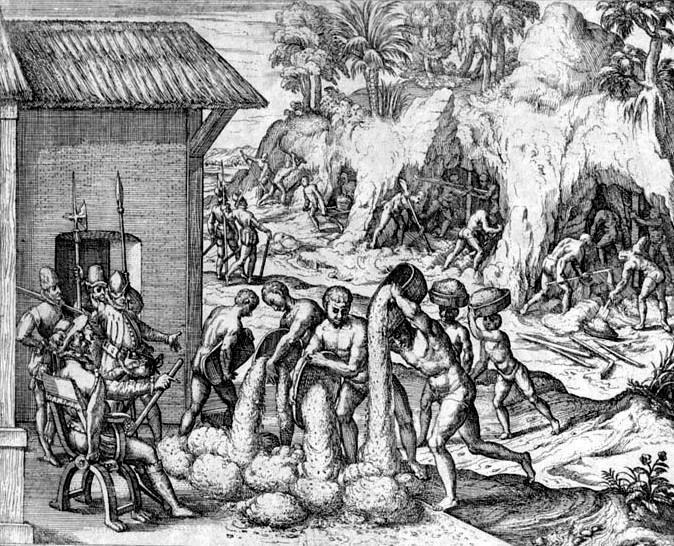
Spain originally founded colonies in the Caribbean (The Spanish Main), but was disappointed with the economic returns. Within a very short period they began to understood that they had not reached the East (Indies). And they also realized that the Caribbean islands laid off a vast mainland and rumors began to circulate of fabulously rich native empires. This launched a period of conquest (16th century). Spanish conquistadores carved out parts of North, Central, and South America and created a vast empire. This included Native Americans at the hunter-gather stage as well as sophisticated empires, including the Aztec, Mayan, and Inca Empires as well as smaller Native American kingdoms. The defeat of these empires left the areas conquered in ruin. So the Spanish had to find a way of ruling theie empire and of rebuilding an economy. They chose the repartimiento/encomienda system which had been used by the Spanish after conqueing the Canary Islands. The repartimiento was the process of dividing up the Indo-Americans and assigning them in an encomienda. Encomienda comes from the Spanish word 'encomendar' meaning 'to entrust'. It was essentially a trusteeship, a term used by the League of Nations after World War I. The Spanish used the encomienda system in several areas they conquered. It was of special importance in Peru and Mexico, notably the area of the most sophisticated Indo-Amercan empires. Under the encomienda system, the Spanish Crown entrusted Conquistadores and prominent Spaniards with the rule over native communities. Many such grants involved huge areas. It was essentially a recreation of the European feudal system. The Native Americans were tied to the land and provide labor and tribute to the Spanish lord. In return the Spanish lord would provide protection and education. As it developed in reality, it became virtual slavery. The treatment of the Native Americans was horrendous, especially those used for mining, but there were many other abuses. The Crown attempted to protect the Native Americans go a degree, but the King was very far away. Some church men like Bartolomé de las Casas (c1484–1566), also attempted to reduce the abuses, but to little affect.
It was the Indio peasantry that supported the entire Spanish colonial system. The peasantry for the most part did not own land, but worked on a land owners estate--the hacienda. This was part of the encomienda system justified by right of conquest and in exchange for the protection and conversion to Catholicism. The Indian peasant on a hacienda was allowed to use a small plot of land for subsistance. The plot had various names. In Ecuador it was known as a huasipungo. The peasantry in exchange for his plot was subject to various obligations, including tribute (head tax), the mita, the reparto, and sales taxes. Tribute collection was assigned to the caciques/kurakas, who were supposed to turn over the funds collected twice a year to the corregidores. There was considerable abuse with the peasants charged too much and the Crown received too little. Mit'a was a Quechua (Inca) term for mandatory labor. It was continued after thd Conquest as the mita by Spanish officials. Spanish colonial officials both modified and intensified the obligations. The reparto was the 'reparto de mercancías' was the requirement to purchase commonly unwanted products, such as textiles, often at outrageously high prices. Both the caciques and colonial officials at different levels cooperated in raising prices to maximize returns and their share of the profits. 【Walker 】 These various requirements on the Indo-pesantry seriously affected their livelihood and prosperity.
The Spanish proceeded to build one of the great world empires, the first truly global empire. Today when we think of empire, we think of the British Empire. But until the 19th century, it was the Spanish Empire that was the great global empire. Previous empires had been either regional or like the Mongol Empire a purely terrestrial territorial expansion. Spain established colonies on all continents except the Arctic and Antarctica. This culminated in a bloody military campaign against French occupation and loss of most of its empire (early-19th century). The Spanish Empire (Imperio Español) comprised territories and colonies around the globe administered directly by the Spanish Crown. Spanish conquistadores, navigators, and priests founded colonies in the Americas, Africa, Asia and Oceania.
The Spanish established a massive empire, but it did not produce the wealth that the Spanis crown expected, in part because it was not the wealthy Indies that Columbus expected. The Conquistadores were fixated on gold and despite Atalappa's treasure extorted by Pizzaro and the ongoing search for El Dorado, the Spanish found very little gold.
What they found was silver. The wealth Spain extracted from its empire was primarily silver. The Spanish discovered a huge silver resource high in the Andes at Potosí in what at the time was Peru (modern Bolivia) only a few years conquering the Inca (1545). They eventually opened several thousand mines using enslaved native and African labor. At virtually the same time, an important silver resource was discovered at Zacatecas in Mexico (1546). This Spanish silver is perhaps best known for the annual treasure fleet transporting it and smaller quantities of gold to Spain. The bullion was laboriously transported from Potosí to Lima and by sea to Panama, across the Isthmus by mule and then to Portobelo on the Caribbean. There convoys of Spanish caravels would deliver trade good and pick up the bullion for delivery to Spain. Tuning to to Portobelo the European goods needed in the colonies, carry back to Spain the precious bullion with which the colonists The Quinta or 20 percent was paid the the Crown. Less well known was the Pacific treasure convoys (the Manila galleons) ships which delivered even larger quantities of silver to China via Manila in the Philippines. This was made possible by the Single Whip Law or Reform (一条鞭法), a fiscal law instituted during the middle Ming dynasty (early 16th century)--the same time that the Spanish Conquistadores carved out Spain's Empire. Zhang Juzheng promulgated Law throughout the empire (1580). The Chinese Imperial tax collection unit changed from rice to silver. Despite the increasing popularity of silver in coins, copper coins were still used in the basic day-to-day transactions; however, silver was the main form of payment for major transactions in the commercial sector. 【Barker, p. 2.】 China at the time had the world's largest economy--the engine for world economic growth. Europeans wanted Chinese products (silk, pprcelin, tea, and other goods), but had little the Chinese wanted to trade. Spanish silver made the all important China trade possible. And the value of the silver was heightened by arbitrage. The silver was worth more in China than in Europe. The annual Spanish treasure was the envy of other European powers. And other European powers from an early point (England and France) contracted privateers to attack it. The attacks became part of the Dutch war of independence
The Spanish Sea Dogs, men like Drake, Hawkins, and Raleigh Most of the attacks were in the Caribbean, but Drake famously conducted a Pacific campaign. These attacks would be a major reason that Philip II sent the Great Armada against Queen Elizabeth who was financing the English privateers. The trade was channeled through the Royal Casa de Contratación (House of Trade) created in Seville (1503). This monopoly turned Seville into the richest city in Europe. Of course Seville or even all of Spain could not nd an increase in prosperity from this flow of bullion spreads outwards through Europe. The region of Seville, and indeed the whole of Spain, could not provide all the goods needed by the colonies. Thus raw materials as well as manufactured goods from Europe were shipped to Seville for transport to America. This helped to promote economic growth in Europe, but not in Spain itself. Much of the wealth was used by the Spanish crown to fight religious wars in Europe--most prominently to pressures Protestantism.
Columbus calculated a smaller wotld than existed. His goal was to open a shorter trade eoute to the East: India, the spice islands and China. What he found were small islnds populated with primitive people. There was little to trade. But there these people jad small quantities of gold. This fired up great interest among Europeans. And the next generation of Eueopeans were moticated by a quest for gold and silver which would have a massive impact on the European economy. Of all the Europeans who descended on the Americasr, only the Spanish would find the gold and silver they wanted.
After Ferdinand and Isabella, under the Spanish Habsburgs, Spain with the wealth flowing in from the new Empire became the superpower of the age with vast, political, military, and economic power. The question would become what would Spain do with its vast power. What would become of Spain and its people and neighboring countries as well as Western civilization as a result of the power Spain had acquired. What major advances in occurred in Spain as a result of its wealth and power. Were their important cultural, economic, political, scientific, social, or other achievements. The answer is eerily similar to the fate of the Soviet Union--virtually nothing. The reasons why are very similar to the Soviet Union despite the separation in time and ideology--the suppression of human freedom.
English audacity and technology at sea laid the groundwork for the Royal Navy and command of the seas. The swashbuckling English sea captains of the Elizabethan era were known as "sea dogs". They were a breed apart. They were adventurers who combined considerable maritime and military skill they allowed them to successfully seize Spanish treasure. Francis Drake, John Hawkins, Walter Raleigh, Martin Frobisher, and lesser known names for four decades fought a private war with Spain, the great naval power of the day. Queen Elizabeth was a secret partner, but well known to King Philip. The Queen loaned ships and took her share of the loot from privateering expeditions aimed at Spanish or French shipping. The long conflict with Spain was rooted in an English hunger for Spanish treasure and a commercial and maritime rivalry. The depredations of the Sea Dogs convinced Philip that he must act against England. There best known achievement is defeating the Great Armada and with it the threat of Spanish Catholic absolutism. They bedeviled the Spanish treasure fleet and thus gained for England a share of the American bullion flowing into Europe. The English then formed overseas trading companies and very modest colonization attempts were made in the Caribbean and North America by Sir Humphrey Gilbert and Sir Walter Raleigh. One of these colonies was Jamestown, one of the foundation stones of the future United States.
Three powerful developments came together at roughly the same time. The fall of Granada and thus the completion of the
Reconquista as well as Columbus'' first voyage both occured in the same year (1492). Luther nailed his 95 Thesis on the church door soon after, unintentionally launching the Reformation (1517). By time the Hapsburgs in the person of Charles V oversaw a vast European realm, including both German and other central European provinces as well as Spain. The Spanish army as a result of the Reconquista was the strongest in Europe and as gold and silver poured in from the the Indies, Charles and then his son Philip II had at their command vast power. Much of the strength of the empire was devoted to supporting the Catholic Church and suppressing the Protestants. Great efforts were made to keep Protestants out of their American colonies. (In sharp contrast to what occurred in the English colonies.) Two of the best known Spanish efforts were the effort to destroy Protestantism in the Netherlands and England. This proved enormously expensive. The huge effort to build the Spanish Armada was almost a total failure. And the tiny Netherlands fought the Spanish armies to a standstill in the Dutch War for Independence. The Spanish and German Hapsburg as well as the Spanish Bourbons undeniably succeeded in stemming the Protestant advance, but they failed to destroy the Protestant stronghold on northern Europe. And the Spanish in particular would ultimately squander much of the wealth of the indies. This and the Spanish Inquisition would in a short period turn the country into a military, economic, and intellectual backwater.
The Spanish Empire was founded by Ferdinand and Isabella. Through the marriage of Philip the Handsome to Joanna of Castile, the daughter of Ferdinand and Isabella (1498), the Hapsburg Spanish dynasty was established with their son, Charles I of Spain (Charles V of the Holy Roman Empire). The Empire was ruled by the Hapsburgs (16-17th centuries). The War of the Spanish Succession changed this. It was the first war of the 18th century in Western Europe. It resulted from Louis XIV's desire to gain control over Spain. It was fought in Europe from (1702-14). The War was primarily fought on land and was the first major engagement of English forces on the European continent beyond French coastal areas. It was the last of the wars launched by Louis XIV in his drive to expand French power and territory. Two great military leaders emerged, the Duke of Marlborough and Prince Eugène who secured major victories over the French. The War eventually stalemated and the English withdrew. The Treaty of Utrecht (1713) left the crown in Bourbon hands, but with the stipulation that the French and Spanish crowns would never be unified. England gained important territories including Gibraltar and areas of Canada. Bourbon rule had consequences for the Spanish Empire. The Bourbons imposed new fiscal measures to 'rationalize' imperial administration and attract more revenue. This began the destabilization of the Empire at the same time recovering populations were putting more pressure on available resources. 【Walker 】
The wealth that flowed into Spain unlike Britain, did not succeed in building a great world power. After a century of empire building, countless wars, and efforts to destroy the Reformation, Spain began a long, slow decline. The Spanish and Portuguese Empires were established at about the same time with at first little competition from their European rivals. This ushered in the modern global era (globalization in modern parlance) and the rise of Western dominance in global affairs. Spain was also adversely affected by clinging to medieval economic structures while other countries were adopting more efficient economic and financial systems. Spanish economic policies such as they were seem aimed primarily at maintaining the privileges of the aristocracy and existing social structure. There is absolutely no indication that the Monarchy understood the importance of promoting or even maintaining the the economy or the relationship between the economy and a powerful military, both land forces and a navy. The list is legendary. The Monarchy took step after step which adversely affected the economic underpinnings of the Spanish military.
The Americas were not empty when Columbus arrived (1492). but the diseases introduced within a century would depopulate large areas. And the civilizations that existed did not have the technology of resisting the European invasion. The Europeans had been fighting each other for centuries, often major wars over small provinces like Alsace, Bosnia, Lombardy, Sicily, or. Silesia. Suddenly two huge continents were discovered with vast resources. The result of the colonization effort cold impact the European balance of power. Four countries made a major effort: England, France, Portugal, and Spain. The French effort ended with the British victory in the French and Indian War (1754-63). This opened up English/ British control of North America. Somehow Portugal managed to obtain possession of half of South America--Brazil. Spain lost interest in the Spanish Main (Caribbean), but built an empire on the nainlnd with the other half of South America and Central America where gold was found. The Spanish held claim to large areas of North America, but did not settle the area north of Mexico. The impact of English, Portuguese, and Spanish rule in the Americas was drastically different. And much of the difference resulted from the culture these counties enplaned during the colonial era. Most of the area gained independence (1783-1824). The polices pursued by the various independent republics are important (actually not disimilar), but it is the nature of the colonial culture that led to a massive imbalance that we see today--especially the Encmienda and Repartimiento. The British in North America created a super power which largely determined the outcome of the 20th century in which the great totalitarian powers were defeated by liberal democracies led by the United States. The former Portuguese and Spanish colonies (Latin America) essentiall sat out the World Wars in which the future of the world was determined. And during the Cold War, much of the population favored Soviet Communism. In addition, the United States has generated technologies that have remade the modern world. Latin America has created weak economies producing with low living standards and little in the way of new technologies and with large numbers of people desiring to emigrate to El Norte. Latin America had not generted a single world-class university. Many factors explain this dichotomy. But one factor that stands out among all others is land ownership patterns. Spanish ewasders tell us that this is incorrect because the Encmienda was only in place foe a goet poeriod (1503-12), but was not reversed was the land owneershipo patterns set in motion by the emcomienda.
Spain's territorial reach beyond Europe spanned five centuries, although it was sharply reduced with the American wars of independence (early-19th century). The last possessions were lost as a result of the Spanish-American War (1898-99). The last African colonies were given independence (1975). It is important to assess the impact of the Spanish Empire. The population of Latin America today is approaching 700 million. Roughly half is part of the former Spanish Empire and the the other half part of the former Portuguese Empire (Brazil). The two Iberian empires had many of the same characteristics. The result compared to British North America are very different in income, living standards, life span, education, and many other economic indicators. Particularly striking is Nobel Prize awards in the sciences, medical advances, and math. Americans win about half of the awards. Latin Americans virtually none. Many Spaniards do not like this comparison and attribute it to the post-colonial period. In fact much of the region's failure is attribut to the region's Iberian colonial past. Not all, but to a substantial degree.
Barker, Tom. "Silver, silk and manila: Factors leading to the Manila Galleon trade," scholarworks.calstate.
Blasco, Pablo Iñigo. Internet conversation (February 9, 2024).
Boyle. David. Towards the Setting Sun: Columbus, Cabot, Vespucci, and the Race for America (Walker & Company, 2008), 421p.
Thomas, Hugh. World Without End: The Global Empire of Philip II (Allen Lane).
Walker, Charles F. The Tupac Amaru Rebellion (Harvard University Press: 2014), 347p.
Wells, H.G. The Outline of History: The Whole Story of Man (Doubleday: New York, 1971), 1103p.

Navigate the Children in History Website:
[Return to the Main European empire page]】
[Return to the Main Spanish hisory page]
[Introduction]
[Animals]
[Biographies]
[Chronology]
[Climatology]
[Clothing]
[Disease and Health]
[Economics]
[Geography]
[History]
[Human Nature]
[Law]
[Nationalism]
[Presidents]
[Religion]
[Royalty]
[Science]
[Social Class]
[Bibliographies]
[Contributions]
[FAQs]
[Glossaries]
[Images]
[Links]
[Registration]
[Tools]
[Children in History Home]
Navigate the Boys' Historical Clothing national pages:
[Return to the Main Spanish regional page]
[Return to the Main Spanish country page]
[Return to the Main countries page]
[England]
[France]
[Germany]
[Italy]
[Netherlands]
[Portugal]
[Mexico]
[Peru]