|
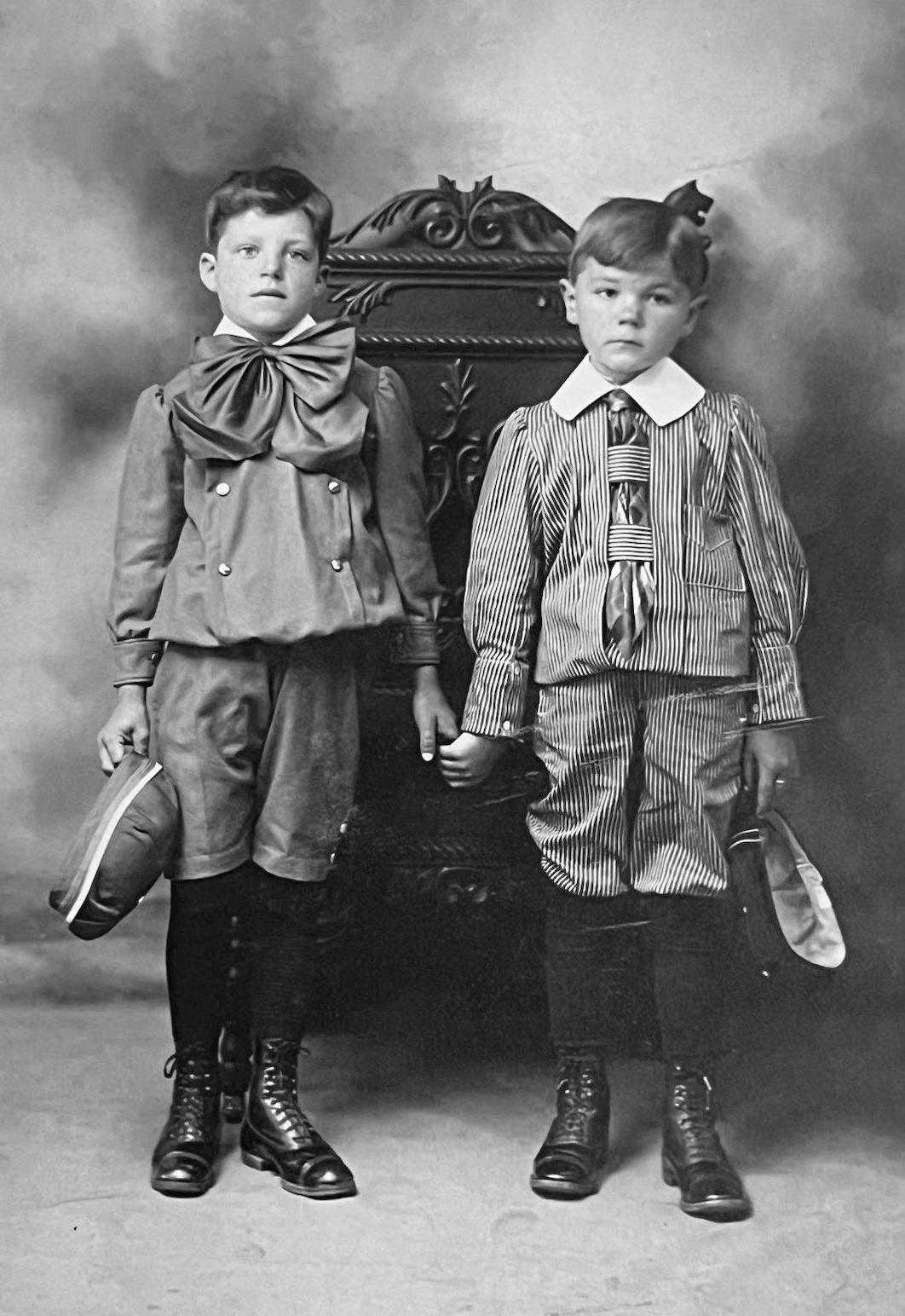
Readers often ask us how we estimate dated for undated images. This is an excellent question and an important one because most of the images we have archived are undated. Unless we estimate dates, we would be unable to use the vast majority of the available photographic record. And this portrait is an especially interesting image because mother has decided on two looks very different for her boys who are relatively close in age, albeit divided by a particularly important dividing line --- school attendance. The older boy is of school age (at least 6 years old. The younger boy is probably a year away from attending school. Now what are the clues on which we are e basing our dating.
About 1900, we began to see all kinds of new-style mounts. We see new styles, colors, and sizes for the mounts used by the studios creating cabinet cards. In this case, the mount was a dark green-gray color that became popular in the 1900s decade, not in the 1890s. Now what caused the sudden change in mounts that had become relatively standard for over four decades? It was the Kodak Brownie, introdfuced in 1900. The Brownie was the first easy-to-use amateur camera that made the family snapshot possible. Until the Brownie, amateur photography was possible, but complicated and expensive. Anyone could use a Brownie, and the price was within the range of middle-class families. Faced with this new competition, we believe the studios were upping the ante by providing new mount styles their customers could choose from. This is our guess. We welcome reader thoughts as to why all the new mountain styles suddenly appeared at the turn of the century.
The big difference here is the bows or lack of one. As part of the Fauntleroy Craze, collar bows became very popular and increasingly large (1885-1905). They were not mandatory with the large collars worn with Fauntleroy suits, but they were very common. And mother has tied the one here with surgical perfection. After the turn of the century, these huge bows began to decline in size, worn by increasingly younger boys, and relatively quickly disappeared. A large collar bow like this one commonly dates to the 1880s-90s. But the fact that his younger brother does not have one or at least one that is tied, is more attuned to the 1900s. This suggests to us a date very early in the 1900s decade.
Beginning in the 1860s we see boyswearing shortened-length pnts. SAt frst the youngder boys, but the age range increased over time to include older boys by the 1890s and 1900s. Knickers were commonly worn in Europe, but not very commonly in America during the 19th century. Knee pants became standard for American boys by the 1870s. The younger boy here is wearing what we call bloomer knickers. That is, knicker-length pants done with a simple drawstring. We see them mostly worn as part of tunic suits which became popular with the turn of the century (1900-20).

Navigate the Boys' Historical Clothing Web Site:
[Return to the Main American bow type page]
[Return to the Main U.S. decorative garment bow page]
[Return to the Main U.S. decorative garment page]
[Return to the Main U.S. garment page]
[Introduction]
[Activities]
[Biographies]
[Chronology]
[Clothing styles]
[Countries]
[Bibliographies]
[Contributions]
[FAQs]
[Glossary]
[Images]
[Links]
[Registration]
[Tools]
[Boys' Clothing Home]