|
Energy has played a key role in both American history and few countries have been so abundantly blessed with energy resources or geographically configured so as to effectively utilize those resources. Americans like Europeans began by depending largely on wood and their own bodies, as well as the labor of draft animals. Many major shifts followed including water power; fossil fuels (coal, oil, and natural gas), electrical power, nuclear energy, and finally renewables. England began founding the 13 Atlantic-coast colonies (17th century), this was before the advent of significant mechanical power, but wind-driven sailing power brought the colonists to North America and played a major role in the economy,At the time the colonies were settled east of the Appalachians. Few countries at a time that land trans port was costly and primitive had such access to transport. America's abundant fortress provided the raw material to building ships and the American colonies by the time of the Revolution had one of the world's largest merchant marines. Just before the steam age, magnificent clipper ships competed on the world's oceans. With the industrial Revolution, energy became increasingly important. The Industrial Revolution created a huge and increasing demand for energy. At first wood was used to power steam boilers, but was soon replaced with coal, America had both. There were few roads in ante-bellum, although Henry Clay's American system soughth to build some. The major highways for commerce, were the great river systems of North America. They were plied by at first Riverboats. Animals provided power on land. Canals like the Erie Canal augmented the rivers , Canal barges were pulled by mules. The great Conestoga wagons carrying the pioneers west were pulled by oxen. By the mid-19th century, America was building one of the great rail systems of the world which would soon surpass riverine transport, but not totally replace it. And vital for transport and industrialization was coal. America had vast coal resources. Coal dominated the 19th century. American coal mining grew rapidly in the early-19th century, doubling or tripling every decade. It was centered in Pennsylvania and West Virginia. This began to change after the turn-of-the 20th century. Oil proved to be a much more effective fuel for navies and maritime transport in general. With the invention of the internal combustion engine (ICE), a vast consumer demand was unleashed. And the United States also had major oil fields, the first to be developed. The first American well was drilled in Pennsylvania (1859). Abundant energy helped propel America into the industrial era which the country would dominate. Americans with its vast energy resources embraced industrialization, urbanization, consumerism, and the information age. At first oil was used to produce lubricants and kerosene for lighting. The development the ICE changed that, along with diesel and jet engines. American oil played an important role in World War I even more so in World War II. t the end of the War, nuclear power was born. Along with oil came another hydrocarbon--natural gas (NG). Again America has huge reserves. America's coal consumption is rapidly being replace with NG which is more clean burning. American oil production peaked (1970s). Innovative new technologies like fracking and horizontal drilling has massively increased oil and NG production. Environmental groups are attempting to prevent drilling and pipeline construction. With the invention of electrical power and lighting (late-19th century), hydro-power and ego-thermal became important. And in recent years other renewable technologies have been developed, including nuclear, solar, wind, and tidal power. Energy essentially erased time and space. It took months to cross the North American continent. Today any city in America can be reached in a few hours. American life today is not possible without fossil fuel, but fossil fuels bring with them green house gases leas=ding to global warming. Just as coal solved huge problems in the 19th century. And oil and natural gas solved major problems in the 20th century,. Renewable energy solutions sources will be needed in the 21st century.
Energy has played a key role in both American history and few countries have been so abundantly blessed with energy resources or geographically configured so as to effectively utilize those resources. Americans like Europeans began by depending largely on wood and their own bodies, as well as the labor of draft animals. Many major shifts followed including water power; fossil fuels (coal, oil, and natural gas), electrical power, nuclear energy, and finally renewables.
England began founding the 13 Atlantic-coast colonies (17th century), this was before the advent of significant mechanical power, but wind-driven sailing power brought the colonists to North America and played a major role in the economy. At the time the colonies were settled east of the Appalachians which were asigifican barrier to moving West. Few countries at a time that land trans port was costly and primitive had such access to land transport. The Europeans and Chinese wee bulding canals. Tivers havean inherent fisadvantages. Many or not anavigablke. Anf he ones that are navigagle oreast to go downstrean, but more fifficukt to go upstream. America's abundant fortress provided the raw material to building ships.
The American colonies by the time of the Revolution had one of the world's largest merchant marines. Europeans, especially the British were running out of the lumber needed to build ships. It took enormous quantyities of lumber to build ships--especially naval vessels. The Industrial Revolution began in Britain (mid-18th century). This involved substuituting human or animal power with mechanical power, but it was motly driven with water power along rivers.
Just before the steam age, magnificent clipper ships competed on the world's oceans. With the industrial Revolution, energy became increasingly important. The Industrial Revolution created a huge and increasing demand for energy. At first wood was used to power steam boilers, but was soon replaced with coal. America had both. There were few roads beyond cities in ante-bellum America , although Henry Clay's American system sought to build some. The major highways for commerce, were the great river systems of North America. They were plied by at first Riverboats. Animals provided power on land. Canals like the Erie Canal augmented the rivers , Canal barges were pulled by mules. The great Conestoga wagons carrying the pioneers west were pulled by oxen. By the mid-19th century, America was building one of the great rail systems of the world which would soon surpass riverine transport, but not totally replace it. And vital for transport and industrialization was coal. America had vast coal resources. Coal dominated the 19th century. American coal mining grew rapidly in the early-19th century, doubling or tripling every decade. It was centered in Pennsylvania and West Virginia. With the invention of electrical power and lighting (late-19th century), hydro-power and ego-thermal became important.
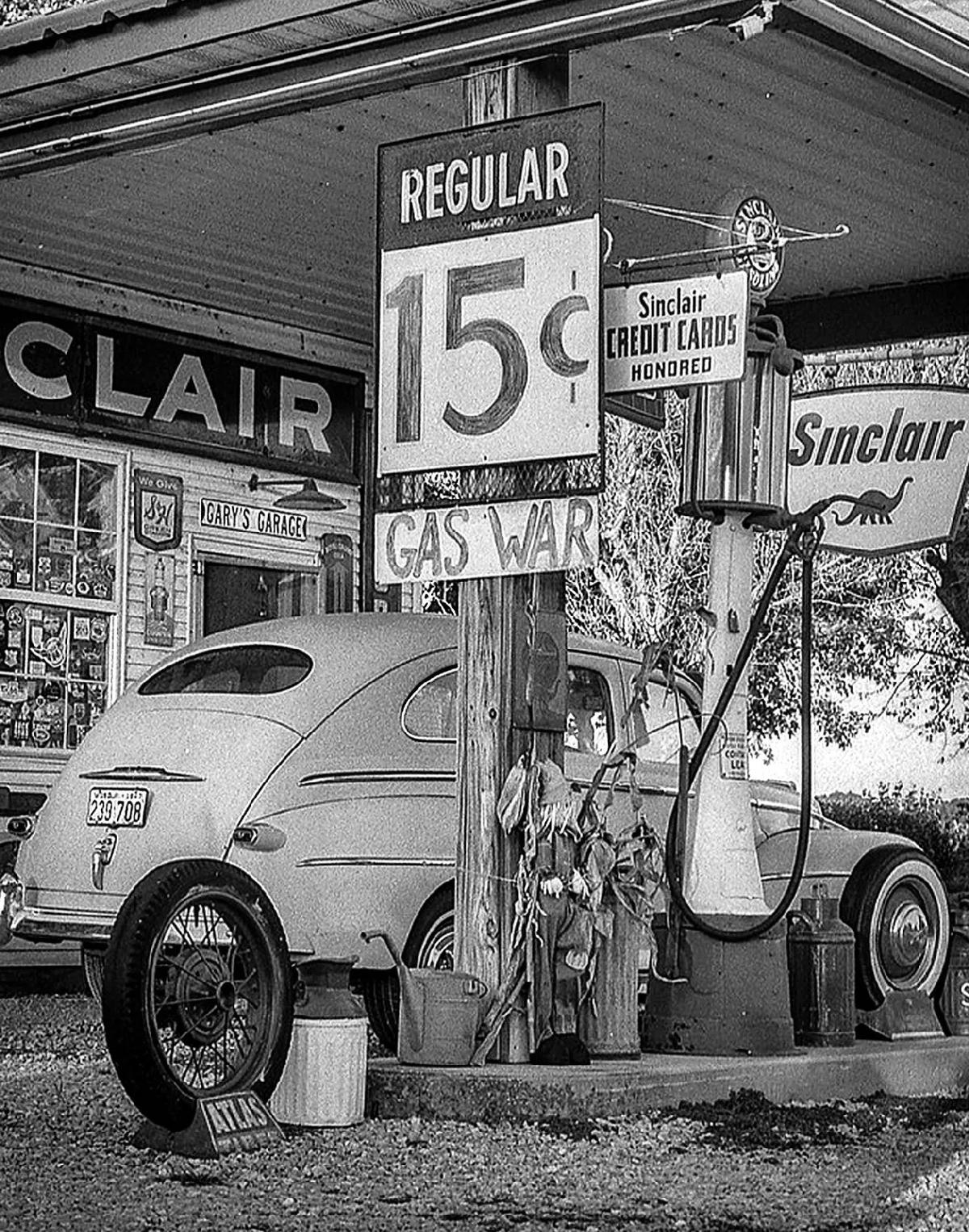
All This began to change after the turn-of-the 20th century. Oil proved to be a much more effective fuel for navies and maritime transport in general. With the invention of the internal combustion engine (ICE), a vast consumer demand was unleashed. And the United States also had major oil fields, the first to be developed. Europe had coal, but not oil. Only America had both. The first American oil well was drilled in Pennsylvania (1859). Abundant energy helped propel America into the industrial era which the country would dominate. Americans with its vast energy resources embraced industrialization, urbanization, consumerism, and the information age. At first oil was used to produce lubricants and kerosene for lighting. The development the ICE changed that, along with diesel and jet engines. American oil played an important role in World War I even more so in World War II. At the end of the War, nuclear power was born. Along with oil came another hydrocarbon--natural gas (NG). Again America has huge reserves. America's coal consumption was rapidly being replace with clearer-buring NG. American oil production peaked (1970s).
Innovative new technologies like fracking and horizontal drilling massively negan increased oil and NG production. Environmental groups are attempting to prevent drilling and pipeline construction. And in recent years other renewable technologies have been developed, including nuclear, solar, wind, and tidal power. Energy essentially erased time and space. It took months to cross the North American continent. Today any city in America can be reached in a few hours. American life today is not possible without fossil fuel, but fossil fuels bring with them green house gases leas=ding to global warming. This gave rfise to the Dreen Movement. While green actividsts raiaise many bimprtanbt points, nany do not understand that for the dorseeable future, mikdern life rquires fossile fuules. Just as coal solved huge problems in the 19th century. And oil and natural gas solved major problems in the 20th century,. Renewable energy solutions sources will be needed in the 21st century. Butv renewable techology is not yetready to replace fossil fuels as Valfiornia is finding out.
Coal fueled the industrial revolution which began in America during the early 19th century. It was used as the fuel for the steam engenies in factories, train locomotives, and ships. It also became the fuel for heating homes. It was no longer possible with the growth of cities to supply adeuate quantities of wood. In addition the smoke created from wood fires was a problem. Demand for coal declined after World War I as oil began to replace coal in industry. The Depression further reduced demand. Mine owners sought to prevent miners from organizing. Violent tactics were used against the miners whonin many cases resorted to violence themselves. The New Deal aided unions attempting to organize. John L. Lewis led the United Mine Workers (UMW) nsuceeded in organizing the miners (1930s). He succeeded in gaining high wages and improving working conditions. This further reduced employmentv as mine owners mechanized the minining process.
Oil drilling and petro-chemicals became a part of the American mining complex (mid-19th century). At the time, there was only a limited market for oil, but this changed as kerosene began to become an important home lighting product and then with the perfection of the internal combustion engine, creating a demand for gasoline and diesel. America and Russia were the only industrial countries with domestic oil resources. This would have a major inpact on the 20th century. A black gold rush began in Pennsylvania (1850s). It was part of a series of developments that would make America the most important industrial power by the turn of the 20th century. One of the titans of indudtry was John D. Rockefeller who created a vast mononoly--the Standard Oil Company. The United States controlled most (85 percent) of the world production and refining of oil. Much of this came to be controlled by Rockefeller's Standard Oil monopoly. Rockefeller's monopoly was not to sell gassoline, but primarily kerosene (paraffin) which became the primary home lighting fuel with the decline of the whaling fleet. Standard Oil began to face legal issues after the passage of the Sherman Antitrust Act (1890). The company also began to be criticized in the court of public opinion. Ida M. Tarbell, a McClure's Magazine begn to investigate. Standard Oil was forced to break up into 34 smaller companies (1911). [Standard Oil] Several of the derivative companies became oil giants in their own right. This changed after the turn of the century as America elecrtified and Henry Ford's Model T-Ford and internal combustion engine put America on wheels (1909). Gasoline and diesel replaced keroscene as the primary refinery products and the market grew far beyond that for keroscene. Gasoline had been nearly worthless up to this point. The perfection of the internal combustion engine chnged this. This process began in Europe, but Henry Ford's mass produced Model-T Ford was so inexpensive that even workers could afford it. This spawned a huge new industry that required vast quanities of steel, copper, and rubber. Nothing like this occurred in Europe where automobile construction remained a craft industry. The major source of oil in the early-20th century was the United States. European countries were developing oil fields, but except for Russia in their colonies or countries they influenced. Here the major British effort was in Iraq. The American oil industry shifted from Pennsylvania to the southern plains (Oaklahoma and Texas). California also became important. At the time of World War I (1914-18), resource challenged countries were dependant on the United States. This was not a major problem at the time as military technology did not yet rely heavily on mechanization. Armies moved long distanceds by rail and at the battlefield supplies and artillery were moved by horses. Major changes were underway. Oil was needed for aircraft and sunmaries. The new tanks required oil. There were advantage to shifting surface ships from coal to oil. The Royal Navy did it, the Germans did not because they had such limited sources of oil. America entered the War (1917). The United States did not have a sizeable arms industry and had to fight the War with British and French arms. What the Americans had were trucks which gave the Allies a major advantage in logistics. Oil was a factor in World War I. It was absolutely critical in World War II, the World's first mechanized war. The German Blitzkrieg required vast quantities of oil. The British in particular were developing oil fields. The United States still produced 60 percent of the world's oil. As one author quipped, the Allies would literally float to victoiry on aea of oil. The Germans and Japanese on the other hand were desperate to get oil. The Japanese attacked America, primarily as part of a vast military operation to get oil and other resources. The Germans attacked the Soviet Union for the same reason (1941). It would lead to national catastrophe. After the War, Americans came home and wanted homes in the suburbs and shiny new cars to get there. New highways criss-crossed the country. America had fallen in love with the automobile in the 1910s, but now Americans could aford far more luxurious cars (1950s). Vast quantities of oil were needed. To feed the insatiable demand and as existing oil fields declined, oil had to be imported for the first time. Oil imports increased 500 percent and came to supply most of the domestic demand. Arab countries attempted to change American foreign policvy through a oil embargo (1973). This did not work, but the dependence on foreign oil continued into the 21st century. Vast quantities of wealth were transferred to the Middle East and other oil exporters, including Russia. This suddenly changed (mid-2000s). President Obama as part of a green effort wanted to improve enviriomental conditioins by significantly increasing the price of oil which would have reduced consumption. It would have also caused a sharp recesion just as America was pulling out of a severe finncial criis. American oil men had other ideas. They developoed inovative new drilling techniques in shale areas (fracking and horizontal drilling). The result was aharp increases in dimestic unconventional shale oil and natural gas production. This brought oil and gas prices plummetuing and America is once a gain a major force in the world oil and gas industry. It also reduced oil prices, a major benefit for Europe abd refuced money flows into Russia, Middle Eastern, and other oil exporters.

Navigate the Children in History Website
[Return to the Main U.S. economic sector page]
[Return to the Main U.S. Economics page]
[Return to the Main Economics page]
[About Us]
[Introduction]
[Biographies]
[Chronology]
[Clothing]
[Disease and Health]
[Economics]
[Environmental issues]
[Feminism]
[Geography]
[History]
[Human Nature]
[Law]
[Nationalism]
[Presidents]
[Religion]
[Royalty]
[Science]
[Social Class]
[Bibliographies]
[Contributions]
[FAQs]
[Glossaries]
[Images]
[Index]
[Links]
[Registration]
[Search]
[Tools]
[Children in History Home]