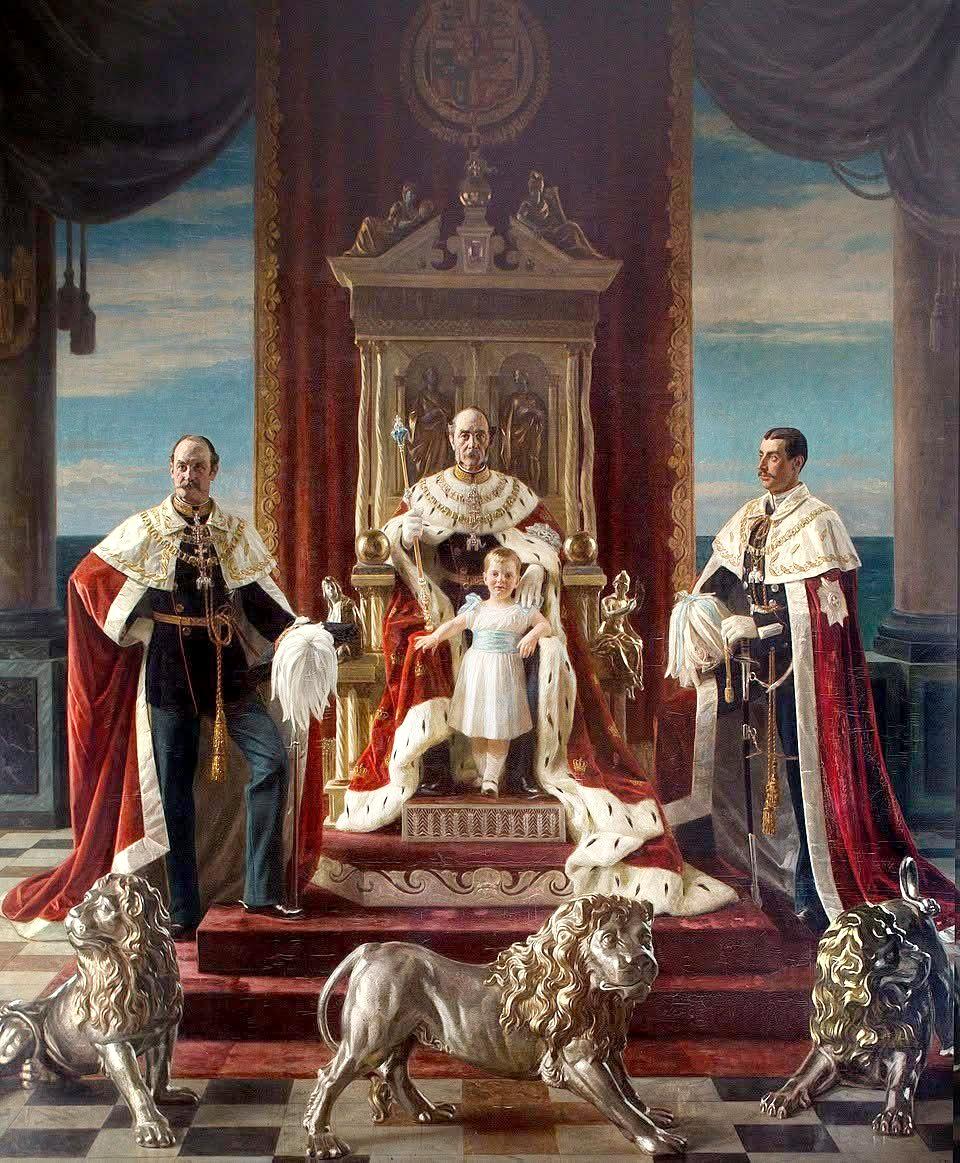
Figure 1.--This is a painting titled 'The Four Generations' Laurits Tuxen, depicting Danish monarchs.
It features King Christian IX (1818-1906) seated on the throne, surrounded by his son Frederik VIII (1843-1912), grandson Christian X (1870-1947), and great-grandson Frederik IX 1899-1972). The scene is set in the Throne Room of Christiansborg Palace in Copenhagen. The painting was completed in 1902 and highlights the continuity of the Danish monarchy.
Denmark is one of the smallest countries of Europe. Modern Denmark consists of a mainland and a large number of Baltic/North Sea Islands. Denmark was once a major European power. The Danes were one of the countries that burst on to the European scene as the Vikings--almost conquering England. Denmark was an early convert to Protestantism and played an important role in the Reformation. Denmark was one of the first countries to face a unified Germany when the Germans seized the Duchies of Schleswig and Holstein in southern Denmark (1864). This made an eneny of future Queen of England--Alexandria, a Damsh Princess. She was the wife of the future Edward VII. Germany had been an ally of the British since the 17th century. But the Germams became increasingly aggressive after unification (1871). More and more Brirish peopole began to sdhare Alexandia's views, dpite Queen Victorias family ties to the Geraman monarcy. . The turning point was when Kaisher Wilhelm II began buidimng a highseas fleet (1900s). World War I engulfed Europe (1914), but Denmark managed to remain nedtral. They were not bso fortunate when Hitler and Stalin launched World War II (1939). The Germans invaded again (1940). King Christian's princvipled stand agaimnst the NAZIs preserved the momatchy into the future. The Danes won the admiration of the world when they became one of the few countries in Europe (the others being Spain and Bulgaria) to protect their Jews. The monarch today is thoroughlymodern and a highly respected part of Danish national life.
Historical Background
The great paradox of Danish history is that this democratic and peaceful country was once the terror of Europe. The Vikings pillaged large coastal areas of England, Scotland, Ireland, and France. The Danes even succeed in conquering England in the 11th Century. Denmark for a time cvontrolled all of Scandanavia, but over time lost control of Sweden and Norway. The Dames also conquered large areas of the Baltic littoral. The shape of modern Denmark was formed at the Congress of Vienna (1814). As Denmark had if not sided with Napoleon, at least fell under his sway. As a resultg Norway was given to Sweden and Pomerania to Prussia. As a result, Denmark withdrew from big power politics and adopted neutrality. Denmark became a constitutional monarchy after he Revolutions of 1848 swept Europe. The first democratic constitution — the Constitutional Act of the Realm of Denmark (Danmarks Riges Grundlov) was ratified (1848i). A chuck of southern Demamark was seized by Prussia (1864). This was one of Bismarck's wars leading to German unification. Denmark was able to remain neutral in World War I, but was invaded and occpied by the NAZIs (1940). They were spared the worse of German occupation because of their Nordic ethnicity and the fact that there was relatively little resistance to occupation. King Christian prinvcpled non-violent stance was also imprtant. Against all odds, the Danes managed to save most of their small Jewish population. After the War Den,mark contyinued to evolve tward democrtaic soacilaism. The found eventially that socialism does not work, but mainatined sustanial welfare policies.
The Monarchy
The Danish monarchy is a unique institution. It began with Viking warlords attacking England and almost conquering it. More than a thousand years ago, a Viking warrior named Harald Bluetooth Gormssn founded the kingdom of Denmark, and began the creation of a national government, and began the country's Christianization. Not a great deal is known about him, but several forts dated to this period have been found in escavations. The country has since had an unbroken royal line of 50 kings and two queens and it's actually a world record. And even though not all the Danish kings have by any means had illustrious reigns, the Danish monarchy throughout its thousand-year history, from the Viking kings to the modern constitutional monarchy, has had an almost mythic ability to adapt to the social and political changes of the centuries. In many ways it has been the Crown that has preserved this small country on the Jutland Peninsula at the tip of the European continent through wars, revolutions, reformations, and foreign occupation. There is a long association with the English/British crown. Anne of Denmark was Queen of Scotland from her marriage to King James VI (1589) and became the Queen of England and Ireland when James became king of England (1603). Frederick III (1648-70) helped arrange the marriage of his son George with Anne Stuart who after the Restoration of the monarchy in Britain became an actual ruling queen.
Imdividual Monarchs
We have little information in the Viking war lords that terorized Christian urope am almost conqered Englamd. These war lords ocer time develped ino the Damish momatchy. Denmark’s transition to Christianity was a gradual process that began in the early medieval period and was largely complete by the late-11th century. The first known Christian ruler of Denmark was Harald Klak (Harald Klak or Harald the Black), who was baptized (around 826 AD). This was the first recorded conversion of a Danish war lord to Christianity, but it did not impact Viking raiding. An subsewquent Danish war lords were pagan for two centuries. The last pagan ruler of Denmark was Gorm the Old (Gormr riddar) who ruled in the first half of the 10th century, probably from the 930s until his death (around 958). He is described in medieval sources as the final ruler of Denmark before the Christianization of the realm. We do not have dtailed information on Damiksh kings until the 17th cebtury when Denmark was still a European power.
Valdemar IV Atterdag (1340-75)
Valdemar IV was known as 'The Restorer'. He was born (about 1320). He became king (1340). He is known as 'The Restorer' bcause he reunifyed Denmark. The Danish Kingdom had basically collapsed as a result previous kings mortgaging of its territories. When he rose to the throne, Denmark no longer functioned as a unified realm. Much of Denmark was controlled by important lords. In such a chaotic reign, Valdemar gradually regained lost territories. He restored the kingdom and reestablished royal authority. He did this by often brutal force. This included actions against Sweden when he invaded Gotland, the large Swedish island. He taxed his subjects heavily and restrained the rights of the nobility. He faced many uprisings. He also had to contend with the expanding Hanseatic League and the Black Death.
The House of Oldenburg dominates the Danish monarchy. Frederick began his personal rule of Denmark and Norway at the age of 24 years (1559). He inherited capable and strong realms, largely because of the work of his father, Christian II. Christian weathered the Count's Feud (a civil war). It is at this time that Denmark under Christian became Protestant--the second country after Sweden to become officially Protestant (1536). His reign became a period of economic recovery. Christian greatly increased authority of the Crown as a centralized power. Frederick continued his father's conversion to Protestantism. This played an important role in the survival of the Reformation in its early years. Denmark at the time was an important European power. Frederick is described in his youth as belligerent and adversarial, easily aroused by ideas of honor and national pride. 【Danmarks Historien】 He built a powerful fleet. The result was two wars. The first went well under the elderly commander Johan Rantzau because Frederick did not take on a major power. The result was taking back Dithmarschen -- part of Schleswig-Holstein. The second war did not go so well -- the Northern Seven Years' War. Somewhat chastened, Frederick adopted a more cautions foreign policy. The result was a more tranquil reign in which the population prospered. Frederick spent turned himself to domestic matters, spending time hunting and feasting with members of the court. He focused his attention to architecture and science which was beginning to become important. Historians varied in their assessment of Frederick: unlettered, inebriated, brutish, intelligent, quick-witted, articulate, open, and loyal. Over time opinions bout him have tended to be more positive. Frederick married his cousin Sophie of Mecklenburg (1572). It was one of the happier royal marriages of the era. In only 10 years after the wedding, they had seven children. Contemporary sources describe them inseparable and harmonious. His son Christian was only 10 years old when he died (1588).
Christian IV (1577–1648) was King of Denmark and Norway and Duke of Holstein and Schleswig from 1588 until his death in 1648. His reign of nearly 60 years made him not only the longest-reigning monarch in Danish history, but in all of Scandinavian history. This was possible because his father, Frederick II died when Christian was only 10-years old (1588), at which time his reign was overseen by a regency council. Niels Kaas was Chancellor of Denmark. Kass playwd a major role in the education and preparation of Christian It was Kass who helped marry off Princess Anne (Anne of Denmark) to Jamces VI of Scotland (future https://www.histclo.com/royal/eng/royal-ukj1.htmJames I of England.) . Kass died when Christian was only 17 years old--not yet ready for the king ship. Another issue was Danish kings were still elected. Christian was a member of the House of Oldenburg, Christian began his actual personal rule of Denmark and Norway at age 19 years (1596). (At the time the two countries were not yet united, but were governed by the same monarch. Historians rank him one of the most popular Danish-Norwegian kings. He is also seen as ambitious ans an exceedingly active monarch. He launched many reforms and projects. Christian IV oversaw a level of stability and prosperity impressive for 17th century Europe. 【Lockhart】 This was the case even though he entered two very expensive wars. First there was the Kalmar War with Sweden (1611-13). Next was the Thirty Years' War (1618–48), which devastated Germany. And it undermined the Danish economy with little gain. Denmark at the time was a major European power. The Thirty Years War was the last war in which Denmark would play a major role. Christian virtually rebuilt and renamed the Norwegian capital Oslo as Christiania after himself. Oslo would not be used again until Norway became independent.
Frederick III was King of Denmark and Norway from 1648 until his death in 1670.
Frederick was The second-oldest son of Christian IV and Anne Catherine of Brandenburg. He only became the heir apparent After the death of his older brother Prince Christian died just before their father died. Frederick instituted absolute rule in Denmark-Norway (1660). This was confirmed by law as the first in Europe (1665). He also ordered the creation of the Throne Chair of Denmark. His father launched a series of failed and costly aggressive wars. As a result, most of the country had no desire for more foreign adventures. 【Nolan】 Frederick was excluded from the talks leading to the Peace of Westphalia which ended the Thirty Years War. Bremen had been lost to Sweden which was also freed from paying Oresund Tolls.
Denmark still had an election process to be king. To win this election, Prince Frederick was forced to make significant concessions to the nobility. Despite the desire for peace, Frederick waged losing wars against Sweden. Frederick liked to be painted on horseback leading men in battle. Despite the martial depictions, he was not very good at winning battles. Fredrick lost the Dano-Swedish War (1657–58). And in the continuation. Dano-Swedish War of 1658–60), Frederick had some success. It looked like King Charles X Gustav of Sweden was about to suffer a catastrophic defeat. Frederick III had declared war on Sweden. Then in a surprise move, Charles X Gustav led troops across the frozen Baltic to Zealand and approach Copenhagen with 5,000 men. Frederick was unprepared and had to sign the Treaty of Roskilde.
It was Frederick who finally disbanded the elective monarchy in favor of an absolute monarchy. This would not change until the Napoleomic era (1814 in Norway) and (1848 in Denmark). Frederick married Sophie Amalie of Brunswick-Lüneburg. Their son became Christian V.
Christian V (1670-99)
Christian V was born in Flensburg (1646). Flensburgis in Schleswig is now part of Germany, notable for the location of the rump NAZI Government after Hitler committed suicide. Christian became King of Denmark and Norway at only 24 years of age (1670). He was the first hereditary king of combined kingdom of Denmark-Norway. Christian proved to be a popular king, especially among the common people, in part because he restricted the power of the nobility whose authority was directly felt by the population. He was the first Danish king anointed at the Frederiksborg Castle chapel. He became an absolute monarch as a result of the decree that institutionalized the supremacy of the king in Denmark-Norway. Christian strengthened the absolutist system pursued by his father. Christian sought to further weaken the aristocracy by expanding his father's practice of allowing both Holstein nobles and Danish and Norwegian commoners to enter state service. Danish possession of Holstein would become a major issue in the 19th century--leading to Bismarck's first war. Christian's major misstep was the Scanian War early in his reign (1675-79) which weakened the Danish economy. His contemporaries were Elizabeth I in England who respected still limited Parliamentary authority and Louis XIV of France who was the archetype of divine right absolutism. Christian sought to show case his power through architecture. He wanted to create a Danish Versailles. He died at the relatively young age of 59 years, cutting short what could have been a lengthy reign (1699). This proved to be a turning point in European history. Peter the Great launched the Great Northern War the following year (1700-21). Sweden and Denmark were major European powers. The War led to the rise of Russia as a European power and the decline of both Denmark and Sweden.
Christian was born in 1786. He became King of Denmark in 1839. He was the nephew of Christian VII and ascended to throne from Frederick VI. As governor and king of Norway in 1814 he accepted a democratic constitution that still, with some modifications, is the basic charter for Norwegian government. Christian married twice. His first wife was Charlotte of Mecklenburg-Schwerin (1784- ), but they divorced in 1810. He then married Caroline Amelia of Holstein-Sonderburg-Augustenburg (1796- ) in 1815. Christian's reign brought prosperity to Denmark. The issue of Danish rule in the duchies of Schleswig-Holstein, with a large German population, became a prominent issue in 1846. The expansion-minded Hohenzollerns were interested in adding the duchies to their Prussian territories. Christian was succeeded by his son, Frederick VII.
Frederick VII (1848-63)
Frederick was born in 1808 during the height of the Napoleonic era. He succeeded his father, in 1848 and promulgated a democratic constitution ending absolute monarchical rule. As he gave the Danes a democratic constitution, King Frederick is highly regarded in Denmark. His reigned, however, was marred with the Schleswih-Holstein dispute with Prussia, but he managed to stave off the Prussians. The great powers convinced Prussia to back down when war threatened. Although successful in adopting a democratic constitution, Fredericks's private life was quite another matter. He married three times. First with Wilhelmine Marie of Oldenburg in 1820. They separated in 1837. Second he married Caroline von Mecklenburg-Strelitz in 1841. They divorced in 1846. Then he set up house with his mistress, a milliner with a shady past. He eventually contracted a morganatic marriage with her and she was given the title of Louise, Countess von Danner Rasmussen in 1850. Despite these three marriages, Frederick had no heirs. Apparently Frederick was impotent. When one of his wives was inaccurately reported to be pregnant, Ling Louis-Philippe is reported to have said, "Well, God bless the farther, whoever he may be." As a result, the niece of his father and her husband Christina succeed him.
King Christian is often called the grandfather of Europe because of the number of his descendants who became monarchs. Strangely this king who produced so many European monarchs, never even expected to be King of Denmark. He became king because his wife was a niece of King Christian VIII. Christian was born in 1818. Christian's father was Duke Frederick William of Schleswig-Holstein (1785- ). His mother was Princess Louise Wilhelmina von Hessen-Cassel (1789- ). By his father, he was a direct descendant of King Christian III of Denmark and his mother
was a granddaughter of King Frederik V. Prince Christian studied at the Military Academy of Copenhagen
and he entered the Danish army in 1837. That same year he pursued the young Queen of England, Victoria, who had just acceded the throne. Victoria instead chose Prince Albert of Saxe Coburg. Christian married Princess Louise Wilhelmina of Hesse-Casselin 1842. Christian produced two kings and a queen. His son Frederick succeed him as King of Denmark in 1906. His son Charles became King Haakon VII of Norway in 1905. His daughter Alexandra
married the Prince of Wales (future Edward VII) and became Queen of England.
Frederick VIII (1906-1912)
Frederick was born in 1843, son of Christian IX, was born in Copenhagen and educated
at Oxford University. He fought as a young man in the hopeless war war with Prussia and Austria in 1864 over Schleswig-Holstein. He continued to be interested in military affairs. He married Louise Josephine Eugénie of Sweden in 1869. Louise was a somewhat eccentric person whose major preoccupation was painting illuminations on vellum. They had eight children: 1870: Christian Carl Frederik Albert Alexander Wilhelm (1870- ), Christian Frederik Carl Georg Valdemar Axel (1872- ), Louise Caroline Josephine (1875- ), Harald Christian Frederik (1876- ), Ingeborg Charlotta Carolina (1878- ), Thyra Louise Caroline Amalie (1880- ),
Gustav (1887- ), Dagmar Louise Elisabeth (1890- ). He reigned for a relatively brief 6 years. He died in Hamburg Germany in 1912. He was succeeded by his son Christian X. Another son became king Haakon VII of Norway.
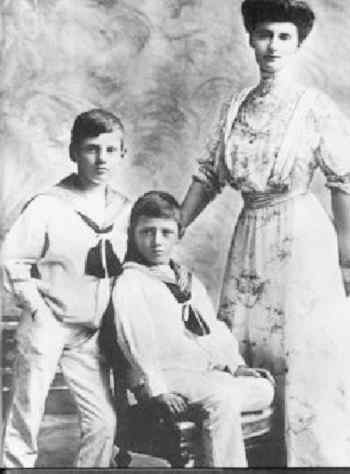
Figure 2.--This photograph of 1909 shows Crown Princess (not pictured) came to the throne as King Christian X in 1912, perhaps the most beloved of all Danish kings. The boy standing later succeeded his brother as King Frederick IX (1947-1972). His daughter is the present Queen Margarethe. The seated boy is Prince Knud.
Christian X was born in 1870 at Charlottenlund. He married Queen Alexandrine, born
Hertuginde, Duchess of Mecklenburg-Schwerin in 1898. They had two sons. Frederick the
Crown Prince was born in 1898. Knud was born in 1900. Some of the major achievements of his reign were a new democratic constitution granting the vote to women and the sale of the
Virgin Islands to the United States. After the German invasion in 1940 the King led his
people in passive resistance to attempts to bring the Danes into the NAZI order. The King's bravery was an inspiration to the Danish people, one of the few countries to have some success in resisting the Germans. This was in part possible because the Germans with their racially based world view were unwilling to be as brutal in Denmark as they were in other countries like Poland
King Frederik IX was born in 1898. His whole life centered on the sea
and music. The King was educated as a Navy Officer as well as an Orchestra Conductor. He
married Queen Ingrid (born in Sweden in 1910). Their eldest daughter, Margrethe Alexandrine Torhildur Ingrid, was born on April 16, 1940, during the dark days following the German invasion. The popular Crown Prince and his consort, stayed with the King in German to face the Germans with his people. Hitler's troops had invaded defenseless Denmark on April 6 (only months after signing a non-aggression pact) in preparation for the invasion of Norway. The birth of the little princess acquired a symbolic value as a ray of hope in a time of darkness. During the war years, Frederik the IX and Crown Princess Ingrid were very active in strengthening the Danish identity. They traveled all over the Danish realm (i.e. Faerorene and Greenland) and this became a major part of their lives as a
Royal Family when peace finally arrived. When King Frederik and Queen Ingrid never had a son, the throne was destined to go to his brother's eldest son--Ingolf. But after the Danish referendum by the people, the law was changed and from 1953 King Frederick's direct descendant was secure--Margrethe II. But it could not then be foreseen that Margrethe might become Denmark's first queen regnant. The Danish constitution did not permit a woman to succeed to
the throne. It was not until an amendment to the constitution was adopted in 1953 that a referendum approved the introduction of female succession. It was a popular choice. In King Frederik, a man with the common touch and a gift for music, and in his wise and dignified consort, Queen Ingrid, Denmark had a royal couple who were loved and respected. And now their eldest daughter had to learn the craft of queenship. Her apprenticeship was planned with care and professionalism. A modern queen must possess many skills, and it is generally agreed that on the throne of Denmark there sits one of the world's best-trained monarchs.
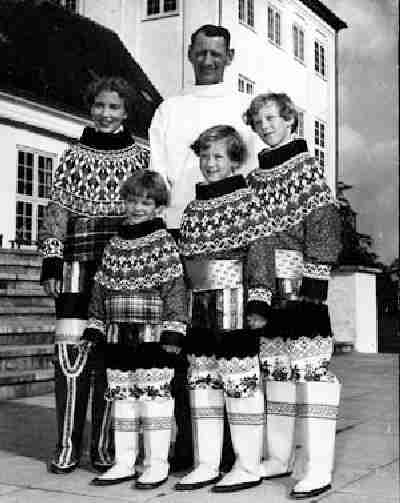
Figure 3.--King Frederik IX and Queen Ingrid are shown here with their their three girls. The eldest became Queen Margrethe. They are dressed in folk costume.
Since 1972 Queen Margrethe II has reigned the country. First of all she is taking care of her official duties as the Queen. She is married to a Frenchman and has two sons. But at the same time Queen Margrethe is a very modern queen: She is a painter, a writer, a speaker, a translator and a debater ofs ocial issues. Crown Prince of Denmark (born 26 May 1968) will be the first Danish king with a university degree. On completing his studies in political science and constitutional law at the University of �rhus, Crown Prince Frederik can add the letters a Master's Degree in Political Science (M.Sc.) to the titles he was born with. This tells us something not only about the Prince's abilities and ambitions, but also about the demands that will be made upon a future head of state in an ancient monarchy, where the monarch does not sit purely symbolically at the head of the table in the Council of State, but where the survival of kingship has been placed in the hands of the personality who is expected both to preserve and to renew the tradition. Like his mother, the Crown Prince has been given a thorough all-round education. But the Queen and Prince Henrik have always stressed that he must find the boots that fit him best. Crown Prince Frederik and his brother Prince Joachim (born June 7, 1969) attended a private school, and they both matriculated from the Secondary School (1986). The Crown Prince served with the Royal Lifeguards, then continued his career with
the Regiment of Hussars, where he is now a first-lieutenant of the Reserve.
Sources
Danmarks Historien (Christoffersen Peder and Gyldendals Forlag), side 298.
Lockhart, Paul D. Denmark, 1513–1660: the Rise and Decline of a Renaissance Monarchy (2007).
Nolan, Cathal J. Wars of the Age of Louis XIV (2008)..