|
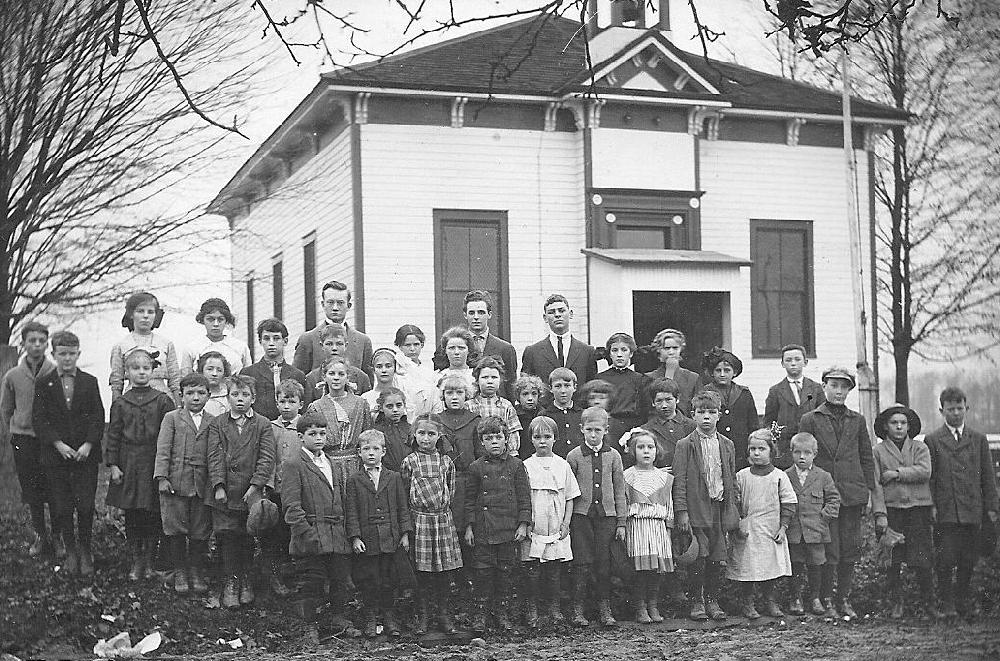
The 1910s are a relatively easy decade to identify with the garments the children wore to school. The most odious give away is the huge hair bows the girls, including older girls, wore. Flat caps were very common in the 1910s, not universal, but very common. School wear still tended to be formal in the early-20th century. We still see a lot of boys wearing suits and ties to school in the 1910s. They were mostly lapel jackets, but we continue to see a few collar-buttoning jackets. We see some sailor suits, mostly younger boys in urban schools. Sailor styling seems more common with the girls. Suits were still commonly worn to school, at least in urban areas. Norfolk knickers suits worn with flat caps were very popular--an iconic symbol of the decade. Many younger boys and boys in rural areas did not wear ties with their jackets. Ties were more common at urban schools in middle-class neighborhoods. Notice several of the boys on the previous page are wearing suit jackets with overalls. We don't see any overalls here and only a few boys are wearing ties with their suits (figure 1). We see a lot of sweaters in the 1910s, including new styles. Many are done like button-up jackets. Most boys wore knickers to school in the 1910s. In rural ares overalls were more common. A few younger boys wore knee pants, but most boys wore knickers mostly with long stockings as was the case with knee pants. There were colored long stockings, but black was standard. Some school images show all the children, both boys and girls wearing black long stockings. We still see motley high-top shoes.
The 1910s are a relatively easy decade to identify with the garments the children wore to school. The most obvious give away is the huge hair bows the girls, including older girls, wore. Flat caps were very common in the 1910s, not universal, but very common. Unlike other decades, we do not see very many other styles at school. Girls might wear tams (berets), but hair bows were so popular that girls unlike the 1900s did not wear head wear.
School wear still tended to be formal in the early-20th century. We still see a lot of boys wearing suits and ties to school in the 1910s. They were mostly lapel jackets, but we continue to see collar-buttoning jackets. Norfolk jackets were very popular. We see some sailor suits, mostly younger boys in urban schools. Sailor styling seems more common with the girls. Suits were still commonly worn to school, at least in urban areas. Norfolk knickers suits worn with flat caps were very popular--an iconic symbol of the decade.
Girls continued wearing mostly dresses to school. Blouses and skirts were not yet very common. Secondary levels girls had gym classes. For many it was the first ntriduction to sports. The uniforms were often middy blouses and bloomers.
Many younger boys and boys in rural areas did not wear ties with their jackets. Ties were more common at urban schools in middle-class neighborhoods. We see standard ties as well as some bow ties.
Half the American population still lived in rural areas (1910s). In the 1900s, rural children still dressed much like city kids. But in the 1910s rural kids commonly wore overalls. Notice several of the boys on the previous page are wearing suit jackets with overalls. We don't see any overalls here and only a few boys are wearing ties with their suits (figure 1).
We do not see sweaters in the 19th century. We first begin to see sweaters in the 1900s, but we do not commonly see sweaters until the 1910s. We see a lot of sweaters in the 1910s, including new styles. There are pull-overs with rolled collars and heavy button-up cardigans. Many are done like button-up jackets. This is when the letter-man sweater first appeared.
Most boys wore knickers to school in the 1910s. In rural ares overalls were more common. A few younger boys wore knee pants, but most boys wore knickers which were became essentially universal (1910s). So universal that school zone road signs depicted boys wearing knickers into the 1970s. It was mot just primary-level boys wearing knickers. We also see knickers in secondary schools. Unlike the 1900s, older boys mostly wire long pants, but the younger secondary level boys commonly wore knickers.
Children tended to wear the same hosiery (1910s). Both boys and girls of all ages wore the same hosiery. The were worn for warmth, but also for modesty. Long stockings were worn during the summer and winter, although there were heavier weight long stockings for winter. The major exception was that many children went barefoot during the summer. At the time, more of the American population lived in the northern sates and the winters were longer and colder than is the case today. This mean that warm weather clothes were more important. Almost all boys wore knickers with long stockings as was the case with knee pants in the 1900s. . There were colored long stockings, but black was standard. The colors, however, were mostly dark and the black-and-white photography of the day does not capture the shades. There were lighter colors, mostly worn during he summer. And thus what we see at school were dark colors. Girls also wore black long stockings. Some school images show all the children, both boys and girls wearing black long stockings. Girls and younger boys might wear white long stockings, but black was standard for school wear. We do not see many children wearing knee socks which would appear in the 1920s.
We still see mostly high-top shoes at school. Both boys and girls wore high-top shoes. There were gender specific styles, but many children were similar-styled footwear,

Related Chronolgy Pages in the Boys' Historical Web Site
[Return to the Main American 1910s Page]
[Return to the Main Chronology Page]
[The 1900s]
[The 1910s]
[The 1920s]
[The 1930s]
[The 1940s]
[The 1950s]
[The 1960s]
[The 1970s]
[The 1980s]
[The 1990s]
[The 2000s]
Navigate the Relate Boys Historical Clothing Style Pages
[Return to the Main U.S. country page]
[Long pants suits]
[Short pants suits]
[Lederhosen]
[Kneesocks]
[Eton suits]
[Jacket and trousers]
[Blazer
[School sandals]
Navigate the Boys' Historical Clothing School Uniform Pages
[Return to the Main U.S. School 1910s Chronology Page]
[Return to the Main U.S. School 20th century Chronology Page]
[Return to the Main U.S. School Chronology Page]
[Return to the Main U.S. School Uniform Page]
[Return to the Main National School Uniform Page]
[Australia]
[England]
[France]
[Germany]
[Ireland]
[Italy]
[Japan]
[New Zealand]
[Poland]
[Singapore]
[Scotland]
[Singapore]
Navigate the HBC School Section
[About Us]
[Activities]
[Chronology]
[Clothing styles]
[Countries]
[Debate]
[Economics]
[Garment]
[Gender]
[Hair]
[History]
[Home trends]
[Literary characters]
[School types]
[Significance]
[Transport and travel
[Uniform regulations]
[Year level]
[Other topics]
[Images]
[Links]
[Registration]
[Tools]
[Return to the Historic Boys' School Home]