|
Soon we shall be coming every night and every day, rain, blow, or snow -- we and the Americans [...] We are going to scourge the Third Reich from end to end if you make it necessary for us to do so. You cannot stop it, and you know it. You have no chance.
-- British propaganda broadcast -- 1942
World War II was the first war in which aircraft played a critical reole. And an important part of the role was strategic bombing which devastated the Axis powers. The strategic bombing left German cities piles of rubble and Japanese cities smoldering cinders. The Allies have been crticized for this on moral grounds. Ironically it is the Axis which began strategic bombing both before and after World War II began. Germany bombed British cities and shelled French cities in World War I !915-18). Japan began bombing Chinese cities (1931). Italy bombed Ethiopian cities (1935). Germany and Italy bombed Spanish cuties during the Spanish Civil War (1936-39). You do not see complaints from Axis countries as long as it was Axis bombers devastating cities in other countries.
The German and Japanese outrage over strategic bombing did not begin until the Axis air forces began to lose the capability to bomb other countries and the Allied bombers began to reach Axis countries. Suddenly they saw strategic bombing as a war crime and moral outrage. Arguably the most controversial aspect of World War II was the Allied strategic bombing campaign. There are two elements of the campaign that remain controversial. First is the effectiveness of the campaign. Second is the morality of the campaign. With the NAZIs in command of the Continent, the only way that Britain could strike at Germany was by air. German air defenses meant that the RAF could only bomb at night and restricted British strategy to area bombing. This significantly inhibited the effectiveness of British operations. The entry of America into the War meant that the air offensive could be significantly expanded. Both Churchill and Roosevelt were committed to strategic bombing. The hope was that strategic bombing would force the NAZIs to capitulate. The Allies at Casablanca demanded unconditional surrender (January 1943). The American buildup of air forces in Britain continued throughout 1942 and by the beginning og 1943the 8th Air Force was ready to join the British in an around the clock bombing campaign against Germany. American and British planners agreed on four priority targets: 1) U-boat building facilities, 2) aircraft production plants, 3) ball bearing plants, and 4) oil refineries. Although not at the time, the Allied strategic bombing campaign has become the most controversial aspect of World War II.
Strategic bombing was not new to World War II. The first strategic bombing campaign was the German World War I campaign aimed at knocking Britain out of the War. The Germans who had expected another quick victory by their well prepared army, were shocked to be stopped at the Marne and the Generals realized by 1915 that they would be unlikely to crack open the Western Front. Given mounting losses and shortages at home, the Generals turned to strategic bombing as a possible way to bring the war to a successful conclusion (1915). At first the Kaiser ordered that the raid be confined to military targets. The generals at first may have believed that this was possible, but it very quickly became obvious that with the technology at hand that it was not. And as the Kaiser lost influence, the generals adopted the strategy of breaking British civilian morale. And civilians were terrified, but did not crack. The British after a year of Zeppelin raids developed methods to shoot down the slow, vulnerable Zeppelins. The Germans after sustaining heavy losses retired the Zeppelins, but then introduced the faster Gotha bombers. This time the goal from the onset was to break British civilian morale. The impact was just the opposite. The perceived savagery of the German attacks actually increased support for the War and a desire to punish the Germans. The most significant impact of the German camping was to instill a fear of aerial bombardment. Thus while the British slashed military budgets, money was found to research and develop air defenses. Thus when German bombers arrived a second time (1940), the Chain Home Network was operating to help defend Britain.
The strategic bombing left German cities piles of rubble and Japanese cities smoldering cinders. The Allies have been criticized for this on moral grounds. Ironically it is the Axis which began strategic bombing both before and after World War II began. Japan led the way. The Japanese began bombing Chinese cities as they seized Manchuria (1931). Notice that during the annual Japanese commemoration of the atomic bombing of Hiroshima and Nagasaki that there are no tears for the larger number of Chinese civilians killed by the Japanese bombing of Chinese cities. Italy bombed Ethiopian cities (1935). Germany and Italy bombed Spanish cities during the Spanish Civil War (1936-39). Hitler threatened an aged Czech President Hácha that he would destroy Prague unless he complied with German demands. You do not see complaints from Axis countries as long as it was Axis bombers devastating cities in other countries. The German and Japanese outrage over strategic bombing did not begin until the Axis air forces began to lose the capability to bomb other countries and the Allied bombers began to reach Axis countries. Suddenly they saw strategic bombing as a war crime and moral outrage. As British Air Marshal Arthur Harris famously said as he unleashed RAF Bomber Command on the Reich, "The Nazis entered this war under the rather childish delusion that they were going to bomb everyone else, and nobody was going to bomb them. At Rotterdam, London, Warsaw, and half a hundred other places, they put their rather naive theory into operation. They sowed the wind, and now they are going to reap the whirlwind."
President Roosevelt appealed to belingerents not to bomb civilian populations or unfortified cities (September 1, 1939). The British and French quickly endorsed Roosevelt's appeal. Hitler replied days later. Hus rambling reply was what you might expect. He accused Polish civilians of commiting 'fearful atrocities aginst German soldiers'. And he claimed the British of waging war against German women and children referring to the Royal Navy blockade. Neverthelees, Hitler insisted that Germany would conduct the war 'in a chivalrous and humane manner'. Actually, few countries in history have treated a defeated emeny in such a barbrous manner. The Germans murdered about a quarter of the Polish population, although bombing would be a small part of the killing.
The air war began in Poland from the onset of the German invasion (September 1, 1939). Most of the atrocities committed by the Germans during the War were carried out in occupied countries. Word filtered back to Germany, but awareness varied. The well connected and well educated knew, many ordinary Germans did not. The bombing of Polish cities and civilians was not, however, held back, but prominently displayed to foreign journalists as well as the German people in movie newsreels -- Die Deutsche Wochenschau (The German Weekly Review) . Hitler intimate and Armaments Minister Albert Speer writes, "I remember his [Hitler's] reaction to the final scene of a newsreel on the bombing of Warsaw in the autumn of 1939. We were sitting with him and Goebbels in his Berlin salon watching the film. Clouds of smoke darkened the sky; dive bombers tilted and hurtled toward their goal; we could watch the flight of the released bombs, the pull-out of the planes and the cloud from the explosions expanding gigantically. The effect was enhanced by running the film in slow motion. Hitler was fascinated. The film ended with a montage showing a plane diving toward the outlines of the British Isles. A burst of flame followed, and the island flew into the air in tatters, Hitler's enthusiasm was unbounded . 'That is what will happen to them!" he cried out, carried away. 'That is how we will annihilate them!" [Speer, p. 303.] These newsreels were shown in all German movie theaters. We wonder how German movie audiences reacted to theses newsreels and how many thought that the Germans were not the only country that could build bombers. Goebbels of course would later claim that the Allied bombing of German cities was war crime. He clearly did not see the German bombing of Polish cities or later British cities in the same light. It only became a war crime in the NAZI view when Germans were being killed.
Finland had a very small air force when Stalin launched the Winter war and only minimal air defenses. Helsinki was protected by the 1st Anti Aircraft Regiment. They had four heavy anti-aircraft batteries of three to four guns each, one light AA battery and one AA machine gun company. Other cities had minimal air defenses. They Finns faced the largest air force in the world -- n the Soviet or Air Force (VVS). Air warfare was still relatively new. War plans were still largely theoretical. Many Red air Force commanders were consumed in Stalin's purges. But even had this not happened, there was no well throughout Soviet plan as to how to effectively use its air superiority. The Soviet air attacks were mostly conducted by the long-range bombing and reconnaissance group of the Soviet Air Force (VVS), the Aviatsiya Dalnego Deystviya (ADD). This group was under the direct control of the Soviet High Command (Stavka). The Soviet bomber fleet was diverse, in part because Stalin was obsessed with building a massive force and unwilling to retire obsolete types. Three hours after the Red Army attacked along the Finnish border, Red Air Force planes bombed Helsinki. The most intensive bombing raids of the War occurred long the first few days. we are not sure why. One would have expected Soviet air attacks to have intensified as the ground war faltered. The Soviets bombed Helsinki only eight times during the Winter War, dropping a mere 350 bombs on the city. Some 97 people were killed and 260 injured. Some 55 buildings were destroyed. In World War II terms this was minuscule. Civilians in other cities were more affected. The Red Air Force carried out 2,075 bombing raids on 516 localities. Nearly 1,000 Finnish civilians were killed. The city of Viipuri, a priority Soviet target , was essentially leveled, hit by nearly 12,000 bombs. The small Finnish Air Force was largely committed to protecting Finnish cities and could not support the Army. The Finns could not stop the Soviet bombers, but did inflict losses. They are believed to have shot down 240 Red Air Force planes. [Trotter, pp. 187-93.] The Soviet air offensive was basically ineffective despite the size of the Red Air Force. Unlike the Luftwaffe, the Red air Force was not skilled at close air force. It was used as more of a strategic bomber force. The trouble with this was that Finland was not a highly industrialized country and there were few targets of importance. The rail system was the main Soviet target. The Soviet pilots went after small village depots of limited importance. They cut the rail lines repeatably, but the damage was easily repaired. Finns would have the trains running again in a a few hours. The Soviet bombings like the land invasion led to sharp criticism abroad. President Roosevelt asked the Soviets to refrain from bombing Finnish cities. Soviet Foreign Minister Molotov replied that "Soviet aircraft have not been bombing cities, but airfields, you can't see that from 8,000 kilometers away in America."
Even before World War II began, the NAZIs were threatening neighboring countries with destruction from the air. Hitler's vaunted Luftwaffe in fact did not have a strategic bombing force. The rapid movement of the Panzers, however, supported by the Luftwaffe's tactical bombers allowed them to exact terrible damage. It was the British and Americans, however, that were building heavy, long-range bombers capable of waging a strategic bombing campaign. We wonder how many German civilians watching the destruction of Warsaw realized that their Führer had sent in motion forces that would wreak the same damage to their cities. All of the major air forces of the world, including the Luftwaffe, Bomber Command and the U.S Army Air Forces, began the War wedded to the high explosive bomb. This was true despite the fact that as early as World War I the thermite bomb had been developed and its potential known. Germany had produced a very large stockpile of thermite bombs with the intention of using them against Britain. Churchill reports that the British were preparing a major bombing campaign against Germany for 1919. [Rumpf, p. 103.] The War of course ended before the campaign could began in ernest. We arenot sure why the German thermite bombs were not used. Ludendorff after the War claimed that the General Staff concluded that while they would cause extensive damage, they would not affect the outcome of the War. [Rumpf, p. 93.] Of course what Lundendorff said after the War has to be taken with considerable skepticism. Regardless, no country began the War intending to rely on incendiaries. The reason seems to be the same reason naval planners were wedded to battleships. Generals and admirals like big bangs. Thermite bombs merely fizzled. The Luftwaffe uses incendiaries on London and other British cities, but they were only a secondary part of the bomb load. General Albert Kesselring who oversaw air operations against Britain as commander of Air Fleet 2 wrote, "We overestimated the effect of the high-explosive bomb, as the Allied did later. .... The incendiary bomb was a more efficient weapon; dropped in thousands, even hundreds of thousands, over a given area it could cause fires which would destroy completely, where a high explosive bomb would only damage." [Kesselring] Both the British and Americans began the War using mostly high-explosives. In the inexorable series of unintended consequences, the Luftwaffe taught the British the potential impact of incendiaries. It took a while for air commanders to extensively employ incendiaries, but in the end it would be the German cities that were consumed by fire. One of the commanders that learned this less was General Curtis LeMay. When he was transferred to the Pacific, the terrible potential of the thermite bomb was turned against Japanese cities with largely wooden buildings. Assessments after the War concluded that the potential destruction of incendiaries was potentially 4 to 5 greater than high explosive bombs, although this depended to a large degree on the target. [Rumpf, p. 99.]
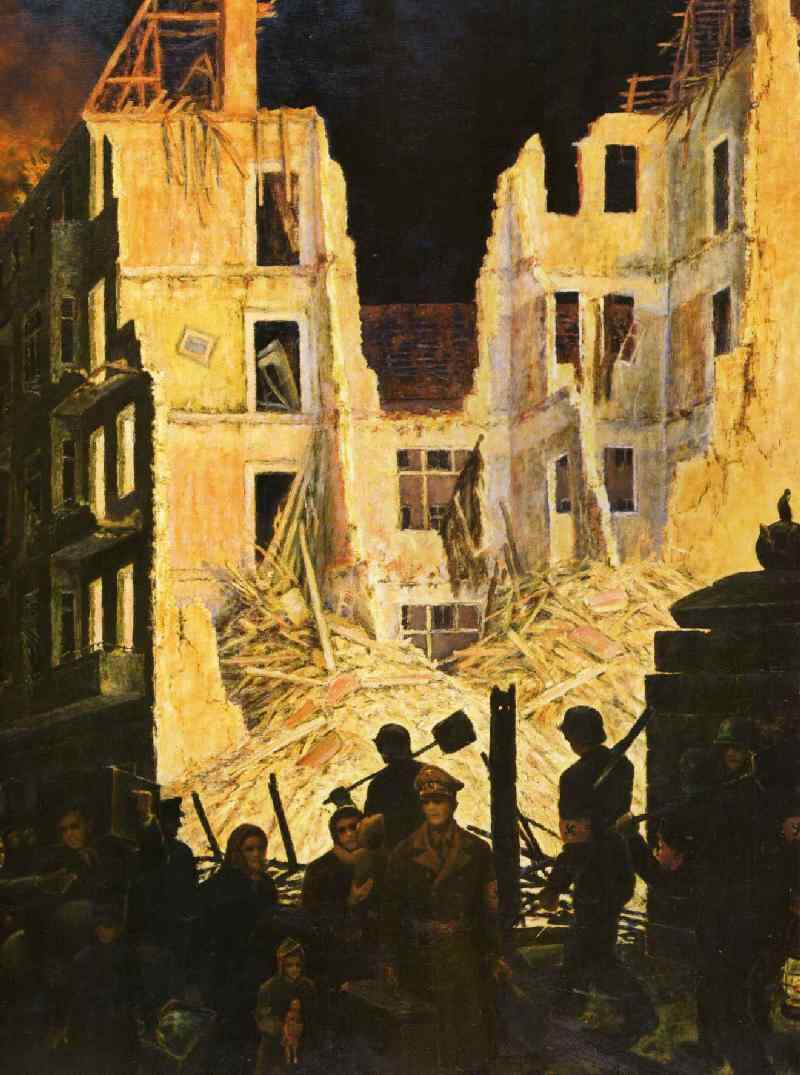
Unlike many countries the Germans attacked, the Germans had air defenses. And the delay in the Allied strategic bombing campaign gave the Germans the time to build not only a formidable air defense line, but also a first-class Civil Defense system. There was both Air Defenses and Air Protection (Luftschutz). The German air defenses were formidable. The Kamhuber Line radars not only directed the German fighters, but alerted the cities of an coming bombing raid. The British fought the campaign at first with obsolete aircraft. But by the end of 1942 the Lancaster was ready and the American 8th Air Force with its B-17s and B-24s were in place. President Roosevelt and Prime-minister Churchill agreed to a round-the-clock bombing campaign (January 1943). The strength of the Kamhuber Line and the Luftwaffe took a deadly toll on Allied formations (1943). The arrival of the long-range P-51 escorts changed this and the Luftwaffe could no longer defend the Reich's cities. The basic defense became the anti-aircraft Flak batteries. The Flak batteries could take a toll on the bomber formations, but could not stop them. The Germans called Civil Defense Luftschutz (Air Protection). German civilians had to rely on the the bomb shelters and civilian defense facilities from the increasingly heavy Allied raids. In the end, the Allies leveled virtually every major German city. The civil defense program, however, proved very effective in protecting civilians.
The initial British bombing raids in 1939 dropped leaflets. The British were reluctant to actually bomb German cities, in part fearing reprisal raids from the Luftwaffe. I have little information on the French at this time. There was not significant bombing campaign, except for Luftwaffe operations in Poland (September-October 1940), until the Battle of Britain. After the fall of France (June 1940), German cities were no longer as vulnerable to RAF attacks. Bomber Command had only small numbers of heavy bombers and they were slow, poorly defended, and had a limited load capacity. Throughout the Battle of Britain, small numbers of British bombers hit German targets in night time raids. The rids were wholly ineffectual in a military sense. Hitting a military target at night with 1940s technology, especially 1940 technology was very difficult. Sometimes the raiders did not even hit the intended city. Some of the raids were also very costly in air crews and planes. The raids did have an in important psychological impact. British raids on Berlin so enraged Hitler that he ordered a change in Luftwaffe tactics in the Battle of Britain, which may have well resulted in a favorable turn in the battle in favor of the British
The air war in the West wound down in 1941. The Luftwaffe launched some heavy raids on Britain before shifting east to prepare for Barbarossa. With the attack on the Soviet Union, Luftwaffe bombers were primarily deployed in the East and to a much lesser extent in the Mediterranean. Hitler focused on the Soviet Union and ordered all projects shelved that could not be made operational in 12months. The British conducted raids during 1941, but they were done with small numbers of planes and with negligible results. More importantly the RAF was pouring enormous resources in Bomber Command and building an increasingly important bomber force. The British during 1942 increased the number of long range four engine bombers from 41 to 539. They also were training increasing numbers of air crews. America, although not yet in the War, expanded its commitment to air forces. The United States had developed a long-range strategic bomber in the 1930s--the B-17. Congressional resistance had limited actual construction. The fall of France changed many minds in Congress concerning military appropriations. President Roosevelt in 1941 ordered Air Chief Hap Arnold to build a strategic bomber force of 5,000 planes. The United States also commenced an enormous pilot and air crew training program.
Adolf Hitler on December 11, 1941, declared war on the United States. This conveniently solved FDR's dilemma of how to enter the war against the NAZIs when America had been attacked by the Japanese. Curiously, America was the only country on which Hitler ever declared war. The entry of America into the War changed all calculations of the international strategic balance. The Soviets alone in 1941 were already out producing the Germans in many areas such as tanks--despite the larger German industrial capacity. The entry of America was to mean that German war production would be only a fraction of Allied production and that difference was already being felt on the battlefield. The story of American industry in the War is phenomenal. FDR in 1941 was already supplying Britain and the Soviets through Lend Lease. The declaration of war enabled FDR to harness the vast American economy to war production. This was something that the Germans had still not done as late as 1942. Within the first year alone, America built 24,000 tanks and 48,000 planes. An impressive start, but just the beginning. American industry in 1942 equaled the armaments production of all three Axis countries combined. And this was occurring at a time when the Soviets alone, not to mention the British, were already out producing the Germans. America in 1944 doubled its arms production again. [Fest, p. 656.] These were numbers the Germans could not hope to match. In no theater did these overwhelming numbers show up more than the air campaign. At a time that the Luftwaffe could not fulfill its required role along the vast Eastern Front, a tidal wave of long range American bombers (B-17 Flying Fortresses and B-24 Liberators) flowed into England, each had the range to hit every German city including Berlin. The American planes began arriving in England early in 1942. England became, in effect, a huge unsinkable air craft carrier in the North Sea. Combined with the RAF's new Avro-Lancasters, the Allies were building a massive air armada aimed at German industry.
The strategic bombing campaign was begun by the the Royal Air Force's Bomber Command (BC). BC had the capacity to bomb Germany from bases in France an the onset of the War, but declined to so out of fear of retaliation. After the fall of France, BC's relatively short range bomber fleet had a limited capability of reaching targets in the Reich. Thus British strikes were limited while a new long-range force built around the Avro Lancaster was built. The British unlike the Germans did have the capability of building both a tactical and strategic air force. RAF-BC carreied the brunt of the air war through the first half of 1943. American military planners developed a war fighting concept based on strategic bombing and even before the War began had developed the B-17 Flying Fortress to do just that. As soon as America entered the War, American airmen began arriving in Britain. The principal American force to pursue the strategic bombing campaign was the 8th Air Force based in Britain. It was was eventually to muster larger number of bombers than the British, but in 1943 was still a smaller force. The 8th Air Force began initial operations against the Germans in 1943. The 8th Air Force was still a relatively small force for the objective assigned. The average daily strength of the 8th Air Force was only about 100 bombers for the first half of 1943. American air commanders were convinced that the heavily armed B-17s and 24s could fight their way into Germany against fighter opposition. Thus in addition to the assigned targets the destruction of the Luftwaffe was a secondary objective. [Rumpf, pp. 61-62.] British air commanders were doubtful, but could not convince the Americans who did not yet have experience with raids into the heavily defended Reich. A range of aircraft were involved in the campaign. By far he most important were the British Avro Lancaster and the American B-17 Flying Fortress and the B-24 Liberator. The opposing force was the German Luftwaffe whose primary air defense planes were their standard fighters, the ME-109 and the FW-190.
Much less known than the British World War II evacuation of children from urban areas is the German evacuation program evacuating children. The program was called the Kinder Land Verschickung (KLV) which operated during World War II (1939-45). The children had to go to rural areas on "holiday" but really they should be out of the cities and towns that had difficulties feeding them and were being bombed by the Allies. Both schools and the Hitler Jugend (HJ) were involved in organizing the KLV. The HJ was especially important in the KLV organization beginning in 1940. About 2.5 million German children were send to 9,000 camps until end of World War II. Unlike the British evacuation effort, the children were not paces with families. In many cases the children were accompanied by their teachers, but the HJ was in control..
The British had been bloodied by the Germans. Their initial British reluctance to use their bombers had disappeared in the Blitz. Churchill made it clear, "We ask no favors of the enemy. No, we will meet out to the Germans the measure and more of the measure that they are meeting out to us. We remember Warsaw in the first few days of the War. .... You do your worst and we will do our best." The man given the job of organizing the strategic bombing campaign for RAF Bomber Command became known as 'Bomber Harris'. After the War, Harris was never given recognition for the assignment he fulfilled and while other commanders received Knighthoods Harris never did. It is only recently that a statue to him was erected in Parliament Square. It is the target, as is Winston Churchill's statue, of left-wing graffiti writers when there is a protest rally.
The air plane was first used in any significant way in warfare during World War I. It was used entirely in tactical operations. Plans were in place to begin strategic bombing in 1919, but the War ended before this began. After the War, military analysts theorized as to the possible military impact of strategic bombing. The idea terrified Europeans, but no one in fact knew about the actual military impact. Both the Axis and Allied powers believed that terror bombing campaigns would undermine civilian moral and destroy their will to fight. Air power in World War II proved to be critical, but the impact was much more complicated than some proponents of air power had theorized. During the World War II, terror bombing had mixed results. It proved effective in Poland (Warsaw), the Netherlands (Rotterdam), and Yugoslavia (Belgrade). In other countries such as England (London and Coventry) and Germany (Hamburg), it was not effective in undermining morale. In Britain ' London Can Take It' unified the civilian population and made them more determined than ever. This would seem to be the situation in Germany where the Allies not only returned tit for tat but bombed German cities to rubble. The difference appears to be whether the civilian population is prepared and perceives that it is possible to effectively resist. In the instances where terror bombing did force the country to surrender, it was accompanied with a land invasion which convinced civilians that resistance was futile. While the strategic bombing campaign failed to destroy the German will to resist, it did play a role in the destruction of the Luftwaffe and finally destroyed the German war economy.
One of the least understood topics concerning the World War II air war is the accuracy of nombing. This is especially the case today given the accuracy of modern smart weapons. World War II flyers, however, did not have smart weapons. The German Luftwaffe developed considerable accuracy with their low level tactical operations, especially with Stuka Dive bombers. Dive bombing was the most accurate form of bombing which is why American carrier-based dive bombers at Midway hit four Japanese carriers while Air Force B-19s operating at higher altitudes with horizontal bombing missed.
The Luftwaffe in the opening weeks of the Battle of Britain pursued a precision bombing campaign targeting the RAF--specifically the infrastructure of Fighter Command's 11 Group in southeastern England. It might well have worked had Hitler not ordered a terror bombing campaign targeting London and other British cities. American military planners were wedded to the principle of precesshttps://www.histclo.com/essay/war/ww2/tech/land/tank/tank-pro.htmlhttps://www.histclo.com/essay/war/ww2/tech/land/tank/tank-pro.htmlion bombing. This became ingrained in the American preparations. The Army Air Corps claimed that they could hit a pickle barrel with their Nordon Mark 15 Bombsite. Considerable accuracy was possible with single bombers in the clear and uncontested skies of the Arizona dessert. Conditions proved very different over northern Europe with the German defenses, the often cloudy weather, and bombers flying in large inflexible formations, Bombers on test runs in Arizona were able to bring bombs to within 500 ft of the target. The Eighth Air Force pursued day light operations in part to apply constant stress on the Luftwaffe (the British bombed at night) and in part to pursue precision raids. Such efforts broke down in some operations. [Budiansky] Actual results achieved by American bombers over northern Europe were that most bombs fell more than 1,000 feet from targets. The British bombing at night fared even worse. And it is important to realize that German and Japanese workers and their families did not live in leafy suburbs. They did not have cars. Most waled or bilked to work and their homes were located very close to factories, shipyards and the other industrial facilities where they worked. These two factors, the inaccuracy of bombing and the residential neighborhoods close to the war pilots are important factors to bear in mind in assessing the strategic bombing campaign.
After the failure to destroy the Royal Air Force (July-September 1940), the Luftwaffe continued to bomb at night, bi\ut these were terror raids. It was not possible to hit specific targets at night. When Hitler decided to invade the Soviet Union (December 1940), the Luftwaffe began to shift east. With this and the continuing RAF build up and after Hitler declared war on America (December 1941), the balance of power in the air shifted. The British and Americans began hitting targets in occupied France. German raids declined. President Roosevelt and Prime-minister Churchill announced around the clock bombardment of Germany (January 1943). The Americans at first thought that the B-17s could fight their way to targets in the Reich during the day unescorted. It soon became clear that they could not. American P-47 Thunderbolts were available for escort duty in 1943, but did not have the range to accompany the bombers all the way into the Reich. Luftwaffe fighters waited to pounce just after the escorts peeled off. Only at the end of the year did longer range P-51 Mustangs began to arrive (December 1943). As the air battles moved across the Channel to occupied France and the Low Countries and then the Reich, the circumstances changed. Germans defenses proved daunting. Large numbers of planes were shot down and air crews forced to bail out. This was extremely dangerous in itself. One aviator writes, "Knowing that there wasn't nearly enough sky below him McKibben hurried to bail out of his doomed fighter. He quickly released his harness and simultaneously reached up with his right hand, unlocked the canopy and slid it back. 'I started to step out onto the left wing but was jerked back by my oxygen mask--I had forgotten to disconnect it.' Reflexively, he reached up and tore the mask loose from his helmet, lept into space and pulled his parachute's ripcord. 'I was upside down when the chute opened,' NcKibben recalled. 'The opening shock launched my escape kit from out of its pocket inside my flight jacket and it smacked me right in the eye. Barely able to see out of one eye and with and with his feet caught in the parachute shroud lines." Pilots and air crews bailing out had to land in enemy territory. The Resistance in France and the low countries got some of the airmen to safety. Most were picked up and became POWs. Those shot down over the Reich became prisoners if they were not beaten and lynched by civilians.
The Germans in addition to military measures to stop the Allied bombing, the Germans led by Armaments Minister Speer. There were three major efforts made to protect war plants, none of which in the end solved the problem. The first adjustment was to decentralize production. Instead of having one large plant as America developed to mass produce weapons, the Germans began breaking down production into modular parts. Creating a large number of small plants meant that the Allies were confronted with a much more difficult problen of finding and hitting many small targets instead of one big, easy to find target. There were, however, problem associated with this effort. The Germans lost the advantages of mass production. It also increased the reliance on a transport system that could be targeted, not to mention the problem of food shortages. And there was the increased problem of tolerances. The parts did not always fit together perfectly. This proved to be a major problem with the advanced Type 21 U-boat. The assemblers couldn't get the parts to fit together. The second adjustment was to go underground. This was a very difficult undertaking, carving out underground tunnels. Thus it was only used for high priority weapons, like the V-weapons. But again there was the problem of transport. And underground production did not solve the transport problem. The third adjustment was camouflage. This was used for large plants that could not be broken up into small steps, like the critically important synfuel plants. The Americans were the primary force to strike at the transport nodes because they bombed during the day when it was possible to acquire specific targets. With the defeat of the Luftwaffe, the bombers needed less cover. The P-51 escorts were given orders the come down to the deck they began to hit trains and barges and other smaller targets. By the end of the War, the once impressive German transport system essentially no longer existed.
Once America joined the War in December 1941, a massive bombing campaign against Germany from England became feasible. America's industrial potential gave the Allies the ability to mount a strategic bombing campaign orders of magnitude above the Luftwaffe's capability. The air campaign became a major aspect of Allied strategy. While American began building in facilities in 1942, the British debated how to begin the strategic bombing campaign in 1942. Some wanted to target key German industrial sites, especially German synthetic fuel plants. Had they done so at this time might have changed the course of the War. Hitting precision targets, however, over heavily defended, often cloud-covered German cities was no easy matter with 1942 bombing technology. [Speer, p. 287.] In addition the British had been bloodied by the Blitz and the much easier to execute strategy of area bombing was appealing. The strategy of area or terror bombing of civilians won out. RAF planner Charles Portal was the leading advocate of area bombing. Air Marshall Arthur "Bomber" Harris, the head of RAF Bomber Command, introduced area bombing as the RAF's principal strategy in the bombing campaign. Harris phrased it succinctly, "The Germans sewed the wind, now they will reap the whirlwind." The RAF began its area bombing strategy on March 28, 1942 with a massive night time raid on Lübeck, virtually destroying the historic city. Hitler transferred two bomber groups of about 100 planes each from Sicily which conducted Baedaker raids targeting British treasures -- their historic cities. The balance of forces, however, had turned decidedly against the Germans. The RAF responded on May 30 with its first 1,000 bomber raid on Cologne. The results were devastating. One of the worst hit cities was Hamburg. There were firestorms which devastated the central cities. The firestorms sucked trees, vehicles, sections of buildings, and people into the conflagrations. Those not killed by the bombs and flames were suffocated by the smoke and lack of oxygen. The American 8th Air Force with even larger number of bombers than the British began initial operations against the Germans in 1943. The Americans opened their full-scale daylight bombing campaign on with an attack on Wilhelmshaven (January 27, 1943). Throughout 1943, German cities were exposed to 'round the clock bombing' inflicting serious civilian casualties. The Americans bombing by day, attempting to hit specific targets using their Nordon bomb sites. The British bombed by night and at best could hit specific cities. Large numbers of German civilians were killed, injured, or rendered homeless. The RAF on May 16-17 began targeting German industry in the Ruhr. The American and British air crews suffered very heavy casualties against German fighters and increasingly effective anti-aircraft guns. At times it was unclear if the bombing campaign could be sustained. Long range fighters were not available in 1942-43 to escort the bombers to their targets in Germany. The actual impact of the campaign was disappointing. German civilian morale did not crack under the British area bombing and the Americans found it much more difficult to hit specific industrial targets than anticipated. Even so, the air campaign forced the Luftwaffe to deploy major assets defending German cities rather than on the critically important Eastern Front where the War was decided. Especially important large numbers of Luftwaffe fighters and even more important trained pilots were being shot down by the bombers. In addition large numbers of artillery pieces and huge quantities of ordinance , which could have been used against Red Army tanks, had to be diverted to anti-aircraft defenses. These defenses were manned largely by the Hitler Youth.
The Allied air campaign against Germany in the months leading up to the Normandy invasion has to be cut back. Targets in France associated with the landings were given the highest priority. The strategic bombing campaign had, however, forced the Luftwaffe to essentially pull back to Germany. As a result, there was virtually no Luftwaffe operations to oppose the Allied landings on June 6. After D-Day and the subsequent operations to support the beach head (June 1944) and breakout (July 1944), the strategic bombing campaign could be resumed in full force against Germany with an ever expanding air armada. The bombers when operations were resumed had fighter escorts, long range P-51 Mustangs which significantly reduced the losses of planes and air crews.
Gerrmany was a major industrial country, but not the world's dominant or even largest industrial power. Thus German industrial allocations had to be carefully calculated if they were to win the War. Fortunately for mankind, they were not. And this was especially true of the war in the East with the Soviet Unioin--the Ostkrieg. The Ostkrieg was certainly the decisive engagemnent of World War II. Whoever prevailed there was going to win the War. The Allied Strategic Bombing Campaign did far more than damage German war industry, it forced the NAZIs to devote the majority of Gernany's potent, but limited industrial power on the war in the West instead of where it was most needed--the Ostheer. Contrary to popular conceptions, the German economy was not effectively harnessed for war. Civilian consumption was not drastically curtailed as was the case in Britain. Women were not further mobilized for war work, especially married women. Industrial production was not totally directed at the War effort. Only when the War began to go against Germany and Albert Speer was appointed Armaments Minister (1942) did German industry begin to take needed steps to maximize production and reach some of its potential. [Speer] The Germans, as a result, despite the bombing were able to expand war production. This was the case through 1943. Only in late 1944 and the full force of the strategic bombing force was released from D-Day support did the German economy begin to collapse under the weight of Allied bombing. Some have used this to charge that the Allied bombing campaign was ineffective and a misallocation of resources. This is not the case. Without the bombing, the Germans could have substantially increased war production in 1942 and 43. Some time ago I notice a comment in an important book on World War II. The author states that the German war economy was oriented to the war in the West, and not the Ostkrieg. [Weinberg] That rather surprised us at the time, but we have since come to conclusion that he was absolutely correct. It took a huge industrial effort to support operatiins in the West (the West Wall the Air War, the Battle of the Atlantic, the Atlantic Wall, the V-Weapons, etc.). In contrast the Ostheer was mostly unmotorized infantry using horse-drawn carts. We are always amazed that when authors describe the Ostkrieg, they almost always phrase the importance in terms of manpower (German deployment and casualties), never in terms of industrial power. Manopower is important, but as any military historian knows, it is only one factir in warfare, and not alwaysd themost important. Our contention is that the War in the West forced Hitler to send the Ostheer into the Soviet Union largely on foot and once there without the industrial support needed for the decisive engagement of the War.
After D-Day (June 1944), the Allied bombing campaign was significantly intensified. This time the campaign was much different. The bombers now had fighters now had P-38 fighters accompany them from French bases which moved closer to the German border as the Allies took Paris (August 1944). Even longer range P-51 Mustangs, arguably the best propeller fighter of the War were deployed in increasing numbers. The result was a renewed and even more intense Allied air campaign with dramatic decline in Allied air crew losses. And as the fighters engaged Luftwaffe fighters there was a dramatic and unsustainable loss of German pilots. The Allies established air superiority over Germany and bombed German cities at will. The Allied bombing killed an estimated 0.6 million German civilians and destroyed or seriously damaged some 6 million homes. Göering is reported to have said that he realized that te War was lost when he first saw the American P-51s over Berlin. Berlin and other major cities by 1945 were wastelands. This time German war production was affected, not only because of the damage to industrial cities, but because the Allies targeted Germany's production of fuel. The Romanian Ploesti oil field were targeted as well as synthetic fuel plants in Germany. About one-third of Germany industry depended on these plants. Most of the Luftwaffe's fuel came from them. [Hillgruber, p. 420ff.] By the end of the War many German units were reduced to using horse drawn carts. The Luftwaffe which still had aircraft could not maintain an an effective training program because of fuel shortages and eventually could even muster the fuel to fly the rapidly dwindling number of remaining planes.
Hitler by late 1944 no longer spoke to the German people in sharp contrast to earlier years when he ws a constant presence on German radio. His deteriorating physical condition, relentlessly depressing reports from the fronts, and the destruction of German cities by Allied bombing were all factors. Hitler's mouth piece Josef Goebbels became his spokesman. Goebbels raged about vengeance and secret weapons. There were indeed secret weapons. The world's first combat jet, the ME-262, was introduced in 1944. It was an innovative extremely effective fighter and if properly used could have severely impaired the Allied air campaign. Hitler's interference, however, prevented it from being effectively used. The V1 beginning June 13 were used to target London and other British cities after the D-Day landings in June 1944. The V1 could be shot down, but there was no defense against the V-2 ballistic missiles which soon followed. There were many other projects under development or on the drawing boards. Some like the ME-163B Komet were futuristic concepts. Especially significant, however, was a new generation of jet fighters which would have been ready in 1946. Only the Allied bombing campaign prevented some from actually being built.
With the Bulge Offensive faltering, Hitler launched Operation Bodenplatte (Home Plate ) (January 1, 1945). The Bulge Offensive was aided by clouded weather over northern Europe making it impossible for the Allies to bring their huge air force into play. Just as Patton's Third Army reached Bastogne, the skies opened up and Allied aircraft began to savage Wehrmacht armored columns and supply lines. This and the attacks on the German synthetic petrol plants also meant that the German armored columns were also running out of fuel. The Bulge offensive from the beginning was based on capturing American supply dumps. When this did not occur, the Bulge offensive was doomed. Hitler through in his last desperate gambit, a bold stroke to destroy Allied air power. The Luftwaffe had been preparing for several months, gathering its last remaining reserves. Luftwaffe fighter commander and air ace ace Adolf Gulland was put in charge of the effort. Galland "... organized a plan for a 'Great Blow' by building up a reserve of fighters and fuel to release a sudden devastating attack on a large bomber stream. By November 12 there were 3,700 fighters of all kinds available, around 2,500 assigned for the blow. The object was to shot down at least 400 bombers in one raid to try to deter the Allied offensive and buy time for the buildup of modern air equipment, 'the shock the enemy needed,' one of the pilots later told his American captors, to make thm cease their inroads into the heart of Germany." [Overy] Bodenplatte also included attacks on Allied forward fighter bases supporting the attacking Allied armies in the Low Countries. It proved to be a Pyrrhic German tactical success.
The most criticized Allied air raid occurred at Dresden near the end if the War. The Americans and British conducted incendiary raids on Dresden (February 13-14). They created a firestorm killing thousands of civilian. The raid was ordered hurriedly after a request by Stalin who believed that reinforcements were being rushed through Dresden to counter a Soviet offensive.
At the time the city was full of refugees fleeing west from the Red Army. The raid has been criticized not only because of the casualties, but because Dresden was not a city with industries supporting the War. The number of casualties is a question still debated by historians. The raid was ordered hurriedly after a request by Stalin who believed that reinforcements were being rushed through Dresden to counter a Soviet offensive. Ironically, the Soviets used the raid as anti-American propaganda after the War. After Dresden, Prime-Minister Churchill ordered Air Marshal Harris to end area bombing. Churchill explained: "It seems to me that the moment has come when the question of bombing of German cities simply for the sake of increasing the terror, should be reviewed. Otherwise we shall come into control of an utterly ruined land." There are to today annual memorial services in Germany to remember the dead. The neo-NAZIs in recent years have made Dresden a major issue and make appearances at the annual memorial services. After Dresden, Prime Minister Churchill ordered Air Marsahl Harris to end to area bombing.
We are especially interested in collecting personal World War II experiences.
One girl recalls the bombing. "Germany, 1944. The sound of the war I remember most was the faraway hum of bomber squadrons, like bees. If you squinted straight up, you could just barely see them, whole swarms of them, silvery flashes in the clear blue sky. During the day, when the sirens sounded their first warning, school let out, and we ran home. My parents had reinforced one room in our basement with concrete, a massive steel door and heavy beams to hold up the ceiling. We spent many nights down there, and I remember how good it felt each time I was finally able to return to my own bed upstairs. Just days after my seventh birthday, our house took a direct hit. When we crawled out of our bomb shelter, there was a big crater where most of our house had been. Our stove was dangling from the last piece of remaining kitchen wall. My room, my birthday presents, all gone. Miraculously, we all survived. [Radel]
A Berlin girl recalls, "I grew up with my mother and father in an apartment on Friedrichshaller Strasse in the close-in southwest Berlin suburb of Schmargendorf. My father and mother did not support the Nazi party, but were reminded by pro-Nazi neighbors that it would be politically correct to fly a small Nazi flag on state occasions. My father died of a WWI infantry injury in 1941.
I was 16 at the beginning of 1943 when Berlin became a bombing target for the Allied air forces, which lasted through the end of the war. My Mother and I spent many nights in our basement air raid shelter in our apartment house. The British airplanes would bomb our city during the night and the American planes would attack during the day. British surveillance planes would drop red and green flares to show where the bombs should be dropped. On occasion, I would be coming home from night school when the sirens alerted us to another air raid attack, and I would try to find a public air raid shelter, when I knew that I could not make it home. Of course my Mother would worry terribly about my whereabouts. Several times during night bombings, Mom and I went to the large public bunker on my school's grounds, and a couple of times the bunker shook from the bombs above. A lot of times I would pass a bomb that hadn't exploded. The closest bomb to hit our neighborhood was a blockbuster that failed to explode and landed in the middle of our street about 500 feet from our front door. Once, I passed a smaller bomb in the morning as I walked to the surface commuter train, and when I came home that night the street was closed to all traffic because of it. We used to watch the American airplanes drop bombs from the rooftop of our apartment house. We could actually see the bombs fall from the planes. Our air raid warden would scold us for being on the roof, afraid that other approaching planes might go off course and drop bombs on us.
Besides the blockbuster bombs, the British also used liquid phosphorous canisters that set houses on fire. Another type was a phosphorous stick about 18 inches long. One of these crashed through our apartment roof and set the attic on fire. Once we could no longer hear the planes, the air raid warden and several of the male residents found it and were able to extinguish the fire.
Huddling in our shelter and knowing that we were being bombed certainly was terrifying. At the end of the war Berlin was deep in the Russian zone, but fortunately the Allies divided it into sectors and my home ended up in the British Sector. I got a job in an American Army day room serving refreshments, and there I met my future husband." [Ortmann]
There is no precise accounting of Germans killed as a result of the Allied strategic bombing campaign. Estimates vary. We have seen estimates ranging from 0.3-0.7 million Germans. While huge numbers, when you look at the horrendous destruction of German cities, one can not help but wonder why more Germans were not killed. The reason of course is the efficiency of the German Civil Defense program. The millions of civilians killed by the Germans in contrast had no such defense. The bombing destroyed or seriously damaged some 6 million homes. German industry which was located almost entirely in the cities, was devastated. Luftwaffe Chief Göring is reported to have said that he first realized that the War was lost when he first saw the American P-51s over Berlin. The strategic bombing campaign was a major force in the destruction of the Luftwaffe. Berlin and other major cities by 1945 were wastelands of rubble. German war production was finally affected, not only because of the damage to industrial cities, but because the Allies targeted Germany's production of fuel. The Romanian Ploesti oil field were targeted as well as synthetic fuel plants in Germany itself. About one-third of Germany industry depended on these plants. Most of the Luftwaffe's fuel came from them. [Hillgruber, p. 420ff.] The transportation system, another major target, was destroyed. By the end of the War many German units were reduced to using horse drawn carts. Germany quite simply could no longer wage war. Some historians motivated by ideology more than facts claim that the strategic bombing campaign did not work. This is simply inaccurate. It did work. The cost in men and material was enormous and it took until late 1944 to mortally wound the NAZI war economy. The morality can be questioned. In the end, however, the strategic bombing campaign did work. Germany by the end of the War was also no longer a modern industrial nation. The future of the country was now in the hands of the Soviets and Western Allies.
The most controversial aspect of World War II today is the Allied Strategic Bombing Campaign. Interestingly at the time this was not a matter of great reflection, especially before Dresden. There are two elements of the campaign that today controversial. First is the effectiveness of the campaign. Here the debates concerns the earlier phases of the campaign. There is little doubt that in the later phases of the campaign that German industrial production was affected and the mobility and effectiveness of the German war machine shattered. Second is the morality of the campaign. Here too often critics of the campaign use arguments that are essentially a condemnation of war itself. Here it should be remembered that it was Germany that launched World War II. It is true that civilians as the strategic bombing campaign unfolded became the target and as many as 0.6 million German civilians were killed. It is also true that NAZI Germany killed about 12 million civilians and POWs in concentration camps and death camps and was planning the destruction of much larger numbers of civilians had they won the War. German assessments of the strategic bombing campaign usually stress the terrible toll on civilians. Allied assessments normally accentuate the role of the campaign in destroying the German war machine and by implication saving tens of millions of lives that the NAZIs had slated for destruction and even more that were to be consigned to slave labor in a NAZI dominated New Europe.
There is a vast body of literature on World War II, both fiction and non fiction. The Battle of Britain, the Blitz, the British evacuation of children, the V weapon attacks, and the Allied air campaign over northern Europe have been covered in thousands of books. There have also been large numbers of movies and television programs, again both documentaries and fiction accounts. These accounts address both the bravery of the aeviators and the suffering and endurance of the British people. Some of the accounts about children and books by adults looking back at their childhood are touching. HBC has drawn from much of this extensive literature and media presentations. Surprisingly given the fact that the Germans suffered more than any people in the War from the aerial campaign there has been an almost defening silence from German writers. We note very few writers or film makers who have addressed the subject.
Budiansky, Stephen. The Men, Machines, and Ideas that Revolutionized War, from Kitty Hawk to Gulf War II (Viking: 2004), 518p.
Corum, James S. Luftwaffe: Creating the Operational Air War, 1918-1940" (University Press of Kansas, 2000).
Fest, Joachim C. Hitler (Vintage Books: New York, 1974), 844p.
Freidel, Frank. Franklin D. Roosevelt: Rendezuous with Destiny (Little Brown: Boston, 1990), 710p.
Hillgruber, Andreas. Strategie=Hitlers Strategie: Politik und Kriegf�hrung 1940 bis 1941 (Frankfurk am Main, 1965).
Kesselring, Albert. Soldat nis zum letzten Tage (Bonn, 1953).
Lindkvist, Syen. A History of Bombing (1999). HBC has not yet been able to consult this important work.
Ortmann, Helga. "Bombs over Berlin," The Washington Post (May 28, 2004), p. W11.
Overy, Richard. The Bombers and the Bombed: Allied Air War over Europe, 1940-1945 (2014), 592p.
Radel, Ingeborg. "Bombed on a birthday, "The Washington Post (May 28, 2004), p. W11.
Rumpf, Hans. Edward Fitzgerald, trans. The Bombing of Germany (Holt, Rinehart and Winston: New York, 1962), 256p.
Sebald, W.G. Trans by Anthea Bell. On the Natural History of Destruction (Random House), 202p.
Snyder, Louis L. Historical Guide to World War II (1982).
Speer, Albert. Richard and Clara Winston, trans. Inside the Third Reich (Avon Books: New York, 1970), 734p.
Weinberg, Gerhard L. A World at Arms: A Global History of World War II (Cambrige Universit Press: New York, 2005), 1178p.

Navigate the CIH World War II Section:
[Return to Main World War II air campaign war essay page]
[Return to Main World War II page]
[About Us]
[Biographies]
[Campaigns]
[Children]
[Countries]
[Deciding factors]
[Diplomacy]
[Geo-political crisis]
[Economics]
[Home front]
[Intelligence]
[POWs]
[Resistance]
[Race]
[Refugees]
[Technology]
[Bibliographies]
[Contributions]
[FAQs]
[Images]
[Links]
[Registration]
[Tools]
[Return to Main World War II page]
[Return to Main war essay page]