
D-Day: Normandy--Carentan (June 10-14, 1944)
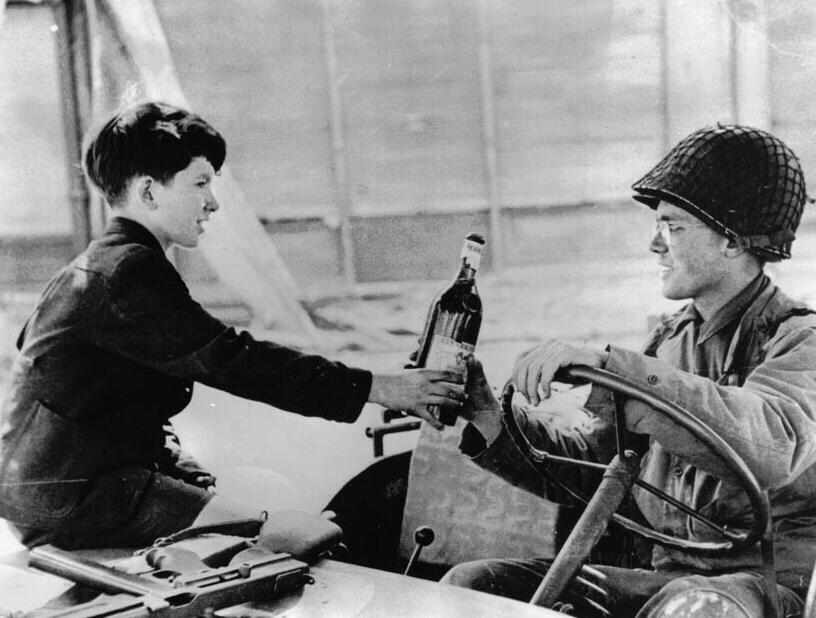
Figure 1.--This International News Photo was distribured by the Office of War Information. It was captioned, "Tribute to a Liberator". The caption read, "A French boy presents a bottle of his family's treasured wine to an American soldier at the wheel of a jeep moving through Carentan. This Normandy town was taken after two days of bitter fighting in the sparring that preceeded the drive to capture Cherbourg." The photo was dated June 27, but it may have been taken earlier. A French reader writes, "This French boy and the American soldier perfectly represent our country free again. French children in 1944-45. I was one of them, were fascinated with the Americans, their Jeeps, and all their considerable equipment. And this is not to mention all the chewing gum and Hersey bars to be had. After the war the miniature Jeep toys were especially prized by all us boys."
|
|
Carentan after the Allies had secured their initial lodgement emerged as a key strategic position. It was a small town of only about 4,000 people, but it was a crossroads that sat astride the N-13 highway as well as the Cherbourg–Paris railroad. And Cherbourg with its invaluable port was a key objective that the Allies desperately needed. Carentan itself was also located between the American beaches--Utah and Omaha. The Germans as well as the Americans could read a map. It would thus be a critical battle fallowing the Ameican landings. The town had existed since Roman days. The Romans were master engineers. The land around Carentan
was low-lying, crossed by rivers and extensive marshes. Canals were built to drain the area for agriculture.
Napoleon had once flooded the area, turing Carentan into a fortified island. The Germand did the same, making Carentan a very difficult objective for ground forces to take, especially lightly armed infantry. The Americans had few options. They had to attack over the narrow roads, the only dry approaches. The Germans deployed Major Friedrich von der Heydte's 6th Fallschirmjäger (parashoot) Regiment to defend the town. And they had their guns zeroed in on the roads. General Bradley ordered the 101st Airborne, the "Screaming Eagles" to take the town. The lightly armed 101st had been droped on the night preceeding the D-Day landings. The drop had not gone well and the Division was spread all over Normandy. They managed, however to regroup sufficently to protect the access roads onto Utah Beach--the western flank of the D-Day landings. The 101st fought a bruising fight with the Germans, but they made it impossible for the Germand to attack the Utah Beach landing on the critical first day. The 101st was to be evacuated, but Carentan was so important that Bradley ordered them to take the town, setting up one of the most important battles of the Normandy campaign. The 101st was part of VII Corps which had landed at Utah. Taking Carentn would enable VII Corps to link up with the 29th Infantry Division of V Corps driving west from the Omaha Beachhead.
Carentan
Carentan was a small town of only about 4,000 people. It is located near the north-eastern base of the Cotentin Peninsula in Normandy. It is situated on the Douve River just inland from the beaches at Normandy. The protected location in the Douve Valley made it ideal for boat building. A town had existed at this location since Celtic days. It is believed to be the ancient Celtic port of Crociatonum controlled by the Unelli (Veneli / Venelli) tribe.
The Romans under Caesar conquered Gaul (1st century BC). The Romans were master engineers. The land around Carentan was low-lying, crossed by rivers and extensive marshes. Canals were built to drain the area for agriculture. Carentan is located close to the sites of the medieval Battle of Formigny during the Hundred Years' War. Napoleon using the Roman canals had once flooded the area, turning Carentan into a fortified island.
The Allies unleased their long awaited, massive forces on Hitler's Fortress Europe. The assault has been described a an immense coiled spring suddenly released. Eisenhower selected Normandy because of the massive German deployment at the Pas de Calais, the more obvious location. There were five landing beaches. The Allies used airborn troops, both parachute and glider drops to protect the flanks of the invasion bridgehead. The Americans committed the 82nd and 101st Airborn to protect the right flank of the beach landings, both Utah and Omaha. General Eisenhower after the War said that it was the most difficult decesion he had to make because he knew that they would suffer grevious losses. He visuted the paratroopers just before they borded the C-47s and took off in the evening of June 5. In the early morning hours of June 6, 1944, the two American paratroop divisions were dropped at the base of the Cotentin Peninsula. There mission was to protect the landing beaches and prevent the Germans from rushing reinforcemnents to the beach defenses. This mean, however, that the lightly-armed paratroopers had to face heavily armed Germans. The plan was for the units landing on the beaches to rush inland as rapidly as possible and relieve the paratroopers. The drops did not go well. Both divisions were badly scattered across Normandy. This proved to be both an advantage and disadvashntage. Dispersal seems to have confused the Germans who were unsure where to focus their attack.
Dispersal scattered the paratroopers, complicating their avility to seize their objectives. Even so the paratroopers
secured most of their objectives--primarily the routes the U.S. VII Corps needed to advance inland off Utah Beach, the far right flank of the allied landing force. The U.S. 4th Infantry Division landed on Utah Beach shortly after dawn (June 6). Casualties unlike on Omaha were light.
Strategic Location
Before the drive on Cherbourg could begin, a more pressing problem had to be addressed. The American beachheads pn Utah and Omaha were divided by Douve River valley. Thus Carentan after the Allies had secured their initial lodgement emerged as a key strategic position. While only a small town. Carentan but it was a crossroads that sat astride the N-13 highway as well as the Cherbourg–Paris railroad. And Cherbourg with its invaluable port was a key Allied objective that the Allies desperately needed. Carentan itself was also located between the American beaches--Utah and Omaha. Carentan was thus needed to link the lodgements at Utah and Omaha beaches which were separated by the Douve River estuary, The Germand like Napoleon flooded the fields up to the town's outskirts. Carentin was also needed as a staging position for the drive on Cherbourg and Octeville. Cherbourg with its critically needed port was a major objective. In the immediate aftermath of the landings, however, it was linking Omaha and Utah that was the most pressing sitution.
Battle Shapes Up
The Germans as well as the Americans could read a map. It would thus be a critical battle fallowing the Ameican landings. The Germans like Napoleon earlier, flooded the area, rurning Carentan into a fortress--a very difficult objective for ground forces to take, especially lightly armed infantry. The Americans had few options. They had to attack over the narrow roads, the only dry approaches.
101st Paratroop Division Ordered to Take Carentan (June 9)
General Bradley ordered the 101st Airborne, the "Screaming Eagles" to take the town. The lightly armed 101st had been droped on the night preceeding the D-Day landings. The drop had not gone well and the Division was spread all over Normandy. They managed, however to regroup sufficently to protect the access roads onto Utah Beach--the western flank of the D-Day landings. The 101st fought a bruising fight with the Germans, but they made it impossible for the Germand to attack the Utah Beach landing on the critical first day. The 101st was to be evacuated, but Carentan was so important that Bradley ordered them to take the town, setting up one of the most important battles of the Normandy campaign. The 101st was part of VII Corps which had landed at Utah. Taking Carentn would enable VII Corps to link up with the 29th Infantry Division of V Corps driving west from the Omaha Beachhead and thus unifying the Allied beachheads. Linking Utah and Omaha was the most difficult of these operations to achieve a combined lodgement.
Battle for Carentan (June 10)
The 101st was the clost unit to Carentan. They were attacking German targets, primarily inland artillery emplacements positioned to shell the beachhead. They also prevented the Germans from bringing up reinforcemebntsto the beach defenses. The Division gained in strength as the scattered men had largely joined the main body. Often this mean mixing up the two divisions (June 9). They then crissed the flooded Douve River valley, a difficult operation in itself. A few causeways passing through the flooded fields. They managed to take Carentan the next day, launching a dawn attack. An all-day battle ensued, involving house to house fighting. The GErmans had strong, well-prepared positions using the fortress-like stone houses of the town. The capture Carentan, have the Americans a continuous front connecting Omaha to Utah Beach. The other three beaches had already been connected with Omaha.
6th Fallschirmjäger (parashoot) Regiment
The Allies were paratroopers were not the only partroops in Normandy. The Germans were the first to use paratroop units during the War, dropping units in the Low Countries (1940). After the losses on Crete (1941), however, Hitler refused to authorize another drop. And the loss of air superority over the battefield meant that drops were no longer possible. Units still existed, however, and were used a elite infantry. One if the larfest regiments were the 6th Fallschirmjäger. The Germans deployed Major Friedrich von der Heydte's 6th Fallschirmjäger (parashoot) Regiment to defend the town. And they had their guns zeroed in on the roads. One of the German soldiers writes, "Because we had no time to teach the young Fallschirmjäger to pack their own chutes, we old-time Fallschirmjäger packed them at night. (an old-timer, I was nineteen at the time.) There was no regular schedule according to service regulations because above all we had to fulfill the training exercises .... The bombing of civilians in Cologne interupted our training period, after which we had to recover corpses for a whole day. Psychically, this was a great challeng, because as German soldiers we couldn't even comprehend an attack against civilians. The attack on our homeland was a terroble experience." [Griesser] The author quotes Obergefreiter Dietrich Scharrer in the 7th Company. This provides an insight in why German soldiers fought so hard to the end. It is interesting that he seems to think that attacking civilans was something German soldiers did not do. Of course the Germans began attacking civikliabns, including bombing Polish towns from the first day of the War. And we now know that knowledge of German attrocities was widespread among thecofficers and men of the Whermacht. It is possible, however, that the younger men were not aware of what had been done in theur country's name.
The 101st ordered to take Carentan forced a passage across the causeway into Carentan (June 10-11). A shortage of ammunition forced the German forces in the town to withdraw (June 12). American air power attacked German efforts to resupply and reinforces forces in Normandy, includung Xarentan. This gave thelightly armed paratroopers a chance. The 101st held on to Carentan despite constant German pressure. The most serious German attack included an armor reinforced counterattack to the south-west of town (June 13). It was known as the Battle of Bloody Gulch. It came at a time before link up and the 101st had no heavy weapos. This was the last conceted German effort to retake Carentan. As the bttle played out, the 17th SS PzG Division counter-attacked the 101st Airborne (June 13). The Germans enteredCarentan because the American partroopers did not have the heavy weapons to stop the Germnan armor. The attack was, however, stopped and thrown back by the timely arrival of Combat Command A (CCA) of the U.S. 2nd Armored Division. The American 29th Infantry Division was at the same time attacking westward over the Vire River from the Omaha Bridgehead. They also had had the heavy weapons needed to beat back the German armor. Possession if Carentan was vital to the sucess of the Normandy landings. It allowed VII and V corps soldiers to link up, joining the Omhaand Utah bridgeheds. This mean that the Germans could no longer attack isolated bridgeheads in detail. Possession of Carebtan Carentan ptovided a base for a concerted push for Cherbourg and eventually St-Lô. Once St.-Lô was in American hands, the Cotentin Peninsula could would be secured and the breakout into the interior of France could begin.
American Air Field (June 15)
Engineers of the Ninth Air Force IX Engineering Command began began building a combat Advanced Landing Ground for fighter aircraft just south of Carentan (June 15). The airfield was declared operational (June 25). The field was designated as "A-10". These forward air fiekds were importahnt because they increased the effectiveness of air operatuiions. Rather than having to fkly back and forth across the Channel, Allied air support would be immediately available. It also provided a needed strip for damasged aircfraft. The field was was used by P-47 Thunderbolts of the 50th Fighter Group until mid-August. The P-47 was a robust fighter capavle of carrying impressive orrdinance for cliose griund support. As the battlefield moved north, the field was used as a support airfield for supplies and evacuation of wounded men. until November.
Cherbourg (June 27)
The 4th Division immediately began staging for a drive toward Cherbourg and its invaluavle port. The Germans had fortified Cherbourg. Obtaining aort would be vital to Allied operations. It would take some time to amass the needed force. The first priority was to firmly establish the lodgement and to join up with the Omaha landing. Cherbourg was the major port located near te Normandy landings. It was situated at the tip of the Cotentin Peninsula and thus could not be taken with the initial assault. It was, however, a key Allied objective. The Americans from Utah Beach cut off the Peninsula. After Carentan fell to te Americans, the Germans were not in a position to defend the Cotentin Peninsula which mean that the Cherbourg garrison was on its own. The Germans in Cherbourg held out for a few weeks and did their best to destroy the port. The Germany thought that without a deepwater port that the Allies could not ammount a decisive military force in France. The Germans did not anticipate Mulberry. They also expected the German garrison to hold out longer than it did. General Sattler, deputy German commander, surendered June 27 bringing the end to directed German resistance on the Cotentin Peninsula, although some isolated German units around the city continued to hold out for a few days. Hitler ordered the garison to hold out to the last man. Few of the soldiers at Cherbourg chose to do so. By July 1 all organized resistenced was ended.
Sources
Griesser, Volker. The Lions of Carentan: Fallschirmjäger Regiment 6, 1943-1945 (2012), 288p.
CIH -- WW II

Navigate the CIH World War II Section:
[Return to Main World War II Normandy fighting page]
[Return to Main D-Day page]
[Return to Main French World War II page]
[Return to Main U.S. World War II page]
[Biographies]
[Campaigns]
[Children]
[Countries]
[Deciding factors]
[Diplomacy]
[Geo-political crisis]
[Economics]
[Home front]
[Intelligence]
[POWs]
[Resistance]
[Race]
[Refugees]
[Technology]
[Bibliographies]
[Contributions]
[FAQs]
[Images]
[Links]
[Registration]
[Tools]
[Return to Main World War II page]
[Return to Main war essay page]
Created: 11:07 PM 2/29/2008
Last updated: 9:42 PM 6/12/2013