|
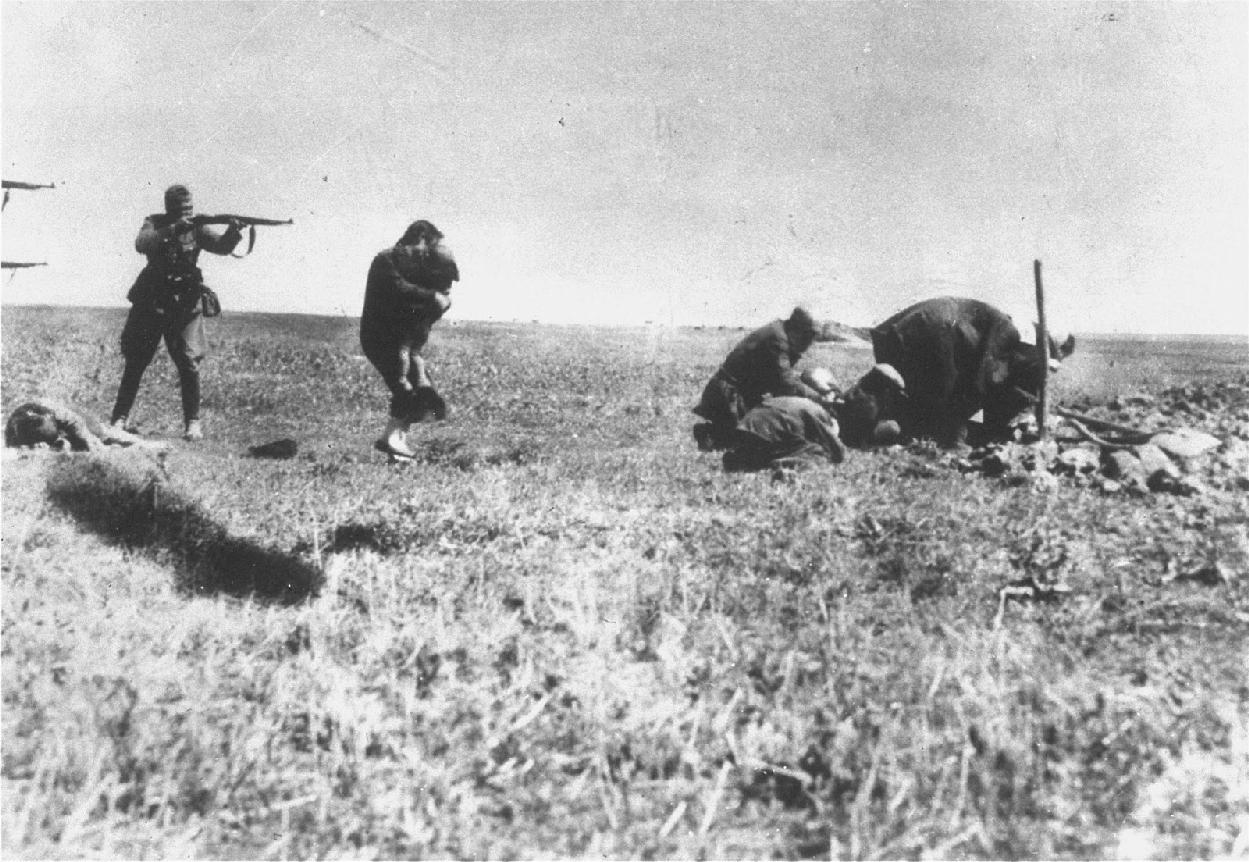
The German Army in Belgium executed 6,000 civilians and acquired a reputation for brutality that lasted throughout World War I, some think unjustly. The Germans in World War II would more than live up to this reputation. The Wehrmacht and paramilitary formations killed about 100,000 civilians in Poland (1939). Operation Barbarossa was to be something even more horific. It would be unlike any other campaign in modern history. Hitler made it very clear to the Wehrmacht that the campaign in the East would be conducted differently than any other modern campaign--it was to be a war of extermination. Mass executions of Jewish men, women, and children as well as Communists were to be carried out. Four SS Einsatzgruppen were responsible for most of the killings, together with local collaborators, but the numbers of Jews encountered was so large that regular Wehrmacht units would also have to nparticipate in the killing actions. It was not just the Jews that were to be killed, but also Communist Commisars in the Red Army and Party and Government officials. Eventually large numbers of Slavs were to be killed to clear land for German colonization. In the end this war of extinction may have doomed Operation Barbarossa because it precluded the effective utilization of the the large number of anti-Communist Russians and Ukranians needed to fight the massive Red Army.
Hitler met with more than 200 senior officers to lay out what he expected of them in the coming invasion of the Soviet Union (March 30., 1941). He presented his vision of a merciless ideological war of annihilation (Vernichtungskrieg). Hitler urged them to overcome their professional military misgivings and lead their
troops in a lightening campaign against the Red Army which he saw the fatal blow to 'Jewish Bolshevism�. The Soviet intelligentsia was to be extiminated. Hitler insisted that ideology had to be an integral part of military operations and rear area security. OKH and senior commanders had to allow the troops to �do their
share� in the Weltanschauungen (ideological) ooerations alongside the SS. Hitler insisted that there was an unbridgeabke racial and ideological divide between National Socialist Germany and the Bolshevik Soviet Union. The rapid execution of all proven, potential, and merely suspected enemies at the front and in the rear
areas, either by the SS or the regular troops was essential to quickly destroy the Bolshevik system and to 'spare limit the spilling of German blood�
Hitler from the outset of preparations for the invasion of the Soviet Union made it clear that Barbarissa would be different. He had OKW issue standing orders that spelled out just how the war in the East woukd be persued. And unlike World War I, it would not be just severe, this time it would be genocidal. The SS Einsatzgruppen would be tasked with killing all Jews they encounteed, but this task would not be limited to just the SS killing squads. The wehrmacht was expected to play its role in the killings. The Wehrmacht orders were not as clear as those given to the Einsatzgruppen commanders, but they were on paper and signed by OKW and were in fact clear enough. OKW issued a series of orders setting the perameters for the conduct of German troops in the Soviet Union. OKW issued a series of orders setting the perameters for the conduct of German troops in the Soviet Union. Each were in blatant violation of international law. They included the Barbarossa Order, the Commissar Order, and the Kommunisten Order. Note that these were not secret orders given to the SS, but commands issued by the Wehrmnacht high command in total violation of the rules of war and international law. There were also orders that affected the Western Allies, including the Commando Order and Night and Fog Decree.
Despite the orders issued by OKW and subiordinate commands, Hitler had no confidence that the Wehrmacht would execute these orders with the severity he expected. The Wehrmact actually arrested and was prepared to court martial both Wehrmacht and SS members who committed attrocities. Nor did the orders fully describe what he wanted done. Hitler concluded that the Wehrmacht was just not the institutiin needed to carry out the actions he required. He gave SS Reichf�hrer Himmler the responsibility for carrying out "special tasksresulting from the struggle which has to be carried out between two opposing political systems" (March 1941). Himmler ordered the creation of four Einsatzgruppen (Special Operations Groups). Einsatzgruppen had been sent into Poland, but they were not as large nor did they have the clear instructiond given to the four new Einsatzgruppen. They were established to follow in the wake of the advanzing Wehrmacht and carry out murder on a large scale. The Einsatzgruppen were nominally under the command of the three Army Groups that conducted Barbarossa. In fact, they followed instructions from Heydrich RSHA. Both Himmler and Heydeich had personnal access to Hiler. Hitler made it clear to the Wehrmacht that he decribed as the "Judeo-Bolshevik intelligentsia" completely eliminated. He appeas to have gone much furher with Himmler and Heydrich. He never went further in open statements to the military leadership and precisely what he told the SS can not be proven. there is, however, every reason to think that the barbaritites carried out by the SS, reflected Hitler's instructions. Heydrixh ordered the Einsatzgruppen commanders to to clear the newly conquerred territories of "suspect elemnents". Note that there was no attempt to link the actions with resistence, but simply "suspect elements" Heydrich ordered the commanders to incite local pograms against Jews. The idea was to be able to show that local populatiions had begun the campaign against Jews. SS-Brigadef�hrer Franz Stahlecker, a protoge of Heydrich fom the SD and commander of Einsatzgruppen A explained, "It has to be shown that the local population themselves had taken the first measures on their own as a natural reaction against decades cof supression by the Jews." {Streit, pp5-6]
The Wehrmacht Stanbding Orders such as Barbarossa (March 1941), Commissar (June 1941), and Guidelines for the Conduct of Troops in Russia (June 1941) are well known. Less well known are some of the subsequent follow-up orders issued by a variety of German commanders. One such order was issued by Field Marshal Walter von Reichenau (1884-1942) commanding the German Sixth Army in the Ukraine during Barbarossa. Von Reichenau was a strong NAZI supporter within the Heer from an early point. Once the NAZIs seized power, he acted as a liaison officer between the Heer and the Party. He played an important role in convincing Hermann G�ring and Heinrich Himmler that Ernst R�hm and the SA had to be removed as a threat to both the Heerand the Party leadingtonthe Night of the Long Knives (1934). Reichenau knewcof and supported the SS Einsatzgruppen in killing Jews after the combat troops had occupied an area. His orders ytob the 6th Army are known as the Reichenau Order (October 1941). Hecdid not believe that many German soldier were fulfilling the estabblished standing orders in Russia. This order was issued as Red army resistance began to stiffen. The 6th army was the German force that woulkd be trapped in Stalingrad about a year later.
The German Hunger Plan (der Hungerplan) also called der Backe-Plan or Starvation Plan was a NAZI World War II food management plan. It is sometine called the Backe Plan because he plaed such an important role in planning and implementing the plan. Herbert Backe was an official in the Ministy of Food and evenually appointed to that post. The Ministry was responsible for the German rationing program. Actually there was no single centrally coordinated plan, but several separate if some times related operations. Germany's World War I experience encouraged the idea of using food as a weapon. Hitler was not the first in this arena. Stalin preceeded him by about a decade with the Ukranian famine (1932-33). We are not sure to what extent NAZI officials were aware of this. The NKVD did an efficent job of preventing details from leaking out to the West. And Western Socialists and Communists, including those in Germany did not want to believe the rumors. The desire to use food as a weapon. This combined with the NAZI regime's rush to acceptance eugenics theories as scientific fact resulted in a genocidal brew of genocidal policies. NAZI food policies were different than the Allied blockade policies which were designed to win the War. Part of Hitler's war objectives were the murder of millions of people which sometimes were given a priority over the war effort. The Hunger Plan was not a policy designed to help win the War, although sometimes presented as that. Many of the individuals killed were working in war industries supporting the German war effort. This actually impeeded the war effort as a labor shortage developed in Germany requiring the introduction of forced labor to man German war industries. Rather the killing of millions Jews and Slavs was a primary German war goal. Hitler asked officials in the Ministry of Food, the agency responsible for rationing, to develop a Starvation Plan, sometimes referred to as the Hunger Plan. The Minister was one of the chief advocates for eugenics in the NAZI heirarchy. The largest elements of the Hunger Plan were: 1) Occupation policies in Poland, 2) Ghetto policies, 3) Starvation of Polish and Soviet POWs, 4) Generalplan Ost. Scholars studying the Hunger Plan provide a somewhat varried list of its elements, largely because there was no single, well coordinated NAZI eff ort, but rather the work of various officials with similar objectives and values. These include besides Backe, Reicharshall G�ring, Reichf�hrer SS Himmler, SS Obergruppenf�hrer Heydrich, and Minister of Food Darr�.
The Battle of Britain in many ways changed the course of the War. An invasion of Britain was impossible without air superiority. Hitler, fearing a cross-Channel invasion, decided that the only way to force the British to seek terms was to destroy the Soviet Union. He began shifting the Wehrmacht eastward to face the enemy that he had longed to fight from the onset--Soviet Russia. The nature of the War changed decisevely in the second half of 1941. The Germans invaded Russia in June 1941, launching the most sweeping military campaign in history. It is estimated that on the eve of battle, 6.25 million men faced each other in the East. The Soviets were surprised and devestated. Stalin ignored warnings from the British who as a result of Ultra had details on the German preparations. Stalin was convinced that they were trying to draw him into the War and until the actual attack could not believe that Hitle would attack him. The attack was an enormous tactical success. The Soviets were surprised and devestated. The Soviet Air Force was destoyed, largely on the ground. The Germans captured 3.8 million Soviet soldiers in the first few months of the campaign. No not knowing the true size of the Red Army, they thought they had essentally won the War. German columns seized the major cities of western Russia and drove toward Leningrad and Moscow.
The German treatment of Polish and Soviet POWs was barbaric and esentially genocidal. Many died from starvation, exposure, and mistreatment. The German policy was in part a planned method of elimination and in part their inablity to deal with the massive numbers surrendering during Barbarossa. German plans for the Occupied East were a genocide targetting the Slavs--Generalplan Ost. Thus when it looked liked the Soviet Union would be quickly knocked out of the War, there was no real desire on the part of the Germans to provide for the vast numbers of POWs. Most Soviet POWs were taken during Barbarossa (June-December 1941). Whole Red Army Army Groups surrenderd en masse. The Germans took 0.6 million Red Army soldietrs captive at Kiev alone. At some camps the Soviet POWs were not even provided barracks and other structures and were exposed to the elements even during the winter. While in terms of fatalities, the worst time for POWs was in 1941 when the German took huge numbers of POWs. There would be Red army soldiers taken after Barbarossa, but not in the same huge numbers, in part because the Red Army was learning how to deal with Blitzkrieg and German power had been reduced after the Red Army Winter offensive (1941-42). German tretment improved somewhat as they began to use Soviet POWs for forced labor, but it was still unimagineitevly brutal. The Germans recruited some anti-Soviet POWs to form anti-Soviet Russian units. The Germans never, however, fully trusted these units and did not fully equip them. The Soviet POWs liberated by the Red Army were treated abominably. Many were transported to the Gulag. Stalin's attitude was that they should have never surrendered.
It is not precisely known when Hitler ordered the mass murder of European Jews. The principa NAZI concern before the War was to first rob German Jews abd then drive them from the Reich. They had considerable success with both, but the Anschluss (1938)and seizure of Czechoslovakia (1938-39) brought more Jews within the Reich than the NAZIs began with. And many more still came with the invasion of Poland (1939). So the Reich had more Jews than when Hitler came to power. Even so the decesion to murder European Jews had not been taken. The NAZIs were talking about a reservation in Poland around Lublin or shipping the Jews to Madagascar. The turning point in NAZI thought was Barbarossa (June 1941). The formation of the SS Einsatzgruppen meant killing on a large scale. The orders were at first muddeled, byt Hedrich quickly made it clear that they were to kill Jews without mercy. And once the killing began in the Soviet Union, the fate of the Jews in the rest of NAZI occupied Europe was sealed. Hitler made the decesion at a time when it looked like Germany had won the War and there would be no repercussions. This changed with the Red Army offensive before Moscow and the American entry into the war (December 1941). This meant that it was no longer clear that Germany would win the War. Even so, Hitler went ahead with the plans to kill European Jews. Most of the Jews were killed after this time. The gas chambers needed to kill in large numbers obly became operational (April 1942). About half of the Jews which perished in the Holocaust were killed after Stalingrad (January 1943) when it was clear that Germany could not win the War. As NAZI prospects declined, Hitler maintained the killing process. As it became clear that the War was lost, in his mind he saw himself in fufilling at least one war goal--exterminating the Jewish people.
The full extent of NAZI barbarity is not well understood. The NAZI killing of Jews is well known, byr what is not generally know is that the extermination of the Soviet people, the Slavs and others was a primary NAZI war goal. Only the Red Army precvented this from occuring. The SS Reichssicherheitshauptamt (RSHA -- Reich Security Office) was the NAZI agency which drafted the Generalplan Ost (General Plan East). This was the NAZI blueprint for the most horrendous crime ever envisioned in human history. The Holocaust directed at Europe's 11 million Jews was just one part of Generalplan Ost. The basic outline for Generalplan Ost was sketched out by Hitler in Mein Kampf. The invasion and occupation of Czechoslovakia gave the NAZIs the first slice of eastern territory to begin their transformation of eastern Europe (March 1939). But the NAZIs considered the Czechs to be the most advanced Slavs. And they needed Czech industry for arms production. So the Czechs were left with a puppet government and Germinization was put off least it disrupt arms production. Poland was the next slice of the East. It was much bigger slice and the Poles were Slavs that Hitler despised. Himmler launched into the Germinization process in the Wartergau, but Frank protested with Himmler began dumping Jews and Poles in the General Government. So again Germinization and whole-scale deportations had to be delayed. Himmler and NAZI Party officials argued about Eastern policy. Himmler wanted to settle Germans in the East and to carefully select the existing populations for German blood.
Mazower, Mark. Hitler's Empire: How the Nazis Ruled Europe (Penguin Press: New York, 2008), 726p.
Shepherd, Ben. War in the Wild East: The German Army and Soviet Partisans (Cambridge, 2004).
Sholokhov, Mikhail. Fate of a Man.
Streit, C. "The Germany Army and the policies of genocide," in Hirschfeld, ed. Policies of Genocide.

Navigate CIH World War II Section:
[Return to the Main Operation Barbarossa page]
[Return to the Min Einsatzgruppen page]
[Return to Main German World War II page]
[Return to World War II First phase campaign page]
[About Us]
[Biographies]
[Campaigns]
[Children]
[Countries]
[Deciding factors]
[Diplomacy]
[Geo-political crisis]
[Economics]
[Home front]
[Intelligence]
[Resistance]
[Race]
[Refugees]
[Technology]
[Bibliographies]
[Contributions]
[FAQs]
[Images]
[Links]
[Registration]
[Tools]
[Return to Main World War II page]
[Return to Main war essay page]