|
Once it was clear that the French Army was defeated, Mussolini decided to join Hitler and declared war on France and Britain. Even though German armies were pouring through France, Mussolini's attack in the south was unsuccessful. Mussolini also invaded Egypt from Libya, hoping to seize the Suez Canal (September 13, 1940). Although badly outnumbered the British 8th Army not only stopped the Italians but counter attacked (December 9, 1940). The British move toward Benghazi with a series of victories. The Italians are near collapse. Hitler in order to prevent the fall of Libya orders a small armoured force to Libya to support the Italians. The force under Erwin Rommel begins to arrive March 22, 1941. Rommel and his Africa Korps stop the British and even though he has only a small force launches a counter-attack (March 30, 1941). Rommel drives the British back into Egypt. Here Rommel's inovatic tactics and the superority of the German Panzers were critical. ANZAC resistance at Tobruck helps to stop Rommel. A British counter offensive drive Rommel and the Italians back into Libya (November 18, 1941). Rommel strikes and again drives into Egypt (January 21, 1942). This time Rommel takes Tobruk (June 21, 1942). He moves toward Suez, but is stopped after a ferocious battle at El Alemain (July 2, 1942). A standoff occurs as the two armies prepare for a show down. Churchill gives Montgomery command of the 8th Army (August 13, 1942). This is thehighwater of the German war effort. Rommel is only a few miles from Suez and Von Paulitz's 6th Army is investing Stalingrad. Here America's entry into the War begins to swing the ballance. American industry provided Montgomery, with supplies and equipment in massive quantities. The Germans bogged down in the Soviet Union can not devote the men are material needed by Rommel. The British defeat of the Italian Navy in the Mediterrean means that much of the supplies sent to Rommel are sunk. The British are assisted in this effort by Ultra.
American historians comminly refer to the fighting in the Western Desert as the North African campaign. In fact, the British term "Western Desert" confused me because it was fought in eastern North Africa. The British of course adopted the term from their perspective in Suez and Egypt. The Italian attack came out of the Western Deseret as seen from Suez.
Mussolini was cautious as Hitler and Stalin launced World War II (September 1939). Mussolini watched Hitler ovewhelm the armies of neigboring countries and wanted in on the spoils of war. All he had was Albania Finally seeing France defeated and thinking Britain was soon to follow, Mussoliio brought Italy into the War (June 1940). Only Britain did not capitulate as expected. And as Britain fefied Hitler, the F�hrer expected Mussolini to do his part in the War. There was no cordination. Hitler expected Mussolini to do as he bid him and tht to attack the British. . Hitler was anxious to knock Britain out of the War so he could focus on his major onjective--the Soviet Union. He was frustrated when G�ring's Luftaffe faild to deliver his victory. And Italy had two camopaigns to wage against a very much undefeated Btitain. A land campaign in the Western Desert and a naval campsign in the Western Mediterranean. And Hitler was pressing him to vigiorously pursue both to pressure Brtain which was hanging in largely because they were receiving aid from America. Mussolini' army and naval commanders were not anxious to engage the British. And when they did the results.were not favorable. At first it seemed that the massive Italian army in Libya would easily overwhealm the British in Egyptand seize the Suez Canal. After minths of inaction giving the British time tio build up a small force, the Italians struck (September 13, 1940). Although badly outnumbered the British firce whivh would eventualy become th 8th Army stopped the large Italian force. The Italians dug into defensive poditions. They wee overwhealmed by a small British force which drove the Italians bsack into Libya. The Italian Navy performed better ghn the Army, but still suffered major reversals in encounters with the Royal Navy. These defeats made it jnceasingly dfficult to opriotect supply convoys to Libya.
Mussolini assumed thatvhis military would achir=eve the same stunning victories as the Germans. The military failure of Italian arms both surprised and shocked him. Mussolini had ignored the warnings from his generals. The Germans did not rate the Itlians highly, but the enormity of their failures shocked the Germans as well. The British Western Desert Force did more than save Suez, it convinced Hitler than he would have to intervene to save Mussolini. The first German action was to divert 500 Luftwaffe planes from Norway to Sicily. They were used ti bimb Bengazzi which left the port inoperable to supply O'Conner's advancing Western Desert Force. Hitler did not trust Mussolini They met at the Brenner Pass (October 4). Hitler did not tell Mussolini about his plans to occupy Romania 3 days later. [Willmott, p. 114.] Mussolini returnd the favor when he invaded Greece (October 28). The difference was that the Italian invasion ws a disster. The Italians were unprepared and the weather was terrible. The Greeks pushed the Italians back into Albania. The British provided air support. It was clear tht Hitler would have to rescue Musolini not only from the British, byt also the Greeks. British air power in Greece threatened the all important Ploesti Oil Fields. And it could not have come at a worse time. After canceling Operation Sea Lion, planning was beginning for Barbarossa. Hirler wanted to concentrate all his energy and forces on what he realized would be the decisive German offensive of the War. And the British victory over the Italians in the Western Desert as well as the Greek resistance to the Italians, convinced Prince Peter, still a teenager, to declre his majority and stage a coup, replacing the refency of Prince Paul and rejecting the Axis. The Yugoslavs and Greeks woukd pay dearly for their defiiance, but Hitler was forced to divert resources from Barbarossa which would basically determine the whole course of the War to Africa and the Balkans, two areas that would have little impact on the War. And perhaps most importnt, many historians believe that Hitler's Balkan adventure delayed the launching of Brbarossa perhos making the difference between success and failure.
Hitler in an effort to prevent the collapse of the Italians in Libya ordered a small armored forece to Libya to be commanded by Panzer commander Erwin Rommel who had made a name for himself in France. Hitler at this time was focused on the upcoming invasion of the Soviet Union. He had rejected the suggestions of Admiral Raeder and others who advocated an offensive in the Meditrranean to settle the war with Britain rather than invading the Soviet Union. He was prepared, however, only to spare a very small force to stabalize the situation in Libya. OKW formed the Afrika Korps (February 19, 1941). It was a decesion that set in motion the 27-month German campaign in North Africa.
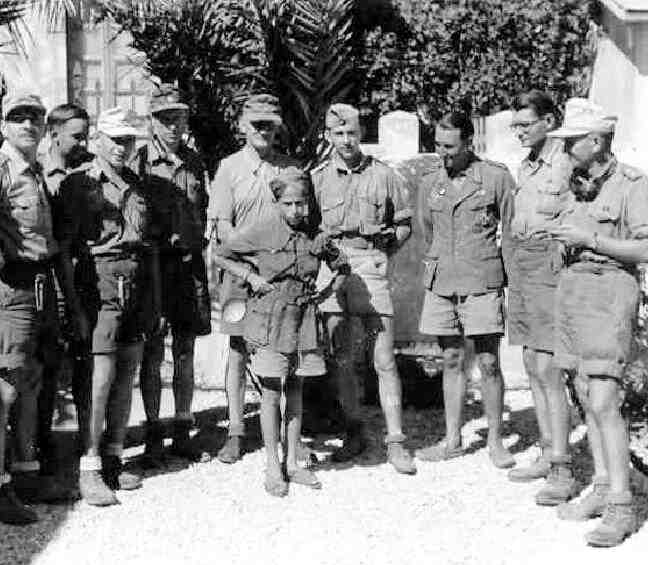
The Afrika Korps (the Geermans used different names) was to be a small expeditionary force to support the Italian army and prevent the British from completing the seizure of Libya. The force under Erwin Rommel began to arrive (March 22, 1941). Rommel was officially subordinated to the Italian coomander in North Africa, although he often ignored the chain of command. His orders were to support the Italians and hold Libya. He was not authorized to launch an offensive into Europe. Rommel was given only a small German force. His initial forcee was the 5th Panzer Regiment and a collection of small units. (The 5th Light Division was later redesignated the 21st Panzer Division.) Rommel organized his force into the 5th Light Division. Rommel struck even before all his force had arrived in Libya. His Africa Korps stopped the British and even though he has only a small force launched a counter-attack (March 30, 1941). Rommel drove the British back into Egypt. Here Rommel's innovatic tactics and the superority of the German Panzers were critical. At this stage of the War, the Germans had mastered armored warfare and the British despite the figtingbin Poland and France had not. Rommel was soon reinforced with the 15th Panzer Division. This provided Rommel's Afrika Korps with two German divisions and various small support units to support the Italian units. The Italians seemed unwilling to fight on gtheir own, but along side German units many Italian units did stand and fight.
The fighting in the Western Desert took place against the struggkle for control of the Mediterranean. The Mediterranean became an active theater of war when Italy entered the war (June 1940). Italy had a modern fleet and with France out of the War, immediately challenge the beleagered Royal Navy for control of the Mediterranean . The Italian fleet supported by air bases in Libya, Sicily, and Italy posed a formidable challenge. The British considered withdrawing from the Mediterranran and falling back on Gibraltar to husband naval strength for the critical campaign in the North Atlantic. Churchill was, however, determined to fight it out with the Italians, setting up a series of derocious naval engagements, some of the lsrgest surface engagements of the War. The British controlled the two entances to the Mediterrean (Suez and Gibraltar). In between and in many ways the key to the Mediterranean was the small British bastion at Malta.
Armies in World War II had to be supplied by rail and sea. Air supply could be used to supply surrounded units on an emergency basis, but could not deliver heavy equipment or the supplied needed for major forces over an extended period. Italy was the major Axis player in the Mediterranean area and even after the German took over the bulk of the North African campaign, it was the Italian navy supported by the air force that had the major responsibility of delivering supplies to the Axis forces in North Africa. [Sadkovich] The Royal Italian Navy organized and protected the convoys that supplied Rommel and the Afrika Korps. They faced formibable attacks by British aircraft, submarine, and surface units. And unknown to the Axis, Admiral Cunningham was getting Ultra intercepts, allowing him to effective use his limited forces to devestate the Italian convoys. The Italians proved unable to deliver adequate supplies to the Axis forces in North Africa. To preserve the Ultra secret, the British allowed some supplies to get through. They were so limited, however, that Rommel was force to take up a defensive position at El Alemaine and gradually Montgomery with extensive American support built up a far superior force.
Mussolini's invasion of Greece from Albania without consulting Hitler destabilized the German southern flank (October 1940). The Italian invasion failed and the Greeks drove the Italians back into Albania. The invasion caused the Greeks to seek support from the British. The British occupied Crete (Novemberc 1940). This endangered the German southern flank just as they were beging to prepare for the huge Bsrabarosa eastern campsign. It also exposed the German position in Romania. Romania was critical to the German war effort because the Ploesti oil refieries were Germany's promary source of petroleum. Ploesti was within range of bombers based in Crete. Hitler decided to secure his southern flanl before invading the Soviet Union. Yugoslavia which had been finally enduced to join the Axis, suddenly pulled out when a coup deposed the government. Hitler ordered the Wehrmacht to invade Yugoslavia and Greece. The Greeks turn to the British for assistance. It is at this time that Churchill honored a pledge to assist Greece weakened the 8th Army in Egypt. After quickly subduing Yugoslavia and Greece, the Germans conducted a daring parachute assault on Crete (May 1941). The invasion suceeded, but the elite paratroppers took heavy casualties. Fortunately for the British, the major naval battkles with the Italian fleet had been won. Crete was too far away from the Western Desert to support the Afrika Korps, but seaplanes from Crete did help cover the Italian supply convoys.
Rommel's successes caused some reevaluation at OKW. Rommel's force was redesignated Panzer Group Afrika (August 15). Rommel was made the Group commander. Command of the Afrika Korps was given to Ludwig Cr�well. The Panzer Group consisted of the Aftrika Korps and various German support units and two corps of Italian units, none with heavy armor. Panzer Group Afrika was redesignated as Panzer Army Afrika (January 30, 1942.) The Italian Army had desinigrated whwn attacked by the British. Under German leadership the Italians did fight, not as effectively as the Germans, but they did fight. The DAK's successes also brought considrable German media attention.
Malta was the cornerstone of the British campaign in the Western Desert. British possession of Malta and the invaluable naval and air bases there played a major role in interdicting Italian and Germany supply convoys to Libya. And it was supply shortages that played a key role in defeating Rommel and the Afrika Korps. Malta became the most bombed place on earth. German and Italian air forced relentlessly pounded the island. The island somehow managed to with tand the fiercest air assault of the War. The Italians began bombing Malta in 1940. The Luftwaffe joined in the campaign (January 1941) even before Rommel arrived in North Africa. Malta by March 1942 was enduring an average of 10 air raid alerts daily and there had been 117 straight days of bombing. The bombing was devestating. It also prevented supplies, food, and fuel from reaching the island. At one point Malta was near to capitulation, left virtual no fuel, food, or fighters. It was a convoy with an American carrier that finally succeeded in getting needed supplies through. Civilians suffered teribly. They had to move underground. Newsreels in Britain and America showed school children moving rapidly into undergrond bunkers when the air raids sireens sounded. The population was near starvation at one point. The Axis did not, however, launch a parachute assault on the island. They had the capability as shown in Crete. Senior Axis commanders advised just sych an action. After the German terrible losses suffed by the German parachute units on Crete, however, Hitler demured, After the War, historians have taken to summrizing the assul on Cretr as "the wrong island". The Axis seige was not fully lifted until July 1943 after the Axis surrender in Tunis and the invasion of Sicily. [Holland] Operaions from Malta also played an important role in interducting Axis supply lines to Tunis, fforcing the surrender there. Some orphaned children were sent to Australia.
ANZAC resistance at Tobruck helps to stop Rommel.
A British counter offensive drove Rommel and the Italians back into Libya (November 18, 1941).
Rommel re-captured western Cyrenaica (late-January 1942). He advanced his two German divisions and Italian allies to within 26 miles of El Gazala and 64 miles from his oold nemesis--Tobruk.
The battle of El Gazala occurred at a critical time of the War. The Axis after the German defeat before Noscow (December 1941) seemed to have recovered and was achieving one victory after another. Europe was still firmly in the NAZI grasp. The Whermact smashed Soviet armies in the Crimea (Kerch and Sevasterpol) and at Kharkov. The Germans were beginning a two front advance toward the Caucusus and Stalingrad. In Asia the Japanese had seized Singaporte, the Philippines, and Burma and preparing to advance into India. The sole bright spot had been the American naval victory at Midway (June 1942).
The British advance into Libya and German counter stroke was followed by a lull in the fighting (February to mid-May 1942). Both armies regrouped their men and equipment and prepared what they hoped would be the campaign winning battle. The British Eighth Army was commanded by Major General Neil Ritchie under the close supervision of the Commander-in-Chief Middle East, General Sir Claude Auchinleck--known as the Auk.
The Axis forces were theroretically an Italian command , but Erwin Rommel was in effective control. The two commanders had very different orders. Churchill after 2 years of war needed a victory. He wanted
Auchinleck to be more aggressive. He wanted the 8th Army to to retake Cyrenaica. This would put he Desert Airorce in a position to support Malta andf engage Axis shipping. Auchinleck did not agree with Churchill. Senior British commanders tended to agree with Auchinleck. He believed that any British offensive should be carefully planned and the troops well equipped. He wanted time to prepare the attack. The result was conflict with Churchill who ordered him to 'comply or resign'. Auchinleck responded with a commitment for a June offensive. The German position was almost the reverse. Rommel who wanted to attack faced a skeptical OKW. OKW wanted a cautious approach. OKW was understandably focused on the summer campaign in the Soviet Union. OKW gave Rommel the go ahead to take Tobruk (May 1). They saw possession of Tobruk as helpful for Operation Hercules -- the seizure of Malta. So both sides were preparing the strike (mid-May).
El Gazala was Rommel and the Afrika Korps' major victory in the Western Desert. It was a masterpiece of aggression and maneuver. It was fought around port of Tobruk in Libya.
Rommel feinted east and then turns back to attack his old nemesis--Tobruk. This time it fell with little fighting (June 21, 1942). Churchill who was in Washington conferring with President Roosevelt. The two were stunned. Churchill upon receiving the news called it a �disgrace�. The loss of Tobruk so quickly was a stinging blow to Allied morale. The President asked how he can help. Churchill requested tanks. President Roosevelt orders 300 Sherman tanks to be immediatly dispached to Egypt.
The British after the outbreak of World War II began describing their air forces in the Middle East as the Desert Air Force (DAF). Af first the air contingent was very small. The Desert Air Force was formally constituted as the Western Desert Air Force (WDAF) (late-1941). Air Vice-Marshal Sir Arthur Coningham, an Australian who grew up in New Zealand, took over command of RAF No.202 Group (1941). He began the first steps to the creation of the the DAF and would command throught the desperate figting with Rommel's Afrika Korps until the British vctory at El Alemaine. He oversaw the important development of close air support tactics that the Germans had mastered before the War. No.253 Wing was formed to experiment with the close air support tactical operations that would be so important in the Western Desert fighting (July 1941). WDAF's primary function was to provide close air support to the Eight Army. This would be the first time that the Germans woulkd have to face the tactical air tactics that they had developed. And here the Desert Air Force woulkd have several advantages over the Luftwaffe. The Germans from the beginning saw the Wstern Deseryt as aide show as they launched Barbarossa. The British in contrast saw the Western Desert as of critical importance and for an extended period when the War was being decided on the Eastern Front was the only active Allied front. They also had access to virtually unlimoyed fuel supplies while the Afrika Korps was constantly starved forv fuel. And the Desert Air Force received major deliveries of aircraft from both Britain and the United States. No. 253 Wing at first was composed of two squadrons of Hurricane fighters and one of Blenheims bombers. As fighting intensified in the Western Desert as the British victory in the Battle of Britain enable the British to deploy air units to the Western Desert, No. 258 Wing and No. 269 Wings were formed for front line operations. No.262 Wing was formed for the defence of the Nile Delta Zone. No.258 and 269 Wings formed the core of the WDAF when it was formally constituted (October 1941). WDAF's first major operation was to support Operation Crusader (November 1941). The DAF would eventually include squadrons from the British Royal Air Force (RAF), the South African Air Force (SAAF), the Royal Australian Air Force (RAAF), the United States Army Air Force (USAAF), and other Allied air forces. Besides playing a major role in the British victory in the Western Desert, the Desert Air Firce was the proving grounds for the development of the close air support tactics that would be needed when the Allies closed with German units in Europe, As the Allied air strength steadilky expanded and would eventually include bomber contingents, including long-range bombers that could strike targets in German occupied Europe. The primary targets would be the critical Ploesti oil fields in Romania and targets un Sivcily and Italy.
German victories early in the war came in large measure because they had developed the techniques of modern war, called at the time Blitzkrieg. This involved the use of rapidly moving armored formations supported by close air support. The British had scored some successes in the western desert, but against the Germans it was generally becaue they had superior forces. One mistake the Btritish constantly made was to expose their armor to extremely effective German 88mm anti-tank guns. Against other opponents the Germans had defeated them before they could develop these tactics and necessary counter measures. One of the maxims of warfare is to avoid multiple engagemenrs with the same ememy as he learns your tactics and how to counter them. Blitzkrieg involved using air power for tactical support and concentrating armor forces.
British and Italin/Germany armies launched offensives which swung back and forth between Egypt and Libya. It looked like Rommel's Africa Corps might reach Suez in 1942, but the British stopped him at El Alamein. Here the two armies prepared for a massive battle. The Afrika Korps supply lines crossed the Mediterranan where with the help of Ultra, the British destroyed large quantities of supplies. The British in turn had longer supply lines, but their new American allies delivered vast quantities of weapons and supplies. This enabled Montgomery's 8th Army to smash the Afrika Korps (October 1942). While this made headlines, the more decisive action occurred to the west in French North Africa. Amercan and British landings in North Africa known as Operation Torch sealed the fate of the Axis desert campaign. Even if Rommel had broken through to Suez, he would have been forced to turn west to deal with the Allied landings in French North Africa. The Allies driving east from their Moroccan and Algerian beachheads linked up with the Brish advancing west (November 1942). While generally given less attention than other campaigns, the Anglo American offensive, joined by the French French played an important role in assisting the hard-pressed Soviets on the Eastern Front. The Wehrmacht's strategic reserve had not yet been committed in November 1942. All rational calculations argued for it to be committed against the Soviets in the struggle over Stalingrad. Hitler instead used major components to hold Tunisia. The Luftwaffe was ordered to launch a massive operation to transport troops to Tunisia and support them. More than 1,000 Junkers transport planes were loss in the effort, planes and crews which could have been used to supply the 6th Army at Stalingrad. The Axis lost 200,000 soldiers at Stalingrad, but 250,000 in Tunisia--about Half Germans. These were losses of such magnitudes that the Germans could not replace them. [Atkinson] North Africa was also notable because the Anglo-American military operation was worked out and the Allied armies first learned the techniques of modern war needed to defeat the Blitkrieg tatctics of the German military machine. The American army obtained its first combat experience in North Africa.
Barr, Niall. Pendulum of War: The Three Battles of El Alamein (Overlook, 2005).
Churchill, Winston S. Memoirs of the Second World War (Bonanza Books: New York, 1978), 1065p.
Holland, James. Fortress Malta: An Island Under Seige 1940-43 (Miramax, 2003).
Schofield, Victoria. Wavell: Soldier and Statesmen (2006).
Willmott, H.P. The Great Crusade: The History of the Second World War (1989).

Navigate the CIH World War II Section:
[Return to Main Western Desert page]
[Return to Main African campaign page]
[Return to Main early World War II phase]
[Return to Main World War II campaign page]
[Biographies]
[Campaigns]
[Children]
[Countries]
[Deciding factors]
[Diplomacy]
[Geo-political crisis]
[Economics]
[Home front]
[Intelligence]
[Resistance]
[Race]
[Refugees]
[Technology]
[Bibliographies]
[Contributions]
[FAQs]
[Images]
[Links]
[Registration]
[Tools]
[Return to the Main World War II page]