|
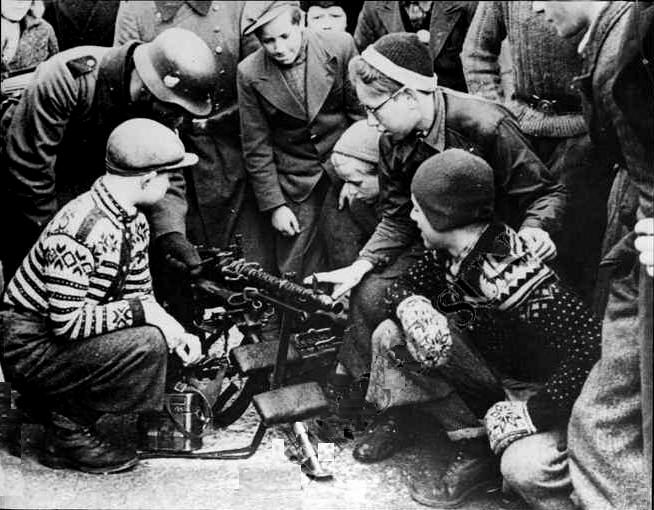
Norwegian officials were intent on maintaining the country's neutrality as they had done in World War I. Norway had no professional army and only a poorly trained militia. Officals had seen the German newsreels of what had happened in Poland and were intent on maintaining the country's neutrality. In fact they persued this course even after the NAZI invasion was underway (April 1940). German sea and airborne units while their comrads rolled into Denmark, launched their invasion of Norway (April 9). The Germans in a single day launched multiple seaborn ar airborn attacks to the complete surprize of the completely unprepared Norwegians. [Greene and Massignani] The Germans targeted Oslo, Bergen, Trondheim, Stavanger, and Narvik. The Norwegians were stunned by the German invasion, but managed to organize some resistance. Three German cruisers and four troopships were sunk. The Allies land an expeditionary force landed in southern Norway (April 16-19), but were eventually forced to withdraw (May 3). When the Germans took the key rail center of Dombas, organized Norwegian resistance rapidly ceased. A British ground force retook Narvik (May 28), but was eventually withdrawn. The superiority of the Luftwaffe and developments in France were the deciding factors (June 10). The NAZIs placed a Reich-commissar in charge of Norway which took over the legal administration of the country. The Reich-commissar dissolved all Norwegian political parties except the pro-NAZI Nasjonal-Samling (September 25). The occupation regime was run administered by 13 commissars. Control of Norway ptoved useful to the NAZIs as naval and air bases made it difficult for the Royal Navy to bottle up the U-boats in the North Sea. Norway was also an important source of raw materials. Later after the invasion of the Soviet Union, the Germans were able to launch devestating raids on Allied convoys delivering war materials to Murmansk and Archangel. The NAZIs much admired Norway as a rich source of Nordic Aryan breeding stock. The Resistance was active in Norway. The resistance aided by the British staged some important raids and kept the Allies informed of German military movements. They also saved about half of Norway's small Jewish population from the Holocaust. The Germans maintained a substantial army of occupation. Later in the War, the Allies tried to convince the Germans that they were planning an invasion, to discouraging the Germans from drawing down the occupation force to strengthen the Atlantic wall in northern France.
Norway declared its independence from after a referendum (1905). This was a reflection of the rising nationalism in Europe. The kings of the three Scandinavian countries met in Malmö to make a joint declaration of absolute neutrality (December 1914). Norway like the other Scndinavian countries managed to remain neutral in World War I. The Royal family had ties to the British royal family, but there was some public sympathy for the Germans. Norway being the most westerly Scandinavian countr with a North Sea coast was most exposed to the War. Norway was an important maritime nation and its shipping industry was heavily damaged.
Having escaped the horrors of World War I through neutrality. The Norwegian people and political establishment made neutrality the centerpiece of their foreign and defense policies. And accounts of the War significantlyexpanded pacifist sentiment in the country, This was true both for those who wanted no involvement, but also many who convinced themselves that war was the great evil. This made considerable sence give the huge loss of life and destruction resulting from Wold War I. Norwegian attitudes, however, did not change with the rise of the great totalitarian powers, the Soviet Union (1918), Fascist Italy, (1923), and NAZI Germany (1933), not to mention far way Imperial Japan. Norwegian defense policies even after Hitler and the NAZIs seized power
were based on four elements. 1) Conservative parties pursued fiscal austerity which left little room for meaninful defensespending. 2) Wihspread public belief in pacifism and the Norwegian Labour Party's oposition to defense spening because of itspacifist belies. 3) Faith in the doctrine of neutrality which had workd in World war I. 4) A geneal belief that the distance from Germny provided a degree of safety. The increasing beligerance of Hitlr and the NAZIs caused some Norwegians tobecome concerned. At firstit was the Norwegian military staff and right-wing political groups, but as the liklihood of wr became more obvious, public opioon and thought inmin-stream political parties began to change and King Haakon began quitely promoting increased defense measures. The Norwegian parliament began approving increased defense expenditures (late-1930s). They approved loans to finance defense ependitures. The decesions were, however, made to late. The defense projects were still mostly uncompleted at the time Hitler and Stalin launchd the war.
Norway was also an important source of raw materials for the German war effort as well as a critical route to get vital Swedish iron ore to the Reich. Germany was dependent on imported iron ore for its steel industry and the primary supplier was Sweden. Without Swedish iron ore, Germny could not hve conducted the War. A problem here was the Swedish ports could not be used year round. The answer well before the War was the The Iron Ore Line (Malmbanan). It was a 398-kilometre (247 mile) rail line built between Riksgränsen and Boden in Sweden and an ice-free ports in Norway. The line had two branches, from Kiruna to Svappavaara and from Gällivare to Koskullskulle. This got the iron from the ines to Swedish Baltic ports. But they froze up in the winter. The rail routes also included the Ofoten Line, from Riksgränsen to Narvik in Norway, and the northernmost part of the Main Line Through Upper Norrland from Boden to Luleå which also connected to Narvik. The railway from Narvik to Luleå was 473 kilometres (294 mi) long. The first section of the line, from Gällivare to Luleå, opened (1888) and extended to Kiruna (1899). The extebsn to ice-free Narvik was added (1903). Electrification took place between 1915 and 1923. Grman possession of Norway this assured the around the year delivery of Swedish iron ore.
Vidkun was the son of noted Lutheran minister and genealogist Jon Lauritz Quisling. Both parents came from distinguished families in the northern town of Telemark. Their son was notable as the country's highest scoring war academy cadet. He upon graduation). He helped save lives in Russia, working with Fridtjof Nansen, to help alieviate cthe famone following the Revolution and Civil War. He also reached the rank of major in the Norwegian Army, but served as defense minister in the agrarian government (1931-33). Despite is Christian upbringing, Quisling was very impressed with Hitler and the rise of the NAZIs in Germany. His experiences in Russia had made him intensely anti-Bolshevik, but thisxdoes not explain his anti-democratic orientation. Quisling and state attorney Johan Bernhard Hjort formed the Nasjonal Samling (National Unity--NS) Party (May 17, 1933). This was Constitution Day in Norway. The NS was the Norwegian National Socialist (NAZI) party. Nasjonal Samling was in all respects a Norwegian clone of the NAZI Party. The NS was anti-democratic and this was reflected in the Party structure which was based on the NAZI Führerprinzip.
The party at first had some modest success It polled nearly 30,000 votes (1933). This was a respectable showing in a country with a very small electorate, but this was before Norwegians understood just what Quisling represented.
Quisling was supported by the religiously rooted Norwegian Farmer's Aid Association which he had worked with during his gime in government. As the NS developed, however, support dwindled. Quisling closely followed Hitler and NAZI policies in Germany. The NS shifted from aparty with religious roots to a clearly pro-NAZI party with hard core anti-Semitic beliefs rejecting democracy and with little in the way of Christian foundation. As a result, support from the Church dwincled. Still the NS received about 50,000 votes (1936). After this support rapidly declined as Norwegians read more about developments in Germany. Hitler met with Quizling after the War began (December 1939). Hitler was apparently impressed with Quisling. It was at this time Hitler began to consider a possible Norwegian campaign.
Hitler launched World War II with the invasion of Poland (September 1, 1939). Hitler as was his tendency, did not declare war on Poland, but invaded without a declaration of war, considering Poland an illegitimate state. Britain and France as they pledged, declared war on Germany (September 3). Norwegian officials were intent on maintaining the country's neutrality as they had done in World War I. All the Scandinavian countries as well as Finland declared their neutrality. Hitler and the NAZIs were not popular in Scandinavia, but no one fully understood the extent of his deparavity. And not only were the Sandinavian countries therated by the NAZIs, but as a result of the NAZI-Soviet Non Aggressioin Pact, there was a threat from Stalin and the Red Army to the east which also invaded Poland. The Scandivaian were, however, most concerned with NAZI Germany, but generally believed that Neutralism would again protect them. As it worked out, only Sweden would suceed in maintaining its neutrality, but under very restricted conditions.
Norway had a very small population and no professional army and only a poorly trained and armed militia. Officals had seen the German newsreels of what had happened in Poland and were intent on maintaining the country's neutrality. Norway as a result retained a strict neutrality. [Stenersen, p. 117.] Both Britain and Germany realized, however, realized the strategic location of Norway. While Norway has remained neutral in World War I, the fact that it was not controlled by Germany, helped the British bottle up the Germany Navy and restricted U-Boat operations. Both the Allies and Germany made plans to invade Norway, in violation of Norwegian neutrality. The Germans struck first.
Norwegian officials persued the policy of persuing neutrality even after the German invasion was underway (April 1940). The one Allied offensive in the first year of the War was planned to secure Norway. The Germans responded with an offensive north on April 9, invading Denmark and Norway. It was a rapidly organized invasion to counter a planned British attempt to move into Norway to cut off iron shipments. The German Krriegsmarine suffered severe losses, especilly of destroyers. The British fough on in northern Norway for 3 weeks, but the superiority of the Luftwaffe finally forced them to withdraw. The loss of Norway not only provided access to raw material, but meant that the U-boats could not br bottled up as they were in World war I. It also mean later in the War that supplying Russia would be very difficult.
The Norwegian Storting in an emergency session after fleeing Oslo granted full authoruty to the King and his ministers. The Royal family separated when the Germans struck. King Haakon VII and the Crown Prince joined the Norwegian Army and then the British and French who landed at Narvik. The Queen and younger children were evacuated to safety in neutral Sweden. The King was evacuated with the Allied forces (June 6). They set a Government-in-exile in London. They were able to finance operations with the Norwegian gold reserves that been removed for safe keeping. The Norwegians and the other governents-in-exile were at first unsure about the future given a German invasion of Britain was widely expected. The RAF's victory in the Battle of Britain made that impossible and the Norwegians could plan their contribution to the War. A few Norwegian servicemen escaped with the Allies. They were reconstituted in Britain and armed. King Haakon became the leading symbol symbol of the Norwegian people's struggle for independence during 5 long years of German occupation. King Haakon broadcast from London. It was illegal to listen, but mazny did and drew inspirtation from the King.The Government-in-exile led and coordinated Norway's war efforts from London.
Operations began to support the resistance which was organized in Norway. Norway had a substantial merchant fleet and the captains of the vessels not seized in port by the Germans, mostkly took their ships to Britain and supported the Government-in-exile. The Norwegian merchant fleet played an important role in supplying Britiain during the Battle of the Atlantic was Norway's primary contribution to the Allies. Half of the Norwegian fleet was sunk during the war, The resistance was supported from the Shetlands. Despite the efforts of Maj. Gen. Vidkun Quisling to promote collaboration with the German occupiers, most Norwegians remained loyal to the King and the Government-in-exile. The Government-in-exile in London appointed Crown Prince Olav Chief of Defence (June 30, 1944). He thus took command of the Norwegian armed forces. Eventually the Government-in-exile began to address the problem of how to deal with colaborators like Major General Quisling. Several decrees were issued defining treasonoable acts. The situation was different in Norway than France whwre Vichy was the legitimate government. The Government-in-exile defined treasonable acts and increased the penalties, including reving the death penalty. A new measure was enacted--"loss of public confidence," (tap av almenn tillit). Conviction resulted in depriving the individual of specified civil privileges and honors. Included in the decress was declaring membership in the collaborationist Nasjonal Samling a crime. These war-time decrees were finalized in the Landssvikanordning (December 15, 1944). By this time it was clear that liberation was only a matter of a few months.
The German occupation of Norway began wih the invasion of the neutrl country (April 9, 1940) and lasted until the liberation following the German surrender (May 8, 1945). Except for Polaand, Norway and Demarrk were the two countries occupied by the NAZI for the longest period. The character of the occupation, however, was very different because of the NAZI racial policis which saw the Nordic population of Norway and Denmark as having racial value. Norway was continuously occupied by the Wehrmacht during this period and for reasons known only to Hitler, it was proportionally the most heavily garrisoned country in the NAZI Empire. The Reichskommissariat Norwegen (Reich Commissariat of Norway) became the civil authority throughout the occupation. The Reichskommissariat worked with the collaborationist Quisling puppet government. Qisling entered the English language as synnomnous with traitor. Iinically, Quisling was frustrated that the Germns did not give him the power he sought. Thre were other NAZI-snpathizers, but not many. King Haarkon and the legitimate government managed to escape to Britain and set-up a government-in-exile in London. The NAZI occupation authorties appointed leaders and local officals. Quisling's pro-NAZI Nasjonal-Samling (NS) colleagues were appointed to head labor unions and other organizations. The Germans banned all political parties except the NS. They Reichskommissar Terboven ordered several important security operations. He imposed martial law on Trondheim in the north. He destroyed the village of Telavåg. NAZI authorities considered Norway to be a rich source of Nordic breeding stock. There were no organized kidnappings that we know of, but some sources say that Norway was not imune to occasional NAZI kidnappings. More importantly, there were extensive liasons between the large number od German soldiers and Norwegian girls. Norway is a small country. It also had a small Jewish population. The Jewish population in 1940 totaled about 2,100 people, about 1,500-1,600 were Norwegian citizens. Quisling immeiately fter the Germam invasion launched actions agains the country's Jres.
Norway was to play an important part in the German atomic bomb effort. There was at the time of World war II only one place in Europe capable of producing the large quatities of heavy water needed to produce the plutonium which could be used for fissionable material. That was Telemark in Norway. And the NAZIs had occupied Norway (April 1940). The Norwegians had constructed the Vemork hydroelectricity power plant outside Rjukan in Tinn. The 60-MW Vemork plant was named after a waterfall, but is often referred to as Telemark which is the name of the county. The plant was constructed for Norsk Hydro (1911). The primary purpose was to produce hydrogen needed to manufacture fertilizer. Norsk Hydro built the first commercial plant at Vemork specifically to produce heavy water (1934). It had the capacity to produce of 12 tons of heavy water annually. Just before the German invasion, Deuxième Bureau (French intelligence) successfully removed 185 kilograms of heavy water from the plant. Norway was still neutral at the time. The plant's managing director, Aubert, agreed to loan the heavy water to the French for the duration of the war. The French secretly transported it first to Oslo and then on to Perth, Scotland and finally to France. Of course the French could not conceive of French capitulation to the Germans. The saga of the that heavy water is a story initself, but in 1941 the French managed to get it aboard a British ship and safely to Britain. Many Norwegian scientists fled Norway when the NAZIs occupied the country. Profess or Leif Tronstad, designer and construction supervisor of the Vemork plant, remained with his family in Norway. He managed to inform the British of German plans to increase production of heavy water. A double agent informed Tronstad that the Germans had learned of his illegal transmissions and he had to flee to Britain (September 1942). RAF reconisance flighs provided additional information. (A HBC reader is trying to acertain if the RAF used thecAmerican P-51 Mustangs fitted with extra fuel tanks (150 gallon) in the ammo/gun bays during 1942-43. [Bybee] British and Resistance attacks prevented the Germans from getting much of the plant's production back to the Reich. Norwegian resistance damaged the plant. The attacks were code named Freshman, Grouse and Gunnerside. The Gunnerside attack targeted the fuel cells and destroyed the plant works (February 1943). The Germans attempted to repair the damage and had the plant operational agin (August 1943). The resistance kept the Allies informed of German activities. The Americans bombed the plant (November 16, 1943). The plant was so severly damaged that Göring, responsible for the bomb project, ordered the heavy water production effort moved back to the Reich which was absurd as Germany did not have the s electrical generating capacity. About 14 tons of heavy water survived the bombing. The Germans attempted to transport the drums of heavy water protected by SS guards by rail and ferry (February 20, 1944). The resistance blew up the ferry. The Germans were only able to salvage three drums. [Drummond] This ended German efforts to get Norwegian heavy water to the Reich.
The Germans occupied Norway early in the War (April 1940). And like other counties invaded and occupied by the NAZIs, children were affected. Norway was a little different thn most of the NAZI-occupied countries. The NAZIs much admired Norway as a rich source of Nordic Aryan breeding stock. In fact Norway w more Nordic/Ayan than Germany itself. A aesult, Himmler's Lebensborn ptogram functioned in Norway. We do not yet have details, however, on the extent to which the Lebensborn program operated in Norway. There does not seem to have been any organized kidnapping program as was the case in Poland and the East. The Resistance was active in Norway and numerous Norwegians were arrested and executed by the occupation authorities. We do not have details on their children. Most seem to have been taken in by family. The Germans maintained a substantial army of occupation, per capita, the largest of any occupied country. Later in the War, the Allies tried to convince the Germans that they were planning an invasion, to discouraging the Germans from drawing down the occupation force. They could have been used to strengthen the Atlantic wall in northern France. Thus over the 5 year occupation of Norways, there were many liasons between German soldiers and Norwegian women. After the War, these women were shunned. Over 10,000 children were fathered by German soldiers. Had the Germans won the war, these children would probably have begun part of the Lebensborn program. With the Allied victory contact was lost with the fathers. These children were like their mothers shunned and harassed. They were bullied at school and descriminated against when they began working. The Norwegian parliment finally offered a small cash payment as retribution (March 2005). There were also Norwegian refugees. Most sought safety in Sweden, but some made it to Britain. Unlike the Finnish evacuee children taken in by the Swedes, the Norwegin refugee children mostly came with their families.
Control of Norway at first was useful to the NAZIs for both naval and air bases. The air bases proved of little use in the Battle of Britain because of the limted range of German fighters. They could not escort the bombers on raids. And the bombers sent on unescorted raids were savaged buy the RAF fighters alerted by the Chain Home Radio network. These bases did make it impossible for the Royal Navy to bottle up the U-boats and other commerce raiders in the North Sea as they had to an extent done in World War I. Norway provide the Germans vital naval bases. U-boats operated from Norway for 5 years (1940-45). U-boats began using Norwegian ports soon after the invasion (April 1940). U-boats operated from Bergen, Narvik, Trondheim, Hammerfest and Kirkenes. Initial planning for U-boat bunkers began (late-1940). The Todt Organisation began building bunkers in Bergen and Trondheim which were completed between 1942 and 1943.
The Luftwaffe provided air cover to coastal shipping and mde it difficult fot the Royal Navy to lay the same effective minefields that they laid during World War I. The occupation of France, however, made this advantage less important that it seemed as the U-boats began operating from French Atlantic ports. Many units, however, also operated from Norwegian bases. The French and Norwegian bases were a huge advantage that the U-boats did not have in World War I. U-boats leaving from Kiel and other ports would usually call in at Norwegian based before venturing out into the Atlantic. The Norwegian bases were used to both extend the range of operations out into the Atlantic and to intercept the Artic convoys to Murmansk and Arlangel. Norway after the invasion of the Soviet Union (June 1941) took on greater importance. The British and than the Americans attempted to ger war material to the Soviet Union. The first convoys were dispatched to the northern ports of Murmansk and Archangel. The Germans were able to launch devestating raids on these convoys from naval and airbases in northern Norway. The fall of France meant that the U-bots primarily used the French Atlantic ports for the crucial period of Battle of the Atlantic (1940-43). The liberation of France mean that the Norwegian bases took on more importance, but by this time the Allied anti-submarine operations had defeated the U-bot threat ad it was increasingly dangerous for U-boats to venture into the Atlantic. More than 240 U-boats eventully operated from Norwegian bases for at least part of the War. They were primarily part of the 11th U-boat Flotilla. While the U-boat bases were tghe most important, some of the Kreigsmarine surface units were also based in Norway. While the Kreigsmarine destroyer force was largely destroyed in the invasion of Norway, several of its its major fleet elements were deployed to Norway.
Norway was involved in the air war from the very beginning that the Germans invaded ending Norway's neutrality (April 1940). Germany did not have a land border with Norway. Thus the initial assault force had to be conducted by air and sea. This limited the German assault. The Luftwaffe assembled more than 500 aircraft for the campaign in Scandinavia, including 300 medium bombers and 50 Stuka dive-bombers. The Germans bombed Morwegian cities. The German ambassador to Norway, Curt Bräuer, met wih King Haakon and presented the German demands, incluing appoiting Quisling prime minister
The King refused and told his Council that he would rather abdicate. The Germans reacted by bombing Nybergsund, the village they believed the King was located. They were right, but the King left when he heard the the sound of bombers, From a snow covered wood he watched the Liftwaffe obliterate the village. This left no dount in the King's mind as to the character of the Germans. As the Norwegian Army was so limited and the Norwegians depending on neutrality made no real preparation, the Germans were able to pull it off. Luftflotte 5 was responsible for German air operations during the invasion and for the opperationd from occupied Norway from there after. With the onset of the Battle of Britain, Luftflotte 5 was assigned to attack northern Britain (August 1940). This did not work out well. Britain's Chain Home Network detected the first attack which had to be conducted by unesorted bombers because the fighters did not have an adequate range. The air commanders had thought that the bombers could hit coastal instalations and return before the British could scramble their fighters. The Germans did not come again. The Norwegian had only asmall air force before the war. The British helped train a new force n Canada during the War. Luftflotte 5 after Hitler launched Barbarossa (June 1941) played a major role along with Kreigsmrine surface and U-boat units in German efforts to stop the Allied Arctic convoys delivering supplies to the Soviets. As the War progressed, Luftflotte 5 took on a more defensive roles as the allied began bombing Norwegian targets. These were primarily the Heavy water facilities (Tungtvassaksjonen), Kreigsmarine vessels, and German shipping from Norwgian ports. A major target became the German capital ships that hid in Norwegan fjords. Operation Catechism managed to sink Tirpitz (November 1944). At the end of the war, the Germans devestated an allied force attacking a rare surviving German destroyer (February 1945).
Svalbard is in the Arctic Ocean, but in Word War II terms is ore associted with the Atlantic campaign. Norway obtained possession of Svalbard, an Arctic Archipelago at far nothern lattitudes after World War I. The largest amd main island is Spitzbergen. It is located at lattitudes well above the most northerly location in Alaska. Its remoteness and harsh climate left it beyond the normal European competition for territory. Mineral deposits on Svalbard attracted increasing interest by the turn-of-the 20th century. It was the Versailles Treaty after World War I that created the basis for settling national claims (1919). The Spitsbergen Treaty followed (1920). Svalbard was awarded to the Kingdom of Norway, but citizens of signatory nations were granted residence, property, commercial, and research rights. Norwegian and then German soldiers were stationed on Svalbard during World War II. There was only limited military action. The principal value of Svalbard was as a source of meterological data that would affect military operations in Europe. Weather fronts sweep east and south from the North Atlantic and Arctic affecting European weather. The Allies had a better fix on this as they had weather stations in North America, Greenland and Iceland. Thus weather reports from Svalbard were of great value, especiallt to the Germans who had limited advanced warning on developing weather fronts. The Germans invaded Norway (April 1940) and then deployed units to operate a weather station on the island (1941). Svalbard also continued producing coal. The Norwegian Government in Exile decided to evacuate the Island's civilian population (September 1941). The German invasion of the Soviet Union (June 1941) increased the importance of obtaining weather information and thus the military value of Svalbard. The British began running the Arctic convoys to Murmamsk to help supply the Red Army. These Arctic convoys passed between Svalbard and northern Norway and the Germans were determined to stop them. The Allies deployed a small force on the ships Isbjørn and Selis to establish a base at Isfjorden. The Luftwaffe sank the ships in Gr?nfjorden. The survivors regrouped to Barentsburg. The Germans battleships Tirpitz and Scharnhorst which had been deployed to Norway to stop the Arctic convoys shelled Barentsburg, Grumant, and Longyearbyen (1943). A German U-boat destroyed Svea and most houses in Van Mijenfjorden.
The Norwegian Resistance to the Germans was active from the moment the Germans landed in the country. The Norwegiam Resistance was aided by the British and staged some important raids and kept the Allies informed of German military movements. Allied strategy came to be different than in most other countries. The objective was not to liberate Norway, but to convince the Germans to wastefully deploy more forces in Norway. As a result, the Norwegians and British did not always view operations in the same light. The Norwgians faced difficulties. The Germans were very good at supressung resistance. The greatest advantage the Germans had as oposed to operations in other countries was the very large German military garrison in the country with relatively little to do, except hunt down the Resistance. The Norwegian ratio of germans to occupied population was the highest of any occupied country. The German focus changed a little after the invasion of the Soviet Union (June 1941) and a new Murmansk Front was opened. This was, however, an area far removed from southern Norway where most Norwegian lived. The Norwegian Resistance also had some advantages. The country had a long North Sea coat which made it very difficult for the Germans to patrol. Much of the country, especially the area north of Trodheim was only lightly populated. This provided the Resistance a lrge area where they could hide and stage operations. There was also a long border with neutral Sweden, a country sympathetic to the Norwegians. and like the North sea coast, the length of the Sedish border made it difficult to patrol. Of course crossing the Swedish border than making it across the North Sea. It was from the British and the North Sea, however, that explosives, weapons, and operatives had to come. The Swedish order was more of an escape route. The geographic layour and the nearby location of Britain gave the Resistance advantages that the Resiatance movement in most other vcountries did not have. General Otto Ruge helped organize the Norwegian secret army (Milorg). The Resistance movement was stronly unifoed. There was no importnt Communist faction, unlike Czechoslovakia, France, Greece, Poland, and Yugosalvia. The Norwegians proved a highly patriotic group. The pro-NAZI group led by Vidkun Quisling was unable to garmer any signigicnt support. The major issue which arose within the Norwegian Resistance was over tactics. Milorg wanted to focus on intellignce gathering and other operations such as helping Norwegians escape to Sweden. These opertions did not result in German repisals on civilans which would mean executing hostages and other atrocities. Britain's Special Operations Executive (SOE) wanted intelligence, but also wanted Milorg to conduct sabotage and raids on German facilities. Aggreemnt on tactics was not reached untill 1942 and involved compromise on both sides. The major action of the Norwegian resistance was the attack on the Rjukan heavy water plant, par of the German attomic bomb plot (1943).
After the invasion of the Soviet Union (June 1941), the Allies attempted to supply the Soviets through the Atlantic convoys which delivered supplies to Murmansk and Ark Angel. Cutting of these shipmkents became a imprtant to the Germans. In addition to ferocious attacks on the convoys, the Germans launched a grpund attack from occupied northern Norway on Murmansk. It would be the most northerly campaign of the War, indeed of any war. The battle was conducted at 70°N, much further north than the Aletuian campaign in the North Pacific. Weather was an impotsnt issie in the Ostkieg, but it was not fought in the Arctic. The Murmnsk Froint was foughtbin the arctic. Supplying units that far north was a serious problem and the weather conditiions the men faced were more severe than those faced anywhere else. The German advasntage was mobility and the Arctic was not an evironment in which mobility could be achuieved. The German campaign soon bogged down. The Germans with the Russians advancing in Poland and the Allies preparing to land in France began to retreat from the Murmansk front (1944). Hitler refused to contenence a withdraw from Norway despite the desperate need for men as the Soviets and Western Allies were closing in on the Reich.
Finland had to agree to expel the Germans from their country, inclusing Pestamo wjich they had to ceede. Germany had substantial forces in northrn Norway and Finland. The Finns had no obligation to clear the Germans from Norway. The Soviets were anxious to seize Pestamo and drive the Germans from northern Norway. The Germans observing Soviet prparations decided to withdraw and pursue a scorched earth policy, burning very building. The operation involved the deprtation of the population of Finnmark (northern Norway) south. The Norwegian Government in Exile urged the population not to cooperate, apparently feeling it was important to maintain a Norwegian presence in Finnmark. As a result, thousands of people took to the hills and hid in caves. About a third of the Norwegians decided to hide in the desolate wilderness instead. Anyone who the Germans found attempting to remain were shot. The Germans retreated in the north, but some 0.5 mllion German troops remained in Norway depite the desperate need for men on other fronts. The German forces in Finnmark withhdrew south to the Lyngen line north-east of Tromsø. That left the northern island of Sørøya a kind of 'no mans land' between German and Soviet front lines. Northern Sami (Sørøya) off Norways norther coat is Norway's fourth largest island. Sørøya looks on the map to be a stratergic psition because of the Allied Arctic Comvoys. As best we can tell, however, the Germans made little use of it because of its remote location. The Norwegians that fled the German deportation were in difficult circumstances. The Norwefian GIE learned that some 1,000 civilans were in difficult conditiion on Sørøya and being subjected to German raids (January 1945). A Royal Navy squadron of three destroyers raided the uisland. The Norwagians were consideraing the possibility of establishing a base on the island. The destroyers ships returned to Kirkenes with 220 civilians and an assessment that the whole island needed to be evacuated. Another force of 80 Norwegian soldiers returned organize an evacuation and to begin work on a Norwegian coastal battery which had been trained and equipped in Scotland (February 6). Four Royal Navy destroyers evacuated some 500 civilians (February 15). Thry were brought to safety in Scotland via Soviet Murmansk. The rescue operation was code named Operation Open Door. Some 100 civilians decided to stay behind with the Norwegian forces. The Germams mounted an attack 2 weeks later. They captured some of the Norweagian soldiers, the rest and the civilaims scattered, and a low-level camapign was fought (February 1945). After the fighting died down. Sørøya is a huge islnd and the Germans made no real effiort to hunt thed Norwegians down. This was the situation when the Germans finally surrendered (May 1945).
A substantial German army was garrisioned in Norway. They were bypassed by the Allies and played no role in the defense of the Reich. In the last month of the War, Reichskommissar Josef Terboven was favirably disposed to the possibility of making Norway a NAZI bastion (March 1945). He liked the idea of a refuge for NAZI leaders. Of course the fact that he had commotted war crimes was part of the reason he liked the idea. After Hitler commited suiiside (April 30), the idea of a NAZI bstion in Norway of the alps evaportated. Nothing had been done to prepre for either. Hitler's appointed successor, Admiral Dönitz, summoned Terboven and General Franz Böhme, Commander-in-Chief of German forces in Norway, to his headquaters in Flensburg. Herered both to follow OKW instructions. General Böhme upon returning to Oslo issued a secret order to his commanders instructihg 'unconditional military obedience' and 'iron discipline'. German forces in Denmark surrendered (May 4). Gen. Eisenhower dispatched instructions to resistance headquarters in Norway (May 5) which was conveyed to Gen. Böhme. It included details on how to contact with Allied General Headquarters. Dönitz dismissed Terboven from his post as Reichskommissar (May 7). His powers were transferred to Gen. Böhme. Bohme surrendered to the Allied forces (early morning of May 8), The major oroblem for the Germans ws finding someone to whom they could surrender. The 1st British Airborne Division was still recovering from the heavy losses at Arnhem when it was ordered to Norway. Parts of the division had been detached to oversee the German surrender in Denmark. Advanced units flew into Oslo (May 9). They were assigned to oversee the surrender of the German troops. The main part of the division was delayed by bad weather. Their responsibility was to maintain law and order, secure the needed airfields, and oversee the German surrender. The division consisted of 6,000 men to duisarm the 350,000 Germans in Norway. The Division proceeded to repatriate POWs held by the Germans, find and arrest war criminals. The Germans were assigned to disable their extensive minefields. Crown Prince Olav and five government ministers returned to a liberated Norway (May 13). King Haakon, Crown Princess Märtha. and the children returned (June 7). The day of course was especially chosen. It was exactly 5 years to the day that the King and Crown Prince had been forced to flee leave the country with the departing Allied firce.
The German invasion and occupation of Norway and Denmark did not substantially affect the outcome of the War, but it did have some substantial impacts. The first and most important gain for Germany was that it guaranteed the year-round delivery of Swedish iron ore to Germany. Swedish iron ore was a key cog in the German industrial war production. Without the Swedish iron ore, Germny could not have waged World War II. A second impact for Germny might have been that it made it impossible for the British to bottle up the German Navy and its U-boats in the North Sea as they had done in World War I. Of course this was undone by the German Western Offensive and the fall of France which gave the German Navy access to French Atlantic ports. A third advantage the Luftwaffe hoped for was that Norway would assist them in the air campaign against Britain. This proved optimistic and it soon became apparent that the German Luftwaffe built primrily for close air suport of ground forces did not have the needed range to effectively strike Britain. The bombers could reach Britain from Norwegian bases,but not fighter esports. Bombers attempting to strike Britain from Norway were savaged by RAF fighters (August 1940). The situation in Norway did not change until Hitler orderd the invasion of the Soviet Union (June 1941). Britain and America attempted to supply the Soviets through the shortest nd quicket route--the Arctic Sea. The Luftwaffe could, however, attack the Allied North Sea convoys to supply the Soviet Union. German air and naval assetts in Norway made this very costly. The Allies had to turn to the longer, safter route through Iran, but shch required more time and shipping. Norway became backwater of the War--although Hitler decidd to garrison the country with some 0.5 million German troops. This as it played out was the princple contributiom of Norway to the Allied war effort was to keep a substatial force German force occupied in the frozen north away from the decisive battles of the War.
In the end, the primary impct of Norway on the War was Hitler's decissiontomake German occupation permanent. H extended the Atalntic Wall up the Norwegian coast. And it was not just men that Hitler pourd into Norway, but vast quantities of munitions, arms, and concrete and steel to build ober 300 military instalations. Important naval artilleryguns and other facilities were intalled up and down the coatthat could hve been used to trenghn the defenses along the Channel. He garisoned Norway with some 0.5 million German troops who were essentially out of the war while Germany was gighting for its life (1944-45). Had the War gone differently, Norway could have providd a route for the eventual NAZI assault on America, using Iceland and Greenland to reach the North American continent. But Germany did not have the resources for this, at leat until it defeated the Soviet Union. As it was, Norway proved an enormous distraction for Hitler, absorbing resources that could have been more effectively used in Brbarossa or the subsequent defense of the Reich. If a small part of that had been divered to Normandy, it is likely that the D-Day invasion would have failed. The primary impact on Norway was to end the country's commitment go neutrality and pacifim as a national defense policy. Norway would be an important part of NATO during the Cold War.
'Terror in thar Arctic' is a true story involving children in World War II occupied Norway. The author is Bjarnhild Tulloch.
It is about 5-year old Bjarnhild. She attempted to make sense of what ws happening and the change to her family. As the war escalated, conflicts in her family deepened. Her oldest sister fell in love with a German officer and bore his children. The tale mixes the bleak and horrific with humour and humanity, tragedy with daring and heroism, as well as funny and sometimes hilarious episodes. It covers a part of World War II little known to British readers, perhaps most notably the forcible evacuation of civilians from northern Norway by the retreating German Army. Through it all, children learned the basics of survival and continued to play outside while listening for air raid warnings. They smuggled food parcels to the Russian prisoners and got little toys in return. As Kirkenes was bombed to destruction, Bjarnhild and her family fled to the countryside. On her tenth birthday, in the path of the oncoming Russian Army, they escaped across a fjord in a rowing boat with a Russian plan in pursuit. They sat out the final battle, sheltering in a dig-out in a nearby hillside, until they were liberated by the Russian Army. A tale that will strike resonance with a lot of people today and reveal the bleak conditions imposed on many people during the Second World War, Terror in the Arctic will appeal to fans of autobiography and Second World War history. Author Bjarnhild, who has been living in Shetland since 1966, is inspired by a number of authors, including Agatha Christie and James Patterson. Terror in the Arctic has been compared favourably to Helga, the autobiography of Helga Gerhardi, who was 15-years old when the war started.
The aftermath of the War in Norwy followed the general direction of that in other Western European countries. After the rough justice of liberation, a juridical process began to identify and judge those who had collaborated with the Germans. This was more difficult than it sounded. Some like Quisling were obviously guolty. But in NAZI occupied countries, it was virtully impossibe not to collaborate to some extent. So the Government had to define just what real collaboration and set standards for punishing the guilty. Formal treason trials were held. The Royal family returned (June 6). Along with the shunning of Norwegian women who collaborated with the Germans, the issue of the Lebensborn children arose. Regugees returned, mostly from Sweden. Food was a serious problem diring the occupation. Not only did production fall, but the Norwegins had to feed the German occupation force. Hitler's precoocupation with Norway meant that it was the most heaviky garrisoned occupied counry (in terms of soldier per occupied person). The food situation could not be immediately rectified. Some Norwedian were sent to Sweden for a while where food was more availabl. The economy constricted under Germn occupation and this included food production. The Norwegian economy collapsed by 45 percent, this was nore than any other country. The location and the importance of the fishing industry were factors. This was more than any other country occupied by the Germans. [Klemann and Kudryashov] The physucal damage was relatvely limited, except in Finnmark--the far north bordering the Soviet Union. Here large areas were destroyed as a result of the scorched earth policy of the retreating Germans. The 'police force' trained in Sweden helped serveas a security force as the police has been compromised by the Germans. The treatmentbof the German POWs became an issue. The War affected how Norwegians thought of themselves. Norway despite its long history was a new nation. It only became independent from Sweden a few decades before the War (1905). There was little of the patriotic fervor we seein oher European srates. The German occupation in mnt ways helped define the Norwegian national identity. The Resistance if rather exagereated, provided pst-War Norwegian military and political leaders durable role models. Some historians believe that the shared hardship of the NAZI era provided the kind of national purpose that built needed support for social welfare programs the Norwegian Labour Party governments enacted. It also led to the abandonment of Norway's policy of neutrality inherited from Sweden. Norway became a founding member of NATO (1949). There was a broad political and popular consenus that the country should have a military like Sweden that could resist a future invasion. The major issue as in the rest of Western Europe was economic recovry. Some economists believe it would take Europe a generation to recover. And economic recovery was iniially slow as was the case throughout Europe. The American Marshall Plan appears to have been a turning point. It helped set the German economy in motion which n turn impacted the rest of Western Europe.
.
Bybee, John. E-mail message, April 5, 2011.
Drummond, John D. But for These Men
Goebbels, Joseph. ed, Louis B. Lochner, The Goebbels Diaries, 1942-1943 (Doubleday: New York, 1948), 566p.
Klemann, Hein A.M. and Sergei Kudryashov (2011). Occupied Economies: An Economic History of Nazi-Occupied Europe, 1939-1945 (2011). < Berg, p. 403. >
Stenersen, Ivar, and Oivind Libaek. History of Norway from the Ice Age to the Oil Age (3rd ed. Dinamo Forlag: 2007).

Navigate the CIH World War II Section:
[Return to Main World War II M-Z country page ]
[Return to Main World War II country page ]
[Return to Main World War II displaced children page]
[Return to Main Norwegian history page]
[Biographies]
[Campaigns]
[Children]
[Countries]
[Deciding factors]
[Diplomacy]
[Geo-political crisis]
[Economics]
[Home front]
[Intelligence]
[POWs]
[Resistance]
[Race]
[Refugees]
[Technology]
[Bibliographies]
[Contributions]
[FAQs]
[Images]
[Links]
[Registration]
[Tools]
[Return to Main World War II page]
[Return to Main war essay page]