World War II Isolationist America and President Roosevelt September 1939-December 1940)


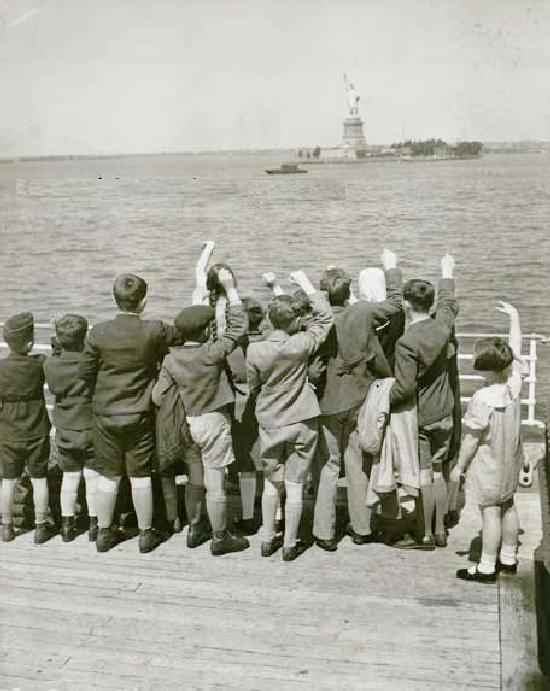
Figure 1.--These very fortunate Jewish refugee children, enroute to Philadelphia aboard the liner "President Harding", are waving at the Statue of Liberty in 1939. Mrs. Roosevelt believed passionately in assisting refugees. The problem President Roosevelt faced that he needed Congressional allies for his efforts to aid the Allies and then after the fall of France to save Britain. There was considerable Congressional opposition centered around the isolationist Republicans to aiding Britain and to rearm. Tragically there was also oppsition to raising immigration quotas to allow more refugees into America. The President's political assessment was that pushing to raise immigration quotas would threaten his efforts to aid Britain and rearm. Many of the President's important measures passed by very narrow Congressional margins.

Against thie background of war in Europe, President Roosevelt who did see the dangers from the NAZIs and Japanese militaists, with great skill and political courage managed to not only support Britain in its hour of maximum peril, but with considerable political skill managed to push through Congress measures that would lay the ground work for turning American into the Arsenal of Democracy, producing a tidal wave of equipment and supplies not only for the American military, but for our Allies as well in quantities that no one especially the AXIS believed possible. President Roosevelt saw American national interest differntly fom most Americans who determined to avoid involvement in another world war. From the onset of war in Europe, President Roosevelt set out to transform America from an isolationist neutral nation into a technically non-beligerant country waging an undeclared naval war in the North Atlantic.

Importance

President Roosevelt is generally considered one of the three greatest American presidents. There are many reasons for this, but the primary reason is his performance in the early years of Wprl;d War II before America entered the War. His leadership was especially extrodinary because he faced reelection violating the "no third term Principle set by Washington and appealing to an electorate that was against America's entry into the War. The new was afrom Europe was a steady stream of terrifying reports beginning with the NAZI Blitzkrieg in Poland (September 1939). Then the Soviets joined with the NAZIs in carving up Europe with not only its own invasion of Poland, but actions against Finland and the Baltics. Then the NAZIs invaded Denmark and Norway (April 1940). The most shocking news was the NAZI invasion of the Lowlands and the fall of France (May-June 1940). Italy joined Germany in the War (June 1940). The next minth the NAZI air assault on Britain began (July 1940). Even though this period was a steady stream od disasters, little noticed at the time was that against bitter resistance from the Isolationists and their mostly Republican allies, President Roosevely laid the foundation for eventual llied victory. Roosevelts policies included aseries of decisive actions: 1) the beginning of American rearmament, 2) The first steps toward the development of the atomic bomb, 3) the creation of a credible American army with the first peace-time draft, 4) the begininning steps toward forging an alliance with Britain, arguably the most importance alliance in history and 5) the conceptualization of Lend Lease. While the NAZI victories in Europe dominated the headlines. It was these actions by President Rodsevelt that would prove decisive in the War and key to the defeat of the dictators. Impressively these were steps that President Roosevelt was able to muster in the face of a public intent on avoiding war. No more astute use of the instruments of presidential power and leadership was ever achieved with the exception of President Lincoln.

No Black-Out of Peace in America (September 3, 1939)

Britain and France on September 3 declared war on NAZI Germany in respnse to the NAZI invasion of Poland. That evening, President Roosevelt spoke to the nation in one of his Fire Side Chats. Americans frightened by development in Europe sat around their radio after dinner to hear the familiar voice of President Roosevelt, "My fellow Americans and my friends: Tonight my single duty is to speak to the whole of America. Until four-thirty this morning I had hoped against hope that some miracle would prevent a devastating war in Europe and bring to an end the invasion of Poland by Germany." It was clear that while America would be neutral, there was no suggestion that the beligerant powers were morally equal. He expressed outrage at aggression that would become increasingly strident as the NAZI tide spread over Europe. For the time being, however, peace was the dominany theme, "Some things we do know. Most of us in the United States believe in spiritual values. Most of us, regardless of what church we belong to, believe in the spirit of the New Testament—a great teaching which opposes itself to the use of force, of armed force, of marching armies and falling bombs. The overwhelming masses of our people seek peace—peace at home, and the kind of peace in other lands which will not jeopardize our peace at home." He pointed out that, "This nation will remain a neutral nation, but I cannot ask that every American remain neutral in thought as well. Even a neutral has a right to take account of facts. Even a neutral cannot be asked to close his mind to his conscience." Secretary Hull advised the President agains this last sentence, telling him that it would make it more difficult to convince Congress repeal the Neutrality Act and give amunition to the isolationists insisting that the President was trying to drag the country into the War. [Morgan, p. 512.] The President closed with an assurance that America would not enter another european war, "I have said not once, but many times, that I have seen war and that I hate war. I say that again and again. I hope the United States will keep out of this war. I believe that it will. And I give you assurance and reassurance that every effort of your Government will be directed toward that end. As long as it remains within my power to prevent, there will be no black-out of peace in the United States."

Neutrality Proclamation (September 5, 1939)

President Roosevelt on September 5, 2 days after the British and French declaration of war, issued the neutrality proclamation required by the Neutrality Acts. He then imposed an embargp on all arms sales to beligerant powers also as required by the Nutrality Acts. The delay was an effort to allow arms to be shipped th Canada ans Allied ships laoded with arms to leave American ports. He had hoped to delay the proclamation a few more days, but complaints fro isolationosts in Congress forced his hand.

Bi-partisan Foreign Policy

The New Deal effort during the 1930s to fight the Depression required a major shift in the role of the American Federal Government and policies toward social wlfare. This and the electoral success of President Roosevelt made him the most controversial president of the 20th century. The Republicans deeply resented the President's populrity and their inability to seriously comntest elections. The President saw from the onset of war in Europe that to confront the NAZIs and Japanese militarists that he wuld have to achieve a bi-partisan foreign policy--a major challenge for a president despised by the Republicans. Without bi-partidsan support, there could be hope of revising the Neutrality Acts. Republican support would also be needed for increased appropriations for rearmament. The President moved away from the social reforms of the New Deal and Congressional Republicanns slowly moved toward the President's foreign policy.

Atomic Bomb Project (October 1939)

American work on an atomic bomb was initiated by President Roosevelt when work done by German physicists led to concern that the NAZIs might build an atomic bomb. Important scientists in 1939 concluded that German scientists had begun to develop an atomic bomb for the NAZIs. Of course the very idea of an atomic bomb was unknown to not only the general public, but even American political and militay officials. Szilard was politically astute enough to know that a group of little known foreign scientists with accents trying to convince America to spend billions of dollars on a project semingly out of Buck Rogers would have little chance of receiving a serious hearing. So Szilard had Teller drive him to see Einstein who agreed to sign a letter to President Roosevelt. Einstein had a reputaion that could not be dismissed. And Hitler's invasion of Poland had convinced the President that strong American action was neded. In this atmosphere, these scientists enduced President Roosevelt to create an "Advisory Committee on Uranium"--the precursor to the American atomic bomb project.

Declaration of Panama (October 1939)

The President on October 3, 1939, issued the Declaration of Panama establishing a 300-mile Security Zone around the Western Hemisphere (October 1939). While American public opinion was leary of steps perceived as moving toward involvement in Europe, issues of hemispheric security were preceived differently, allowing the president to take much more aggressive syeps in this area.

Revision of the Neutrality Act (November 1939)

President Roosevely when war broke out in Europe (September 1939) requested that Congress ease the arms embargo required by the Neutrality Act so that war material could be sold to the democracies (Britain and France) opposing Hitler. The debate over the repeal of the embargo provissions of the Neutrality Act was one of the most bitter since the gret debates over slavery in the 19th century. Roosevelt charged that the words of isolationists like Borah, Johnson, and Fish were being reported on the font pages of the NAZI press. Borah charged, "Our boys would follow our guns into the trenches." [Freidel, p. 323.] After the debate and arm twisting by Roosevelt, the embargo provision was repealed by a new Neutrality Act signed by the President on November 4, 1939. The Neutrality Act still had severe limitations. The Act permitted belligerents to purchase materials of war on a strictly cash and carry basis, but prohibited credit and banned American merchant ships from travelling in war zones designated by the President. Although worded neutrally, "cash and carry" at the time favored Britain and France. Their financial resources and control of the seas enabled them to buy war materials in the United States and transport them in their own ships. It was a marked a shift from isoloation to pro-Allied neutrality and extrenely dangerous politically for FDR withan election only a year away. The conditions were very strict, were to be no U.S. ships in war zone around British Isles, no loans to belligerents, no travel on belligerent ships, and no armed merchant ships. This was the best FDR could do for the Allies at the time. At least arms and munitions as well as other supplies could now be provided the Allies. Hitler hoped that the allies could be defeated before American supplies could make a difference. Here Hitler almost proved right.

Chinese Loans (1939)

A $25 million loan in 1939 allowed the beleagered Chinese Nationalists to buy American planes for the Chinese Air Force. Since the invasion of China in 1937, the Japanese had been using terror bombings of unprotected Chinese cities as a major part of their war effort.

Wells Mission (February-March 1940)

After the sucessful invasion of Poland (September 1939) the Phony war settled in on the Western Front. The Allies were not goung to invade Germany. The Germans planed and delayed their offensive several times. The Roosevelt Administration was aiding the Allies, but no one knew what the outcome of the War would be. There was a fear that America might have to learn to live with the NAZIs. President Roosevelt announced that he was sending Under-Secretary of State Sumner Wells to meet with the principal European powers (Rome, Berlin, London, and Paris) (February 9, 1940). The announced purpose was to inform the President on the situation in Europe. [NYT] The Wells mission has been the subject of considerable historical discussion. [Hilton]

Evasion of the Neutrality Act (May 1940)

The NAZIs lainched their long awaited Western Offensive on May 10 and from the onset scored impressive successes. FDR wanted to help, but was restrained by the Neutrality Act which among other provisions by flying assembled air craft to Brirain ready to fight. The sollution was to fly aircraft to the Canadian border. Push then accross the border and then fly them on to Newfoundland where they could be loaded aboard ships for the British. This was not publicized at the time. American public opinion was still strongly isolationist and most Americans were convinced that the country should stay out of the War. Thus actions like this were done at great political risk.

American Firsters

One of the charges made by FDR opponents was that the New Deal was dominated by Jews. As war approched in Europe, some charged that it was the Jews that were trying to drag America into the War. Charles Linburg delivered some especially ugly speeches.

Danger to America (May-June, 1940)

By mid-May it was increasingly clear that France was lost. By the end of the month with the Panzers closing in on the BEF, it looked like Britain may be lost as well. The French Arny anf the British Fleet had been a bulwark protecting American in connection with the American fleet. Now the French Army was desintegrating. There was the further danger that if France and Britain capitulated that the Germans could gain access to their fleets including British carriers--fleets which combined with the German surface and U-boat fleets would exceed the strength of the American fleet which also faced the Japanese in the Pacific. Here Churchill made it clear that if Britain fell, the British fleet may well fall into German hands. [Lash, p. 149.] The American army at the time consisted of a mere 80,000 trained but not well equipped men. American planners estimated that it would take the Germans about 6 months to seize and man the captured fleets. [Freidel, pp. 333-334.]

Fall of France (May-June 1940)

The sudden quick and surprising fall of France to the NAZIs in June 1940 shocked most Americans. Some wanted to support Britain, convinced that America could no longer remain neutral and allow Hitler to conquer Bratain the rest of Europe. Others like Lidburg, in awe of the mighty Luftwaffe, felt that the NAZIs had already won the War and it would be suisidal for America to challenge the Germans. President Roosevelt was convinced that Hitler and the NAZIs should not be permitted to dominate Europe, but was unsure that Britain would continue to fight.

Dunkirk (May 1940)

The surrender of the Belgian Army left the BEF seriously exposed. The British fell back on the Belgian port of Dunkirk, but the BEF was within Hitler's grasp. Then Hitler stopped the Panzers, allowing the British to evacuate their men and many French. The Panzers had been only a few klometers south of Dunkirk and facing no serious opposition. Hitler ordered the Panzers to halt. Some believe that he hoped this gesture would help convince the British to comes to terms, other believe that is was just as it was described at the time, aneeded pause to regroup and prepare for a more coordinated assault. [Davidson, p. 408 and Fest, p. 630.] What ever the reason, this 48-hour respite allowed the British to organize a defensive perimter around Dunkirk and begin an almost miraculous withdawl. The Belgians had surrendered, but the surronded French First Army continuing to fight occupying key German forces while the British evacuated. The resistance of the French First Army was critical in the success of the Dunkirk evacuation. Nearly 340,000 men were evacuated from Dunkirk, including French and Dutch sholdiers. This is even more important that it sounds as akmost all if the British sholdiers were regulars and would form the corps of the future British Army that would play such an important role in the War. All of the BEF's equipment, however, was lost. Paris soon fell and the French signed a NAZI imposed armistace.

War Cabinent (June 1940)

FDR appointed what was in essence a War Cabinent in June 1940. He appointed two Republicans, Henry L. Stimson as Secretary of War and Franklin Knox as Secretary of the Navy (June 20). With war ranging in Europe and an election coming in November, he wanted to make sure that the American defence program would be bipartisan. It was increasingly clear that America would be at some time involved in the War. The President was determined that if and when America went to war it would be on a bipartisan basis. He not only appointed Republicans to important defense posts, but he also put aside his domestic agenda and liberal reforms. (Ironically War acts such as the non-decriminatory injuction in defense jobs and the GI Bill would play an important role in achieving important New Deal liberal goals.) More frequently leaders use foreign adventures to build domestic popularity. President Roosevelt was using his emense personal popularity and staking his political future on the need to prepare a reluctant populace on the need to prepare for war.

Export Control Act (July 1940)

After the fall of France (June 1940), the question of the Europeans colonies in Southeast Asia arose. The immeduate question was the status of the Dutch and French colonies, both countries having been occupied by the NAZIs. The French in Indo-China recognized Vichy while the Dutch declared alligence to Queen Wilhimina and the Dutch Government in Exile in London. Japan decided to take advantage of the German victory by begining its expansion into Southeast Asia. The Japanese demanded that they be allowed to occupy ports in French Indo-China (Vietnam). The Vichy Government was in no position to resist and the Japanese proceeded to occupy several ports, increasing te threat to British base at Singapore. In repose the Roosevelt Administration pushed the Export Control Act through Congress. The President signed the Act (July 2). The Act gave the president authority whenever he deems "necessary in the interest of national defense," to prohibit or curtail the exportation of military equipment, munitions, tools, materials, etc. This was a act of enormous consequences. Japanese industry was dependant on the United States for many important natural resources, including scrap iron and petroleum. The President immediaely invokes his new powers against Japan by prohibiting the exportation, without license, of strategic minerals and chemicals, aircraft engines, parts, and equipment (July 5). Further steps were tken three weeks later. The President invoked the Act and prohibited exportation, without license, of aviation gasoline and certain classes of iron and steel scrap (July 26). This effectively halted the flow of these stratehic materials to Japan. The Act put the United States on a collision course with the Japanese militarists intent on extending the Japanese Empire or Asian Co-Prosperity Group as they called it. It would lead to war, but such was Roosevelt's political genius it was accepted by a public still intent on avoiding war.

Two Ocean Navy Expansion Act (July 1940)

President Roosevelt's Congressional ally, Congressman Carl Vinson, helped pudh through the the Vinson-Walsh "Two Ocean Navy Act". The President signed the Act which authorized a major increase in the U.S Navy (July 19). The U.S. Navy at the time had 358 ships in service and 130 under construction. The Act authorized the Navy to build 200 more ships including 100 destroyers needed for North Atlantic convoy duty. Also important was the construction of carriers, battleships, and crusiers. The importance of the carriers was not yet fully understood in the era before Pearl Harbor. The Act resulted in the construction of the powerful Essex Class carriers that would overwhelm the Imperial Navy when they began reaching the fleet in late 1943. The act authorized over 1.3 million tons of combat shipping as well as 0.1 million tons of auxiliary shipping. It also authorized te construction of 15,000 aircraft. The Two Ocean Navy Act expanded the Fleet 70 percent. The passage of the act was viewed with considerable concern in Japan. As a result of their larger naval construction program, the Japanese hd achieved naval superiority in the Pacific. This was an achievement that was not fully appreciated at the time even within the U.S. Navy. One of the reasons that led the Japanese to strike at Pearl Harbor was their concern that the American building program approved in 1940 would redress the balance of naval power in the Pacific.

Battle of Britain (July-September 1940)

Aid to Britain in July-August 1940 was a dangerous step for America. Churchill had demostrated at Oran by disabling the French fleet that Britain would fight (July 1940). It was still not clear, however, if Britain could hold out against the NAZI onslaught. Hitler had not yet threatened America. Angering the NAZIs if Britain was not going to survive was a very dangerous step. It was over the skies of Britain that the NAZIs suffered their first revorse of the War. The Battle of Britain is commonly viewed in military terms, but the political consequences were also critical. The Royal Air Force's victory not only meant that a German invasion was not possible, but it helped to convince President Roosevelt that Britain was a credible ally in the struggle against Hitler. The images of the Luftwaffe bombing London and Murrow's nightly broadcasts from Londo in had an incalcuable impact in changing American public opinion.

Edward R. Murrow (1939-41)

The story of American broadcast journalists un Europe before america entered the war is an important one. No single correspondent was more important than famed CBS correspondent Edward R. Murrow (1908-65). Following the Fall of France, the NAZIs launched the Battle of Britain. Americans listened to Murrow describe the horrors of the NAZI Blitz over London. He broadcast during the height of the Blitz (1940) and into 1941. Britain was alone, but Americans were listening and horrified. Murrow's calm sonorous voice described the outrage of the NAZIs bomb a great city. This only confirmed the opinions that most Americans had about Hitler and the NAZIs. Many of his broadcasts were punctuated with actual air raid sirens or even bomb explosions. CBS offices in London as well as the BBC studios Murrow used for his broadcasts were hit at least once. Murrow made one broadcast from the roof of a building during a raid so that he could provide an eye witness account to the American people. Murrow published some of these broadcasts under the title This Is London (1941). It is difficult to assess the full impact of these broacasts. It is undeniable that they increased sympathy for the British, How many Americans made the connection that a country which invaded France and bombed London would eventually attack America, I am not sure. But those who listenened to these broadcasts were more likely approve of aid to Britain and to expanded American defense spending. Churchill suspected that they would help make the British case and approved the broacasts without any war-time censorship. (Murrow at the time was involved in an affair with his daughter-in-law.) Not only did Britain resist the NAZIs, but in the Battle of Britain delivered the Luftwaffe its first defeat. Radio reports from Britain by Edward R. Murrow and his colleagues built considerable sympthy for Britain in America. This was of enormous assistance to President Roosevelt in his fight with the isolationists.

War Material

Although Britain after the fall of France (June 1940) was the only country still in the War against Germany, she was not entirely alone. Even while the bombs fell on London during the Blitz, British merchant men brought a steady flow of weapons, aircraft, munitions, material, and food to the beleagered island. Rarely a day passed wihout a ship leaving an American port for Britain and often more than one a day. FDR was insistent that such help be provided and General George C. Marshall, Army Chief of Staff, agreed that the British war effort be suported. [Gilbert, p. 328.] This was of course hardly the policy of a neutral country.

Bases for Destroyers (August 1940)

Churchill as the Panzers poured into France pleaded with President Rossevelt for assistance. One possibility was mothballed destroyers, sorely needed to protect the North Atlantic convoy routes. The U.S. Navy had "moth balled" 70 destroyers after World War I. In fact FDR as Assisstanat Secretary of the Navy had played a part in this. There were great dangers to America in providing these destroyers to Britain. Not only would it be an act only slightly short of war, but it would weaken the ability of America to rapidly expand its fleet. Even more serious was that if Britain capitualed, the destroyers might even fall into German hands. The President also faced political dangers in that the Republicans could charge him with weakening America's defenses, a serious concern in the middle of the 1940 presidential election campaign. FDR finally agreed on August 14 during the height of the Battle of Britain to provide the British badly needed destroyers for their Atlantic convoys being hard pressed by the U-boats. At this stage of the War any good news was extremely important for the British and Churchill. The executive order was issued August 27, 1940. The United States would trade 50 old Navy destroyers for 99 year leases on British sea and air bases in the Western Hemisphere (most were in the Caribbean and in Newfoundland). The approach was extremely savy politically. It sounded like an actual exchange and involved bases close to the United States. In actuality the British were more than willing to provide America bases. It was also a cold political calculation. It was still unclear as to whether Britain would survive. If there was to be a British Vichy, it would be important to have American bases on the British Atlantic and Caribbean islands. The President also allowed British pilots to train in the United States and British ships to be repaired in U.S. ports. The Flight Ferry Command and Eagle Squadron were created. These were very bold exactions taken by the President without Congressional cover in the middle of the presidential election campaign.

The Draft (September 1940)

The United States in 1940 was still largely unarmed. In particular the U.S. army except for a small professional core practically did not exist. There were still calvalry units and the force that did eist was not armed with modern weapons. The United States in 1940 despite the wars raging in Europe and Asia had an army smaller than that of several small European countries. The American army was smaller than that of Romania. At the Admistration's urging, Congress after an intensive debate, approved the first peacetime draft in American history. President Roosevelt on September 16 signed the Selective Service Act. The first draft had been during the Civil War. The draft envolved men from 21-35 years of age and involved only 1 year of training a military service. The votes in Congress were comfortable majorities as most Democrats and about half the Republicans supported it despite of the upcoming election November election. Undoubtedly the radio bradcasts and newsreel images of London burning under the NAZI Blitz were making an impression on the American people.

Anglo-American Understanding (October 1940)

The Roosevelt Administration, in great secrecy at the height of the American presidential election campaign, committed "to equip fully and maintain" ten additional British divisions (October 24). The President made this commitment at the same time that he was "not going to send American boys to fight in foreign wars, unless we are attacked". Of course equipping British units was a hostile action inviting attack. The President pledged to manufacture the weapons and equipment for these ten divisions in the United States and to provide them so that the divisions would be ready for the 1942 campaign. The Administration pledged to give priority to maintaining these divisions in the field. Arthur Purvis, the head of the British Purchasing Mission in Washington, was told by FDR that the "rule of thumb" would be to make military American supplies availaible to British forces on a 50-50 basis with U.S. forces. [Gilbert, p. 348.]

Election of 1940: The Third Term (November 1940)

The 1940 presidential election is arguably the most important election in American history. The first American President, George Washington, retired after two 4-year terms. This set a precedent that every other president had followed. FDR because of the international crisis decided to run for a third term which became a campaign issue. The national debate over neutrality and isolationism that had been raging since the mid-1930s reached its height. There were powerful spokesmen on both sides. Isolationist groups, such as the American Fist Committee, opposed any risks that could lead to war and shaply attacked the President's policies. International groups and an increasing number of average citizens demanded more active aid to Britain. His Republican opponent was a surprise choice, Wendell Willkie, a wealty busniessman who had swept the Republican primaries. Willkie did not crticise FDR's support for the democracies, by the time of the camapign only England. His nomination was an indication of the shift in public opinion toward intervention. Willkie instead pledged "all aid to the Democracies short of war". He attacked the New Deal on domestic issues, what he referred to as the socialistic policies of the Administration. Roosevelt's foreign policy was, however, an issue in the campaign. The isolationists led by the American First Committee accused FDR of trying to drag America into the war. Speaking in Boston on October 30, the President assured his audinence, "I have said this before, but I shall say it again, and again and again: Your boys are not going to be sent into any foreign wars." Usually the phrase was "foreign wars" and usually the President added, "unless we are attacked". The election was another victory for FDR, but not the landslide of previous camapigns. Still FDR carried 39 of the 48 states. The election, however, was much closer than suggested by the results. FDR saw his re-election as strong pupblic support for a program of military preparedness and aid to Britain.

Arms Allocations (November 1940)

FDR on November 7 allocated half of the expanding American arms productin to beleagered Britain.

Harry Hopkins

The Battle of Britain made a German cross-Channel invasion impossible in 1940. The huge German Army, however, dominatd Europe. The Royal Navy was hard-pressed in the Atlantic. It was unclear at the end of 1940 if the British were prepared to continue the fight. Roosevelt had to know just how determined Britain was. The American Army was still not equipped with modern arms. Should America provide the still limited production of Armaments to Britain before its own military was equipped. Many around Roosevelt, including Harry Hopkins, were unsur how closely Roosevelt should tie American defense to Britain. Roosevelt dispatched Harry Hopkins to assess whether Britain's determination and situation. Churchill did not fully understand just who Hopkins was. Churchill knew that he was close to Roosevelt and informed of Hopkin's WPA work thought him a social worker and began giving him statistics about bathrooms and electrity in British slums. Hopkin's interupted him. ""Mr Churchill, I don't give a damn about your cottagers. I've come over here to find out how we can help you beat this fellow Hitler." Of course nothing could have pleased Churchill more. Churchill rose and said, "Mr Hopkins, come with me," and the two disappeared into Churchill's study. Churchill proceeeded to escort Hopkins all over the United Kingdom, from Scappa Flow in Scotland to the beach defenses in Kent. They spent time together at Chequers. Churchill completely converted him to the British cause. No onereally knew what Hopkins would say in private to Rossevelt when he returned to Washington. At a small dinner party before he returned, Hopkins rose to propose a toast. "I suppose you wish to know what I am going to say to President Roosevelt on my return. Well I am going to quote to you oneverse from the Book of Books. ... "Whither thou goest, I will go and where thou lodgest I will lodge, thy people shall be by peple, and thy God my God." Hopkins then added in at the ending, "Even to the end." Tears were streaming down Churchill's face. [Goodwin, pp. 213-213 and Meacham] Hopkins would become the aministrator of Lend Lease as well as serve many vital diplomatic missions, especially as a go-between for the President with both Churchill and Stalin.

Arsenal of Democracy (December 29, 1940)

President Roosevelt first used the term "Arsenal of Denocracy" on December 29, 1940 in a radio broadcast to the American people. Her expalined the importance of supplying the people of Europe, at the time primarily Britain with the "implements of war". He said that the United States "must be the great arsenal of democracy". The very day he spoke, a Luftwaffe raid on London severly damaged famous buildings and churches in the city center and engulfed St. Paul's Cathedral in flames. [Gilbert, p. 356.] Hitler feared America more than any other country, but was convinced that Britain could be defeated before America could be mobilized or American industry could be effevtiverly harnassed for the war effort. Neither the NAZIs or the Japanese had any idea just how effectibely American production could be converted to war production. Air Marshall Göring sneared, "The Americans only know how to make razor blades." Four years later with the Luftwaffe in tatters, Göring said he knew that the War was lost when American P-51 Mustangs first appeared over Berlin escoring waves of bombers. The record of American war production is staggering and in large measure determined the outcome of the War.

Lend Lease

Britain to the surprise of many fought off the Luftwaffe in the Battle of Britain and stopped a huge Italian army attempting to invade Egypt. The Royal Navy, however, was hard-pressed by the German U-boats in the North Atlantic. A critical point was reached by Britain by the end iof the year. It had exhausted its foreign reserves and no longer had the reserves to buy arms and war material. Churchill wrote to Roosevelt informing him of this (December 1940). Roosevelt was vacatioining in the Caribbean after his electoral victory. It was at this time that the President (and not his staff) conceived of Lend Lease. President Roosevelt first proposed Lend Lease at a press conference (December 17). It was a step he had been considering for some time. Polls showed that by December, 1940, public opinion had shifted significantly. An estimated 60 percent of the American people had come to favor aid to Britain even if it meant war. Britain was in fact in dire straits. It was rapidly depelting its gold reserves and ability to pay cash for war supplies. FDR thus saw the need to in effect "rent" war material to the British. The concept was pure Roosevelt. It sounded like a fair exchange, a loan which America would eventually get back. While to an American public still warry of war it sounded less like participating in war than selling arms. It was, however, a term perfectly suited for the time. Of course it was pure fiction. How could tanks, planes, trucks, bullets, food and other materials used in war be returned. Most would be destroyed or damaged and what good would they be after the War any way? Items like bullets and food would simply be used up.

Sources

Davidson, Eugene. The Unmaking of Adolf Hitler (Univesity of Missouri: Columbia, 1996), 519p.

Fest, Joachim C. Hitler (Vintage Books: New York, 1974), 844p.

Freidel, Frank. Franklin D. Roosevelt: Rendezuous with Destiny (Little Brown: Boston, 1990), 710p.

Gilbert, Martin. A History of the Twentieth Century Vol. 2 1933-54 (William Morrow and Company, Inc.: New York, 1998), 1050p.

Goodwin, Doris Kearns. No Ordinary Time: Frranklin and Eleanor Roosevelt: The Home Front in World War II (Simon & Schuster: New York, 1994), 759p.

Hilton, Stanley E. "The Welles Mission to Europe, February-March 1940: Illusion or Realism?" The Journal of American History, Vol. 58, No. 1 (June, 1971), pp. 93-120.

Hornberger, Jacob G. "Repatriation: The Dark Side of World War II, Part 1" Freedom Daily (February 1995).

Lash, Joseph P. Roosevelt and Churchill, 1939-1941. (1976).

Meacham, Jon. Franklin and Winston (Random House, 2003).

Morgan, Ted. FDR: A Biography (Simon & Schuster: New York, 1985), 830p.

Murrow, Edward R. This Is London (1941).

New York Times (February 10, 1940).


HBC


Navigate the Boys' Historical Clothing Web Site:
[Return to Main World War II American isolation page]
[Return to Main World War II page]
[Introduction] [Activities] [Biographies] [Chronology] [Clothing styles] [Countries]
[Bibliographies] [Contributions] [FAQs] [Glossaries] [Images] [Links] [Registration] [Tools]
[Boys' Clothing Home]


Created: January 1, 2003
Last updated: 3:54 AM 3/16/2009