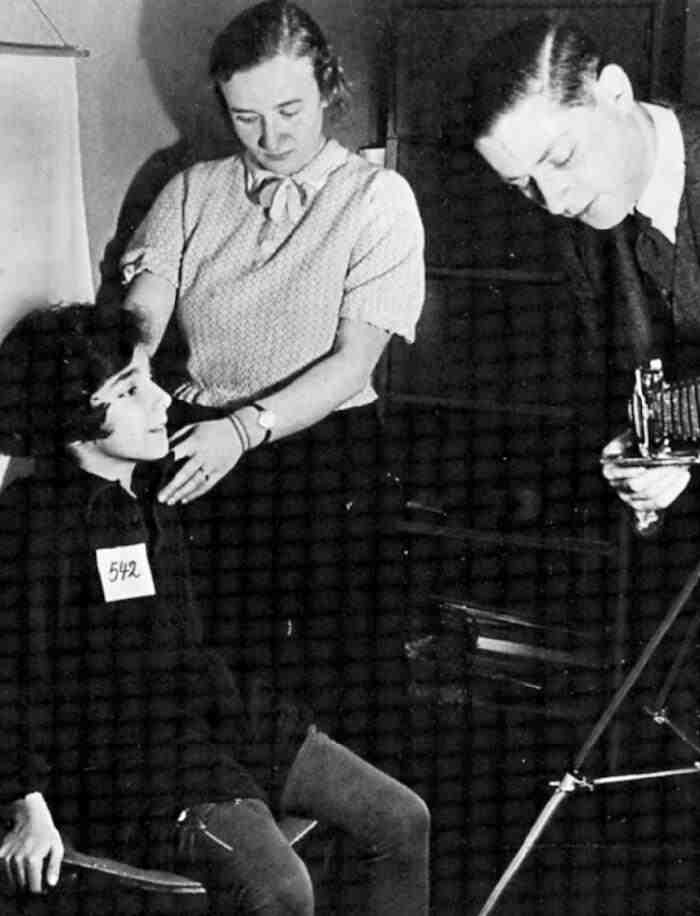
Figure 1.--After the passage of the Nuremberg Laws it was important to classify people. Germans got Bescheinigung with information about their ancestry. To get important jobs you needed proof of Aryan parentage going back centuries. Jews were identified and classified. There were different levels, full Jews and Mixed Mischlinge First and Second class. I do not at this time know the detsails of the classification and regustration process. This Jewish child is being photographed as part of that process. The photograph was taken in Cologne during 1938, perhaps after Kristallnacht.
Geman Führer Adolf Hitler at the Nuremberg Party Congress on September 15, 1935 announced three new laws that were to be cornerstones of German racist policies and the supression of Jews and other non-Aryans. These decrees became known as the Nuremberg Laws. They were decrees which in NAZI Germany had the force of law
forbidding contacts between Aryan Germans and Jews, espcecially marriage and srtipping Jewsof German citizenship. The first 1935 decree established the swastika as the official emblem of the German state. The second established special conditions for German citizenship that excluded all Jews. The third titled "The Law for the Protection of German Blood and German Honor" prohibited marrige between German citizens and Jews. Marriages violating this law were voided and extra-marital relations prohibited. Jews were prohibuted from hiring female Germans under 45 years of age. Jews were also prohibuted from flying the national flag. The first three Nuremberg Laws were subsequently supplemented with 13 further decrees, the last issued as late as 1943, as the NAZIs constantly refined the supression of non-Aryans. These laws affected millions of Germans, the exact number depending n precisely how a Jew was defined. That definition was published November 14, 1935. The NAZIs defined a Jew as anyone who either 1) had three or four racially full Jewish grandparents, 2) belonged to a Jewish religious community or joined one after September 15 when the Nuremberg Laws came into force. Also regarded as Jews was anyone married to a Jew or the children of Jewish parents. This included illegtimate children of even the non-Jewish partner. There appears to have been no serious public objection to these laws. [Davidson, p. 161.]
Violent Outbreaks (1935)
Violent attacks on Jews continued in 1935 despite all the actiions that had been taken against Jews. Hitler had suppressed the SA leadership in the Night of the Long Knives (1934). But the 3 million man membership was untouched and they were demanding more actions, often taking matters in their own hands and openly attacking Jews on the street. Many believed that Hitkler and the NAZI ladership was abandoning their pledge to totallt eliminate Jews from German society. A Gestapo report reported an unstable situatiion, warning that the rank and file of the NAZI Party would set in motion a solution to the "Jewish problem ... from below that the government would then have to follow" (1935). [Kershaw, p. 340.] The NAZI Government had tamped down sporadic attacks and vandalism as well as boycotts (1934). The Government intensified the propaganda camapign campaign against Jews. We are not sure what the purpose of this was, perhaps to draw attention away from Hitler's military moves such as conscriotion and announcing the existence oof the Luftwaffe. There was still a considerabke body of opinion in Germany fearing another war. And of course the propaganda campaign resulted in an uosurge of violence. the violence came primarily from the SA and other Party nmembers, but even among the general pooopukation there was a widespread belief thatthe Jews role in German life should be curbed. Certainly not support for murder or lesser forms of violence. Some of this was long running anti-Semitism, but Gobbels' propaganda machinme must have bad some impact. One historian maintains
there was a difference between the beliefs of the Alte Kämpfer (longtime party members) and the German public. He writes, however, that even people who were not politically active suppoprted more and tougher anti-Semitic laws. [Kulka] The risiung viloence brought the Jewish issue to the attenbtion of Hitler and other NAZI officials.
Drafting the Laws
NAZI officials began preparing legislation. Am initial limited focus gradually intensified. Interior Minister Wilhelm Frick announced that he was preparing a law forbidding marriages between Jews and non-Jews (July 25, 1935). He vmnade the announcement to alert registrars that they should avoid issuing licences for marriages between Jews and non-Jews. Frick's draft law also prohibnited persons with hereditary illnesses from marrying. [Longerich, pp. 57-58.] Dr. Hjalmar Schacht, the Economics Minister and Reichsbank president spoke out against the violence of SA and other NAZIs for practical reasons. He felt it was harming the economy. [Kershaw, p. 342.] Defending the Jews would have cost him his job, but Hitler was willing to consider harm to the econmy. Schacht would eventually go too far when he resisted further defecit spending for the miitary. Hitler wold allow no limits on miklitary spending.
The violence was also harming Germany's international reputation. [Gordon, p. 122.] Now this would not be a major concern for Hitler, but at times he was a very astute politican. He was taking steps in 1935 to repufiate the Versailles Treaty. Thus he mnay have calculated that it was not helpful for Germany to be seen as lawlessa and brutal. As a result he irdered that 'individual actions' against Jews be stopped (August 8). And to make sure they did stopo, rick threatened legal action. [Kershaw, p. 342.] Hitler decided that it was time to appease the radical NAZI elements determined to totally eject Jews from German society and have no reservations about using violence. [Gordon, p. 122.]
A conference of ministers was convened (August 20). Hitler at the time rejected violent mneans, agrreing with Schacht that it would harm the economy. He wanted coimprehensive legislation that would permanently settle thev issue. [Kershaw, p. 343.] The terms of the legialtion to be enacted thatb came out of the conference was: 1) marriage laws to prevent 'racial defilement', 20 stripping Jews of their German citizenship, and 3) laws to prevent Jews from participating in the economy. [Longerich, p. 59.]
The seventh annual Nazi Party Rally was held in Nuremberg (September 10-16, 1935) Hitler decided that the rally would be an nexcellent occassion to announce the much anticipated anti-Jewish laws. [Evans, p. 543.] At the Rally, leading Nazi physician Gerhard Wagner ammoubced that the Government would soon introduce a "law for the protection of German blood" (September 12). Kershaw, p.44.}
Hitler the following day summoned the Reichstag for annunprecdented sessioin outside of Berlin.
Itbwas here that the final touches were put on the new laws.
Geman Führer Adolf Hitler commonly used the annual Nuremberg NAZI Party Rallies (Reichsparteitag) to make important announcements. The Party Rallies are sometimes call conventions or congresses, but this seems a misnomer as the assembled party members did not debate policy, but were there to hear what the leadership told them about Party policy which in 1933 becanme givernment policy. The 1935 Party Congress was particularly important. Hitler had already taken major steps earlier in the year. after making Germany's secret armament program public and reinstituting conscription (a major violation of the Versailles Treaty).
The 1935 Party Rally was called the Rally for Freedom (Reichsparteitag der Freiheit). Here 'Freedom' refered to the reintroduced of conscription (compulsory military service) and German 'liberation' from the restrictions of the Treaty of Versailles. Hitler also used the Rally to put the new Wehrmacht on display to the public. He also announced three new laws (September 15). Leni Riefenstahl used the occassion to shot one of her films at the rally, "Tag der Freiheit: Unsere Wehrmacht". Hitler then announced thrre new laws which he decreeded. The first was the Flag Law which replaced the Weimar red, black, and yellow banner with the red flag containing a white circle and black swastica device. Hitler also announced two other new laws that were to be the cornerstones of German racist policies that came to define the Third Reich and layed the legal foundation for the supression of Jews and other non-Aryans . These decrees became known as the Nuremberg Race Laws. Such decrees in NAZI Germany had the force of law.
The Nuremberg Laws
The Laws announced by Hitler stripped Jews of their citizenship. They also prohibited marriage and sexual relations between Germans and Jews. The Nuremberg Laws redefined German citizenship and established legal program for "the Protection of German Blood and German Honor". Depriving Jews of citizenship at a single stroke, deprived them of a range of civil rights. The Laws prohibitied many basic contacts between Aryan Germans and Jews, espcecially marriage. They stripped Jews of German citizenship and which enabled the NAZIs to use the laws and judicial system to supress the countries Jews. There were three different laws. The subsequent laws and regulations directed at Jews would use the Nuremberg Law as their legal foundation. [Gilbert, pp. 79-80.]
First Decree: Flag Law
The first 1935 decree established the swastika as the official emblem of the German state. This included the official change of the national flsg from the Weimar republican tricolor to the swastical banner. Jews were forbidden to display it. Such displys of citizenship were for "a national of Germany or kindred blood".
Second Decreee: Reich Citizenship Law
The second law, the Reich Citizenship Law, established special conditions for German citizenship that emphazized race. Jews were specifically excluded as being "not of German blood". Jews were thus stripped of their German citzenship. This effectively denied them a range of civil rights, including the right to vote. This essentially formalized unofficial and local measures already taken against Jews, giving them the full force of law and the German state. Hitler made a point of stressing the consistency of this legislation with the Party programme, which demanded that Jews should be deprived of their citizenship rights. The Nuremburhg Laws would serve as the legal basis for expelling the remaining Jewsish children from the public schools.
Third Decree: German Blood and Honor
The third decree titled "The Law for the Protection of German Blood and German Honor" was another major step in formalizing NAZI racial policies. The Law prohibited marrige (Staatsangehörige) between German citizens and Jews. Marriages violating this law were voided and extra-marital relations prohibited. Marriages abroad were not recognized. Stragely, one provision concerned existing marriages, "Proceedings for annulment may be initiated only by the Public Prosecutor." Jews were prohibuted from hiring female Germans under 45 years of age, although implementation of this provision wasdelasyed a few months. . Jews were also prohibuted from flying the national flag, but could display the 'Jewish colors'. Violations of the provisions would result in fines, inprisonment, and/or hard labor.
The Reichstag
Since the Reichstag Fire (March 1933), the German Parliament no longer had a permanent seat. It normally met in the Kroll Opera House (Krolloper). For the 1935 Party Rally it met in Nuremberg (September 15). Hitler anniounced the three new laws which as a result are known as the Nuremberg Laws. Hitler introducing the laws and their alleged motivation before they were actually read and proposed for adoption by Hermann Göring in his position as the President of the Reichstag. Hitler explained, " .... Bitter complaints have come in from countless places citing the provocative behavior of Jews .... a certain amount of [conspiratorial] planning was involved....[To prevent] vigorous defensive action by the [Aryan] people, we have no choice but to contain the problem through legislative measures....it may be possible, through a definitive secular solution, to create a basis on which the German people can have a tolerable relationship with the Jews. ... This law is an attempt to find a legislative solution....if this attempts fails, it will be necessary to transfer [the Jewish problem] ... to the National Socialist Party for a final solution by law (endgültige Lösung)." Of course the term 'final sollution' would be a term used extensively by NAZIS after the outbreak of World War II.
The measures submitted by Hitler were unanimously adopted by the Reichstag. Notably during the 12 years of the Third Reich, the Nazi rule, the Reichstag only passed four laws, the Nuremberg laws were two of them. [We are not entirely sure about the Flag Law.]
Further decrees
The first three Nuremberg Laws were subsequently supplemented with 13 further decrees, the last issued as late as 1943, as the NAZIs constantly refined the supression of non-Aryans. The laws were also the basis for a steady string of regulations which made it more and more difficult for Jews to live in Germany. Laws aimed at Jews began soon after Hitler seized power (1933). One of the first was the Law for the Restoration of the Professional Civil Service which banned "non-Aryans" from the civil-service. There was aroblem though. There was no clear legal method of defining precisely who was Jewish. As a result, a number of Jews were to evade the full force of the new laws. This included people of mixed race as well as Jews who had converted to Christianity. Thus for the NAZIs to target those they wanted to (individuals of Jewish ancestry), laws were needed identifying just who was Jewish. The Nuremberg Laws were an important step, but definitions were needed. These laws affected millions of Germans, the exact number depending precisely how a Jew was defined. That definition was not specified in the Nuremberg laws, but was defined shortly after in a separate decree (November 14, 1935). The NAZIs defined a Jew as anyone who either 1) had three or four racially full Jewish grandparents, 2) belonged to a Jewish religious community or joined one after September 15 when the Nuremberg Laws came into force. Also regarded as Jews was anyone married to a Jew or the children of Jewish parents. This included illegtimate children of even the non-Jewish partner.
A wide range of restrictiions followed. Jews eventually had to use separate seats in buses and parks which were painted yellow. Eventually they were excluded from public parks altogether.
Eventually beginning in early 1939 Jews were tottaly prohibited from from owning businesses and eventually both children and adults required to wear a yellow Star of David on their clothing so they could be easily identified (1942).
Impact
The Nuremberg Laws are perhaps most remembered for their racial provisions. For many Jews it was the legal change in their status that had the greatest impact. Jews employed by the Governmebnt and prominent institutions had been dismissed by 1935. The Nuremberg Laws provided the legal basis for the NAZIs to take the next fundamebntal step against the Jews, confiscating their property. After the Nuremberg Laws were promulgated, a steady series of regulations were enacted to make it impossible for Jews to make a living in Germany and to confiscate their business and other assetts which they had acquired through a process of Aryanization.
Public Reaction
Germany
There appears to have been no serious public objection to these laws within Germany. [Davidson, p. 161.] Of course NAZI domination of the new media meant that there was no public debate and discussion.
Other countries
There was extensive criticism of the NAZI laws in America, England, France, and several other countries. In America the reaction was somewhat regional in nature. The reaction was tempered by the fact that Southern states maintainted a segrefation system which was ominously similar to the Nuremberg Race Laws.
Sources
Davidson, Eugene. The Unmaking of Adolf Hitler (Univesity of Missouri: Columbia, 1996), 519p.
Evans, Richard J. (2005). The Third Reich in Power. (New York: Penguin, 2005). .
Gilbert, Martin. A History of the Twentieth Century Vol. 2 1933-54 (William Morrow and Company, Inc.: New York, 1998), 1050p.
Gordon, Sarah. Hitler, Germans, and the 'Jewish Question. (Princeton, NJ: Princeton University Press, 1984).
Kershaw, Ian. Hitler: A Biography (New York: W. W. Norton & Company, 2008).
Kulka, Otto Dov.
Longerich, Peter. Holocaust: The Nazi Persecution and Murder of the Jews (Oxford; New York: Oxford University Press. 2010)..