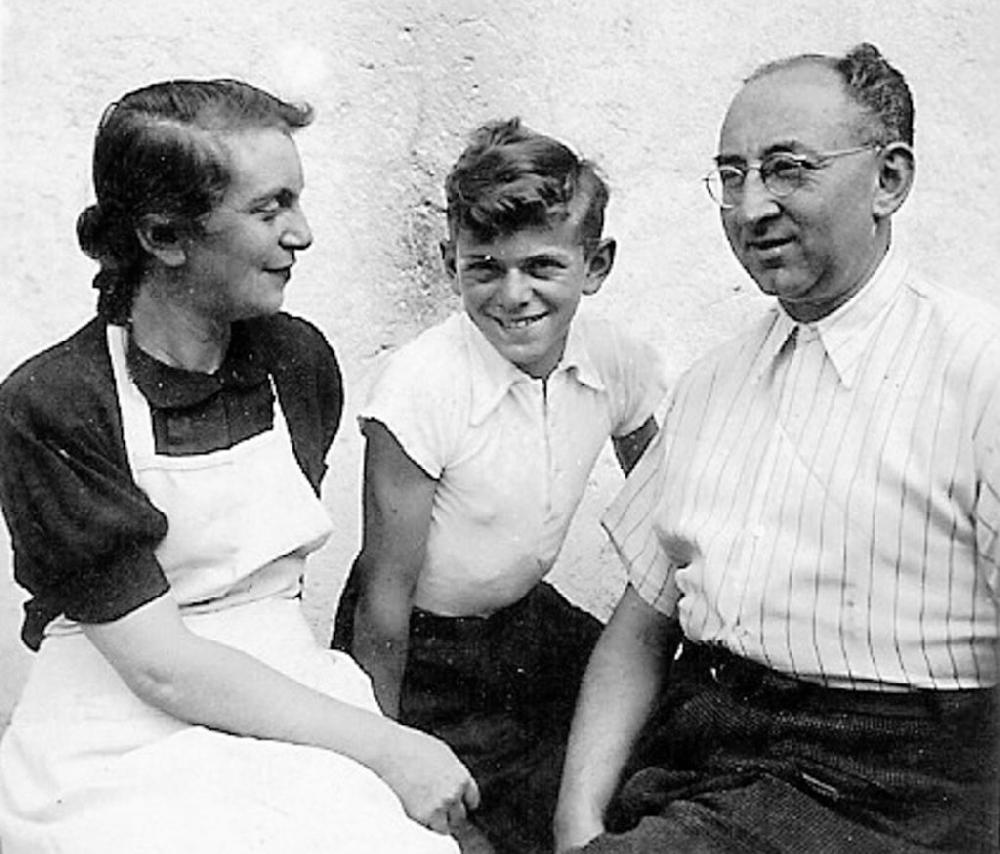
Figure 1.--This is a photo of Harry Arlin, with his parents, Emily and Leo Armstein. They were interned by the Italians in the Ferramonti di Tarsia concentration camp for several years. Conditions were tough, but not genocidal. Arlin explains, 'If the Italians hadn't taken us to their camp, we would have been sent to the German�s camp, and we would have been killed.'
Mussolini was not strongly committed to anti-semitism. Mussolini only imposed the first anti-Jewish regulations in 1938, after prompting from Hitler. Italy had a relatively small Jewish popularion of only about 45,000 people. The Italian people and Catholic clergy, however, managed to hide most of their Jews fron the NAZIs and Fascists. Italian Jews were thus spared the full force of the Holocaust and many managed to survive. The worst time came after Mussolinin was deposed and Italy surrenderedc to the Allies. The Germans quickly disarmed the Italian Army and occupied the country. They used the opportunity to begin rounding up and transporting Jews to the death camps. The Germans only managed to deport and kill about 15 percent of Italy's Jews, the lowest ratio in among occupied countries. This is especially surprising given the fact that Italy was an Axis partner. The lack of commitment on the aprt of Mussolini to genocide and the realtively short paeriod of German occupation are factors in the survival of Italian Jews. Considerable controvery surrounds the role of Pope Pious XII. Despite considerable anti-semitism among Catholic clerics, the clergy played a major role in saving Italian Jews. Ilalian priests, nuns, and monks hid Jews in monasteries, convents, schools, and churches. Jewish families were sheltered and fed at great risk to the individuals involved. One historain describes "massive support" on the part of the clergy often without orders from their superiors for the rescue effort.
Judiasm has a long history in Italy, a history which predates Christinity. Italy was the first European country where Jews appeared, more than 20 years before the birth of Christ. More Jews were brought as prisioners after te suppression of the Jewish Revolt. Jews were driven from Palestine and were spread throughout the Roman Empire in the Disaspora. After the fall of Rome, Europe splintered into many different political units. Jewish communitites florished in Western Chrisendom, but gradually anti-Semtism developed, especially when the papacy set the crusades in motion. The Papacy reeling under the rising force of the Protestant Reformation was increasingly less willing to accept any form of tolleration. Pope Paul IV issued a Papal Bull requiring that Jews in the Papal States (Rome and central Italy) be confined to ghettos (1555). Restrictions on Italian Jews continued in Italy, especially in the Papal States. The situiation for Jews did not change until the French Revolution and the appearance of Frebch armies undwr MNapoleon in Italy. Napoleon op[ened the ghettoes. Napolean granted Jews civil and commercial rights. An exception was the Jews in the Papal State and Tuscany. After Napoleons defeat, however, the civil and commericial rights were once more stripped away and the ghettoes reestablished. Garabaldi and the House of Savoy began the unification of Italy (1848). Under the new Italian Kingdom granted full commercial and civil rights to the Jews. Unification was completed (1861) and Italy was ruled by a constitutional democracy with parlimentary system. It was no longer necessary for Jews to disguise their religion. Freed from the ghetto, unification began a process of assimilation. Roman Jews, freed of papal restrictions, built the Great synagogue overlooking the Tiber (1904).
Benito Mussolini
Mussolini was not strongly committed to anti-semitism. He was not a believer in biological racism, although eventually acceeded to Hitler's strong feelings. He was a firm believer in national traits and was known to make generalizations, not only about Jews but natioinal groups. Mussolini was not, however, committed to murder. He considered Italian Jews to be Italians. Thus anti-semoitism was not part of the Fascist system until Hitler badgered him into it just before the War. He finally introduced anti-Jewish laws (1938). The Fascists in Italy did not kill many Jews. They did after the Germans seized power (1943) help round up Jews for deportatioin to the Death Camps.
Italian Fascism
Mussolini and the Fascists seized power in Italy. The Fascists were not initially ravidly anti-Simetic. Mussollini in fact had Jewish supporters. This Gradually changed. The Fascists enacted the Falco Laws which abrogated article 8 of the Italian constitution guaranteeing religious freedom. Mussolini coming under increasing NAZI influence issued the Manifesto of Italian Racism and declared the Italians to be part of a "pure race" (1938). The Jews were excluded from the pure Italian race. The Fascists proceeded to expell Jews from all public services, including government posts, the army and public schools. Italian Jews began leaving Italy, but as with Jews fleeing the NAZIS, it was hard to find countries to accept them.
The 20th Century has seen the rise of two basic types of boys uniformed youth groups. The Scouts have been the most important. Totalitarian political movements in the 1920s, however, sought to cretate their own scout-like groups that they could use to indoctrinate virtually all young Italians in the principles of Fascism. When fascist and communist parties seized power, they often forced competing youth groups like the Scouts to close.
Italian Anti-Semitism
As Mussolini moved closer to Hitler, anti-Semitism began to become more pronounced and pursued with official sanction. The Italian daily and weekly press controlled by the Fascist regime began to attack Jews with anti-Semitic epitats, referring to them by all-to-familar names loke "Porco Giuda" (Judah the Pig), "Ebreo Lurido" (Dirty Jew), and "Ebreaccio" (Jewboy). While the German alliance is widely believed to be the primary factor in the shift in Fascist racial policies. It was not the only policy. Italy has a long history od ant-Semitism, although by the early-20th century it had significantly declined. The Italian Government had emancipated Jews and they had full civil riights. Especially significant was that anti-Semitism no longer sanction by the Church. There were, however, fervent anti-Semites and this included a section of the Fascist Party. The most notorious was Giovanni, the de-frocked priest and jiournalist who pushed Mussolini to act against the Jews. Here there were individuals who werefervent anti-Semites as well as those who saw it as a necessary acpart of the Alliance with Hitler and the NAZIs.
Racial Census (August 1938)
\
Before issuing the race laws that Hitler was demanding, Italy's Fascist Governent conducted a racial census.
It reported some 58,400 people of Jewish descent in Italy. This incuded som 10,400 foreigners. The totl was less than 70,000. Al told it was a tiny portion of Italy's population 43 million--less than 0.2 percent. An even smaller number deckared theu rekuguin to be Jewish--46,000 including foreigners. The number of practicing Jews refdlect the number of
Jews who had converted. In MAZI terms prctiing Chrisdtins of Jewish ncestry were classified as Jews. Otalian Jews
mostly lived in northern and central Italy which would have fiec comsequences for life and death. The largest communities were in Rome, Venice, Trieste, Florence, Ferrara, and Turin. The Italian Jewish population was mostlyh traditional and secular. Intermarriage with Christiansd by this time was increasingly common. One in three Italian Jews had married Christians. [Sarfatti 2006, 27).
Mussolini only imposed the first anti-Jewish regulations in 1938, after prompting from Hitler. Until this time there had been no actioms taken agaist Italian Jews and Mussolini even counted some Jews among his supoorters.
Mussolini had indicated on severl occassions that a small group of Italian Jews had lived in Italy 'since the days of the Kings of Rome' (rex Romae)) and should 'remain undisturbed'. [Hollander] Mussolini with surprised most Italians by issuing The Manifesto of Race (Manifesto della razza) (July 1938). The document is also referred to as the Charter of Race or Racial Manifesto. It declared the Italians to be descendants of the Aryan race. It targeted races seen as inferior. The Jews were the most obvious targets, but Africans were also targetted. (i.e. not of Aryan descent). In particular, Jews were banned from many professions and could have their property confiscated. Under racial laws, were abolished, Jews were banned from positions in banking, government, and education, and their properties were confiscated[clarification needed]. These laws also targeted African races. The Manifesto set the stage for set of laws stripping Jews of Italian citizenship and taking a long list of legal, social, and economic actions against them. The Manuifesto and subdequent laws are viewed by historians as increasing influence pf NAZI Führer Adolf Hitler over Mussolini and the beginning of Italy's status as junior partner even before the stunning German military victories. The new Fascist Racial Laws included the following provisions, among many others. Jews were expelled from high schools and institutes of higher education, but not primary schools. The difference is unexplained, but presumably reflects a reluctance to take actions against small children. Jews were dismissed from government offices, banks and municipal councils. They were also excluded from many professions (medical, legal, and education). Marriages between Italians and Jews were kegally annuled. properties were subject to confiscation. Commercial joint ventures between Jews and Christian Italian were dissolved. Jewish soldiers and sailors were demoted. Official documents carried by Jewscwere sta,ped with 'Jew' to ensure that they could be easily identified. Foreign Jews from living in Italy and the colonies (including the Aegean Islands) were expelled.
To further ingratiate himself to Hitler, Mussolini subsequently issued a decree banning all Jews from public schools, including the younger primary children.
Italian Jewish Community
Italy had a relatively small Jewish popularion of only about 45,000 people. The Italian people and Catholic clergy, however, managed to hide most of their Jews fron the NAZIs and Fascists. Italian Jews were thus spared the full force of the Holocaust and many managed to survive. There was also the large islands of Sicily and Sardinia. This varied rgional on the Italian Peninsula, in part depending pn how long the Germamd were in control. There also were various colonies and Italian occupied areas, especially the Balkans. The Italians also controlled the island of Rhodes and Corfu.
The Tripartite Pact was signed September 27, 1940. The agreement allied Germany and Italy (which were at war with Britain) and Japan (which was at war with China). Germany and Italy has since 1939-40 been at war with Britain. Japan since 1937 had been at war with China. The alliance did not require the partners to join these wars, but it did require them to come to each other's aid if attacked. The alliance became known as the Berlin-Rome-Tokyo Axis alliance, or commonly the Axis. The three Axis partners German hegemony over most of urope; Italian hegemony in the Mediterranean, and Japanese hegemony in East Asia. After the Axis agreement was signed, several German allies joined the Axis, notably Vichy France and Fascist Spain refused to do so. Japan had no Asian allies, except or the puppet state of Manchukuo.
Once it was clear that the NAZIs had smashed the French Army, Mussolini joined the war his Axis partner and declared war on France and Britain. Mussolini was dazzeled by the military success of the NAZIs and joined Hitler in 1940 with an invasion of France, only after France had been essentially destroyed by the Wehrmacht. The Italian people turned on Mussolini as the illconceived War turned against the Italians and their German allies. The Italian Fascit were certainly not the friends of Jews, but the
Holocaust in Italy was forced on Italy only after the NAZIs occupied Italy in late 1943 and Mussolini became a pawn of the NAZIs in late 1943 of the NAZIs.
Fascist Actions Against the Jews (1940-43)
Mussollini ordered his Fascists to ransack the Jewish sections of Italian cities. Gradually many Jews were arrested and interned. The one thing Mussollini refused to authorize was deportations to the NAZI death camps in Poland. Even though the NAZIs increasingly demanded that the Italiand begin to deport their Jews.
Himmler Visit to Rome (October 1942)
SS Commander Heinrich Himmler visited Rome and met with Mussolini (October 11)--just before the Axis position in North Africa was undermined by El Alemaine and Torch. Himmler as head of German police, wanted Mussolini to aggree to join the German and Italian police forces. He also briefed Mussolini on the Holocaust, in part because he wanted Mussolini to agree to deport the Polish, Czech, and Yugoslav Jews in Italy to Germany. He also apparently raised the question of Jews in Italian-occupied Croatia. [Zuccotti, p. 117.] Prescisely what was said at the meeting is unknown. The most detailed account are Himmler's notes. Himmler invented an elaborate story about the Jews. He inssted that Jews were involved with sabotage, spying, and the resistance. Not only men were involved,but also women and children. As a result, Himmler explained that they were being "removed" from the Reich, the General Government of Poland, and other occupied territories. Himmler asserts that Mussolini agreed that this was the only possible solution. Himmler described confining Jews into concentration camps and used for road construction on the Eastern Front. He said that mortalities were high, because Jews were not used to mannual labor. He also told Mussolini that elderly Jews were csred for in old age homes as well as the special ghetto at Theresienstadt. He even claimed that other Jews were being pushed through the fighting lines to the East and the Soviets were shooting them. [Himmler] Himmler did not comment on Mussolini's response. This suggests that he did not get Mussolini's support for his suggestions. Otherwise he would have crowed about his diplomatic success. It is unclear how much Mussolini knew about the Holocaust. He must have known that the Germans were killing Jews. Italian military units were fighting on the Eastern Front and involved with occupation duties in both Greece and Yugoslavia. Some reports must have reached Mussolini. He may not have known the full extent of the killing or he may not have cared a reat deal. One historian suggests that Mussolini did not challenge Himmler because he had no desire to create an unpleasant scene. [Michaelis, p. 334.] One report suggests that Mussolini after discussing the matter with his own police chief, declined to go along with Himmler's suggestions. [Briones]
Italian Jews in France
Himmler attempted to use the Foreign Ministry to deport Italian Jews and other foreign Jews from the Italian-occupied zone of France (January 1943). [Michaelis, p. 335.]
Italian Surrender (1943)
The worst time for Italy's Jews came after Mussolinin was deposed and Italy surrendered to the Allies. The fall of Sicily came as a great shock to the Italians. The Facists believed that Italian troops would fight more vigorously defendeding Sicily (Italian territory) than they had in the North African campaign. They did not. The War had clearly been a dissaster for Italy. Entering the War had been Mussolini's decessions. Fascist officials hope to place the blame for the War on Mussolini. The Fascist Grand Council arrested Mussolini (July 1943). Marshal Badoglio headed a care taker government. He publically affirmed Italy's commitment to the Axis and the War. Secretly he began secret negotiations with the Allies. Hitler was not fooled and ordered German troops to move into Italy. Finally the Allies announced the Italian surrender and launched an invasion (September 1943). The Americans landed at Salerno near Naples and the British further souTH.
The Germans used the period between the arrest of Mussolini (July 1943) and the Allied invasion (September 1943 to move powerful forces into Italy. Hitler put Field Marshal Alber Kesselring
in charge of German forces. Kesselring correctly reasoned that the Allies would land in the south because central and northern Italy would be outside the frange of Allied airpower. Kesselring proved to be an extremely competent commander and the German forces under him were well equipped and trained units. They fought tenaciously. The Allies decided to shift powerful forces to Britain to support the more important D-Day landings. Thus the Allies entered the Italian campaign with less force than they had deployed in North Africa. They also transferred some of their most capable commanders. The compbination of these factors and the Italian geography meant that the push north would take more time and prove more costly than anticipated.
German Occupation (1943-45)
The Fscist Grand Council after theAllies ijvaded Siculy ordered the arrest of Mussolini (July 1943). The Allies began the invasion of Italy (September 3). Shortly after, Marshal Pietro Badoglio signed an armistice with the Allies (September 8). The Italian Army did not resist the Allies, the Germans were preoared and been moving men and equiopment into Italy. The Germans quickly disarmed the Italian Army and occupied the country. Italian soldiers were trabsported to concentrarion camps in the Reich. Marshal Badoglio himself and the royal family were terrified that the Germans would arrest him and fled to the south to seek American protection. The Germans put up a stiff defense of the American Salerno landings (Bay of Naples) and almost drove the Americans back into the sea. Hitler ordered the rescue of Mussolin which was accomplished -- the Gran Sasso raid (September 12).
Italian Social Republic
Hitler set up Mussolini as head of a new Fascist government, the Italian Social Republic (Repubblica Sociale Italiana, RSI). This was a puppet regime supported by the Germans. Jut 3 days after being rescued by German paratroopers in the Gran Sasso raid, Mussolini was flown to Germany for a meeting with Hitler at his Rastenburg headquarters in East Prussia. By this time, wshile the Germans had failed t Stalingrad and Kirsk, theu still cintrolled sunstantial areas of Wesrbn Euroipe and the Sivoet Union in the East. Mussolini was in poor health and the fight wa out of him. Hitler was insistent that he rey=turn to Italy and set up a new Fascist state in the areas still under Germnn comtrol. Mussolini baulked, Hitler essentully ordered him back threartening tio treat Itly no differently from other occupied countries. Hereprtedly threatened to destroy Milan, Genoa and Turin. Mussolini must hve onderedwhat he had got takly into. He reluctantly agreed. [Moseley] Mussolini returned to Italy and settled in Milan. He announced the creation of the Republican Fascist Party (September 15). He then announced the resumption of the war alongside Germany and Japan (September 18). It was not just the Germnans who hunted Jews. Italians Fascists in the the RSI conducted an extensive and systematic hunt for Jews. RSI officils to nimprtovec their standings with the Germans issued ant-Semetic regulations. (November 30). They ordered the arrest, confinement, and confiscation of the properties of Jews. And now there was no distinction between Italian and foreign Jews which has been the orevious Fascist policyt. All Jews were now subject to arrest, internment, and deportation meaning deaths.
Hunt for Jews
The Allied slog up the mounatenous Italian Peninsula. The German defense was expertly organized by German Geberal Albert Kesserling. The hunt for Jews (caccia all’ebreo) began. Almost immediately after seizing control of Italy, the NAZIs began rounding-up Italian Jews and deporting them to the death canps in occupied Poland. The Germans divided northeastern Italy which they directkly controlled into two main 'operation zones': Alpenvorland and the Operationszone Adriatisches Küstenland. The Germans as might be expecte took the lead in the hunt for Jews. Theiur primy tactiv=c was large-scale round ups in Rome and other cities. This began with the raids in Rome (October 16). It netted 1,259 Jews.
After these inmityil mass arrests, The Germans put the Fascist police charge of hnting down Jews in the RSI. The Germns fighting the Allies did not hve th maznpoweer to dpare for gunting down Jews. Rome was not liberated for some tine (June 4, 1944) anbd notger Itatky not for maby more months (May 1945). As a result, the Fascist poice
NAZI Roundups
The NAZIs used the opportunity to begin rounding up and transporting Jews to the death camps. German soldiers surrounded Rome's ghetto at 5:00 AM ub the morning while people were still sleeping (October 16, 1943). They had names and addresses obtained from the Synagogue. They arrested 2,091 Jews who were then trasported to the NAZI death camps in Poland. THere are 16 who are known to have survived. Overall the NAZIs, however, were not as successful in the Jewish roundups as they had hoped. The Germans only managed to deport and kill about 15 percent of Italy's Jews, the lowest ratio in among occupied countries. This is especially surprising given the fact that Italy was an Axis partner. Jews hid as best they could. Some sought shelter in the Alps. Others were hidden in on farms and in convents and monasteries. Others like Franco Cesana joined the partisans.
Syndrome K
Doctors working at a Catholic hospital in Rome encountered a disease affecting Jewish citizens. They took Jews into their hospital to study the illness which they called Syndrome K. They described it as a virulent virus, deadly, disfiguring, and contagiosissima. It proved to be a total fiction. It was an attept to save them from the Holocaust. It was dreamt up by Dr. Adriano Ossicini, to differenbtiate real patients from healthy hideaways. The hospital was already sheltering political dissidents and a revolutionary underground radio station from the Fascist police. The Germans under the command of Field Marshal Kesselering seized control of Rome (September 1943). They began rounding up Jews and deporting them to the death camps which were still operating. One of the first targets was the historic Roman Ghetto. Right scross from the historic Ghetto was the 450-year-old Fatebenefratelli Hospital built on a tiny island in the Tiber River which flows through Rome. The Ghetto was raided (October 16). A few Jews fled to the hospital. They were admitted and given case files identifying mysterious disease as 'Syndrome K'. The 'K' was conceived for German commander, Field Marshall Kesselring. [Hu] Thinking up a fake disease proved to be a successful subterfuge. The Germans and their Italian Fascist allies kept well away. It worked in part because one of the many NAZI lies invented by the NAZIs was that Jews carried diseases. We are not sure to what extent the doctors were aware of this. Only about 20 Jews were saved, but thus is just one example of actions taken by many Italuabs to save their Jewish citizens. And helps to explain why most Italian Jews survived the Holocaust.
Reasons the NAZIs Failed
The lack of commitment on the part of Mussolini to genocide and the realtively short paeriod of German occupation are factors in the survival of Italian Jews. Considerable controvery surrounds the role of Pope Pious XII. Despite considerable anti-semitism among Catholic clerics, the clergy played a major role in saving Italian Jews.
Time factor
Time was an important factor. The NAZI roundups only began in October 1943 and the Allied reached Rome by June 1944. By this time the Soviet advances in the Eatern Front was forcing the NAZIs to close down and attemp to destroy evidence of the death camps, although Auschwiyz continued to operate for a few more months. It took almost another year before NAZI forces in norther Italy to surrender. This is far differentthan what the Jews in Poland and the rest of Western Europe where they had to hide from te NAZIs for 4-5 years which proved to be virtually impossible.
Individual actions
The clergy
Ilalian priests, nuns, and monks hid Jews in monasteries, convents, schools, and churches. Jewish families were sheltered and fed at great risk to the individuals involved. One historain describes "massive support" on the part of the clergy often without orders from their superiors for the rescue effort.
Media Depictions
HBC knows of two film depictions of the Holocaust in Italy. One is a very sad and realistic depiction, "The Garden of the Finzi-Continis" (Italy/Germany, 1971). This sensitive depiction is in sharp contrast to the unrealistic, perhaps even insensitive depiction in "Life is Beautiful" (Italy, 1998).
Most of the Jews in Italy survived in the Holocaust. It was difficult and many were murdered, but because of the relatively short period of the German occupation and the Allied invasion, most Italiann Jews survived. All too many perished, but unlike most NAZI-occupied countries, most managed to evade the NAZI net. The Germans were most sucessful in the north where the Germans held on the longest and the Fascists were the strongest. The Italian people and the Vhurch were more susposed to hide Jews, especially the children. Thus Jewish children had a real chance for life in Italy. Children were the most endangered. As elsdewhere in Europe, it was virtually impossible for children to survive unless someone hid them. Children are more subject to illness and more easily affected by stesses like malnutrition. Some adults in rural areas managed to escape and hide in isolated areas. Children unavle to fend for themselves or trek long distances were unable to do this. But even beyond their biological vulnerability, children were especially targeted by the NAZIs who saw them as non-producers. Healthy adult Jews or youths were sometimes spared for a time for labor. Children on the otherhand were not useful for work. This is why children and mothers with children were selected for immediate murder when they arrived at camps like Auschwitz-Birkenau. A children few did and have left of moving accounts as to their childhood experiences. We also know about Italians who protected Jews. In many cases we know where they were murdered and when. In other cases they just disappeared, leaving no trace except a few haunting photographic images.
Sources
Briones Luco, Ramon. Chilean ambassador to Italy. Briones had a secret source and reported back to the Chilean Foreign Ministry on the meeting. Copy in National Archives, RG 226, Entry 92, Box 198, Folder 7, document # 14350.
Himmler, Heinrich. Niederschrift ueber meinen Empfang beim Duce, 11 Oct. 1942, copy in National Archives RG 242, Microfilm T-175/R 69/ F 2585529.
Hollander, Ethan J. Italian Fascism and the Jews (University of California).
Hu, Caitlin. "An Itlalian doctot expolains 'Syndrome K', the fake disease he invented to save Jews from the Nazis," Quartz (July 8, 2016).
Michaelis, Meir. Mussolini and the Jews: German Italian Relations and the Jewish Question in Italy 1922-1945 (Oxford, 1978).
Moseley, Ray. Mussolini: The Last 600 Days of Il Duce (Taylor Trade: 2004).
Sarfatti, M. The Jews in Mussolini’s Italy: From equality to persecution (Madison, Wiscomsin: The
University of Wisconsin Press. 2006).
Zuccotti, Susan. Under His Very Windows: The Vatican and the Holocaust in Italy (New Haven, 2000).