|
Sicily has been called the most conquered place in history. A glance at the map shows why. Sicily is the key to the Mediterranean. It is the largest island in the Mediterranean and controls movement between the eastern and western Mediterranean. This fact was recognized from the classical era when both the Peloponesaian War and the Punic Wars were decided settled over control of Sicily. The Cartahenians, Greeks, Romans, German barbarians, Byzantines, Sacerans,Normans, Ottomans, Spanish, and others came and went. Finnaly in World War II it was the turn of the Americans and British. Hitler by commiting his reserves to Tunisia had made Sicily indefesable. The Allied invasion of Sicily, Operation Husky, was the next step in the Mediterranean campaign after the Axis surrender in Tunisia. Control of Sicily would mean Allied control of most of the Mediterranean. The Allies had two other goals. Sicily would provide critical bases for an invasion of Italy. An Allied invasion of Italy in turn would maintain pressure on Germany and force it to divert forces from the Atlantic Wall in France and the Eastern Front in Russia. The invasion was Operation Husky and involved risks. Unlike the Torch invasions, the Axis had strong forces on Sicily that could be expected to vigorous contest the landings. The landing flotilla had to brought from England exposing it to U-boats nd Luftwaffe attacks. The island was defended by the Italian 6th Army, with over 200,000 men, and two German divisions, the 15th an 90th Panzer Grenadiers. The Italians had performed poorly in North Africa. It was unclear how they would fight on actual Italian ground.
After the British victory at El Alamein (September 1942) and the Allied Torch landings (November 1942), it was clear that the Axis would be defeated in North Africa, although several hard months of fishing remained. President Roosevelt and Prime Minister Churchill along with the Combined Chiefs of Staff met in recently liberated Casablanca (January 1943). The Americans wanted to cross the Channel and invade France. It would have been a terrible mistake. Not only were the Germans still too strong, but Americans commanders were not ready for such an ambitious undertaking. The British argued for using the forces in North Africa which were readily at had to invade Sicily. Thankfully the British won the argument, partly because of better staff work and partly because Churchill managed to persuade Roosevelt. [Atckinson, The Day ...] Hitler's decision to rush German forces to Tunisia was another factor. It meant that there would be no quick Allied victory in North Africa. And there was a difference of opinion over the choice of Sicily. Some Allied planners favored Sardinia or Corsica, but the next Allied target would be Sicily. They also announced the goal of "unconditional surrender", although Roosevelt made the announcement without discussing it with Churchill. The decision is controversial. Some have argued that it stiffened German resistance. Unconditional surrender making possible the de-NAZIfication of Germany would seem to have been the correct decision. Roosevelt also saw it as a way to show the Allied commitment to Stalin. [Powaski] Another major decision was the commitment to a"round the clock" strategic bombing campaign against Germany.
Royal Navy submarine Seraph released a body identified as Major William Martin, a supposed Royal Marine officer (April 30). They released the body off Spain where Abwehr operatives were active. Martin was meant to be an officer drowned while acting as a military courier carrying Top Secret documents. The body was released off Huelva beach where it would be found by fishermen. The false papers attached helped to persuade the Germans that the next Allied offensive after North Africa would target Sardinia and Greece as well as Sicily. This helped disuade the Germans from focusing on Sicily. The incident became known in history as 'The Man Who Never Was'.
Hitler by commiting his reserves to Tunisia had made Sicily indefesable. The Allied armies continued the drive on the shrinking Axis enclaves in northern Tunisia. The British took Bizerte and the American Tunis (May 7). The 3-year North African campaign finally ended at Tunis and Bizerte in Tunisia. Italian Field Marshal Messe ordered the remaining German and Italian troops to surrender (May 13, 1943). The prisoners included 130,000 German and 120,000 Italian prisoners. Among the prisoners were General von Arnim and 25 other Axis generals. (Von Armim did not get on well with Rommel which proved to agreat nenefit to the americand placed bewtwn Romme;'s retrating Afrika Kiorps an Von Armin and the German forces Hitler rushed to Tunis. He wa also one of the German commanders secreltly taped by the British in POW camps.)
The surrender marked the end of the once vaunted Afrika Korps. All of North Africa from Casablanca to Alexandria was now in Allied hands. Hitler by rushing forces to Tunisia to oppose the Torch landings had turned a minor defeat into a major loss of men and equipment. It bought the Axis some 5 months, but at a cost the Germans could not afford. The men and equipment lost in Tunisia could have significanty hardened the defense of Sicily and southern Italy.
The German surrender in Tunisia ushered in the next stage of the war in the West and the opportunity to secure a lodgement on the European continent. From the beginning there was agreement that the target would be Sicily. Operation Husky would secure important bases from which the Allies could invade Italy and knock the first of the three Axis powers out of the War. It would also finally secure the Mediterranean and its important maritime routes. There were, however, importnt disagreements among the Allies. U.S. General George Marshall. President Roosevelt' most importnt military adviser, wanted to focus on the invasion of France and attack the Germans in northern Europe. He wanted to strike the Grermans hard and as soon as possible, believing this was the only way to defeat the Germans. He did not want American forces bogged down in interminable operations in the Mediterranean which he saw as a largely backwater of the War and far away from Germany. The German resistance in Tunisia, however, had up set the American timeline. There was now no way that America could prepare a cross-Channel invasion in 1943.
The British who had much more experience with the Germans had many concerns. On the one hand they saw the need for a Cross-Channel invasion. On the otherhand they knew just how skilled and strong the Grmans were. The British were fearfull of the possible lossess and had little confidence in the still inexperienced American Army. This is one reason that Curchill promoted focusing on the 'soft underbelly of Europe'. This would not involve an assault on strongly defended beaches. It could both engage the Germans and knock Italy out of the war. Churchill's goal was to "to persuade the Americans to follow up the imminent conquest of Sicily by the invasion of Italy at least as far as Rome, and then to assist the Yugoslav, Greek and Albanian partisans in the liberation of the Balkans, by air support, arms and coastal landings by small Commando units." [Gilbert]
Sicily has been called the most conquered place in history. A glance at the map shows why. Sicily is the key to the Mediterranean. It is the largest island in the Mediterranean and controls movement between the eastern and western Mediterranean. This fact was recognized from the classical era when both the Peloponesaian War and the Punic Wars were settled over control of Sicily. The Cartahenians, Greeks, Romans, German barbarians, Byzantines, Sacerans,Normans, Ottomans, Spanish, and others came and went. Finnaly in World War II it was the turn of the Americans and British. The Allies in planning Torch has not initially conceived of Sicily as the next step. This was primarily because the United States was still focused on a cross-Channel invasion in 1943 to relieve pressure on the Soviet Union and bring the war to a quick close. The failure of the Allies to bring Torch to a quick conclusion meant that little time existed to transfer their forces to Britain and prepare for am invasion. And the Americans, chastened at Kaserrine were developing a greater respect for German capabilities and a greater willingness to listen to the British and at the same time heigtened rivalry which fortunately for the Allies, Gen Eisenhowe managed to keep under control. The Torch landings against the limited French forces in Morocco and Algeria had shown that a much more powerful force would be need to taken on the Germans in France. The landing craft alone would take more time to assemble. Thus Hitler by moving into Tunisia had forestalled a 1943 invsion if France. But that may have been a pyrrhic victory. It is likely that the Germans could have defeated a cross-Channel invasion in 1943. Hitler paid a heavy price in men and equipment. More importantly he had blooded the U.S. Army. And the British and American armies coming out of the North African campaign, thanks to Hitler, were a far more effective fighting force than had landed in North Africa. The green American Army now had hard-earned battle exerience. The British in Tunisia began referring to the americans as 'our Italians', this would no longer be heard in Sicily. The Allies were in a quandary--where to strike next. Stalin was expecting a second front. Waiting an entire year until spring 1944 could hardly be seen as an effective war strategy or what was expected as a committed ally. Roosevelt in particular wanted another action against the Germans. [Powaski] Inteligence of NAZI-Soviet peace feelers may have been a factor in Roosevelt's calculation. Thus Sicily emerged as the next Allied target. The troops were in place and given the distances involved, the demands on Allied shipping were
manageable.
The Allied invasion of Sicily, Operation Husky, was the next step in the Mediterranean campaign after the Axis surrender in Tunisia. Churchill concerned about a premature cross-Channel invasion, convinced Roosevelt that Sicily should be the next target. It was a disappointment for General Marshal, but the course of events in North Africa was to convince him that it was the best decision. Control of Sicily would mean Allied control of most of the Mediterranean. The Allies had two other goals. Sicily would provide critical bases for an invasion of Italy. An Allied invasion of Italy in turn would maintain pressure on Germany and force it to divert forces from the Atlantic Wall in France and the Eastern Front in Russia. It also offered the prospect of invading Italy and knocking the first Axis country out of the War.
The invasion was Operation Husky and involved risks. Unlike the Torch invasions, the Axis had forces on Sicily that could be expected to vigorous contest the landings. The landings would not be against poorly equipped Vichy forces. And the invasion force would have to cross the Mediterranean and possibly face Axis air attacks. The slow rate of progress in Tunisia afected the planning for Huskey. Senior commanders picked for Husky (especially Montgomery and Patton) were involved in the fighting. Montgomery whose plan for the Huskey assault was chosen dhad not hotly pursue Rommel's Afrika Koprs. And Patton had to be brought into the Tunisian figting after the Kasserine debacle. Montgomery in fact protested to General Alexander just before the assault on Wadi Akarit, "It is very difficult to fight one campaign and at the same time to plan another in detail. But if we can get the general layout of Husky right other people can get on with the detail." [April 4, 1943] Without a overall commander, the planning became confused. Montgomery complained that it was a 'dog's breakfast'. He began to think it may fail because of 'a lack of grip'. [Royle]
Amphibious landings are dangerous military operations. This is especially the case against an enemy force with strong mobile forces. The two German Panzer divisions on Sicily in particular were a serious threat during the first few days when Allied forces were coming ashore and not yet present at full strength or with their heavy equipment. Thus deception efforts are of great importance. Here complete deception need not be achieved. Any reduction of the Axis force, failure to reinforce, or hesitation could be critically important to the success of the Allied landing. After the Axis surrender in Tunisia (May 1943), Sicily was the obvious next step for the Allies. One might think that it would have been very difficult to convince German planners that the Allies would next strike elsewhere. In fact, Allied intelligence was very effective in confusing the Germans. The Allied misinformation effort. One of the most notable was British Operation Mincemeat involving disguising a corpse as a military courier. Spanish authorities as the British anticipated, turned the corpse over to the Germans. The materials included in the courier's bag and pockets (including a love letter) were so well done that they helped conform other efforts to convince the Abwehr that the Allies were targeting Sardinia and Greece. The deception appears to have been excepted at the highest level, including Gen. Alfred Jodl. [Holt}
The Allied landing flotilla had to brought from England poentially exposing it to U-boat and Luftwaffe attacks. The tide in the Battle of the Atlantic was sifting in the Allies favor and the U-boats force under real stress. And the Luftwaffe had been shifted to the Reich to defend German cities. Thus fortunatelly for the Allies, the Germans were no more effective in detecting the Husky flotilla than the Torch fortillas 9 months earlier, And in part thanks to the extensive experince in the Pacific, the Allies had developed increasinhly effective, massive landing craft. The Landinf Ship Tank (LST) wold play a key role in all subseuent Allied amphibious operations-- a far cry from the Rhine River barges the Grmns planned to use to invade Britain.
The island was defended by the two corps of the Italian 6th Army, with over 200,000 men. The commander was General Alfredo Guzzoni. There were also specially designated Fortress Areas around the main ports (Piazze Militari Marittime). Holding the ports was critical in defeating an amphibious landing. The ports were under the command of admirals reporting to Naval Headquarters and were independent of Guzzoni and the 6th Army. The ability of the Axis to defend Sicily was weakened by massive losses the German and Italian armies had suffered in North Africa earlier in the year. There were not only significant casualties as well as the several hundred thousand troops who surrendered on Tunisia (May 1943). But the major problem was the disasters on the Eastern Front and the focus on the final summer offensive at Lursk -- Operation Citidel/Zitadelle which had begun just before the llies landed. The German focus on the lead up to Sicily was on Kursk and the need to concentrate all available forces for the all-important Kursk offensive. And if all of this was not bad enough, as a result of the Tunisian campaign and Allied deception efforts, the Germans only deployed a small force on Sicily. Here there is some historical debate. The general concensus is that Hitler and OKW had been effectively confused if not deceived by Mincemeat that only two German divisions were deployed in Sicily to oppose the Allied landings. So effctive was Mincemeat that even several days into Sicly invasion Hitler apparently convinced himslf it was all a diversionary operation and continued to insist that the main Allied landings would come at Sardinia or Corsica. Those who have studied D-Day will be struck by the similarities. The Italians had performed poorly in North Africa and the Germans held them in contempt. Actually when well equipped and led and deployed with German units, the Italians fought better than they were actually credited. It was unclear how they would fight on actual Italian ground. There was no doubt among Husky planners that the Germans would fight. Fortunately for the Allies, there were also two German divisions on Sicily, the 15th Panzer Grenadiers and the Herman Göring Fallschirm (Parachutte) Panzer Divisions, both reconstituted divisions. (Of course tanks did not fall from the sky. Hiltler after the Crete invasion forbid future parachute drops.) The 15th Panzer had been destroyed in North Africa, but survivors that had been evacuated out and had recovered were used to form the new 15th Panzer Grenadiers. The most powerful unit was the 1st Fallschirm-Panzer (Hermann Göring) Division. Units of the division had surrendered in Tunisia. It was reformd in Sicily. After Crete, German parachutte units no longer made drops in force, but they remained an elite fighting force and the division became a panzer division. The reconstituted 90th Panzergrenadier Division was available, but deployed to defend Sardinia because the Germans were unsure where the Allies would strike. One of the benefits of Operation Mincemeat. One of gthe principles of warfare is that if you defend everywgere, you defend nowhere.
The Husky invasion force and supporting naval craft was massive. The Landing Force was the 15th Army Group under the overall command of General Sir Harold Alexander, Eisenhower's principal deputy. It consisted of the newly constituted U.S. 7th Army commnded by Lt. General George Patton, Jr. and the British 8h Army commanded by General Sir Bernard Montgomery. The British were veternan troops having fought the Germans all the way from El Alamein and even before. The Americans had less experience, but had been blooded in Tunisia. The Allied plan, basically devised by Field Marshall Montgomery. The plan was for the British troops to land in the southeastern region near Syracuse (Siracusa). The Americans would land to the west in the Gulf of Gela. Mongomery saw the amercanss guarding his flank as he droe up the coastal road to Messina. Some half a million Allied soldiers, sailors and airmen labed (July 9-10, 1943). They were delivered by an armada of 2,590 vessels. At the time it was the largest amphibious landing in history.
The British 8th Army under Montgomery landed along the southeast coast. The newly created American 7th Army under Patton landed along the southwest coast. The men came ashore in various transport ships including many of the newly developed landing cradt. There were also paratroop and glider landings. Te Axis forces were expecting a landing, but were not sure that Sicily was the target, which resultd in aispersion of the already limited German forces. Axis reconnaissance flights had spotted part of the massive invasion force the day before, but were not prepared for the awsome size of the Allied force. The Axis command near Palermo were finally aware of the dimensions of the landings. By this time Pantelleria and Lampedusa had fallen. The Italians and Germans raced their mobile forces to the landing area. Unlike Normandy, there were no strong forces in place in the actul landing areas. The landings despite weak beach resistnce did not go well. The task force encountered a storm at sea. British gliders plunged into the sea. Units landed on the wrong beach. Luckily the Germans and Italians were surprised. American Airborne troops, 2 years after the Germans mounted an air born invasion of Crete, first went into combat. They played a key role in the success of the landings. Many units were spread all over the southern coast, well away from their targets. And they sufferd a major friendly fire incident. Even so, the paratroopers played a vital role ihn the success of the landings. They disrupted Axis communications and deflected attacks away from the all important beach landings. Within hours of the landings, German Panzers were moving toward the beaches. Here naval gunfire played a key role in holding off the Panzers. Infantry counterattacks and artillery being landed helped to establish the beachhead. [Atkinson, The Day ...] Two attempts to reinforce the beaches with Airborne troops (both parachute and glider-borne units) ended tragically. The Luftwaffe had launched some limited opposition to the landings and Allied antiaircraft batteries were concerned. They mistook the C-47s and gliders for enemy bombers.
Air power was a major Allied assett. Sicily was, however, on the outer limits of Allied air bases in Tunisia. Even so the Allies except for the furst day had also comlete air superioriity. And even on the first day, Garman air resiustabce was limited. But unlike the Germans, effective ground control operations were not yet developed. (This would not be fully developed until D-Day.) The Allied air forces were by this time were a fearsome force, but the lack of ground control operations mean that it could not yet be fully utilized. Messina which from the beginning was the primary Allied objective was not initially bombed. It was beyond the range of Allied aircraft. The Gerbini airfields on the Plain of Catania was targeted very early in the campaign. The Allies wanted to captured and use it, but if that proved impossble to destroy it.
The American M-4 Sherman tank when intrificed in 1942 was a highly effectibe tank. Asa result of encounters with the Soviet T-34 tank on the Eastern Front, The Germans began major upgrades of their tanks. The Mark 5 Panther and Mark 6 Tiger I appeared on the 1943 battlefied, outclassing the American Sheman in armament and armor. The Shermans had greater mobility, but the terraine of Sicily favored the heavily armored German tanks. Schwere Panzer-Abteilung 504 (sPzAbt. 504), was the second Tiger unit to be sent to Tunisia. The company reached ed in Tunisia (March 1943). The 2nd company was held in Sicily. The company had four platoons, each with two Tiger I tanks and two Pzkpw III support tanks. OKH as the situation deteriorated in Tunisia ordered that armor on Sicily remain there. Altogether 17 Tigers were on Sicily when the Allies landed. Attached to Panzer Division Hermann Göring, the 17 Tigers under the 2. Kompanie of the 504th attacked the American landing zone (July 11). Over 3 days of intense combat, the Americans managed to stop the German Panzers. We see references to Allied naval gunfire. We can not yet confirm that. The Germans did not have needed support and repair units. Thus minor damage could ecapacitate a panzer. The Allies might not penetrate German armor, but a minot hits on the treads could stop a mighty Tiger, meaning they could not advance or retreat along with the ground troops. The Germans did not have the needed specialised workshops personnel and equipment. The Germans themselves destroyed over half of their Tigers to prevent capture. The Germans after the first 3 days lost much of their armor. And the surviving Panzers could only be used as mobile pill boxes. Overall, the small number of German tanks and lack of air support meant that after the fight for the beach heasd, the Germans could only play a role in blocking or slowing down the Allied advance. The terraine was rough and mountenous, unlike the flat plains of the Eastern Front which was ideal tank country in which mobility was a key factor. Rather on Sicily armor was often restricted to roads. And as a result of the poor infrastructure, there were only a few roads which the Germans did their best to block, especially the eastern and northern coastal roads. This meant that the Shermans mobility counted for little and a small number of the heavily armored German tanks could block the roads. The Shermas were, however, available in considerable numbers to support the ground offensive. This was onevadvantage of the Shermans. The ground troops had tank supoort that the Germans infantry could only dream about.
The Axis Sicilians coastal defenses quickly colapsed, although German armor the threatened the American landings for a time. The British landing force cleared the whole southeastern part of the island (July 9-12). Their western flank was protected by the Americans. The Allies than began the drive toward Messina, the ultimate objective. Any German withdrawl could only be conducted through Messina. The British were to drive north along the eastern coastal road and seize Messina. General Sir Harold R.L.G. Alexander was in overall control as Allied ground commander. Patton from the start did not appreciate the supporting role he was given. The Americans were assigned to seize and secure airfields and protect the British frank as they drove north. The Americans took Niscemi and ther British took Vizzini as planned. Then the campaign plan began to change. The British began to encountering siffening German resistance as they attempted to drive north along the coast--the direct route to Messina. The Germans thus focused much of their forces in this area. An important objective was the Plain of Catania with its airfields. Montgomery requested that Alexander allow the British units to move westward in an effort to encircle the Germans rather than attack them directly. This was, however, into the zone initially designated for the Americans. Alexander granted the rquest vand Enna was shifted from the American to the British zone. The Germans based their defense of the island on opposing the British drive on Messina along the coastal rode. The terrain was mountainous, ideal for defensive action. Historians vary on what occurred after the British attack north bogged down. Some reports suggest that Alexander ordered Patton to take Palermo at the northwestern tip of the island. Others say that Patton exceeded his orders in taking Palermo. Once in Palermo, Patton could open a new offensive drive on Messina, from the west, putting the Germans in a vice and forcing them to divide their limited forces. Patton to avoid German strong points, used a series of limited amphibious operations as he moved east along the northern coastal road. The Germans decided to evacuate Messina. The Americans and British finally entered Messina (August 17). They had Messina and bases for an upcoming invasion of Italy. They failed, however, to capture the German force defending the island.
Command of Huskey was given to to Alexander (Fifteenth Army Group) under U.S. Lieutenant General Dwight D. Eisenhower's nominal direction. And with the exception of Patton, all the senior Huskey commanders were British. The Allied naval forces were commanded by Admiral Andrew Cunningham and the air forces were commanded were under the direction of Air Chief Marshal Arthur Tedder. This might be justified by the inexoerience of the Americans, but it made an impression on Eisenhower. When he was chosen to oversee the Cross-Channel invasion, he would ensure that both American and British commanders would be more equally involved, although his major subordinae commanders were again British. This would be the first time, Eisebnhiwer had Montgomery under his command and Monty would prove to be a growing problem as the war shifted to northern France. Pattin and Monty of course proved to be like oil and water, perhsps more like water and sodium. And then Patton created a problenm by slaooing two shell-shocked GIs. .
After the heated debates at Casablanca, Sicily had been chosen as the next Allied target. And General Montgomery riding the prestige of cracking the Afrika Korpos at El Alemaine wa chosen to lead the British invasion force. And it was his plan, after considerable debate, that was accepted for the Allied assault. Much of the infighting was between British commanders.
After firming up the U.S. II Corps after Kasserine, Patton was relieved of command (mid-April). He returned to Casablanca to prepare the U.S. I Armored Corps for Huskey. As one of the invasion commanders, it might be thought that Patton would play a leading role in the Husky planning. He did not. Patton's conflict with Montgomery became increasingly apparent in Sicily. While the German's tied Montgomery's forces down by blocking the coast road to Messina, Patton drove west and seized Palermo and then beat Montgomery to Messina by hours. The German's managed to successfully evacuate their force. Patton was involved in incidents during the Sicilian campaign that almost ended his military career. Most famously, he slapped a soldier suffering battle fatigue in a medical station. Lest publicized was the shooting of Italian POWs. The American soldiers involved claimed that Patton's fiery statements encouraged them to shoot the Italians. As a result, Patton was not chosen to command the American forces in the Italian campaign. [Porch] He was also for several months not brought to Britain and did not play an important role in planning the D-Day invasion.
The commander-in-chief of the Axis forces on Sicily, Field Marshal Albert Kesselring. After it proved impossible to defeat the invasion, Kesselring understood that he could not hold Sicily with the forces at hand, especially because the Italian forces were unrelible. The Germans were not about to habd over iily without a fight, but Kesselring was not about to repeat the costly defeat in Tunisia. He believed that German forces should be saved for a more important fight in Italy. After Patton took Palermo, he ordered General Hans-Valentin Hube, commander of the Axis ground forces, to organize a strong defensive perimeter around Messina and at the same time prepare for an evacuation in the second week of August. Kesselring was a Luftwaffe commander and ordered that available Luftwaffe planes in southern Italy be concentrated and prepare to provide ir cover for the evacuation. In addition anti-aircraft batteries were set up on both sides of the straits. [Royle] Here Hitler gave him a free hand and unlike most other retreats did not oppose Kesselring's plans.
Patton with his amphibious operations hoped to cut off important German elements , but the strength and mobility of the Panzers made this impossible. Patton launched an amphibious landings, Operation Brolo, hoping to bag German armor units (August 11). The landing forced the Germans to withdraw, but failed to cut them off. The German commander, General Hube, on the same day began the full-scale evacuation of Sicily. Carefully laid minefields and blown bridges made it difficult to pursue the retreating Germans closely. The final amphibious end run by a regiment of the 45th Division failed when they landed in the wrong place (August 16). Units of the American 3rd Infantry Division entered Messina (August 17) just hours after the last Axis troops had boarded transports to cross the narrow Straits of Messina. Only a few hours later advanced units of the British 8th Army. This time, however, the Germans had escaped. Hitler unlike Tunisia did not oppose the withdrawal. Given the Allied naval superiority, this was a major accomplishment. It was only possible because the Straits of Messina were so narrow. Strangely Allied air forces did not interfere.
Sicily as part of Italy was part of the Axis. Yet the Sicilians greeted the Americans and British as liberators
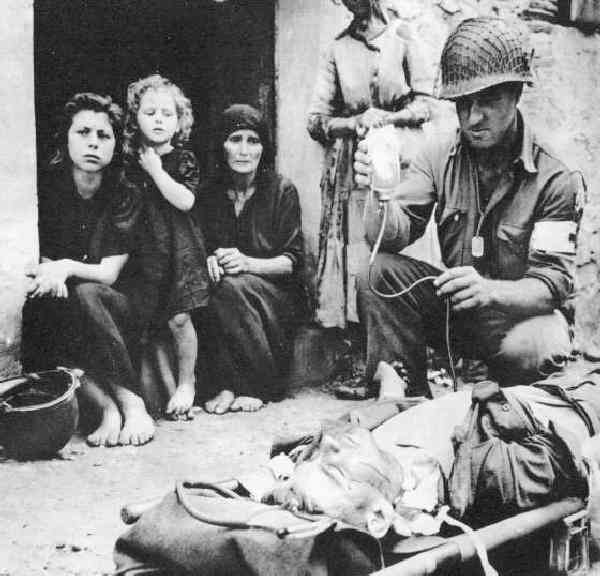
rather than conquerors. With the advent of the Kindom of Italy, there had bee a secessionist movemrnt on the island. And Sicily had not always been mired in poverty. With independence, poverty increased and emigration to America increased. Much of the land was in the hands of big landowners, and neither the Itanian Republic before Mussolini or Mussolin's Fascits did much to change this. The growth of the Mafia was in part a kind of resistnce to th Fascists. Since the War, food had been rationed, further reducing already limited diets. Many were in desperate circumstances by the time the Allies arrived. Children and women scrambled for the food in army garbage. Some offered what little they had, from hazel nuts to grapes, to the advancing soldiers. Most Sicilians were jubilant over the arrival of the Allies. There were jubilant celebrations after the Allies reached village after village en route to Palermo and Messina. The arrival of Americans, especially Americans of Italian ancestry was a special treat. Many Sicilians had relatives in America, and usually successful relatives. Many Sicilians broke down in tears. One less savory aspect of the defeat of Fascism is that the Mafia began to reestablish itself on the island.
Sicily was the first piece of Axis territory to fall to Allies. It had an immediate impact on Italy where the War was increasingly unpopular, causing the removal of Mussolini. Possession of Sicily provided the Allies important bases for the upcoming invasion of the Italian mainland. It also was a training ground for the key Allied operation of the War--the D-Day landings in northern France. Mistakes were made in Sicily. Eisenhower allowed most of the Germans to escape. There would be no bagging of Germans as had been accomplished in Tunisia. It is the Germans, however, that had made the major mistake, although by this stage of the War they had few options. America in 1940 virtually did not have an Army. The Army that America began to build was full of novices with a very small professional core. This was apparent with the amateur Torch landings and the bruising at Kaserine. [Atkinson, An Army ...] The key American commanders (Eisenhower, Patton, Clark, Bradley and others) had no real experience in commanding large armies. Many others proved incompetent and had to be replaced. If they had been pitted against a major German force the results could have been disastrous. Rather they faced relatively small, poorly supplied German formations and they had support from the British. This they learned the basics of modern war from the Germans who did not have the capability of delivering a decisive blow. The importance of the early campaigns like Sicily was the creation of a competent American Army. The result was that the American Army that entered the Continent on D-Day was not the poorly trained and commanded force that began the War in North Africa. In addition, both the Americans and British learned major lessons about amphibious invasion which would greatly assist in the success of the D-Day landings.
Atkinson, Rick. An Army at Dawn.
Atkinson, Rick. The Day of Battle: The War in Sicily and Italy, 1943-1944.
Gibert, Martin.
Holt, Thaddeus. The Deceivers: Allied Military Deception in the Second World War (Scribner, 2004), 1,148p.
Porch, Douglas. The Patth to Victory: The Mediterranean Theater in World War II (Farrar, Straus, & Giroux, 2004).
Powaski, Ronald E. Toward an Entangling Alliance.
Royle, Trevor. Montgomery: Lessons in Leadership from the Soldier's General (2010).

Navigate the Boys' Historical Clothing Web Site:
[Return to World War II European campaign second phase page]
[About Us]
[Biographies]
[Campaigns]
[Children]
[Countries]
[Deciding factors]
[Diplomacy]
[Geo-political crisis]
[Economics]
[Home front]
[Intelligence]
[Logistics]
[POWs]
[Resistance]
[Race]
[Refugees]
[Technology]
[Totalitarian powers]
[Bibliographies]
[Contributions]
[FAQs]
[Images]
[Links]
[Registration]
[Search]
[Tools]
[Return to Main World War II page]
[Return to Main war essay page]
[Return to CIH Home page]