***
World War II Pacific naval campaigns -- Pearl Harbor
World War II Pacific Naval Campaign: Pearl Harbor (December 7, 1941)
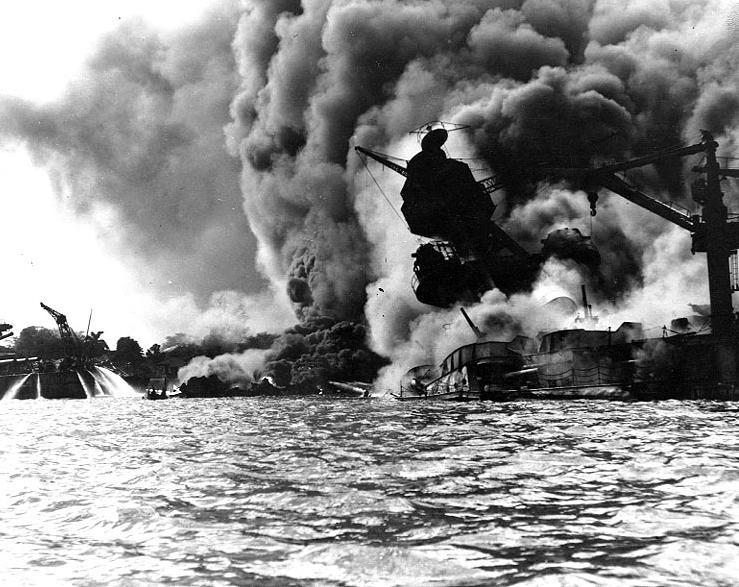
Figure 1.-- The 'USS Arizon' was destroyed when a Japanese bomb hit her forward magazine. Most of the crew was lost. Here she lies a burning wreck. At the left, the crew of the 'USS Tennessee are directing fire hoses on the water to force burning oil away from their ship. Source: Official U.S. Navy Photograph, National Archives collection.
"The time to strike has come. The spirit of the Emperor flies with you. Yours is a scared duty. Your mission divine. Do not fail."
-- Send off orders to Japanese carrier pilots, December 7, 1941.
"Yesterday, December 7th, 1941—a date which will live in infamy—the United States of America was suddenly and deliberately attacked by naval and air forces of the Empire of Japan.
The United States was at peace with that nation and, at the solicitation of Japan, was still in conversation with its government and its emperor looking toward the maintenance of peace in the Pacific. .... always will our whole nation remember the character of the onslaught against us. No matter how long it may take us to overcome this premeditated invasion, the American people in their righteous might will win through to absolute victory. ....
With confidence in our armed forces, with the unbounding determination of our people, we will gain the inevitable triumph—so help us God."
-- President Franklin Roosevelt, War adress tio Congresss, December 8, 1941.
The Japanese militarists having successfully taken on China (1894-95) and Russia (1904-05) and participating in World War I believed that in possession of a powerful fleet they could now enter World War II to complete their onquest of China and expand their empire with the Southern Resource Zone. They thought that the rich, comfort loving Americans, distracted by the Germans in Europe would not have the will or capability of fighting a war in the Pacific. It was thus the stunning surprise Japanese carrier attack on Pearl Harbor that finally propelled America into World War II. On a bright Sunday morning, the six front-line carriers of the Imperial Navy launched 360 modern aircraft at Pearl Harbor, the base of the U.S.Pacific Fleet. Sleek Japanese carrier aircraft with a destinctive red circle thundered out of the sky just as the American sailors were waking up on a sleepy Sunday morning. They not only changed America, but the world for ever. While Pearl Harbor was a stunning tactical victory, it was a strategic blunder of epic proportions. It was a stunningly successful military success, brilliantly executed by the Japanese. Several hundred aircraft, most of Pearl's air defenses, were destroyed. Most on th ground. Eight battleships, the heart of the American Pacific fleet, were destroyed, sunk, or heavily damaged. Fortunately the ships were at Pearl. A ship sunk at sea is a ship lost. Being attacked at Pearl meant that ships coukd be raised. Only two of the battleships were actually lost. Other losses included three cruisers and three destroyers. But by the slender thread of chance, the three American carriers, Yamanoto's principal objective, were not at Pearl. The Pearl Harbor attack was perhaps the greatest strtegic blunder in the history of warfare. The Japanese attack on the Pacific fleet instantly changed a diverse and quareling nation, strongly pacifistic into a single, united people with a burning desire to wage war and the vast industrial capacity with which to wage war with unprecedented intensity. The isolationism that President Roosevelt had struggled against for over 7 years instantly evaporated when the first Japanese bomb fell on Pearl Harbor. Even Lindburg asked for a commision to fight for the United States. America was finally at war.
Looking back as a historian, it is almost incomprehensible that Japan decided to wage war against the United States. War with Britain and the Netherlands is more understandable. Britain in 1941 looked like if not a defeated nation, at least a severely weakened one. The Netherlands was occupied by Axis ally NAZI Germany. America is a very different matter. The United States was not at war. It had not been weakened by the War. And Japan had no commitment that the Germany would join them if they attacked America. War with America seems like an extrodinarily wreckless decession for a country already mired down in a war with China and that had experienced a sharp defeat in a short war with the Soviets. Why would Japan have decided on war with America, a country with a larger population and a much larger industrial and scientific base. The road to war began early in the history of modern Japan. Wars with China (1895), Russia (1904-05), and Germany (1914-18) proved both short and profitable, enabling Japan to build a small empire. The risring influence of the military brought to power men of limited outlook who saw military action as a legitimate use of sate power. They were backward looking men who saw the European empires of the 19th century as to what Japan should seek to establish. And they were men who were strongly influenced by the historic image of the Samurai and Bushido which convinced them that Japanese racial superiority and martial spirit could prevail over the material supperority of America. Despite the power of American induistry, tgey saw Americans as a weak, decadent people who would not fight. Most of the Japanese militarists who made this judgement on which the very life of Japan would hang, knew no Americans and had little or no experience with Ameica.
Last Ditch Diplomatic Efforts
Japanese Foreign Minister Togo Shigenori dispatched senior Japanese diplomat Kurusu Saburo to the United States to assist Ambassador Nomura Kichisaburō. He arrived (November 15). It was a last effort to reach a peaceful resolution of the differences between the two countries. There were important Japanese officials, including Emperor Hirohito and Foreign Minister Togo who were deeply troubeled by the prospect of war with America. Their concern was the danger that Japan might lose the War. There was not a single Japanese leader of any stature, however, that questioned the correctness of Japan's aggressive foreign policy. The central issue that divided the United States and Japan was China. Not one Japanese leader was prepared to offer an end of the "China Incident" and withdraw troops from China. Some were prepared to offer to withdraw in 25 years or some date that meant no withdrawl. The military, however, objected to even this offer. President Roosevelt was primarily concerned about aiding Britain in Europe and the developing naval incidents with U-boats in the North Atlantic. He toyed with the idea of what he called a "modus vivendi" in the Pacific with the Japanese, to delay the outbreak of hostilities. In the end, however, he was not prepared to abandon China. He had earlier set the "oil clock" ticking. The Japanese military was set on war. While they were unsure about the outcome of a protracted war, they determined that never would their chances be greater than at the present time. Delay would mean their oil reserves would be depleted and the American military buildup would reduce the advantages they currently held. They believed that the anticipated German victory in the Soviet Union would enable the Germans to turn west and fully occupy the Americans and British. Secretary CordellHull's ten pont resppnse to the proposals presented by Kurusu was delivered (November 26). The Japanese were outraged when it reached Tokyo (November 27). The orders for war were finalized. The Imperial Conference decided on war and the Emperor put his seal on that decesion (December 1). The Imperial Navy's strike force was already at sea. President Roosevelt appealed to the Emperor Hirohito for peace (December 6). The Emperor did not reply.
Pearl Harbor
Few Americans before December 7 had ever heard of Pearl Harbor. It was in fact not a particularly impressive naval base until President Roosevelt ordered the U.S. Pacific Fleet from San Diego and other West Coast ports to Pearl in a show of force to disuade the the Japanese from further aggression (early-summer 1940). Creating a great naval base is not something that is done instantaneously. [Emerson] This was especially true in the conditions of 1940-41 when America was just beginning to rearm and there were shortages everywhere. Most serious was the shortage of reconisance aircraft. American involvement in the North Atantic against the German U-boats made that a priority. President Rossevely committed the United states to an undecked naval war against the German U-boats (September 1941). This was an extridinarlity risky commitnent and the U.S, Navy at the time hd very limited ASW capabilities. The U.S. Navy at Pearl was still operating on a shoestring and brining the facilities up to standard required of a major naval base preparing for war. [Wallin] There were some important facilities. There was a Navy Yard with a dry dock capable of holding bttleships and carries. There was a marine railway for smaller ships. There was an industrial plant for repairing and maintaining ships. There were adequate mooring and docking locations. This included a berthing area along the eastern side of Ford Island which became known as 'Battleship Row'. The central area of Pear Labor was dominated by Ford Island. This was used as a Naval Air Station for combat landplanes and patrol seaplanes. Across Southeast Loch opposite the Navy Yard was a submarine base and nearby was the critical 'farm' of fuel oil stores. Pearl also had a Naval Hospital and other facilities. All of this, however, was not adequate to suppot the growing Pacific Fleet. There were a range of limitations and defincies. All of this was known to the Japanese in great detail. The naval base was located adjacent to Honolulu. Oahu is a mountaneous island and the base could be observed and photographed from various positions in the surrounding area. As a result, the Japanese knew a great deal about Pearl as they began planning the attack.
Hawaii today is the only American state in which the largest segment of the population is of Asian origins. The Asian portion of the population has declined in recent years, but orimarily because of inter-mariage. Nearly a quarter of the Hawaiian population nw has ancestry including two or more ethnic origins. At the time of the Pearl Harbor attack, the single most important ethnic group was Japanese. These were the ancestors of the substantial emigration from Japan during the period of the Hawaiian Kingdom during the 19th century. The first Japanese in Hawaii are believed to have arrived aboard a damaged ship (1806). It was somewhat controversial at the time, primarily on the part of the new Japanese Meiji monarchy. The Imperial Government was concerned that the emogration if so many Japanese laborors to Hawaiia would lower the image of the Japanese nation around the world. The Imperial Goverment for a time actually banned futher emigration (1869-85). King David Kalākaua visited Japan to arrange for an end to the ban and a royal marriage for one of his daughters. In the background was a desire to establish international connections to balance growing American power. The United States helped negotiate an end to the Russo-Japanese War (1905-06). As part of the extensive diplomatic contacts, American and Japanese diplomats also negotiated a series of notes, collectively known as the Gentlemen's Agreement (1906-07). This was never legislted, but became Government policy. The result was to stop the further immigration of Japanese workers. The Japanese Government agreed to control emigration from Japan. The agreement did not legally ban Japanese immigration, as the Chinese Exclusion Act had done, but in practical terms Japanese emigration ended. But there was already substantial Japanese population in Hwaii and California. In Califormnia it was a small percentage, in Hawaii the Japanese had become the largest ethnic group. It is at this time that Fiipinos began to become an important part of the Hawaiian populaton. The Philippines at the tgime was an American Commonwealth which continued to be the case until after World War II. As a result, of the Japanese emigration to Hawaii, the large Japanese population on Hawaii was of concern to American military commanders as Japan and America moved toward war. The disposition of American aircraft when the Japanese struck was more aimed at preventing sabotage than repulsing a Japanese attack.
American War Asessments
American officials through the Magic intrcepts concluded that a Japanese attack was imminent. They believed that the Japanese were most likely to strike somewhere in Southeast Asia. Naval planners did not believe, however, that the Japanese would dare or have the capability of striking the Pacific Fleet at Pearl Harbor. They thought the strong air defenses on Ohahu would prevent the Japanese from risking their carriers. Nor did they understand the striking power (number of planes) carried aboy the carriers. And the did not understand just how good the Japanese planes and pilots were. They also believes that the shallow water at Pearl would prevent torpedo attacks. (This despite the fact that the British carried off a carrirer torpedo attack on the Italians at their base in Torrento (1940). This was another instance of the American underestimating the capabilities of the Japanese. The Japanese in fact had developed one of the best torpedoes of the War. And they had adapted them torpedos for shallow runs. In preparation for the attack, their pilots trained in low-level reduced speed deliveries. The American tactical doctrine was to separate their carriers. Thus they did not believe that the Japanse could organize a strike with a sufficient number of aircraft so far east to effectively overwealm Pearl's defenses.
Code breaking played a major role in World War II. And like radar, American code breakers almost alerted Pearl Harbor of an impending Japanese attack. American codebreakers broke into the Japanese Foreign Office's top secret system for sending messages (September 1940). The American cryotolgists named it Purple. The information gained from Purple decryptions came to be called Magic within the U.S. government because the Foreign Office used it for only their most important messages. The location of the Magic operation in Washington meant that information from the decrypts were not sent to Pearl Harbor unless the War Department decided to send some of the intelligence obtained. The Purple machine was a successor to earlier machines used to read Japanese diplomsatic mesages. Station Hypo code brakers at Pearl were wirking on JN-25, the Imperial Navy code, but had not yet broken into it. Only after theJapanese attack did Statiion Hypo begin to make real progress with JN-25.
American Aircraft
The American defense of the Pacific Fleet base at Pearl Harbor was based in large part on air bases scattered around the island. It was widely assumed that a Japanese naval force would be detected by naval patrols and engaged by American aircraft. The first-line American fighter was the P-40 Tomahack. It could match the Zero in speed and was more rugged. It had armor protection for the pilot and self-sealing fuel tanks. It was armed with six machine guns and two cannons. It was not, however, as manuervable as the Zero. Using appropriate tactics, the P-40 could be effective against the Zero. The P-40 with its limited manuverability could not be used for dog fights against Zeros.
North Pacific
Morth of Hawaii was the vast streaches of the North Pacific, a largely empty sea with no islands. There was nothing until one reached Alaska, 2,000 miles away. There were some shipping lanes, but usage of those lanes were a small fraction of the level of modern commderce. The Depression had reduced international commerce. And with the Japanese invasion of Chinas, most Chinese ports were in Japanese hands, sharply reducing trade. And trade with the Japanese had been sharply reduced by the American economic sanctions. Thus the North Pacific which in the best of times was lightly traveled was by December 1941 a vast empty sea.
Protective Measures
One might assume that Peal Harbor as the home base of the U.S. Pacific fleet would be protected by a secure ring of impenetravle surveillance. The United States certainly had the technology to so so. A long range ring of reconnisance air craft using the PBY which helped find the Bismarck in the North Atlantic was an excellent reconnisance platform. And an inner rings of radar stations was possible given the technology provided by the British. Tragically this was, however, not the case. There was no serious effort made by either the U.S. Navy or the Army Air Corps to establish a protective security ring. That may sound strange today, but such was the situation in 1941. There were no American naval security patrols in the North Atlantic. Adm. Kimmel had a few PBYs, but not nearly enough to put up a security arc around Pearl. Or to maintain it because of the wear on crews and engines.
The PBYs were only used to nsurevil operational areas which in 1941 meant sea areas to the south of the Hawaiian Islands where the fleet normally conducted paractice exercizes. Radar had provided the British the decisive edge enabling it to defeat the vaunted NAZI Luftwaffe in the Battle of Britain (August-September 1940). Britain and the United States had already began to share research on military equipment. The effectiveness of radar was not yet fully appreciate by either the Army Air Corps or the Navy. The Army had installed SCR-270 Radar sets on Ohahu. Not all around the island, but there were six mobile units scattered around the islan, the beginning of a radar net. As luck would have it, one was set up ar Opana on the northern coast--the perfect spot to detect the Jpanese air squadrons. And about 7:00 am, the two enlised men at Opana detected a massive blip, bigger than any thing else they had ever seen. The problem wa that there was no system established to asses an intercept attacking squadrons. This was the key element that main the British Chin Home Network so succesful. The United States had the radar sets, but not system in place to resomd. The radar men at Opana were not instructed what to do if they detected sometinng. So they called the Information Center at Fort Shafter near Pearl Harbor. They were told to forget about it. Then as the first Jpanese wave approached the coast, the radar signal got lost in the ground clutter.
American Preparations
The Pacific Fleet at Pearl Harbor was not on high alert. Naval commanders at Pearl believed based on available intelligence that a Japanese attack was not imminent. As a result, som preparations are based on fear of sabatoge from the Japanese living on Oahu rather than a naval attack. Planes at the airbases were left wingtip to wingtip on airfields to make them easier to guard. Anti-aircraft guns were unmanned. Ammunition boxes kept locked following peacetime Army regulations. Navy planners do not believe a torpedo attack is possible in the shallow waters of Pear Harbor--depite a successful 1940 British carrier attack at Tarnto on the Italian fleet. Thus ther are no torpedo nets protecting the battleships. The Navy was still operated on a peace-time schedule. On Sunday morning, many officers and crewmen were not at duty stations, but ashore or a variety of leisure activities.
Japanese Plan
Historians focus on Pearl Harbor because the American Pacific Fleet at Pearl was the only substantial military force in the Pacific that could oppose the Japanese. It was thus the centerpiece of the Japanese offensive to lunch the Pacific War. The Imperial Fleet issued Combined Fleet Order No. 1 (November 7, 1941). The order sets out a vast military operation to seize control of the western Pacific. The massive Japanese carrier fleet gave them the aboility to initiate operations throughout the western Pacific. At the heart of the operation, the 1st Air Fleet with about half the Japanese carriers was ordered to to attack and destroy the American Pacific Fleet at Pearl Harbor. The 2nd Fleet was ordered to attack and seize the Dutch East Indies, British possessions in China (Shanghai and Hong Kong, British Malaysia, and the American Philippine Islands. The
4th Fleet was ordered to attack and seize Guam. Attacks were alsoplanned on Wake and Midway Islands. A Northern Force was to guard the Japanese home waters. This was an offensive over a greater geographic than ever before attempted. In terms of the mahnitude of the invasion, it was only exceeded by the NAZI Barbarosa invasion of the Soviet Union.
Flash Warning (November 27)
The United States was not going to begin a war against Japan. This was Japan's choice. The Unites States did have a warning that the Japanese were preparing a strike. The Japanese JN-25 had not yet been broken, but the volume of radio traffic picked up from listening posts in the Far East clearly indicated that something big was about to happen. While the codebreakers could not read the messages, they could tell where they were coming from and the direc. And they were moving south toward the Philippines and Southeast Asia -- not toward Pearl Harbor. What American intelligence did not detect was the carrier task force that departed Hitokappu Bay in the Kuriles (November 26). They observed strict radio silence. They did not even launch sxcout planes for fear that they might need to use their radios if they got lost. Based on the the radio signals that were detected, Adm. Harold Stark, Chief of Naval Operations in Washington flashed this message, to all Pacific outposts:
This dispatch is to be considered a war warning X Negotiantions with Japan looking toward the stabilization of conditions in the Pacific have ceased and an aggressive move by Japanis expected within the next few days X The number and equipment of Japanese troops and the organization of naval task forces indicates an amphibious expedition against either the Philippine Islands Thai or Kra [Malay] Peninsulaor possibly Borneo X Execute an appropriate defensive deployment preparatory to carrying out the tasks assigned in WPL46.
Admiral Chuichi Nagumo (1887-1944)
Admiral Chuichi Nagumo (1887-1944) at the time the war broke out in Europe, was the respcted head of the Naval War College in Tokyo. Before Japan launced the Pearl Harbor attack he was promoted to the rank of vice admiral. He was then named the commander of the First Air Fleet, the most prestigious command. It was a matter of seniority.
Admiral Chuichi Nagumo (1887-1944) at the time the war broke out in Europe, was the head of the prestigious Naval War College in Tokyo. Before Japan launced the Pearl Harbor attack he was promoted to the rank of vice admiral. He is generally considered a competent, but not innovative or creative commander. Some of his colleagues questioned his intelligence, but these seems unfair. Reports suggest he was more lecel-headed than many if his colleagues. Nagumo was then named the commander of the First Air Fleet, the most prestigious command in the Imperial Navy. Yamaoto was concerned about his appointment. The two were not close. Nagumo had been very critical of the Washingon Naval Accords wich Yamamoto supported. Yamanmoto would have liked a different commander, but after locking horns with the Naval High Command in Tokyo was not able to prevent Nagumo's appountment. The appointment was a matter of seniority. Nagumo thus commanded the all important First Air Fleet at the two most important points of the Pacific War. And both commands proved controversial. The stunning success of the Pearl Harbor attack made Nagumo a national hero (December 1841). His decesion to cancel the third strike wave, however, meant that Pearl was left a potent forward naval base with its fleet battered, but the base faciities largely intact. Yamamoto personally criticized him for his lack of aggresiveness.
Japanese Strike Force
The Japanese strike force of six carriers has a complement of 423 planes. It was the most powerful carrier strike force ever assembled. The Japanese used all six of their first-line aircraft carriers: Akagi, Kaga, Soryu, Hiryu, Shokaku and Zuikaku. Vice Admiral Chuichi Nagumo commanded the operation. The Japanese Pearl Harbor Striking Force also included fast battleships, cruisers and destroyers, with tankers to fuel the ships during their passage across the Pacific. There was also an advanced force of I-class submarines, including midget submarines caried by conventional submarines. They were to scout Hawaian waters. The midget submarines were ordered to penrtrate Pearl's harbor defenses, both to press the attack and engage ships trying to escape the air attack in the harbor. Each was equipped with two effective type 95 torpedoes. These carried a larger charge than those carried by aircraft.
Japanese Planes
The American military generally despairaged Japanese industry and their ability to produce modern weapons, especially war planes. The Jsapanese, however, had a competent aircraft industry which had recieved technical assistance from the Germans. Japan thus entered the War with modern aircraft that in many ways outpreformed American aircraft. The Mitshbishi A6M2 Zero had a top speed of 362 miles per hour and a range of 1,200 miles. It was armed with two light machine guns and two 20 mm cannons. It entered into service in 1940. Japanese weapons were named based on the year they entered into service and thus the last dighit of 1940 became the common name for the plane. The great characteristic of the Zero was is manueribility. This was achieved in part through light weight. The Zero was poorly armoured and did not have self sealing fuel tanks. This cavalier attitude toward protecting highly trained pilots proved to have a devestating long term impacr=t on the competence of the Japanese air arm. At Pearl and during the first year of the War, however, American pilots faced highly-trained pilots in modern high-performance aircraft. The Japanese also used the BFN2 Kate torpedo bomber. Kate was the designation given the plabe by American inteligence classifying Japanese aviation. The Kate had retractable landing gear and an inovative variable pitch propeller. It proved highly effective at Pearl.
The Attack
The Japanese plan was to launch three massive waves of carrier aircraft to devestate the Anerican naval base and Pacific Fleet bethed there. Admiral Nagumo launched the first two waves as planned. The first wave of 183 planes was launched at 6:00 AM 230 miles north of Oahu to strike the Pacific Fleet at Pearl Harbor. It consisted of 51 'Val' dive bombers, 40 'Kate' torpedo planes, 50 high level bombers, and 43 'Zero' fighters. Two Army radar operators at Oahu's northern shore station at 7:02 AM detect the Japanese planes. A junior officer decided they were B-17 bombers arriving from the U.S. west coast. They achieved total surprise abd destroyed Pearl's air defennses nd began attacks on the main target, the ships of the Pacific fleet bearthed at Pearl. At sea, Nagumo after receiving the preliminary reports of success from the first strike group at 7:15 AM launched the second wave of 167 planes. They went after what ever ships that were still aflot.
First wave
The first wave reached Pearl and began the assault at 7:53 AM Flght commander Mitsuo Fuchida radioed "Tora! Tora! Tora!" (Tiger! Tiger! Tiger!). The Japanese surprise was total. The first wave targets airfields, carriers, and battleships--only the carriers to the Japanese surprise were not at Pearl. Seven of the eight battleships of the Pacific fleet were moored on Battleship Row locted along the southeast side of Ford Island. The Pennsylvania was in drydock across the channel from Ford Island. Within minites the seven battleships along Ford Island were hit by bombs and torpedoes. The West Virginia settled into the water. The Oklahoma capsized. An armorpiercing bomb hit the Arizona's forward ammunition magazine at about 8:10. The ship exploded in a ball of fire. Many ofvthe Pear Harbor casuaties camd from Oklahoma and Arizona. On the Arizona alone, 1,177 men were killed. The Japanese also hit the California, Maryland, Tennessee, and Nevada, although the damage was not as devestating as that done to Arizona and Oklahoma. The Nevada tried to get underway and exit Pearl to the open sea. Just at this time the second wave of 170 carrier planes reached Pearl (8:30 am). They immediately focused on the ome moving battleship. To prevent Nevada from being sunk in the channel and blocking the entrance to Oear, the Nevada was beached at Hospital Point.
Second wave
While the first wave was ravaging Pearl Harbor, Nagumo brought up the second wave and prepared it for launch. The second wave consisted of 171 planes (54 B5Ns, 81 D3As, and 36 A6Ms) and was commanded by Lieutenant-Commander Shigekazu Shimazaki. They launched as the first attack group was returning to the carriers. The second wave attacks continued until 9:45 am. The second wave was divided into three attack groups. One was assigned to attack Kane‘ohe, the rest Pearl Harbor itself. The three attack groups reched their assigned attack point almost simultaneously, but from from several directions.
The Third Wave
The Japanese based their attack plan on surprise, allowing them to knock out Pearl's aur defenses and carriers. This accomplished, the Japanese air groups would be free to launch a third strike to destroy the base facilities supporting the Pacific Flkeet. As the air defenses and American carriers were destroyed, the Japanese carriers sould be free to launch a third wave without fear of attack. It is at this point that Nagumo waivered. Unexpectedly the American carriers were not at Pearl and Nagumo had no idea where they were. Thus Nagumo had to consider the possibility that the American carriers were grouping for a counter stroke. As a result, he made one of the key decisions of the Pacific War. He decided to cancel the planned third wave and settle for the damage done by the first two waves. It was understandable, but proved to be a huge mistake. It left Pearl a battered, but fully intact naval base from which the surviving cariers could operate. Without Pearl, the United States would have no advance base of any importance in the Pacific. Nagumo's decesion was not just based on the possibility of
an American attack. It reflected Japanese naval doctrine which focused on enemy warships. Port facilities were valued much less highly by naval commanders. The dream of every Japanese commnder was to destroy the American Pacific fleet in one great, decisive naval engament. There was no glory in bombing ports. Admiral Nagumo as a result of the Pearl Harbor attack instantly became a national hero, an important development to be considered as the popular concept is that Japan's military leaders brought a peaceful popultion unwittingly to war.
The American Carriers
The Pacific fleet had three carriers. This meant that the Japanese had a carrier force in the Pacific that was four times larger than the American force. But if you just cout the six fleet carriers of First Air Fleet, it was only twice as large. While the Japnbese vistory was a great shock at the time, looking at this overwealming force, the Japanese success was in fact a forgone conclusion. The fact that American Army Air Corps forces were poorly handled at Pearl and in the Philippines is what turned the attack on Pearl into a disaster. Only by great fortune did the two of the three carriers of the Pacific fleet escape destruction (Lexington and Enterprise). Pacific Fleet commander Admiral Kimmel had ordered Rear Admiral Willliam Halsey to take Enterprise to deliver Marine Corps fighter planes to Wake Island (November 28). Halsey delivered the planes (December 4) and was oi his way back to Pearl. He would have been back in Pear December 7, but heavy weather made it difficult for the screening destoyers to keep up with Enterprie. He slowed down which made him a day late arriving back in Pearl. Admiral Kimmel had also ordered Rear Admiral Newton to take a Task Force 12 built around the Lexington to deliver 25 scout bombers to Midway Island (December 5). Saratoga was still at San Diego having just undergone maintenance and repair. The United States did have four other carriers: Ranger, Yorktown, Wasp, and the brand new Hornet. They were in the Atlantic where the United States was engaged in an undeclared naval war with German U-boats. Yorktown would be the first Atlantic Fleet carrier to be transferred to the Pacific and sailed (December 16).
Critical facilities
While the Pacific Fleet battleships were decestated, the Japanese did not destoy the principl shipyards or base fuel tanks. Perhaps even more important than what the Japanese destroyed at Pearl was not they did not destroy. The Japanese did not destroy: 1) the large dry docks and other repair fac=ilities, 2) the submarine pens and other facilituies, and 3) ship fuel storage facilities. This meant that Pearl continued as an operational naval base. The third wave was planned to hit these facilities, but Admiral Nagumo's decession to withdraw left these facilities in tact, meaning Pearl was still a fully functioning naval bases. And planes rushed from the mainland quickly resstablished Pearl's defebnses meaning that a further attack on the base would be a much more costly undertaking. The result was that the Pacific fleet could begin repairing the damaged ships. It also meant thst it had the fuel for the surviving ships, especially the carriers to conduct opetations. The Ametrican submarine fleet was one of the most important elements of the naval war, but could not be effective without an advanced base like Pearl. The Pearl reoair facililites proived critical in ensuing battle of Midway, also fought by Admiral Nagumo. The battered Yorktown returning from the Coral Sea was patched up in hours and sent to join Enterprose and Hornet with the repair crews still aboard. Some military historiabs suggest that criticism of Nagumo for not launching the third wave affected chis decision making at Midway.
Pearl Harbor was the most disatrous defeat in the history of the U.S. Navy. The Pacific Fleet, the major striking force of the U.S. Nvy was devestated. The United States Navy woulld become an emotmous force during the War. This was not the case before the War. Many World war I ships had been scrapped or mothblled. And Congressional appropriations had been limited suring the iter-War period, although not as limited as those mae for the Army. Thus the 21 ships sunk or damaged at Pearl were a sizeable part of American naval power and included the battkleships. Most of the damage was sustained by the ships of the Pacific fleet and the planes of the U.S. Army Air Corps guarding the base. Battleships were considered the capital ships of the fleet at the time. And every one of the the eight battleship of the Pacific fleet were destrouyed, sunk, or put out vof action. The losses were devestating, but perhaps even more importnt thn what was danaged was what was not damaged. The vital facilities of the base were left virtually untouched. When the planes of the second wave strike force returned to the carriers, however, Pearl Harbor remained a fully functioining forward base for the Pacific Fleet. And mostnotably the battleships not only were mostly old and bnearing obselece were mostly raised and returned to service, but the all important carriers had not been in Pearl and survived untouched. Pear Harbor proved to be a seeminly devestating, but phryic victory.
Personal Experiences
We are collecting personal experiencs connected with the Japanese Pearl Harbor attack.
Dorothy Goo Nahme
One Honolulu resident recalls, "On Saturday, Dec. 6, 1941, I went with my sister and her husband to their newly built house in the countryside near Honolulu. My brother-in-law had decided to quit his city job to establish a piggery. Early Sunday morning, about 7:30, I was helping my sister hang white kitchen curtains when the house shook violently. We ran outside, thinking earthquake. Once outdoors, we noticed what appeared to be white feathers floating to the ground, and we saw in the distance a silver plane spiraling earthward, trailing smoke. Some of my classmates in college were children of military families, and they had told me about Sunday morning military maneuvers, during which they would wave to the pilots from the ground. Seeing the plane crash made me wonder at the extravagance of making the maneuvers look so real. I heard the roar of an airplane at that moment, and I thought I would wave to the pilot with the white curtain still in my hand. I stopped abruptly midway: The plane was not silver, but an ugly dark green with a huge red disc disk painted on the wing. I was so astonished that I did not complete the wave. It was later explained to me that the Japanese plane, after dropping a bomb on Pearl Harbor, flew over our area while circling back to its target. What appeared to be white feathers were actually part of the packaging of the bomb. As these "feathers" fell, so did chunks of shrapnel, many of which we found on the property, large and sharp enough to damage the tin roofs and concrete foundations of the pigpens." [Nahme]
Battle Asessments
Appauling as the casualties at Pearl Harbor were, in actuality the results could have been far worse. Japanese naval doctrine was to employ surprise and cunning, not brute force. This was in part cultural, reflecting principle described by Sun Tzu. It also reflected the idea that Japan in waging war against America would always be fighting from a position of material inferiority. As it was, Japan in launching the Pacific War possessed the most powerful naval air force in the world--the six carriers of the First Air Fleet. In striking power and military competence it was without equal. In chosing military guile abd surprise, the Japanese managed to entirely miss their major target--the Pacific fleet carriers. December 7 proved to be a rare weekend that the American carriers were not at Pearl. Genda, Yamaoto, and other Japanese commanders despite the damage done, realized that they had not delivered the planned knockout blow that would give Japan the time and space needed to build an impregnable Pacific barrier to protect their empire. They were thinking it might buy 3-4 years. [Genda] Reconisance was not a strong point of the First Air Fleet. Staging a surprise attack within the confines of Pear Harbor was even more flawed than just missing the carriers. Still little noted even today is had the Japanese not attacked the fleet an anchor in Pearl, the caualties from a highseas engagement would have been much higher. The Japanese carriers at the time had superior air craft types, a highly effective torpedo (the American naval torpedo at the time essentially did not work), and the pilots were better trained. Except for Arizona most of the crews of the American ships survived as most of the ships were not destroyed. This would not have been the case in a highseas engagement. Given the superior Japanese carrier forces, if the Pacific fleet had engaged the Japanese at sea, the crew and ship lossess could have been catestrophic. Batleship losses when sunk at sea can be catrestrophic. When the Bismarck sunk the Hood, only three sailors survived. Not only did most of the sailors of the Pacific fleet survived, but the battleships with the exception of the Airizona and Oklahhoma were refloated and repaired and joined the struggle gainst the Japanese in the Pacific War. The damage to the Pacific Fleet mean that the wave of Japanese invasion in the eastern Pacific could be carried out without serious naval opposition. Japan's failure to destroy the fleet, however, mean that the core of the fleet existed around which would be built the most powerful naval force in history and within only a few months would conduct fleet actions engaging the Imperial Navy. It would not occur in time to save the Philippines. It would be in time to save Australia.
White House
The Japanese attack began at 7:50 am which was 1:20 pm in Washington. Eleanor Roosevelt after the war described what she observed in the White House. The President's aides and cabinent ministers were rusing in and out with paers in a varying state of excitement, panic, and nervous exhaustion. Elenor did not yet know what had happened. She noticed her husband and was struck by hs "deadly calm" composure. It was only the second time in their long, evenful life togethger that she had noticed thst expression. The first was in 1921 when a dictor informed him that he had contracted polio, an incurable disease and once of the most feared diseases at the time. The President was seated quitely at his desk absorbing the reports as they came in from Hawaii. He was stained and tired, but Elenor described how, "he was completely clam. His reaction to any event was always to be calm. If it was something that was bad, he just became almost like an iceberg, and there was never the slightest emotion that was allowed to show." [Goodwin, p. 289.]
State Department
Secretary of State Cordel Hull had been even more uncompromising toward the Japanese than the president. His 10 points submitted in resonse to the last Japanese diplomatic proposal was taken as an insult in Tokyo. It clearly indicated among other matters that the United States would not abandon China. There would be no American Munich in Asia. The final scene of the Pearl Harbor tragedy occurred in Secretary Hull's office. Hull thus came in on Sunday to receive Ambassadors Nomura and Kurusu. Hull had a particularly low opinion of Kurusu who had helped negotiate and signed the Axis Tripartate alliance. (Kurusa ironically had an American wife and was thus well aquainted with the United States.) The Japanese Ambassador had scheduled the appointment with Secretary Hull at 1:00 pm to deliver the Government response to his Ten Point message and the declaration of war they had just received. The Japanese Government had specified that it be delivered specifically at this time, knowing that it would be a half hour before the attack began. The Embassy staff not knowing gthe importance of the time and still working on the translation of the lenngthy cabel, asked that the meeting with Secretary Hull be delayed.
While Hull was waiting for the Japanese emisaries, President Roosevelt telephoned him a little after 2:00 pm to inform him of the Japanese attack. The two Japanese envoys, still unaware of the attack, arrived 15 minutes after Hull spoke with the president. Thus they arrived at Hull's office after the attack. When they entered his office, Hull refused the normal pleasntries and hand shakes and left them standing. He looked at the note they delivered and sternly replied, "In all my 50 years of public service, I have never seen a document that was more crowded with infamous falsehoods and distortions--infamous falsehoods and distortions on a scale so huge that I never imagined until today that any Government on this planet was capable of uttering them." He did not wait for a reply and nodded toward the door. [Hull, Vol. II, p. 1096.] We do not know what Nomura and Kurusa said to each other on the ride back to the Japanese Embassy. Kurusu is one of the most vilified diplomatic figures in history. The Japanese diplomats were exchanged for Ambassador Drew and his staff through Vichy-controlled Mozambique and returned to Japan (1942). He survived the War and insisted he was unaware of the plans to attack Pearl Harbor. Here he almost certainly was being truthful. The military plans were very closely held. His deninals. however, are rather disengengious. High ranking officials in the Foreign Minister could not have been unaware that Japan was preparing to go to war.
Sneak Attack
News of the "sneak attack" was broadcast to the American public via radio bulletins, interupting many popular Sunday afternoon radio programs. Many other Americans learned of the attack at movie theaters, a popular Sunday afternoon activity. Many Americans upon hearing of the attack had newsreel impages of the smiling Ambassador Kurusa arriving in America a few weeks earlier on a peace image.
The Isolationists were one of the most powerful political movements in American history. Beginning with President Washington, there has always been a strong isolationist movement in America, one that is still presentr today. For about 4 years President Roosevelkt had been fighting the isolationists who had come to see him as a war mongerer, detwrmined to drag America into the European war. Republican Congressmen were importaht isolationists. There were also Democrats, including the Ambassaor to Great Britain, Joeph P. Kennedy. Perhaps the most iportant isolationist was aviator Charles Lindurgh. the greatest hero of the inter-War era. He was an influential voice in the most important isolatiuonist group--the American First Committee. The President won the major battles with the isolationists, including repealing the Neutrality Acts, aiding Britin, beginning a peace-time draft, and Lend Lease. Even so, the isoltionists significatly impeeded his efforts to resist Axis aggression. Even as the nombs were falling at Pearl, the American Firsters staged a major rally in Pittsburgh. In a hall festooned with red, white, and wall bannets, the American Firsters engaged in anti-Roosevelt cheers awaiting the main address by Congressman Gerald Nye. He brushed aside the first news reports of the attack and delivered an anti-Roosevelt tirade, charging that the President was leading us into War and included the standard isolationist line that the munitioin makers were behind the War. Immediately afterwards Nye would blame the British. Few of the isolationists includiung Nye knew as they filed out of the auditorium that their movement that had been so powerful and influential would literally evaporate over night as soon as the Amnerican public learned about a sneal attack on America.
Roosevelt Speeches (December 7-8, 1941)
President Roosevelt's sppech to the Congress asking for a declaration of War is one of the most memorable in American history. There were actually two Roosevelt speeches. The American people after learning about the Japanese attack heard nothing from the President. The President spent much of the day attempting to learn just what had happened and how bad the losses were. This proved difficult in a country not yet prepatred for world war. There was no doubt in his mind that this meant war. He began preparing the war message he would give to the Congress the following day. He called in his scretary, Grace Tully. His speech writers were out of town, so he would have to compose it himself. He was not at a loss for words. The words were there. He knew just what he wanted to say. Tully explains wht transpired. The President wa calm and tolder her, "this will be short." He asked her to sit down. He dictated the most momentous speech of his presidency without pause or hesitation.
The President then met with the cabinet to which he laid out starkly just what he knew. He asked them to not speak to the press. Secretaru Hull wa unhappy with the draft speech. He wanted a long formal recitatiuon of efforts to avoid war. The President then met with Congressional leaders, but was mpre guarded knowing that they might speak to the press. Congressmen Cinnly began asking awkward questions. But the American people heard nothing from the President that first day of the War. They did hear from Mrs. Roosevelt who had a scheduled radio program. It is almost unbelievable that after such atunning event, that the American people would hear from the First Lady first. Noithing like this has ever occurred in American history, but Mrs> Roosevelt was like no other first lady. While now over shawdowed by her husband's war message, Mrs Roosevelt's radio message was similar to husband's, short, concise, and emotional, but more personal, speaking to the mothers of America.
The President's address to Congress is perhaps the most important in American history. America before Pearl Harbor was an economic power, but played a minor role in international politics. After Pearl Harbor, American began to assume its role as alobal superpower. The President's speech is the beginning of this transition.
The United States and Britain, which also was attacked, declared war on Japan the following day (December 8). President Roosevelt in his address to Congres called December 7, "a date which will live in infamy..." Germany and Italy joined Japan and declared war on the United States. This relieved President Roosevelt of the awkward problem of decaring war on NAZI Germany--something the American people had steadfastly resisted. It would have been difficult to explain why a Japanese attack justified declaring war on Germany. Hitler's decesion to declare war is one of the unanswered questions of the War.The Axis treaty did not require them to do so. It was a defensive treaty and Germany and Italy did not have to declare war. And Japan did not reciprocate with a declaration of war on the soviet Union.
Presidential Leadership
President Roosevelt delivered one of the most famous presidential speeches ewhen he asked Congress to declare swar on Japan/ He told the Congress and American people that December 7, 1941 was "a date that would live in infamy". He carfully chose the word. It was also a major turning point in American history. In one stunning stroke the Japanese changed everything, Thdy ended the Depression in America, instantenously erased the isolationist movemrnt, doomed the Axis war effort, ans swept America into the War. It also altered the course of the Roosevelt presidency. The President bhad failed to end the Depression, but we would oversee the victorious American war effort. If the Roosevelt presidency had ended in 1941, hw would have been classed as aresudent with a mixed record. With us war record he emerged as one of the greatest presidents in american history. The President was shaken by the enormity of the cdefeat, but we will never know just hiw shzken. He was outwardly calm. Typically Roosevelt, he was cunning and ddcdptive. He hid the enormity of the Pear Harbor disaster from the public abnd even the Congress. But his leadership away from public view wasc as described by ond historian, steady, sure-minded and decisive. And decesions needed to be made and made fast in the hours after the attack. [Gillon]
Admiral Nimitz
President Roosevelt appointed Admiral Chester W. Nimitz commander of the U.S. Pacific Fleet December 17). Nimitz was one of the outstanding American commanders of the war. Of all the American commanders, Nimitz was the only one that was able to craft amajor victories before the American military buildup provided overwealming material advantages. The military relieved Admiral Husband E. Kimmel, and Army Lt. General Walter C. Short, of their duties for failing to adopt adequate defense measures. Both commanders had, been alerted of Japanese intentions reveled by American code breakers. They did not, however, receive, the final cabel warning Pacific commanders that war was imminent.
Consequences
It was the Japanese carrier attack on Pearl Harbor that brought America into the War. While Pearl Harbor was a stunning tactical victory, it was a strategic blunder by the Japanese of incaluable proportions. It was a stunningly successful military success, brilliantly executed by the Japanese. Eight battle ships, the heart of the American Pacific fleet were sunk. But the three carriers were not at Pearl. Despite the success of the attack, it was perhaps the greatest strtegic blunder in the history of warfare. The Japanese attack on the Pacific fleet at Pearl Harbor changed everything. A diverse and quareling nation, strongly pacifistic was instantly changed into a single united people with a burning desire to wage war. The issolationism that President Roosevelt had struggled against for over 7 years instantly disappeared. Even Lindburg asked for a commision to fight for the United States. As for Japan, the NBC documentary summarizes the consequences succintly, "With the dead lies the vision of a new fleet hidden by the pall and smoke of a shattered fleet--and the vengence of the United States."
Military Impact
Conventional wisdom suggests that the destruction of the American battleships at Pearl allowed the Japanese to sweep over the Pacific in the 6-months followingb the attack. This is a misconception. It was not the destruction of the Pacific Fleet's battleships, but rather the massive Japanese superiority in carriers that allowed the Japanese to sweep through the Pacific. In fact had the United States met the Japanese at sea in a fleet engagement, it is likely that the casualties would have been much greater than those excpeienced in Pearl. Only 3 men survived the sinking of Hood, for example, in the North Atlantic. Most of the casualties at Pearl camme from Aizona. In a general fleet engagement at sea, given the Japanese carrier superiority, the American losses could have been disastrous. In additiion there would have been no way of raising battleships sunk at sea and all but two battleships sunk at Pearl (Arizona and Oklahoma were raised and rejoined the fleet. At the time of the Japanese attack, the U.S. Navy was still wedded to the battleship. The attack in fact forced the American Navy to radically change it tactics and strategic concept. When the critical engagemebts came at the Coral Sea (April 1942) and Midway (June 1942), the only ships playing an important role was the carriers. The American Pacific fleet had developed the competence and tactics to take the Japanese on and te code breakers allowed the American carriers to fight engagements on realtively equal terms despite the overwealming Japanaese carrier superiority.
Raising the Fleet
In the aftermath of the Japanese attack it is often not understood that the eight Pacific Fleet battleships were not destroyed. Two were destroyed: Arizona and Oklahoma. But the other six were not. Had they been sunk at sea they would have been, but they were sunk at their moorings or bedached. This meant that they while battered, they werwe were salvalage. And while the ships were still warm from the fires started by the Japanese attack, expers from the mauiland were flown in to begin the most remarkable salvage opertation in the history of naval warfare. The damage varied from ship to ship. There were two groups of ships.
The first were those that had been moderartely damaged, but could quickly be refloated. The Japanese had not significantly damaged the Pearl Harbor Navy Yard, thus this operation could commednce immeditely. Tenders and ships' crewmen immediately began repairs. These preliminary actions suceeded in putting battleships Pennsylvania, Maryland and Tennessee to a point that they could sail to shipyards on the mainland for repairs beyond the capability of the Pearl facilities (February 1942). Several smaller vessels were also repaired. This included the cruisers Honolulu, Helena, and Raleigh and the destroyers Helm and Shaw. Raleigh and Shaw the two most severly danaged of this group rejoined the fleet (mid-1942).
The second group of ships had been much more heavily damaged. Five more battleships, two destroyers, a target ship and a minelayer were sunk, or so severely damaged as to represent nearly total losses. Arizona and Okahoma were in these groups. Both were too heavily damnaged to rejoin the fleet. Other ships could be refloated, but required very extensive work just to refloat them so repairs could commence. The Navy Yard stripped the destroyers Cassin and Downes of servicible weapons, machinery and equipment (December 1941 - February 1942). The salvaged materiel was shipped to California ship yards where it was installed on new hulls. These two ships thus returned to the fleet in a symbolic sence (late-1943 and early-1944). For the other ships a salvage organization was formally set up only a week after the Japanese attack (December 1941). Captain Homer N. Wallin, from the Battle Force Staff was given the job of overseeing the Salvage Division (January 1942). They reloated some of the ships and salvaged equipment from the ships thst could not be refloated.
The battleships Nevada was refloated (February 1942). It would eventually become the flag ship for the D-Day invasion. They refloated California (March 1942) and West Virginia (June 1942). The minelayer Oglala was refloated (April-July 1942). All reqquired extensive shipyard repairs, but eventually rejoined the fleet.
Many of the salvaged battle ships played important roles in the Pacific War. They were not fast enough to be used in carrier task forces. They were extensively used for pre-invasion shelling. Their most famous action was to smash the Japanese southern force at Surigao Straits during the Battle of Leyte Gulf (OCtober 25, 1941). As the Japanese Southern Force tried to pass through the narrow Surigao Straits six American battleships having executed the classic crossing the "T" maneuver were waiting for them.
They included California, Maryland, Mississippi, Pennsylvania, Tennessee, and West Virginia--all but Mississippi were Pearl Harbor veterans.
Enduring Impact
Pearl Harbor was seared into the national consciouness. Since the foundation of the Republic, American had considered itself protected by two great oceans. Pear Harbor changed this. The Japanese attack demostrated that America was vulnerable to the attack from abroad. The isolationist outlook that had so dominated American thought evaporated over night. Pearl Harbor still resonates in the American psyche today. [Rosenberg]
Conspiracy Theories
The Japanese attack on Pearl Harbor has like the Kennedy assasination spawned a veritable cottage industry in consiracy assessments. These assessments are notably for their poor understanding of the military and code braking as well as the unprofessional cherry picking of facts and events to make their case and sell books. A good example is the Stinnett book. This and similar books should not be considered real history. Certainly President Roosevelt's conduct of American foreign policy keading up to Pearl Harbor is an important topics, but readers should avoid authors like Stinnett who form an opinion based on ideological grounds and then cherry pick facts and events to prove his case. This is not real history.
Pacific War Naval Base
The Philippine Islands was America's advanced outpost in the Pacific. The Pearl Harbot attack was followed by air strikes from Taiwan that quickly crippled American air power on the Phillipines. And with the Pacific Fleet crippled, when the Japanese invaded, General Mac Arthur was forced to retreat to the Batan Peninsula where the poorly supplied American and Filipino forces conducted a valiant defense for several months. The Japanese took Guam without resistance. The Marines on Wake Island put up a spirited resistance. Guam was taken wiThis left Midway and the Hawaian Islands as America's lone outposts in the Central Pacific. The United States rushed planes and supplies to defend the Hawaian Islands, but the Japanese comitted a huge error by not pressing the attack with its powerful carrier force. The Japanese did not resume the attack until 6 months later when the Pacific Fleet was better prepoared and the result was the enormous naval vicyory at Midway (June 1942). This ended the threat of Japanese attack. The United States turned Pearl and the air bases surrounding it into the most powerful advanced naval base in the world. Huge quanities of men, material, planes, and new ships flowed into Pearl. The Pacific Fleet with the seizure of the Gilbert abd Msrshal Islands began the long march east toward Tokyo abnd gradually Pearl became a rear area base, but the headquarters of the Pacifuc Fleet througout the War.
Large numbers of ethnic Japnese lived on the Hawaian Islands. The first Japanese immigrants were brought to the Islands before the Islands were American territory as contract laborers for the American-owned sugar cane and pineapple plantations (1885). Bybthe tgime of World War II, rthere were about 160,000 Hawaiians of Japanese ancestry, about 40 percent of the Islands' population. Most prived to be fiercly loyal to the United States. Unlike the ethnic Japanese on the Pacific Coast, the Japanese on the Islands were not interned in a wholesale operation. We are not sure who made this determination. A small number were arrested by the FBI and interned. They were indivisuals who belonged to Japanese patriotic organizations or for some reason were considered security risks. (Their families were often interned with them.) The numbers were very small. About 2,000 Japanese Americans in addition to 100 German Americans and Italian Americans (both aliens and U.S. citizens) were interned at eight locations on the Hawaiian. It is not entirely clear why they were not interned because the Japanese threat to Pearl Harbor was much greater than it ever was to California. It is probably because the etnic Japanese presense on the Islands was so important to the economy that it would have disrupted the Island economy, including the operations of the military bases. Facilities like Pearl Harbor, for example, had many Japanese workers in the shipyards.
Sources
Emerson, William. Interview by Dorris Kearns Goodwin in No Ordinary Time.
Freidel, Frank. Franklin D. Roosevelt: Rendezuous with Destiny (Little Brown: Boston, 1990), 710p.
Genda, Cpt. Minoru. Guest speaker. Duke University (1966). It was Genda of course who planned the Pearl Harbor attack. Genda was also part of the Midway operation, planning the First Air Fleet's search pattern.
Gillon, Steben M. Pearl Harbor: FDR Leads the Nation into War (2011), 248p.
Goodwin, Doris Kearns. No Ordinary Time. Franklin and Eleanor Roosevelt: The Home Front in World War II (Simon & Schuster: New York, 1994), 759p.
Hull, Cordell. The Memoirs of Cordell Hull Two volumes (New York, 1948).
Nahme, Dorothy Goo. "'Feathers' in the sky near Pearl Harbor," The Washington Post (May 28, 2004), p. W11.
Rosenberg, Emily S. A Date Which Will Live: Pearl Harbor in American Memory (Duke University, 2003).
Stinnett, Robert B. Day of Deceit: The Truth About FDR and Pearl Harbor (New York: Free Press, 2000).
Stinnett is a highly decorated American sailor. We do not question his bravery or patriotism. He is an acclaimed photographer. He is not, however, a trained historian and this book shows that. He carefully cherry picks facts and events to come with the conclusion that President Roosevelt personally adopted a plan to get Japan to strike the United States and kept the truth from Navy commanders in Hawaii is both perposterous and unproven by hidtorical fact. The books fails to understand either the Japanese military and Fireign office, cide breaking, and the American military. The book is dimissed by most competent historians.
Wallin, Vice Admiral Homer N. Pearl Harbor--Why, How: Fleet Salvage and Final Apprisal (Naval History Division: Washington, D.C., 1968).