U.S. Schools: Perkins School for the Blind
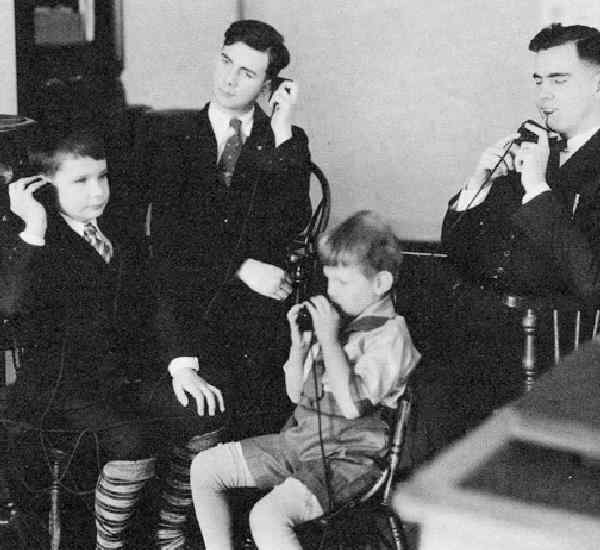
Figure 1.--This photograph shows two boys in 1934 being treated at the famous Perkins School for the Blind in Watertown, Mass., a suburb of Boston. The two boys are deaf and blind and are shown "listening" by means of a Phipps Unit for bone conduction of sound. The older boy on the left, Earl Martin, wears a dark double-breasted knicker suit with striped knee socks and a white shirt and tie. The younger boy, Leonard Dowdy, appears to be wearing button-on shorts with a short-sleeved open-collared shirt with some sort of neckerchief or tie around his neck. He wears tan long stockings. Click on the image for a fuller discussion.
|
|
Perkins is a very old and famous instituion, located now at 175 North Beacon Street, Watertown, Mass., on the Charles River, now a part of metropolitan Boston. The school is 175 years old and was the first school for the blind in the United States. Helen Keller is the most famous graduate. The school was incorporated in 1829 by John Fisher, the
original founder, and opened to receive students in 1832. At first Fisher used the house of his father in Boston. But, having outgrown this residence quite quickly, the school moved in 1833 to the larger home of Thomas H. Perkins, the philanthropist for whom the school has ever since been named. Next the school occupied a converted hotel in South Boston,
Perkins having sold his home and donated the proceeds to the school.
The School
Perkins is a very old and famous instituion, located now at 175 North Beacon Street, Watertown, Mass., on the Charles River, now a part of metropolitan Boston. The school is 175 years old and was the first school for the blind in the United States. The school was incorporated in 1829 by John Fisher, the original founder, and opened to receive students in 1832. At first Fisher used the house of his father in Boston. But, having outgrown this residence quite quickly, the school moved in 1833 to the larger home of Thomas H. Perkins, the philanthropist for whom the school has ever since
been named. Next the school occupied a converted hotel in South Boston, Perkins having sold his home and donated the proceeds to the school.
Charles Dickens
Samuel Gridley Howe, a later director of the school, established a printing department for embossing books. It was at this press that Charles Dickens' famous novel, The Old Curiosity Shop, was printed. Dickens himself visited Perkins in 1842 during a lecture tour of America. On this occasion he met the director of the school, Samuel Howe, who impressed him so much that he wrote about his visit in American Notes. Dickens was especially impressed by the work Howe was doing with Laura Bridgman, a young deaf-blind girl who came to the school in 1837.
We do not yet know much a cout the eduacation of death and blind children. We have no information about the ancient world. We suspect that children with major impairments were commonly euthenized. And as the vast majority of children recerived no formal education. Thus there would have been no povision for children with major disabilities. There are blind and to a lesser extent deaf children known in history, but often these were individuals who suffered their impairment after childhood. This did not begin to change until the 18th century when Protestant European countries began to founf free public education system. As education became more of an established convention, some educators by the 19th century began to address the difficult problem of teaching blind and deaf chilren. As a part of this process, braille and sign language weee developed as useful tools. As far as we know, all of this work occurred in the Christain West. A part of the reason was the affluence of the West. Another factor was differing attitudes toward the value of life un the West. Schools were founded to deal with the special needs of blind and deaf children in both Europe and the United States. Considerable progress was made in teaching these childen during the 19th century. The Perkins School was one of several such schools in the United States. What proved especially difficult was the unique problems of deaf-blind children. Deaf children were often called 'deaf and dumb', but deaf-blind children were in an even worse situation, virtually walled off from the outside world. The Perkins School was one of the first to address their needs. Until this time, thse childen if they survived infancy were commonly confined to insane asylums unless the family was affluent and tolerant enough to be able to afford in home care.
Helen Keller
Helen Keller is the most famous graduate. Years after Dickens visited the school, Kate Adams Keller, mother of a young deaf-blind girl name Helen, read Dickens's book, which provided a ray of hope for the mother's
6-year-old daughter, Helen Keller, who lost her sight and hearing when she was only 19 months old. Anne Sullivan, a graduate of Perkins, was sent in 1887 to teach the child, Helen Keller, in Alabama. At the same time the school established the first kindergarten for blind children in the U.S. After working with her pupil Helen at home in Alabama, Ms. Sullivan returned to Boston with Helen in 1888 and remained there until 1893. Helen wrote extensively about her experiences and about the blind and disabled in society.
Eugenics
The other side of the effort to educate handicapped children was the eugenics movement in Europe and America among other issues addressed the issue of handdicapped children. Primarily the concern in America was with mentally handicapped children. Tragically deaf children and deaf-blind children were often diagosed as retarded. Thosands of children were sterilied. The NAZIs went even furher in Europe. Helen Keller was one of the authors banned by the NAZIs and whose works were involved in the NAZI book burnings. It may seem strange today to ban Keller's uplifting books which talk about how people with disabilities can play a productive role in society. A central concern of NAZI race theory, however, was clensing the national genetic pool. The NAZIs elevated eugenics to an important and well-financed sector, but despite their efforts it remained a pseudo-scence. People with handicaps in NAZI Germany were often sterilized or in the case of severly handicapped children and adults, killed. The boys shown here had they been Germans in the 1930s would have been either sterilized or killed as part of the T-4 Program.
Samuel P. Hayes Research Library
Helen was born in 1880--the same year that the was founded at Perkins. It is considered the largest repository of its kind in the world, containing the most recent and complete
information on the non-medical aspects of blindness and deaf-blindness.
Its huge collection includes books by and about Helen Keller.
New Site
Desperately needing more space as the school grew in numbers and
reputation, Perkins moved to its present location in Watertown on the
banks of the Charles River in 1912. The new site embraced some 38 acres
of land.
Braille and Talking Book Library
In 1931 the Braille and Talking Book Library was established at Perkins. This served children and adults who cannot read conventional print but who don't want to miss out on the latest bestseller of copies of magazines such as Newsweek. In 1951 David Abraham successfullyu produced the first "Perkins Brailler" after years of experimentation. By 1977 something like 100,000 Perkins Braillers were produced and distributed all over the world.
Other Disabilities
Gradually the school began accepting students with various disabilities besides blindness and deafness, assisted in part by a grant from the Conrad Hilton Foundation in 1989. The School enjoys a much deserved reputation for innovation in the treatment of people with diverse disabilities.
Program
The Pekins school developed a program that had specialized classes designed to provide the children the skills they needed to lead independent lives. The program helped the children maximize what ever sight or hearing capability they had. At the same time the school attempted to replicate as much as possible the program and atmosphere of a regular school. There were, for example, gym classes for both the boys and girls.
HBC-SU

Related Chronolgy Pages in the Boys' Historical Web Site
[Main Chronology Page]
[The 1900s]
[The 1910s]
[The 1920s]
[The 1930s]
[The 1940s]
[The 1950s]
[The 1960s]
[The 1970s]
[The 1980s]
[The 1990s]
[The 2000s]
Navigate the Relate Boys Historical Clothing Style Pages
[Main country page]
[Long pants suits]
[Short pants suits]
[Knickers]
[Kneesocks]
[Long stockings]
[Eton suits]
[Jacket and trousers]
[Button-on clothing]
[Blazer]
[School sandals]
Navigate the Boys' Historical Clothing School Uniform Pages
[Main individual U.S. School Uniform Page]
[Main National School Uniform Page]
[Australia]
[England]
[France]
[Germany]
[Ireland]
[Italy]
[Japan]
[New Zealand]
[Poland]
[Singapore]
[Scotland]
[Singapore]
Navigate the HBC School Section:
[About Us]
[Activities]
[Chronology]
[Clothing styles]
[Countries]
[Debate]
[Economics]
[Garment]
[Gender]
[Hair]
[History]
[Home trends]
[Literary characters]
[School types]
[Significance]
[Transport and travel
[Uniform regulations]
[Year level]
[Other topics]
[Images]
[Links]
[Registration]
[Tools]
[Return to the Historic Boys' School Home]
Created: July 16, 2003
Last updated: 1:05 PM 1/18/2012