|
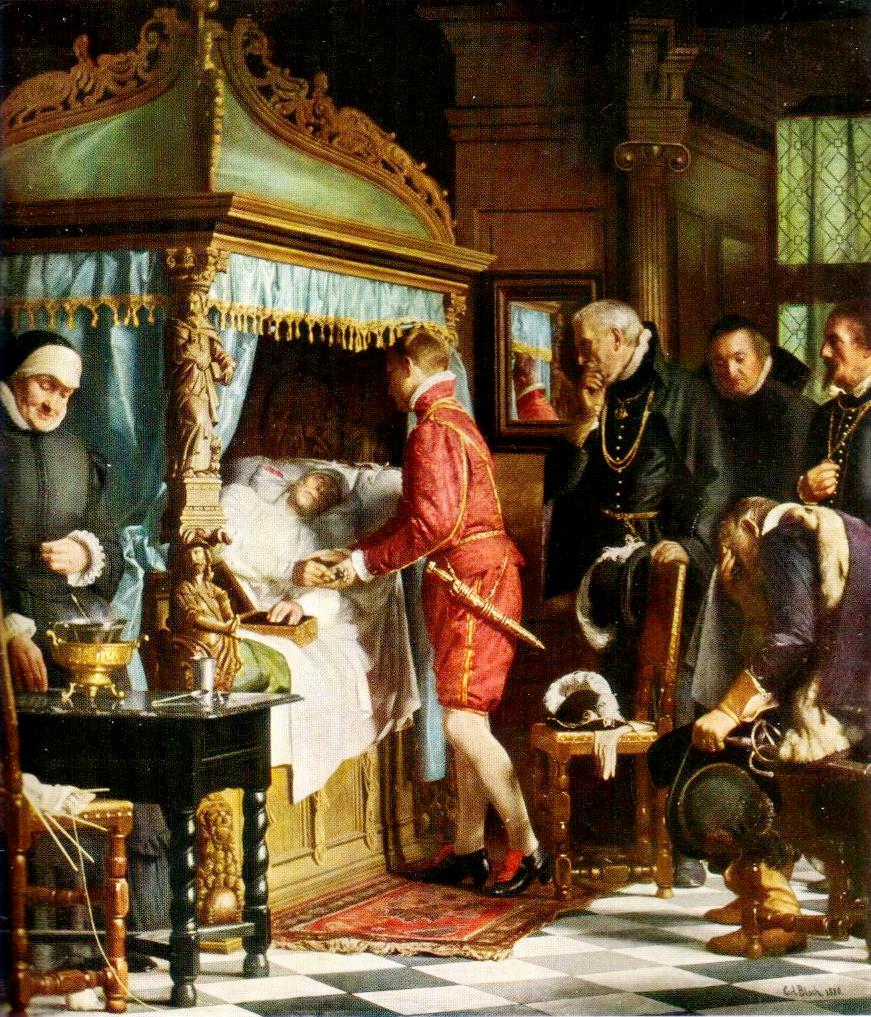
Niels Kaas was a Danish statesman who was appointed Chancellor of Denmark by Frederick II (1573) and served until his death (1594). He was notable for the negotiation of the Peace of Stettin and in the upbringing of Frederick's son Christian IV. Kaas also played an important role in the emancipation of Schleswig-Holstein a principality between Denmark and Prussia that would become important in the 19th century. Kaas was born into a noble Danish family (1535). He tragically lost his parents early. His father was Niels, who died 7 months before his son was born. His mother was Anne Bjørn, who died when he was 5 years old. As a result, Kaas was raised by his uncle Mogens Kaas, an important cleric. It was a momentous time for Danish clerics. Luther lunched the Reformation in Germany (1517). Sweden and Denmark were the first two countries to adopt Protestantism This was a major reason that the Catholic Church was unable to suppress the Reformation. He was the dean of the district of Jelling, and later cantor of Ribe Chapel. The young Niels proved a bright boy an keen scholar. He was educated at the Viborg school, where he pursued studies for 9 years. At a time that religion was still a vital part of life, he focused on on theology and classical studies. As a young teenager, Niels moved to Copenhagen (1549). He was was taken in by theologian Niels Hemmingsen. Under the direction of Hemmingsen, he completed his theological, Latin (the international language of scholarship), and historical training. Kaas began studying under Philipp Melanchthon in Wittenberg (1554). This of course id where Luther nailed his 95 thesis on the church door. He also studied in Frankfurt and Leuven withts magnificent medievl library. He saw the Battle of St. Quentin -- the Spanish victory over the French in the Habsburg-Valois Wars (1557). Kaas returned to Copenhagen and entering the Danish Chancery (1560). His academic studies in history and Latin were valuable in negotiations with other countries. King Frederick unwisely got Denmark involved in the Northern Seven Years' War with Sweden even though Frederick had allies, most notably Poland-Lithuania. The was was over the dissolution of the Kalmar Union. Kaas helped negotiate with Sweden.He was instrumental in completing the Peace of Stettin (1570). Despite enormous cost--this was basically a stalemate. Chancellor Johan Friis died (1570). Frederick and the Herredag (lords of the realm) appointed Kaas to replace him (1573). Steward of the Realm, Peder Oxe, died (1575). This made Kaas the second-most powerful person in the country. Frederick II greatly relied on Kaas, especially his negotiating skills. As Chancellor Kaas dealt with several major issues. He handled the succession crisis in Schleswig-Holstein (1582). He was involved in important diplomatic negotiations with England involving the security of English merchant shipping and other issues (1582-85). Kaas was also appointed Chancellor of the University of Copenhagen. He created the university's first professorship in history. At the University was especially interested in the astronomical research being conducted by Tycho Brahe. When Frederick was disabled by a had toothache, Kaas met the Scottish ambassadors Patrick Vans and Peter Young who were tasked with discuss the marriage of James VI (future James I of England.) He would marry Princess Anne. Frederick died (1588). Kaas as chancellor became the guardian of government. As Prince Christian was only 10 years old. Kaas had many responsibilities. A major issue was the role of the dowager queen Sophia and her father Duke Ulrich III of Mecklenburg-Güstrow. Kaas supported both, but they did not have the support of the Folketing, he developing parliament. Kaas personally oversaw Prince Christian' education and preparation. The marriage of James VI and Anne of Denmark came to fruition (589). James presented Kaas with a gold chain.
Kaas succeeded in emancipating the duchies of Schleswig-Holstein from the Holy Roman Empire (1589). He secured the accession of Prince Christian. This was not a foregone conclusion as the Danish king was still elected. Kaas now seriously ill advised Prince Christian (1594), "Your grace Lord Father, holy remembrance, I promised to his utmost, that I with all power, counsel and faithfulness should ensure that the crown came upon your head. But now prevents death me therein upon the will of God, yet I will do what I can, and provide therefore the honor of your Grace's own hands the key to the vault, where the crown, scepter, sword and orb since his death, having been bestowed. Take therefore the kingdom treasures of God himself, bears the crown with Price and glory reigns spire with wisdom and grace, bring the sword of justice and power and keeps the orb lay with counsel and prudence. God bless the king! Farewell king, farewell kingdoms and lands, father surely all the world! Come, O Jesus, if you will, now I die happy." Christian was 17 years old. He would come into his majority 2 years later (1596).

Navigate the Boys' Historical Clothing Web Site royal pages:
[Return to the Main Christian IV page]
[Return to the Main Danish royal pages]
[Return to the Main royal pages]
[Austria]
[Belgium]
[France]
[Germany]
[Italy]
[Luxenburg]
[Monaco]
[Netherlands]
[Norway]
[Romania]
[Russia]
[Spain]
[United Kingdom]