|
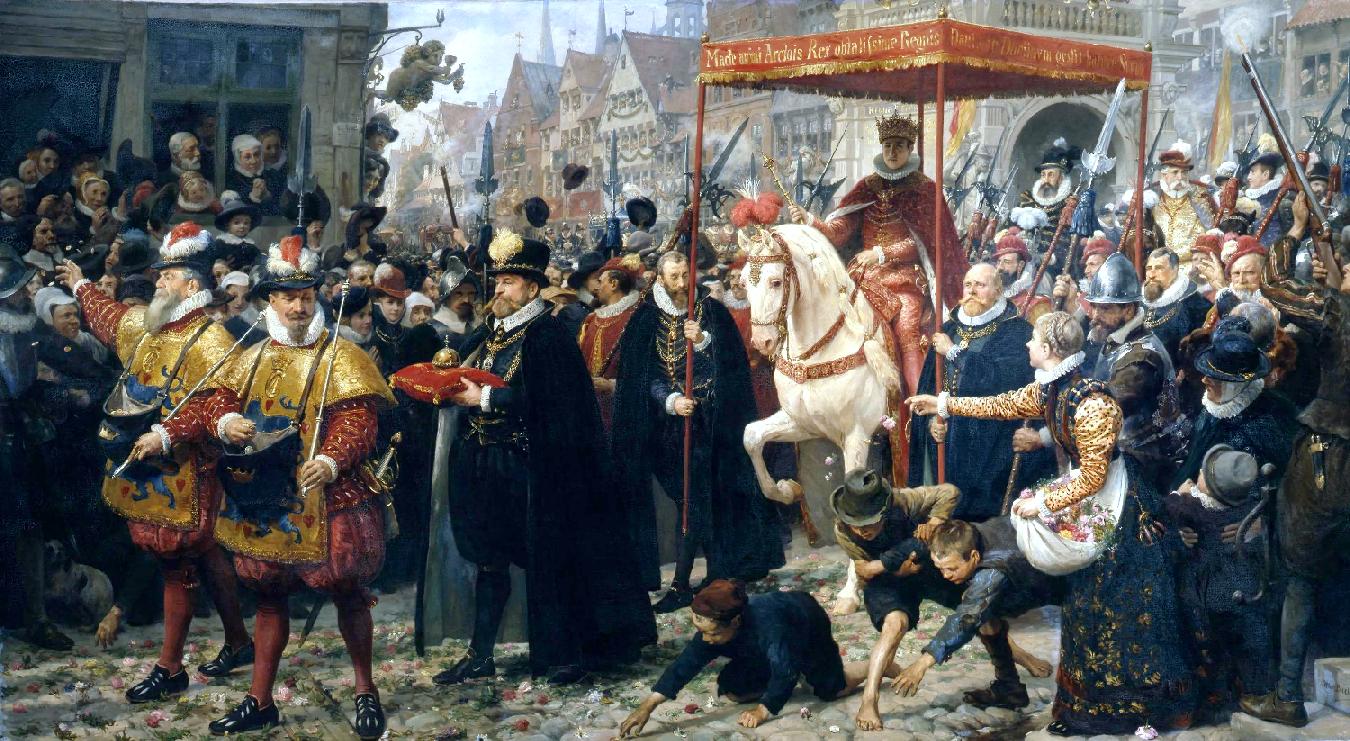
Christian IV (1577–1648) was King of Denmark and Norway and Duke of Holstein and Schleswig from 1588 until his death in 1648. His reign of nearly 60 years made him not only the longest-reigning monarch in Danish history, but in all of Scandinavian history. This was possible because his father, Frederick II died when Christian was only 10-years old (1588), at which time his reign was overseen by a regency council. Niels Kaas was Chancellor of Denmark. Kass played a major role in the education and preparation of Christian. It was Kass who helped marry off Princess Anne (Anne of Denmark) to James VI of Scotland (future James I of England.) Kaas died when Christian was only 17 years old--not yet ready for the kingship. Another issue was Danish kings were still elected. Christian was a member of the House of Oldenburg, Christian began his actual personal rule of Denmark and Norway at age 19 years (1596). (At the time the two countries were not yet united, but were governed by the same monarch. Historians rank him one of the most popular Danish-Norwegian kings. He is also seen as ambitious and an exceedingly active monarch. He launched many reforms and projects. Christian IV oversaw a level of stability and prosperity impressive for 17th century Europe. 【Lockhart】 This was the case even though he entered two very expensive wars. First there was the Kalmar War with Sweden (1611-13). Next was the Thirty Years' War (1618–48), which devastated Germany. And it undermined the Danish economy with little gain. Denmark at the time was a major European power. The Thirty Years War was the last war in which Denmark would play a major role. Christian virtually rebuilt and renamed the Norwegian capital Oslo as Christiania after himself. Oslo would not be used again until Norway became independent.
Prince Christian's father, Frederick II died when the boy was only 10-years old (1588), at which time his reign was overseen by a regency council. Niels Kaas was Chancellor of Denmark. Kass played a major role in the education and preparation of Christian. It was Kass who helped marry off Princess Anne (Anne of Denmark) to James VI of Scotland (future James I of England.)
Kaas died when Christian was only 17 years old--not yet ready for the kingship. Another issue was Danish kings were still elected. Christian was a member of the House of Oldenburg, Christian began his actual personal rule of Denmark and Norway at age 19 years (1596). (At the time the two countries were not yet united, but were governed by the same monarch.
Christian IV (1577–1648) was King of Denmark and Norway and Duke of Holstein and Schleswig from 1588 until his death in 1648. His reign of nearly 60 years made him not only the longest-reigning monarch in Danish history, but in all of Scandinavian history. Historians rank Christian as one of the most popular Danish-Norwegian kings. He is also seen as ambitious and an exceedingly active monarch. He launched many reforms and projects. Christian IV oversaw a level of stability and prosperity impressive for 17th century Europe. 【Lockhart】 This was the case even though he entered two very expensive wars. First there was the Kalmar War with Sweden (1611-13). Next was the Thirty Years' War (1618–48), which devastated Germany. And it undermined the Danish economy with little gain. Denmark at the time was a major European power. The Thirty Years War was the last war in which Denmark would play a major role. Christian virtually rebuilt and renamed the Norwegian capital Oslo as Christiania after himself. Oslo would not be used again until Norway became independent.
Some monarchs have trouble producing a single heir--think England's Henry VIII. This was not a problem for Christian. He married twice producing 19 legitimate children, although eight died in infancy or early childhood. Anne Catherine of Brandenburg died after producing 7 children. Kirsten Munk married King Christian in a morganatic marriage. They produced an astonishing 12 additional children.
His first wife was Anne Catherine of Brandenburg (the foundational state of Prussia) and family. Christian met Anne on a journey in Germany (1595) and decided to marry her. Anne Catherine and her parents were present at his coronation (1596). Thee marriage was arranged (1597). Queen Anne Catherine has not attracted much historical interest. This probably means that she had little political influence. She commonly accompanied Christian on his travels. At the time, she was praised for her modesty and religious devotion. We have seen no discussion as to whether the marriage was a happy on or not. Christian did take mistresses, mostly at the end of their marriage. The constant string of child births is probably a indication that it was a relatively successful marriage. hey had seven children. The oldest surviving son was Christian (1603)-1647), but he died unexpectedly just before his father. As a result, Frederick (1609-70), succeeded his father as Frederick III. A third son Ulrik was murdered (1611-33). They lost three of their children even before Prince Christian died. Two daughters, Sophia and Elisabeth, and their eldest named son, Frederick, were lost at a very young age.
Christian after the death of his first wife married again (1615). Kirsten Munk was the only surviving daughter of Ludvig Munk (1537–1602) and Ellen Marsvin (1572–1649). They were wealthy and a member oft he nobility, but untitled. Her mother widowed a second time (1611), was the greatest landowner on Funen - .the third-largest Danish island after Zealand and Vendsyssel-Thy. Ellen Marsvin was one crafty lady. She was more than aware of how nobles including monarchs used and discarded young women. And Christian even though he was king, needed he approval for the marriage. Prior to providing approval to the apparent desires of the King there were real negotiations. Her mother had a strong negotiating position. Kirsten was a member of the nobility and not a commoner. Her mother rejected her becoming a mistress. She demanded that her daughter receive properties in her, described as tokens of the king's 'honorable intentions'. It was a morganatic marriage. This meant that Kirsten would not be queen. They were marries, but not in a church. She was ultimately given the title Countess of Schleswig-Holstein (1627). With his second wife, and family there were an impressive 12 children. This was a private marriage not meant to impact the succession. The children were styled counts an countesses of Schleswig-Holstein. We are not sure why this was, especially because much of the population was German speaking. It certainly suggests the importance the monarch attached to Schleswig-Holstein. The oldest boy was Count Valdemar Christian (1622-56). Valdemar would unsuccessfully contest the kingship with Frederick. There were also a number of illegitimate children.
Lockhart, Paul D. Denmark, 1513–1660: the Rise and Decline of a Renaissance Monarchy (2007).

Navigate the Boys' Historical Clothing Web Site royal pages:
[Return to the Main Danish royal pages]
[Return to the Main royal pages]
[Austria]
[Belgium]
[France]
[Germany]
[Italy]
[Luxenburg]
[Monaco]
[Netherlands]
[Norway]
[Romania]
[Russia]
[Spain]
[United Kingdom]