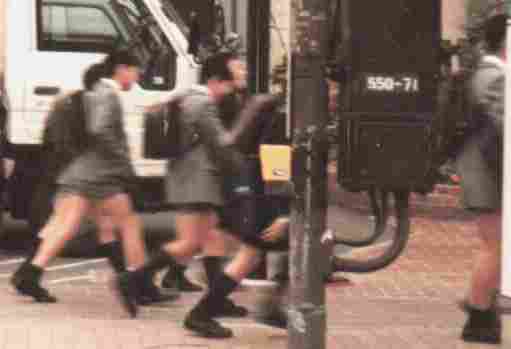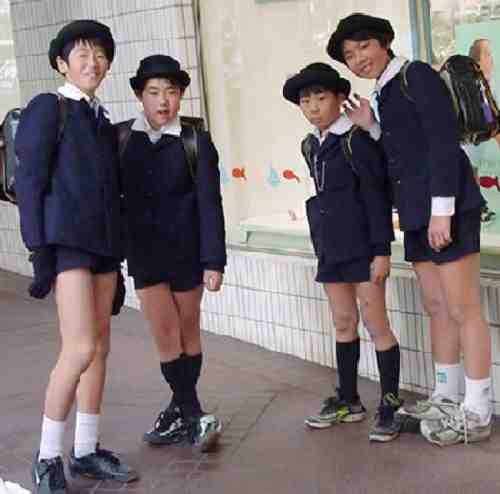
Figure 1.--Many Japanese schools are very strict about the uniform. Often all boys will wear shorts of almost identical length. This is the schools winter uniform. |
Private primary schools, all of which I believe are located in cities, sport a wide variety of uniforms -- indeed, Japanese private primary schools serve almost as a living encylclopedia of boys' fashions over the
past century. Once a school settles on a uniform, it seems to stick with it forever. I have heard of one private school that permits (uniform) long pants in the winter, but virtually all the others require short
pants year round. Most of them require some sort of jacket from October 1 through May 31, and permit shirtsleeves in the summer. I don't have information on specific private schools outside the Tokyo Metropolitan area, but I believe conditions are similar in Osaka/Kobe/Kyoto. The uniforms at some elite private primary schools in Tokyo are as follows:
Known in English as Peers' School and the school to which the
Imperial Family and the descendants of the pre-war nobility typically
send their sons (the Emperor, the Crown Prince, and the late Emperor Showa
are all graduates), this boys school requires military-type hats of the
type once worn by naval officers, navy blue high-collared tunics,
knee-length shorts (unusual among primary schools), dark ankle socks, and
black shoes. Tunics not required in the summertime. Gakushuin has a uniform
with the longer-style knee-length short pants popular during the 1ate 1990s,
but that's because their uniform is unchanged from the early years of 20th
century.
This prestigious, expensive Catholic boys school founded by French missionaries in the 19th century, requires in winter time the Prussian cadet tunic and hat typical of secondary schoolboy uniforms but
with a gold band around the hat and short serge black short pants instead of longs, black mid-calf socks, and boot-like black shoes. The school is unusual in requiring a distinctive summer unform, not just the
white-shirt-and-shorts of most schools: olive green short sleeved shirt, very short olive green short pants, black shoes and black mid-calf socks, white military-type hat. This school supports a
boys choir.
Jiyu gakuen junior high school was a well known private school in Tokyo. The Jiyu Gakuen Junior High School was not just a junior high school. The junior high school was a division part of a larger school.
|
Keio Gijuku (Keio Private School System)is a well known private school in Tokyo. It was not specifically a junior high school, but rather a comprehensive educational intutution offering primary to university education. Keio University is one of the most prestigious private schools in Japan. Keio JuniorHigh was thus only part of the overall program. Keio like most private schools required a uniform. The school had quite different summer and winter uniforms. The summer uniform was rather informal while the winter uniform rather formal. Keio in 1990 even founded the Keio Academy in New York primarily to meet the needs of Japanese living overseas.
This is the most famous private primary school in Japan (although not the most academically rigorous). It is affiliated with Keio University, meaning that like other elementary schools affiliated
with universities, pupils who graduate are guaranteed admission to the University-affiliated middle and high schools and then to the University itself. Thus, children who succeed in getting in to Keio Yochisha and
other comparable schools avoid the "examination hell" that blights the
childhoods of so many other Japanese. Keio Yochisha's student body
consists largely of children of an elite class of celebrities and wealthy
executives. Having a child there is highly presitigious, and the result
is intense competition for places. The elite private schools in Japan are highly influential. Other schools emulate Keio Yochisha in
many respects, including the uniform. The school is quite strict about the uniform. The winter uniform consists of a
distinctive round felt hat, navy blue suit, and broad white, eton-type
collar. The tunic is belted in back with a broad, single pleat. Girls
wear pleated skirts, boys wear short pants cut quite short. Curiously for a school which is quite strict about its uniform, uniform red-striped navy ankle socks and black shoes are optional. Most boys wear sneakers instead and variousdly white or dark knee or ankle socks. This lack of uniformity is quite rare at a Japanese school with a strict uniform requirement. Most boys do not wear coats over their uniforms on the way to and from school even on cold days. A few boys wear overcoats, but it is not common. Sweaters are often worn under the tunics on cold days. The summer uniform consists of a light gray suit (jacket optional). The shorts are even shorter than those on the winter uniform, and worn with a red-striped belt. The boys all have the tradition black school book bag that was origiginally styled like the knapsack worn by Japanese soldiers in the late-19th century.
We know nothing about the Matsuyama School at this time except that a HBC reader tells us that it is a private school. We do know where the school is located. Matsuyama is Shikoku's largest city and capital of Ehime Prefecture. The city is noted for Matsuyamajo, a beautiful, historical castle and the Dogo Hot Springs. Shikoku is on of the Japanese home islands. It is Japan's fourth largest island, southwest of Japan's main island Honshu. Shikoku is divided into four prefectures. Hopefully our Japanese readers will be able to tell us more.
Ochanomizu University has an affiliated elementary school. The University is one one of Japan's top women's colleges--many of the graduates go on to be teachers and the elementary school is essentially a "training school" The boys' uniform is the classic Prussian-sdtyle military school uniform. The pre-World War II Japanese uniforms were very similar to this one, except that tights wearing was common before the war and almost completely disappeared afterwards except among the very young.
|
Affiliated with Rikkyo University, an Anglican institution, this
all boys school is also known by its English name, St. Paul's. The
uniform suggests British origins. Boys wear navy blue beanies, gray suits
with long-sleeved white shirts, red ties, very short short pants
(extending just below the hem of the jacket), navy blue knee socks, and
black shoes. Jackets and ties are not required in the summer. A
standard, knee-length navy coat may be worn to and from school on cold
days.
Tamagawa Gakuen is one of Tokyo's most respected private schools. The Junior High School is referred to as the Lower Secondary School.
Toin Gakuen is a Japanese school corporation, meaning a private school. It offers parents a comprehensive coed school ebiroinmentfor their children. This included kindergarten through to university graduate school. The campus is lkocated in Tetsumachi, Aoba-ku, Yokohama. The school is afiliated with Yokohama General Hospital as an affiliated company. In 1964, the slogan was 'private education that public education cannot do'. At this time a high school opened. Classes are organized according to ability (proficiency level) from the beginning, and classes are provided according to ability. In 1965, a technical college (boys' school) was opened (closed in 1991), a junior high school in 1966, an elementary school in 1967 the following year, and a kindergarten in 1969 (two-year childcare). In 1981, the girls' club was established, and in 1987, the recruitment of technical colleges was suspended and Toin University of Yokohama was established. Opened the German Toin Academy in 1992 (closed in 2012). In 1988, the Memorial Hall (now: Toin Symphony Hall) was completed to provide students more experiences wiyh the arts.
Not sure of the name, but this school is affiliated with Tsukuba
University, this co-ed school has a distinctive peaked dark cap with a
white cotton ball, highcollared navy tunic, very short short pants,
regulation white mid-calf socks and black loafer-type shoes. Probably
one of the smartest uniforms in Japan). The girls uniforms differ substantially
from the boys. The girls skirts are longish and worn with kneesocks. The boys' shorts are very short and with the mid-calf socks. Much like some of the British co-ed prep schools during the 1980s. I'm not sure why there is such a difference.
Among other uniform styles I have seen: ocean-blue blazers, school tie, gray flannel mid-thigh-length short pants, gray knee socks, black shoes, military hat; navy blue jacket, tie, gray plaid short pants, no specific
shoe or sock requirement; navy blue high-collared tunic, very short navy blue short pants, white knee socks, military-style hat, no shoe requirement.
Related Links: Careful this will exit you from the Boys' Historical Clothing web site, but these sites are highly recommended
Boys' Preparatory Schools: Lovely photographic book on British Preparatory Schools during the 1980s with over 200 color and black and white images.
New Zealand E-book: New digital book on New Zealand schools available
New Zealand E-book: New digital book on British prep schools available

Related Chronolgy Pages in the Boys' Historical Web Site
[Main Chronology Page]
[The 1900s]
[The 1910s]
[The 1920s]
[The 1930s]
[The 1940s]
[The 1950s]
[The 1960s]
[The 1970s]
[The 1980s]
[The 1990s]
Navigate the Relate Boys Historical Clothing Style Pages
[Main country page]
[Long pants suits]
[Short pants suits]
[Lederhosen]
[Kneesocks]
[Eton suits]
[Jacket and trousers]
[Blazer
[School sandals]
Navigate the Boys' Historical Clothing School Uniform Pages
[Return to the Main Japanese individual school Uniform Page]
[Main School Uniform Page]
[Australia]
[England]
[France]
[Germany]
[Ireland]
[Italy]
[Japan]
[New Zealand]
[Scotland]
[United States]
Navigate the Boys' Historical Clothing Web Page
[Introduction]
[Activities]
[Biographies]
[Chronology]
[Cloth and textiles]
[Clothing styles]
[Countries]
[Topics]
[Bibliographies]
[Contributions]
[FAQs]
[Glossaries]
[Images]
[Satellite sites]
[Tools]
[Boys' Clothing Home]