|
American President Franklin D. Roosevelt and British Prime Minister Winston Churchill decided that the Allies needed to open a Second Front to take pressure off the hard-pressed Red Army reeling under the German summer offensive driving toward Stalingrad and the oil-rich Caucauses (July 1942). Joseph Stalin demanded an invasion of Europe. Wisely Roosevelt and Churchill targetted French North Africa. American General George Marshall, in many ways the architect of the American victory, was opposed to Totch, considering it a diversion. Roosevelt insisted. While Montgomery's victory at El Alemain often receives more attentiin, it was the Torch landings that were the decisive action. The Amercan and British landings in North Africa sealed the fate of the Axis desert campaign. Even if Rommel had broken through to Suez, he would have been forced to turn west to deal with the Allied landings in French North Africa. General Dwight D. Eisenhower was appointed Allied commander to oversee the Torch Landings. The Allies driving east from their Moroccan and Algerian beachheads linked up with the Brish advancing west (November 1942). Although Hitler rushed reinforcements to Tunisia, the end result was the first major defeat of a German Army by the Western Allies.
France at the onset of World War II controlled North Africa (Morocco, Algeria, and Tunisia). This began with Algeria (1830s). It was the first step after the Napoleonic Wars in rebuilding the French colonial empire. Substantial numbers of French colonists moved to Algeria in particular. French policy becane to recreate Algeria as an extension of France. The French colonists were known ad the "pied noir". Morocco was different. Moricco was a protectorate, not a colony and it was acquired much later (1906-12) and there was a smaller French population. The German World War II invasion (May-June 1940) did not reach North Africa. And the terms of the Franco-German Armistace (June 1940) left French North Africa unoccupied. Vichy had substantial military forces in North Africa,but poorly armed. The Vichy military force in France itself was strictly limited. These limits did not apply to North Africa. There were also important naval bases where part of the powerful French fleet was based.
Robert Murphy was a virtually unknown diplomat at the U.S. Embassy in Paris. When the Germans entered Paris, the Embassy was essentially closed down (June 1940). Murphy was sent to Vichy where Marshal Petain after signing an armistice with the Germans organized a new French government in the unoccupied zone. From Vichy Murphy wrote a number of reports. One of these reports addressed the possibility of arming French forces in North Africa to continue the fight against the Germans. America was still neutral at the time and the idea of an American invasion was not something that Murphy addressed. That report would come to the attention of the President. [Vaughan] And the result was an American diplomatic effort to drive a wedge betweem Vichy and the NAZIs.
We are not sure precisely when President Roosevelt decided that an invasion of North Africa would be America's opening move against the European Axis. He seems to have decided long before America entered the War, perhaps as soon as his election victory (November 1940). This was when he sent Robert Murphy to Algiers on a fact-finding mission. [Vaughan]
President Roosevelt chose Robert Murphy as his Special Representative. Murphy met with the President several times. Unfortunately for historians, there is no record of these meetings. He reported directly to the President. The State Department would be entirely cut out of not only the Murphy mission, but Operation Torch itself. This was typical for the President and an on going frustration for Secretary of State Hull. The Stte Department would find out about Torch only after the landings occurred. Murphy selected a small group to collect information on military forces that could resist the landings throughout French North Africa (Morocco, Algeria. and Tunisia). These men operated under the cover of consular commercial and relief activities. They also made contact with French resistance forces that would assist the Allied landing force and disrupt Vichy resistance. Murphy made his first trip to Algiers (November 1940). He returned to report to the President and then went back to Algiers. [Vaughan] Murphy at first had some hope that P�tain could be convinced to join the Allies and then turned his attention to the Vichy commander in North Africa, General Maxine Weygnd. This also proved fruitless, Weygand refused to break with P�tain and was eventually replaced. [Funk] Murphy saw Admiral Darlan and General Juin as individuals that could bring Vichy forces over to the Allies, but their loyalties were questionable and neither could be safely approached on the subject for fear of alerung the Germans of the landings being planned. [Funk]
The Japanese carrier attack on Pearl Harbor of course changed everything (December 1941). America was now in the War and the American and the once powerful Iolationist movement virtually disappeared overnight. Americans from the time the first bomb fell on Pearl Harbor were firmly behind the war effort. Adolf Hitler removed an inconvient problem that Roosevelt would have faced by declaring war on America. It would have been difficult to pursue a Germany first policy when it was the Japanese who attacked Pearl Hsrbor. Now Churchill had want he had waited for over a year--an American ally fully in the struggle. He rushed to Washington to meet with the President (January 1942). His primary concern was to make sure that despite the Japanese attack, priority would be given to the European Theater and the defeat of NAZI Germany as they had previously planned. Churchill realised that a Cross-Channel; invasion was not feasible in 1942 and saw an invasion of North Africa as the best option open. The discussions were mostly about equipmebt and supplies. But as woul become apparent in Tunisia, the Green American Army was not yet ready to take on the powerful German firces in occupied France. Gen. Marshall was from the beginning focussed on France. Roosevelt over ruled him, a rare such instance, abd sided with Churchill which set the planning for Torch in motion.
The Americans and British agreed from the onset that priority would be given to the defeat of NAZI Germany which posed the greatest military threat. There were substantial differences between the two militaries about the appropriate strategy. The Americans in part because they had not yet confronted the Germans wanted to prepare for a cross-Channel invasion of France as soon as possible. The British were nore cautious, in part because they knew the strength of the Germans and in part because they were unsure about the capabilities of the American Army. American President Franklin D. Roosevelt and British Prime Minister Winston Churchill decided that the Allies needed to open a Second Front to take pressure off the hard-pressed Red Army reeling under the German summer offensive driving toward Stalingrad and the oil-rich Caucauses (July 1942). Joseph Stalin demanded an invasion of Europe.
Churchill had been advocating an invasion of North Africa, concerned that the Allies were not yet strong enough to confont the Germans in France. The Americam military including General Marshal resisted this which they considered a diversion. Finally President Roosevelt broke the impasse and sided with Churchill. The Combined Chiefs of Staff gave the orders to invade North Africa (July 1942). Wisely Roosevelt and Churchill targetted French North Africa. American General George Marshall, in many ways the architect of the American victory, was opposed to Totch, considering it a diversion from the most important action, a cross Channel invasion. Roosevelt who relied heavily on Marshal, however, insisted in this instance.
While Montgomery's victory at El Alamein often receives more attention, it was the Torch landings that were the decisive action. The Amercan and British landings in North Africa sealed the fate of the Axis desert campaign. Even if Rommel had broken through to Suez, he would have been forced to turn west to deal with the Allied landings in French North Africa. Securing North Africa meant essentially meant opening the Mediterranean which would relieve one of the Allies major problems of the war--shipping shortages. It bould mean long voyages around Africa (the Cape of Good Hope) could be avoided. Victory in North Africa also precluded German access to Middle Waern oil and an Axis hook up. While the brutal conflict on the Eastern Front was the central campaign of the War. North Africa was of considerable importance. And here the Allied camapaign assisted the Soviets on the Eastern Front. While Hitler kept the German commitment to North Africa limited to focus on the Eastern Front. Kt is notable that with the Torch landings (Nobember 6-16) Hitler threw very substantial land and air resources into Tunisia only days before the Soviets struck at Stalingrad (November 19). Committing these resources seriously impaired the Germans ability to both aupply the Stalingarad pocket by air and to relieve the Stalingrad pocket on the ground. Even with these forces they may have failed, but without them Paulis and the Sixth Army was doomed.
German military intelligence proved amazingly ineffective throughout World War II. Two of the greatest failures occurred during November 1942. The Germans failed to detect preparations for either Totch or the Soviet Uranus build up in the East go isolate the Sixth Armyb in Stalingrad. The Anwehr provided Hitler no advanced warming of Totch. The British Double Cross system helped confused the Abwehr. A Polish national codenamed Careless was involved. Another agent, Cheese, was also involved. He was also involved in the Western Deset and Huskey (Sicily invasion). Tne problem for the Abwehr was that the British were constantly running convoys down the coast to supply their African colonies. Some of thiose convoys also turned into the Mediterranean to supply Malta. The Germans thus did not know what to make of the convoy leaving Portsmouthb and Glasgow. They seemed not to have detected the American convoy from Norfolk. Only days before the Torch landingfs, German and Italian intelligence did observe a major buildup of Allied shipping around Gibraltar (early November). The Germans dismissed the Allied activity as simply another supply convoy to reinforce Malta. The Italians were less sure, but it was the Germans that were controlling the war effort. The Germans began to see a Allied invasion of North Africa as a possibility. OKW offered Vichy air support in case of a British invasion (Midnight November 7). Vichy military authorities in Algiers accept the offer. OKW asks for rports from the Italian Navy. The Italians conclude the British are about to invade North Africa. Neither the Germans are Italians yet know the Americans are also involved. OKW received reports from the Spanish theorizing an invasion of Italy. Hitler is briefed at Rastenberg in East Prussia and he cocluded that the Allies will land at Tripoli or Benghazi in Libya to cut off the retreating Afrika Korps. He then left for Munich where he is to speak on the annivrsary of the Beer Hall Putch. It would be one of his last major speeches and he was under the impression he had finally won at Stalingrad. The only action OKW took was to order Field Marchall Von Rundstedt, Commander-in-Chief West to prepare to execute Operation Anton, the occupation of Vichy and the seizure of the French fleet if necessary. The Kriegsmarine's war diary reports that commanders were confused. "These contradictory reports cannot give definite indications of the enemy operational goal or goals." Jodl breiefed Hitler on the train to Munich at 7 p.m. Jodl reported that large Allied convoys were in the Mediterranean and headed east. He concluded that the Allies will pass Sicily heading for Malta and Libya. It is a poorly considered assessment. The Allies would never send troop convoys into an area vulnerable to air attack. Algeria was the obvious target. At that very time the convoys began to turn south for Algiers and Oran. Hitler tells Jodl, "If these reports are true, this is the greatest fleet in the history of the world." The F�hrer was now going to face the consequences of declaring war on America. A weel later the Red Army would unleash Operation Uranus on the 6th Army in Stalingrad.
The Allies put together three powerful naval task forces to convoy over 150,000 American and British forces to Vich controlled North Africa. This was the most powerful flotillaever assembled up to that time. The all American Western Task Force with 35,000 troops were ordered to seize French Morocco, targetting Casablanca and Port Lyautey. The Center Naval Task Force was made up of British ships but with 39,000 American troops was ordered to seize Oran. The Eastern Task Force escorted by British warships with 23,000 British and 60,000 American Troops whose ordered to seize Algiers.
The first British ships with equipment left the Clyde (October 2). The first troop convoy left (October 22) with others following (October 26 and November 1). They coverged on Gibraltar. The last ships reached Gibralter (November 4). It is only when large numbers of ships appeared at Gibraltar that Axis analysts began to ask questions. The covering British warships departed their bases (October 20-30). Torch planners had been concern with U boats and anticipated such a major assemblage of shipping would be spotted and attacked. U-boats did spot some of the British convoyst, but did not attach any importance to it. There were no U-boat attacks on the convoys. A factor here was a major U-boat attack on an unrelated convoy en route from Sierra Leone to Britain.
The Western Task Force, so named because they were to land in western North Africa, was also designated Task Force 34. It was an American force commanded by Rear Admiral H. Kent aboard the heavy cruiser, USS Augusta. The Western Task Force departed from the U.S. Navy's principal East Coast base at Hampton Roads (Norfolk Virginia), Casco Bay (Maine), and from other U.S. ports (late October 1942). They were joined at sea by other American forces that had been deployed to Bermuda. The naval component included
three battleships (including the USS Massachusetts, five aircraft carriers (includung USS Ranger, light and heavy cruisers, destroyers, attack transports, cargo transports, oilers, and submarines. The American expeditionary force was ordered to make three landings on the Atlantic coast of French Morocco. The 35,000 U.S. Army troops aboard were commanded by the then virtually unknown Major General George Patton, They comprised the U.S. 2nd Armored Division and the U.S. 3rd and 9th Infantry Divisions. Patton's forces included 250 tanks. The northern group would land at Rabat, about 50 miles northeast of Casablanca. Their principal objective was the airfield at Port Lyautey. The center group anchored at Fedhala Roads and the landings moved on Casablanca. The southern group was to land at Safi, about 150 miles southwest of Casablanca. The plan was to seize the harbor at Safi where the tanks could be unloaded and then drive on Casablanca
The Central Task Force was to land at Oran. The landings were directed by Royal Navy Commodore T. H. Troubridge. American Major-General Llyod R. Fredenhall commanded the lanfing force consisting of about 18,500 troops. Major-General James Doolittle commanding the Allied Western Air Command on the Largs landed at Oran. The Oran landings were supported by a battleship, three carriers, an anti-aircraft ship and nine destroyers acting as a covering force in case the Italian Navy attempted to oppose the landings.
The Eastern Task Force was a combined American-British force which departed from British ports. The Task Force was commanded by Vice-Admiral Sir Harold Burrough. The landing force was commanded by Lieutenant-General Kenneth Anderson. He had the British 78th and the US 34th Infantry Divisions totaling about 20,000 troops. The American troops had been dispatched to Britain soon after America entered the War fully expecting that they would be used for a cross-Channel incasion. The Eastern Task force targeted Algiers.
The air operations to support the invasion were also split into a western and eastern sector. The dividing point was Cape Tenez in Algeria. British Air Marshal Sir William Welsh commanded the British aircraft eastern sector. Major General Jimmy Doolittle placed under Patton's command oversa the American aircraft in the westertn sector. This was the weakest aspect of the invasion. Air coover was provided by carriers, but carriers are vulnerable to both air attack from land bases as well as U-boat attack. Torch was the only World War II anphibious invasion conducted without total air superiority over the beachhead. The French had air forces, but did not use them in a determined manner. And the planes were older models. As a result of the vulnerability to air attack, the initial objectives of the Torch landings were the capture of the major airfields. This would allow the Allies to protect the invasion fleet and to orovide air support for ground operations. The Allies hoped to have the airfields within the first 24 hours.
After the French defeat by the Germans, the armistace left an area of France unoccupied which was governed from Vichy. The Vichy Givernment also controlled French colonies like the three North African colonies. Vichy had an army of about 100,000 men in North Africa, more than half in Morocco, A major concern of Allied planners was how the Vichy forces would react to the landings. While the Vichy troops were lightly equipped, the size of the force combined with French naval forces represented a far from negligible danger to the Allied invasion force. In retrospect this was especially true because the Allied amphibious capabilities and techniques were far from worked out. The Allies hoped that the Vichy forces could be induced to come over to the Allied side. Vichy forces had previously resisted the British (Oran, Dakar, and Syria). Planners hoped that they would be less hostile to the Americans. This proved to be an exercise in what Eisenhower came to see as Byzantine and nearly ended his military career. Eisenhower's first step went well. He met secretly with General Henri Giraud in Gibraltar (November 7). He informed Giraud about Operation Torch and convinced him to become commander of French forces in North Africa on the Allied side. Giraud was a respected figure, but he did not command Vichy forces in North Africa. The situation in North Africa was very complicated. French commanders uniformily hated the Germans, but that did not mean that they were ready to cooperate with the Allies--especially the British. Vichy Commanders reacted variously to the landings. There were many considerations. Many despised the British. The British attack on the French fleet in 1940 affected many French commanders. Others were concernned about the strength if the Allied landings. They were quite aware of the disatrous Dieppe landings. They were not at all sure that the Allies could defeat a German army. (The El Alemaine victory was till not fully appreciated.) Many like P�tain still believed that France's only hope was to accept Hitler's New Order. Vichy commanders were uninterested in beconing associated with another Dieppe. They were also concerned about what the Germans might do in France if they did not resist. In particular they were concerned about German retributions to their families. Many wwre also loyal to Marshal P�tain personally. Others though Vichy's anti-Semetic actions and actiins against Socialists abd Trade unions was needed to reshape France.
General Dwight D. Eisenhower was appointed Allied commander to oversee the Torch Landings. This was a surprise choice. He was a vuirtually unknown colonel who Gen. Marshall noticed and brought to his staff. Earlier he had
beem NacArthur's chief of staff in the Philippines. He was one of the few staff members that MacArthur tolerated to stand up to him. Eisenhower arrived at Allied headquarters at Gibraltar 2 days before the landings. He would direct the invasion force from the British strong pont (November 6).
General Eisenhower was a military man with littkle experience in European diplomacy. He would have to become a fast learner. The Allies needed a French commander that could rally the Vichy forces in France to the Allied side. The Allies wanted to fight Germans not the French. General DeGualle was not an option. He had alienated both Roosevelt and Churchill and besides had no appeal to Vichy commanders. (Which was demostrated at the failed effort to seize Dakar in 1940). The Allies chose General Henri Honor� Giraud who was smuggled out of France. Upon arriving at Gibraltar, Eisebnhower learned that he was demanding to be given command of all Allied forces 48 hours after the landings. Eisenhower's Deputy Matt Clark was also dumbfounded. He was expected to take over command of French forces, not American and British forces. Eisenhower had expected Giraud to rally the Vichy forces so the Allies could land unopposed. The plan was to fly Giraud to Algiers, but Eisenhower had him reouted to Gibraltar. Eisenhower and Giraud argue. Eisenhower offered Giraud the governorship of North Africa and the material support to build an army. Giraud tells Eisenhower that he "... cannot accept a subordinate position in this command. His countrymen would not understand and his honor as a soldier would be tarnished." He shouts at Eisenhower, "I am General Giraud! I'm like Joffre! My prestige! My family!" In the end Giraud proved a disappointment to the Americans. He proved incapale of rallying the Vichy forces like De Gualle was able to do.
The Germans and Italians did not learn about Torch until the Allied soldiers started coming ashore. As a result, they took no efforts to intercept the convoys. Italian Foreign Minister Ciano makes no mention in his diaries until the day before the landings. "... what will the various convoys do that have left Gibraltar and are eastward bound. [Ciano still did not know about the convoy from America.] There are various conjectures. According to the Germns, the provisioning of Malta or an attempt at landing un Tripolitania [westernn Libya] in order to fall on Rommel's rear, According to our General Staf, the occupation of French bases in North Africa. The Duce, too, is of this opinion; in fact, he believes that the landings will be accomplished by the Americans, who will meet almost no resisance by the French. I share the Duce's opinion; in fact, I believe that North Africa is ready to hoist the Gaullist flag. All this is exceedingly serious for us." [Ciano, November 7, 1942, p. 540.] A few hours after writing this in his diary, Ciano would know. German Foreign Minister called Ciano on the telephone. "At five thirty in the morning von Ribbentrop telephoned to inform me of the American landings in Algerian and Moroccan ports. He was rather nervous, and wanted to know what we intended to do. I must confess that, having been caught unawares, I was too sleey to give a very satifactory answer." [Ciano, November 8, 1942, p. 540.]
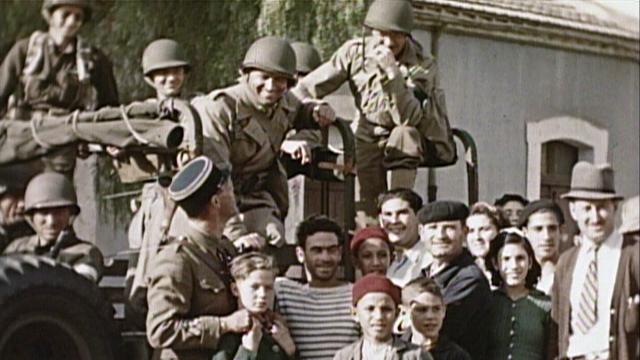
The Allies forces landed in Casablanca, Oran and Algiers. French resistance varied. Vichy forces resisted at Oran, in part bedause the Beitish were involved. This was the third major Allied amphibious operation of the War. (Dieppe and Guadalcanal was came earlier.) There were mistakes made, but the limited Vichy resistance resulted in success. Although commanders had mixed feelings, few Vichy soldiers had ny desire to fight the Americans. There were no German units to bolster Vichy resistance. For the Allies it was a learning experience.
American policy even after Pearl Harbor was aimed at separating Vichy from the Germans. It was hoped as planning for Torch ungolded that they could convince Vichy not to resist the landings in Noth Africa. As the landings in North Aftica commenced, a letter from President Roosevelt was delivered to P�tain (November 8). His response is instructive. "It is with stupor and sadness that I learned tonight of the aggression of your troops against North Africa. I have read your message. You invoke pretexts which nothing justifies. You attribute to your enemies intentions which have not ever been manifested in acts. I have always declared that we would defend our empire if it were attacked; you should know that we would defend it against any aggressor whoever it might be. You should know that I would keep my word. In our misfortune I had, when requesting the armistice, protected our empire and it is you who, acting in the name of a country to which so many memories and ties bind us, have taken such a cruel initiative. France and her honor are at stake.
We are attacked; we shall defend ourselves; this is the order I am giving."[Philippe P�tain] In actuality, Vichy forces
did resist the Americans and British landing in Morocco and Algeria, but did NOT resist the German landings in Tunisia. There would be no French resistance to Grman incursions on the Empire or to France itslf.
Vichy forces resisted at Oran. General Mark Clark attempted to negotiate with Admiral Jean-Francois Darlan who was the Commander-in-Chief of Vichy forces to achieve a ceasefire. Darlan agreed to a cease fire (November 11). French troops in Morocco and Algeria, stopped fighting but some joined the Germans in Tunisia. More importantly they turned Tunisian ports over to the Germans. Here Darlan was involved in double dealing. Eisenhower made perhaps his most contriversial decession of the War. He appointed Darlan as the political head of the French North Africa. The appointment outraged Free French leader General Charles De Gaulle. While De Gaulle and Giraud did not get along, De Gaulle (for good reason) saw Darlan as a Fascist and a NAZI collaborator. While De Gaulle was essentially correct, from a military point of view, accepting Darlan reduced Allied casualties and facilitated the landings and a rapid Allied buildup. Although not authorized in advance, Churchill and Roosevelt supported Eisenhower despite considerable political criticism. Darlan as it turned out did not last long. Ferdinand Bonnier de la Chapelle, an anti-NAZI royalist assasinated him (December 24). Giraud took his place.
German F�hrer Adolf Hitler threatened Vichy leader Henri-Philippe P�tain that he would order the Wehrmacht into the un-occupied area of France if the Vichy forces in North Africa did not oppose the Allied landings. He ordered the Wehrmacht to prepare to occupy Vichy and seize the French fleet. Hitler was disatisfied with French resistance in Niorth Africa. Vichy was officially neutral according to the 1940 Armistice. Vichy Secretary of the Navy, Admiral Darlan, at the time in Algiers surrendered and defected to join De Gaulle and the Free French (November 11). They were gaining increasing support from both servicemen and civilians. His replacement, Admiral Auphan, guessed correctly that the Germans were aiming to seize the large fleet at Toulon, and issued orders for scuttling these vessels. The Germans had prepared a plan to occupy Vichy very early in the occuopation of France (December 1940). As a result Field Marchall Von Rundstedt had a plan in place and executed Operation Anton only 2 days after the Torch landings (Novemnber 10, 1942). The 1st Army moved from the Atlantic coast, using roads parallel to the Spanish border. The 7th Army advanced from central France towards Vichy and Toulon, under the command of General Johannes Blaskowitz. The Italians posrticipated in the Operstion from the west. The Italian 4th Army seized the French Riviera. An Italian division landed on Corsica. All thus was unopposed. German Panzers as a reached the Mediterranean coast (evening November 11).
Operation Anton included Operation Lila with the objective of capturing the substantial French fleet ships at Toulon. It was carried out by the 7th Panzer Division reinforced with units from other divisions. Four combat groups including two armoured groups and a motorcycle battalion from 2nd SS Panzer Division Das Reich formed a spearhead to rush tioward Toulon. Marinedetachment Gumprich was assigned specifically to get on board the major shios and prevent scuttling oprrations. This all went perfectly, however, French naval commanders managed to keep their ships out of German hands in tact, denying the Germans a major prise. The Germans launched a heavy assault. The fleet was in Toulon on the Mediterranean coast, but the Germans reached the coast (November 11). Amazingly naval crews used deception tactics to delay the enemy. Somehow the French naval commabnders managed to delay the Germans fir 2 weeks. The French scuttled their vessels (November 27). could be carried out. The Germans managed to seize only 39 small ships, while the French destroyed 77 vessels including all the larger ships (November 27). Three battleships, seven cruisers, 28 destroyers, and 20 submarines were scuttled under the mjoses of the Germsns. A few submarines managed to escape to North Africa now in Free French and Allied hands. It marked the end of Vichy France as a credible power. Admiral Raeder in particular had hoped to seize French vessels for his surface fleet. Vichy was officially neutral, but complinyt with Germsn demands. Occupying Vichy gained them little. The only real prize was the fleet nbd they failed to seize it.
At the time of the Torch landungs, there wereb no Gerrman forces in Tunisia, it was entirely in French Vichy hands. Axis North African operationms including the Afrika Koros were launched entirely from Italian Libya. Torch came at time when Hitler's attention was fully focused on Stalingrad. Tunisia would proved to be last country, actuaally a French colony, that Hitler would invade (except for his Axis allies, Italy and Hungary). At the time the Germans were encountering stiff Soviet resistance in Stalingrad, but believed the city would fall within days. Zukov had not yet launched his massive offensive cutting Stalingrad off. At a time when the strategic imparative was to defeat the Soviets in Stalingrad, Hitler's focus was affected. He reacted immediately, but without fully considerung the consequences. He committed scarce reserves to Tunisia, a posdition of only minor importance compared to the central imortance of the Ostkrieg. (This severely depleted the Wehrmacht's strategic reserve and weakened the Grman capability of effectively dealing with the Soviet Stalingrad offensive when it came day later--November 19.) Admiral Darlan after surrendring the Vichy forces in Morocco and Algeria pretended to cooperate with the Allies. He secretly ordered Vichy commanders in Tunisia to allow the Germans to use Tunisian ports and airfields. Had he not dione this, there wiould have been nio protracted fight for Tunisia. The French people were sympathetic to the Allies, but Darlan was still not sure about the outcome of the war. From his perspctive it looked like the Germans had won in Stalingrad and he had to be concernd about their reaction in France itself. As a result, he ordered Vichy forces in Tunisia which the Allies had not yet reached to cooperate wih the Germanhs. Hitler was able to rush available German and Italian forces from Sicily and southern Italy to Tunisia. Many Germans arrived by Luftwaffe transports--the same transports that wpuld soon be so badly needed at Stalingrad. Vichy officials in Tunisia equivocated. They did not close the all important airfields to either side. Allied reconnaissance flights reported 40 German aircraft had landed at Tunis (November 9). British photographic reconnaissance showed around 100 German aircraft of various types on the Tunis airfield (November 10). The Italian Air Force sent 28 fighters to Tunis. The Germans began a massive airlift (November 12). The initial German airlift would bring in over 15,000 men and 581 short tons (527 t) of supplies. Walther Nehring was assigned to oversee the German buildup and command of the newly formed XC Corps (November 12). He flew into Tunis (November 17). The Allied air cover did not yet extend to Tunis and Bizerte. Thus Italian ships were able to bring in heavy German weapons, including 176 tanks, 131 artillery pieces, 1,152 vehicles, and substantial quantiies of supplies. Thus Germans had three divisions in place, including the powerful 10th Panzer Division (end of November). The Italians moved two infantry divisions into northern Tunisia to support the Germans. Hitler ordered General Jürgen Von Armim with the newly formed 5th Panzer Army with 47,000 Germans and 18,000 Italians to stop the Allied advance from the Torch landings and protect the rear of Rommel's retreating Afrika Korps. The 5th Panzer Army was a smaller force than the advancing Allied 1st Army, but more experienced and better armed. The Allied 1st Army was a largely American and British force with poorly armed French units. The 5th Panzer army had powerful weapons including, a few new Type 6 Tiger tanks and its 88-mm anti-tank guns. They were especially effective before the Allies could project their air power over Tunisia. Withut this commitment to Tunisia, the auir lift to Stalingrad would have been more effective.
After El Alemaine (October) and the Torch landings (November), the Allies moved toward Tunisia from both the west and east. The Tunisian ports (especially Tunis and Bizerte) prove to be the key to Africa. Montgomery's 8th Armny's drive west was slow and methodical . He had no wat to rapidly reach the Tunisian ports. And Rommel managed to turn the French Mareth Line into a strong enough position to temporarily stop the 8th Army. Thus it was up to the Allied First Army which landed in Algeria to seize Tunisia. As in Morocco and Algeria, Tunisia was occupied by Vichy forces. In Tunisia, however, Hitler rushed in strong German forces to oppose the Allies. The Germans were able to build up forces in northern Tunisia faster than the Allies. And the German managed to bring in heavy armaments that defeated a lightly armed Allied push to seize the Tunisian ports. Some Vichy forces joined the Allies, but other stayed out of the critical initial fighting. In particular they did not close the airfields and ports to the Germans. This coulkd have been done with aelatively small force before the Germans brought in heavy weapons. As a result the Allied First Army woukd have to fight the 5th Panzer Army in a protracted fight for Tunisia.
The Casablanca Conference was the first of the great Allied mid-World war II conferences involving the heads of state (Churchill and Roosevelt). The meeting of Roosevelt and Churchill and their military staffs occured after a fundamental shift in the military situation. The Conference followed the great British victory at El Alemain (August 1942). The Soviets had surrounded the German 6th Army in Stalingrand which was about to surrender. The Americans had checked the Japanes in the Pacific (Midway and Guadacanal). And the Torch Invasions had uceeded in securing French North Africa except for Tunisia. Stalin was invited, but was unwilling to leave Moscow. Also involved were the Free French leaders--Henri Giraud and Charles de Gaulle. The two were, however, not on speaking term and had to be coaxed to even shake hands. The Allies were in essemce seizing control of the conduct of the War for the first time. Thus the Conference dealt with hw to employ the steading increasing Allied military resources. And here there was a major disagreement between the Americans and the British. General Marshal had from the beginning wanted to focus on a cross-Channel invasion of France as the shortest route to Germany and victory. Churchill did not disagree with the logic of this, but bekieved that the Whrmact was just too strong. He remembered the horific battles of World War I like the Somme and did not want to attempt the invasion until success was assured. He almost certainly was correct that the Americans did not yet appreciate the strength of the Wehrmacht and the challenge of a cross-Channel invasion. He was, however, himself wrong with his assessment of the "soft underbelly of the Axis. The British came to the Confrence much better prepared than the Americans. Churchill's problem was that the Americans had alternatives. There was both the Pacific School and the Germany First group. e was concerned that if he did not agree to a cross-Channel invasion in 1943, the Americans would focus on the Japanese in the Pacific. American at the time had feployed about equal fotces in the Pacific (under MacArthur) anbd Europe (under Eisenhower)--about 350,000 men each. Churchill wanted to follow up Torch with Sicily and an effort to knock Italy out 0f the War. Churchill knew he could not convince the Americans to postpone the cross-Channel invasion. But he also knew what the Americans did not yet fully preceive that a commitment to Sicily and Italy would mean that the resources would not be available for a 1943 invasion. Churchills' persuasiveness was aided by the fact that the Britih came to Casablance with a single position and a much more prepared staff. They has a signals ship which put them in touc. The British proved to be what one historian describes as "masters of words". Here it was not just Churchill, but the British generals as well, especially Air Chief Marsahal Sir Charles Portal. [Keegan, pp. 317-19.] Chuurchill got what he wanted, the Torch Armies and Montgomery's 8th Army would be allowed to press on to Sicily. Churchill also managed to convince Roosevelt to postpone the cross-Channel invasion until 1944, but agreed to organize a combined staff to prepare for the invasion. Roosevelt and Churchill agreed that the next target would be Sicily in an effort to knock Italy out of the War. They also agreed to launch a combined strategic air offensive against Germany. The Casablanca Directive ordered the approsach of around-the-clock bombing, the Americans by day and the British by night. The British were sketical about day-light bombing, but deferred to the Americans. The American 8th Force was ready in Britain for the offensive, but would find the British were correct. Roosevelt announced the Allied demand for "unconditional surrender". He never explained how he reached the decession to do this. There appears to have been some staff discussion, but it does not seem to have come from staff planning. Roosevelt made the announcement without clearing it first with Churchill. Roosevelt seems to have concluded that World War II was in part due to the Allies failure to occupy Germany after World War I. He was determined not to repeat that mistake. Churchill had some misgivings, but decided to gonalong with Roosevelt, especially because he got what he wanted, the go ahead with Mediterranean operations. General Albert Wedemeyer, with the War Plans Division assessed Casablanca, "We lost our shirts ... we came, we listened and we were conquered."
The Battle of Kasserine Pass was the first engagements between the new American Army and the Wehrmacht. It was one of the important battles of the War, but not fully understood to this day. The Allies form a wider front in Tunisia with 1st Army. The 1st Army was composed of the British V Corps is in the north and the Amrican II Corps is in the south. The wider front streaches out the 5th Panzer Army's resources. Meanwhile Rommel had executed a 1,300 mile fighting retreat, the longest such retreat in the history of war. Hitler had ordered the Afrika Korps to stand and fight to the death at El Alemaine. Instead Rommel executed a withdrawl saving the German troops (but not the heavy equipment or many of the Italians). But it meant that he still had an effective army and with new tanls from Germany had a substantial force. Rommel arrived in southern Tunisia and began preparing his defenses using the Mareth Line (January 26). Montgomery did not persue Rommel closely, but oversaw a more deliberate advance. This meant that Rommel had considerable time when he reached Tunisia to both prepare the Mareth Line defenses for the 8th Army and deal with the advancing 1st Army in his rear. Von Armim and Rommel focus on the southern flank of 1st Army. The Allies for their part did not think the Germans were capable of a major offensive in the south, in part because of the difficult supply situation. Allied inteligence at this stage was almost entirely dependent on Ultra which reported nothing on Tunisia, but was providing useful information on Rommel's operations at the Mareth Line. Rommel and Von Armim did not like each other and as a result their opoerations were poorly coordinated. Rommel clashed with General von Arnim over both tactics and logistics. Allied air and sea operations were slowly strangling the Axix armies in North Africa. Von Arnim using 10th and 21st Panzer on loan from the Afrika Corps struck out of Mazilla and Faid Pases (February 14). Rommel convinced Kesserling to given him 10th and 21st Panzer back, but Armim delayed, restricting Rommel's operations. The Allies suffered losses at several battles in the south. Rommel seized the important air base at Thelepte (February 17). The Americans fell back on the Kasserine Pass, in the Tunisian Dorsal Mountains.
Rommel concludes that Kasserine is the soft spot in the over extended Allied front. . Von Armim scored successes to the east. Rommel's victory at Kasserine was the most severe. Poor weather meant that there was no air cover. The Americans had not yet developed successful tanl tactics and were still unaware of how ineffective the M2 Stuarts and M-3 Grants were. The Americans falling back from engagements east of the Pass, formed a defensive line accross the Pass. The Germans succeeded in gaining the high ground on both ends of the American line and after softening it up (February 19)., he drove straight through it (February 20). The Germans in a week of furious fighting had succeeding in killing or capturing several thousand Americans and destroying much of their heavy equipment in the south. For a while Rommel conceived of driving north to the coast and rolling up much of the 1st Army. But Von Armim did not join him and heavy American air strikes destroyed some of his limited armor force (February 23). In addotion the 8th Army was approaching the Mareth Line and he had to return to direct the battle there. The victory at Kasserine underscored the strategic error of the entire German North African campaign. Despite brilliant victories, Hitler was unwilling or unable to commit a sufficent force to achieve victory and the only accomplishment was to twach the British and Americans how to fight modern mobile warfare. It took the British about 2 years to learn. The Americans were must quicker students. The Americans studied the Kasserine in detail and very quickly introduced joint air-ground operations. Patton who was given command of II Corps was a particularlyvstrong proponent. The M-2 and M-3 Tanks were phased out and tactics devedloped for using the thin-skinned and lightly gunned M-4 Shermans. Eisenhower also replaced ineffectual commanderz and revised training preparations.
The British were especially critical of the American performance in North Africa. And Ultra intercepts showed that this was the general German assessment, which led them to undersestimate American units in future engagements. One German concluded that the Americans are only "playing with war". Rommel himself was less sure about such assessments. He saw the Americans as inexperienced, but was impressed to the raoid American response, pooring reserves into key passes making it difficult to exploit the victory at Kasserine. [Liddle Hart, pp. 404-407.] American artillery and air power also impressed Rommel.
The Royal Air Force had stopped the Germans at the Channel (1940). And an American blank check (Lend Lease) meant that the Germans could not defeat the British. But with the French defeated and the NAZIs occupying most of Europe, Britain did not not have the capability returning to the continent and liberating even Western Europe. For that the Americans were needed. Only the Americans had the possibility to mobilize and equip an army that could return to the continent. The first real test of the Americans in the Pacific came in Guadalcanal (August 1942). On the West it was Torch. The effort to seize Tunisia as part of Torch was mostly a British effort as the American forces landed im Morocco and western Algeria. It was the British First army that landed at Boucie (eastern Algeria) close to the Tunisian border. As a result, for the most part American forces were no available. And Hitler's decision to rush German forces into Tunisia stopped the Allied drive. It would take some time to move the American forces east. Casablanca to the German Tunisia was sometning like 1,000 miles and this had to be done by truck very basic roads during the winter rains turning the roads into quaqmires. Shipping shotages meant that trade offs had to be maid. And the Americans decided on men over equipment. Meaning ther was a erious shortage of trucks--the only way Americans had to move east. And there was not only the logistical problem. The Vichy forces had to be dealt with and while open resistamce ended after the firt few days. They refused to join the Free French meaning the Americans could not move full force east. The invasion was done on a shoe string with limited preparation. The American forces were green and not full trained. The officers yet untested. They were not yet well equipped. The limited supply of M4 Shermans had been shipped to Mongomery's Eighth Army in Egypt. The Americans had to land with obsolete M2-Stuarts and M-3 Grants. The Americans thus experienced problems in the initial contact with the Germans, most vividly seen with the disater at Kaserine. Fortunately for the Americans, this occurred in a theater in which the Germans did not have the capability to exploit their inital success. Two results flowed from this. First, the commanders who would lead the army emerged, including Eisenhower, Patton, Bradely, and Clark. Commanders who could not performed were relieved. Second, the Americans Army was blooded and learned from the experience. The men now knew what to expected from a determined and well-armed ememy. Commanders also adjusted tactics as well as training protocals. Third second inpact of Kaserine was less forunate. The British began to think that American soldiers were inferior. They began to refer to the Americans as 'our Italians'. This is how both Field Marhall Alexander (commander of Allies forces in North Africa) and Montgomery thought. Alexander did not say so penly, Montgomery did. Whch is a little strange given the fact that it had taken the British 3 years to lean how to fight the Germans. The Americans would prove must quicker learners. Alexander would change his opinion. Montgomery never did. [Weinberg, pp. 443-44] While the British and Americans were laening how to fight the Germans, it should be noted that the Allied victory in North africa were basically due to Allied superiority in men and supplies along with naval and air dominance.
The British Eighth Army crossed the border from Libya into Tunisia (February 4). Here they faced the Mareth Line. Utilizing the Wadi Zauzaul to the south and coastal hills to the north, the Merrith Line was a formidable defensive position. The 22-mile line was bult by the French before the War to protectv against an Italian invasion. By an irony of history, a German general who was a proponent of mobil warfare would use it against the British. twer the fighting in Central Tunisia, Rommel arrived back at the Mareth Line (February 25). Montgomery�s Eighth Army begins to arrive in force (February 26). Rommel decided to strike at Montgomery. He uses his armor to hit the 8th Army's left flank. Ulra intercepts have alerted Montcomhery who positions mewly received 17 pound anti-tank guns firing 76 mm shells. Rommel loses 52 Pamzers which because of the Allied blockade are virtuallu irreplaceable. Rommel withdraws behind the protection of the Mareth Line. At this time an exhausted Rommel was recalled to Germany. 8th Army attacks on the Line are beaten back. Finally New Zealand units manage to go around the Line through the desert. The 8th Army finally begin penetrating the the Mareth Line (March 20). A mass attack of 22 squadrons of the Desert Air Force hammrs the Germans. The Afrika Korps begin a full retreat.
The battle for Tunisia involved two prongs. The first prong was the 8th Army driving east in the south. The second prong was 1st Army Torch force diriving west in the north and central area. The 8th Army pierced the Mareth Line (March 31), setting up the final Battle of Tunisia. Actually the Allies in the north had begun the Tunisian campaign several months earlier with an amphibious landing near Sfax in eastern Tunisia (January 5). The two-pronged Allied drive made slow but steady progress in forcing the Axis troops into a pocket along the north central Tunisian coast. The Afrika Korps was forced to fall back north to join up with German nd Italin forces holding northn Tunisia. Finally the 1st and 8th Armies linked up with the 5th Panzer Army (April 8). The combined force became Army Group Africa which fell back on the ports of Tunis and Bizerte hoping for reenforcemnt nd resupply. By this time as Allied air and naval power closed in, only a trickle of supplies were arriving to support the Axius forces. The Germans establish a striong defensive perimter around the two ports. Rommel was evacuated to the Reich. Von Arnim was left to face the growing and well-supplied Allied forces. He had a powerful force and his men were determined to resist despite the weight of the forces against them. The Italians who outnumbered the Germans were much less willing. The Allied blockade becomes increasingly effective, isolating the Axis forces which was running out of suplies. The principal strong point defending the Axis pocket in the north was Hill 609 which had stopped the initial Allied drive in 1942. It was surrounded and taken by the 34th American Division (May 1). This was a National Guard Division that had been hammered by the Germans earlier in its baptism of fore. And like a lot of American units had learned a great deal about fighting the Germans. Effective Axis resistance collapsed (May 6). The British 7th Armored Division captured Tunis, the capital of Tunisia (May 7). The American II Army Corps captured Bizerte, the last remaining port in Axis hands. Isolated German resistance continued, but they were surrounded by massively superior forces. Von Armim surrendered (May 12). Some 267,000 Axis soldiers surrender. This was the largest surrender of Axis soldiers until the end of the War. The Axis forces had sustained 40,000 casualties in Tunisia alone.
The North African campaign was a side show of World War II, but there were real consequences of the campaign.
First, it stopped the Italians and Germans from seizing Suez and going on to seizing the vital oil rsources of Iraq and Iran where there was substantial pro-German sentiment. It also maintained British supply lines to Asia and Africa.
The North African campaign prevented all of this and the effort to turn the Mediterranean into an Axis lake.
Second, seizing North Africa brought France back into the war as a fighing ally. The Vichy forces in North Africa becane Free French forces. The Free French forces were limited, but not insignificant.
Third, Torch had captured Hitler's attention at the critical time just before the Soviet Uranus offensive isolating the German Sixth Army in Stalingrad. This should have been the entire focus of the Hitler and OKW. Instead, Hitler committed part of Germany's dwindling strategic reserve and limited Luftwaffee transport aircraft to North Africa.
Fourth, Hitler's decision to defend Tunisia turned what would have been a minor Axis loss into a substantial one. More Axis soldiers surrendered in Tunisia than Stalingrad, although the largest number were Italian. The initial idea in North Africa was just to commit a small frce to save Libya for the Italians. Hitler's idea was to focus everything on Barabarossa and the destructionof the Red Army. In the end, however, Hitler commited major firces to North Africa.
The Germans and Italians suffered 620,000 casualties, while the British Commonwealth lost 220,000 men. American casualties in Tunisia alone totaled more than 18,500 men. The Allied victory in North Africa destroyed or neutralized nearly 900,000 German and Italian troops.
Fifth, and perhaps most importantly, the green American Army got its baptimism under fire. Essentilly the Germans taught the Americans how to fight a modern war. And it occurred under circumstances that the Germans did not have the strength to win. Ksserine was a bitter lessons, but in terns of World War II a small one. Eisenhower learned very quickly the commanders he could rely on. Quite a number of commanders were sent home to America. The Ajmericans proved much quicker learners than he Bitish. The American Army that landed in Normandy was a very different Army than landed in North Africa.
Ciano, Galeazzo. Ed. Hugh Gibson. The Ciano Diaries, 1939-1943: The Complete, Unabridged Diaries of Count Galeazzo Ciano Italian Minister for Foreign Affairs, 1936-1943 (Garden City Publishing: New York, 1946), 582p.
Clark, Mark W. Calculated Risk (New York, 1950).
Funk, Arthur L. "Eisenhower, Giraud, and the Command of 'TORCH'" Military Affairs Vol. 35, No. 3 (Oct., 1971), pp. 103-108.
Hart, Liddell. Ed. Rommel Papers.
P�tain, Phillpe. Letter to President Roosevelt (November 1942).
Vaughan, Hal. FDR's 12 Apostles (Lion Press, 2006).
Weinberg, Gerhard l. A World at Arms: A Global History of Wlorld War II (Cambrige Universit Press: New York, 2005), 1178p.

Navigate the CIH World War II Section:
[Return to Main Alamein/Torch page]
[Return to Main World War II campaign page]
[About Us]
[Aftermath]
[Biographies]
[Campaigns]
[Children]
[Countries]
[Deciding factors]
[Diplomacy]
[Geo-political crisis]
[Economics]
[Home front]
[Intelligence]
[POWs]
[Resistance]
[Race]
[Refugees]
[Technology]
[Totalitarian powers]
[Bibliographies]
[Contributions]
[FAQs]
[Images]
[Links]
[Registration]
[Tools]
[Return to Main World War II page]
[Return to Main war essay page]
[Return to CIH Home page]