|
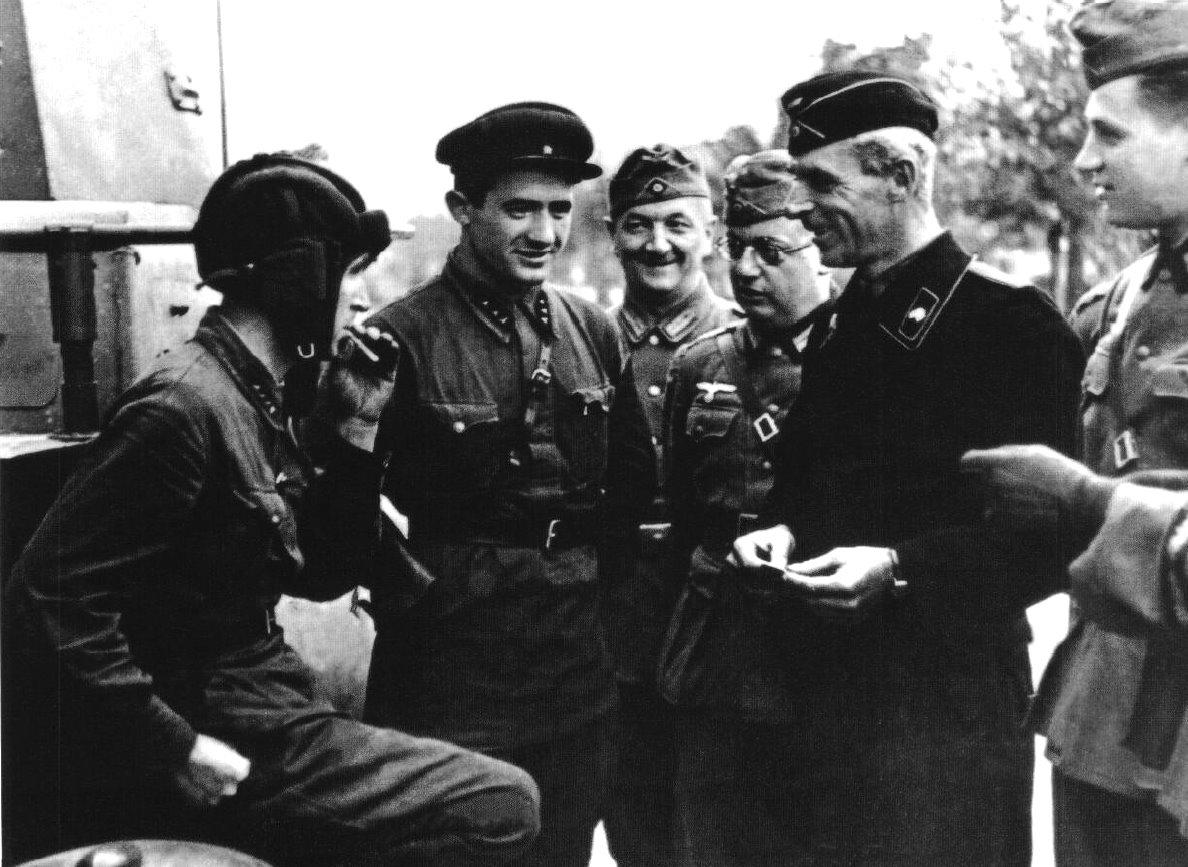
The NAZI-Soviet Non-Aggression Pact (August 1939) essentially made the NAZIs and Soviets allies. The Soviets never joined the Axis, although Japanese diplomats argued that they should be allowed to join. Even so, the Soviets were a very important NAZI ally. World War II histories generally mention the Pact in terms of making possible the NAZI invasion of Poland and then generally provide littleadditional information on the Pact and the NAZI-Soviet alliance. This is in part because after the NAZI invasion of the Soviet Union, the Soviets became a key element of the Allied struggle against the Axis. And this Soviet aggressions were inconvenient in depicging the struggle with the Axis as one between good and evil. Unfortunaltely, subsequent historians have focused on NAZI campaigns and occupation policies and generally left untouched the 2 years in which the NAZIs and Soviets cooperated. There was extensive cooperation between the two powers as they proceeded to divide Europe between themselves. The relation was troubled over differences between how Eastern Europe was to be divided, espcially disagreements over Finland, Lithuania, and Romania. With the Royal Navy blockade in place, the Soviet Union became Germany's most important supplier of strategic materials. The Soviets also facilitated contacts between Germany and Japan.
NAZI Foreign Minister Ribbentrop and newly appointed Soviet Commissar for Foreign Affairs Molotov on August 23, 1939, signed the Nazi-Soviet Non-Aggression Pact. At the time of thesigning, British and French delegations were in Moscow trying to reach an understanding with Stalin. Hewas convinced, however, that they were tring to draw him into a war with Hitler. The two countries which until that time had been bitter foes, pledged not attack each other. Any problems developing between the two countries were to be delt with amicably. It was last for 10 years. The Pact shocked the world and the purpose was immedietly apparent. It meant that Germany could attack Poland without fear of Soviet intervention. Thus after defeating Poland, Germany did not have to fear a full-scale European war on two fronts. What was not known at the time was that there was a secret protocol to the pact which in effect divided Eastern Europe betwen the two countries. This protocol was discoered after the end of the World War II in 1945. The Soviets continued to deny this protocol until 1989. The NAZIs 8 days after signing the Pact invaded Poland on September 1, 1939, launching World War II. Britain and France declared war September 3. Poland's fate was sealed on September 17, when the Soviets invaded Poland from the east. Although the Soviet's did not enter the War against Britain and France, the Soviets were virtual NAZI allies as they provided large quantaies of strategic materials, especially oil. Communist parties in Britainand France opposedthe war effort. The Communst Party in America opposed President Roosevelt's efforts to expand defense spending and assist Britain and France.
The Japanese saw the Soviet Union as their great enemy. The Strike North Faction in the military hoped to cooperate with NAZI Germany to destroy the Soviet Union. The Japanese were shocked with the surprise announcement of the NAZI-Soviet Non-Aggression Pact (August 1939). Hitler, true to character, did not discuss the n=mobe withbwither the Japanese or Italians, his parters in the Abti-Comintern Pact. It caused major shidts in the Japanese Government. Those officials who had place great importance on ghe Germans were badyly damaged.
The Japanese at the time were fighting a substantial campaign--Khalkhin Gol against the Red Army on the border between Mongolia and Manchuko (occupied Manchuria). An important element in the Japanese Goivernment, the Strike North Faction, had wanted to use Japan's growing military power to attack the Soviet Union. This was nearly 2 years before Barbarossa. The stunning Red Army victory made a lasting imoression on the Japanese. This was a major step in the eventuall accendancy of the Strike South Faction--attacking America and Britain. As Japanese policy coalesed on a move south, Japanese diplomats promoted the idea of allowing the Soviets to join the Axis. Had Hitler listened to them, the history of the 20th century could have been been very different.
World War II histories focus on the NAZI invasion of Poland (September 1) which launched the War. A massive German assault smashed into Poland from the north, west, and south. The outnumbered Polish Army with inadequate weaoponry fought valiantly but was quickly overwealmed. Generally little attention is given to the subsequent Soviet invasion (September 17). At the time, the battered Polish Army was preparing for a stand in eastern Poland. The Soviet invasion made this impossible. The Soviets proceeded to persue the same policies to destoy Polish national life as the NAZIs. The only basic difference was the Soviets did not launch a campaign against the Jews.
The NAZI-Soviet Non-Aggression Pact (August 1939) essentially made the NAZIs and Soviets allies. The Soviets and NAZIs were very important allies. World War II histories generally mention the Pact in terms of making possible the NAZI invasion of Poland and then generally provide littleadditional information on the Pact and the NAZI-Soviet alliance. This is in part because after the NAZI invasion of the Soviet Union, the Soviets became a key element of the Allied struggle against the Axis. And this Soviet aggressions were inconvenient in depicging the struggle with the Axis as one between good and evil. Unfortunately, subsequent historians have focused on NAZI campaigns and occupation policies and generally left untouched the 2 years in which the NAZIs and Soviets cooperated. There was extensive cooperation between the two powers as they proceeded to divide Europe between themselves.
The relation was troubled over differences between how Eastern Europe was to be divided, espcially disagreements over Finland, Lithuania, and Romania. The Soviets though the Balkans was their backysrd. For Hitler, Romnia was vital because of the Ploesti oil fields.
A tradecagreement was announced even beforectgecNon-Agression Pact. The first German�Soviet Commercial Agreement was reached (August 19, 1939). The trade agreement covered whay was described as 'current' business. The Soviets promissed to deliver 180 million Reichsmarks in raw materials which were to be ordered by German companies. This involved axwude range of strategic materials. Rhe single most important was oil, the single greatesrt weakness in the German war economy. The Germans pledged to deliver 120 million Reichsmarks in German industrial goods. The Germans also granted the Soviets a merchandise credit of 200 million Reichsmarks over 7 years at very favorable interest rates. As thectrade developed, the Soviets began delivering the raw materialscrequested. ThecGermans were muchb less prompt abiut delivering thevindustrial products thecSoviets requested, Once the War began, the Royal Navy blockade restricted German access to raw materials. The Soviet Union thus became Germany's most important supplier of strategic materials. Oil deliveries were cespecially important. Although the Soviet's did not enter the War against Britain and France, the Soviets were virtual NAZI allies as they provided large quantaies of strategic materials, especially oil. The Soviets not only cooperated in the defeat of Poland, but became Germany's most important supplier of strategic materials. Commercial agreemets detailing the deliveries were discussed by the Reich Minister for Foreign Affairs and the Chairman of the Council of People's Commissars, Molotov (September 28, 1939). A final agreement was reached a few months later, the Memorandum on the German-Soviet Commercial Agreement (February 11, 1940). The Soviets agreed to immediately begin deliveries of strategic materials and agreed that industrial goods from Germany would be delivered on a longer time frame, meaning that the NAZIs never paid for most of the Soviet deliveries. The Soviet commitment included: 1 million tons of grain for cattle, and of legumes (120 million Reichsmarks), 0.9 million tons of oil (115 million Reichsmarks), 0.1 million tons of cotton (90 million Reichsmarks), 0.5 million tons of phosphates, 0.1 million tons of chrome ores, 0.5 milliom tons of iron ore, 0.3 million tons of scrap iron and pig iron, and smaller quantities of platinum, Manganese ore, metals, lumber, and numerous other raw materials. I effect throughout 1940 and half of 1941 while America was supplying Britain, the Soviet Union was supplying NAZI Germany. Communist parties in Britain and France opposed the war effort. The Communst Party in America opposed President Roosevelt's efforts to expand defense spending and assist Britain and France.
One little known aspect of the coopeartion betwwen the NAZIs and Soviets was cooperation between the Soviet NKVD and NAZI SS. Some readers tell us that that the NAZI-Soviet Pacr was not an alliance, but kit was very much an alliamce. There was diplomatic, economic, and military coordination and cooperation. In fact the level mof coopearion was closer than the multitude of alliance made in Europe for centuries. An nothing shows this more clearly than the vcooperation between the security agencies of the vtwo totalitarian giants--the NKVD and SS. There were several high-level meeyings amd lower level meetings that are not recorded. It is unclear just what was discussed at these meetings, but it is clear that the primary goal mwas to more fully repress the occupied Polish people. The meetinfs occut\rred before the industrailm killing of Polish Jews began, but it is almost certain that the Jews were on the agenda.
The Soviets also facilitated contacts between Germany and Japan. The a href="/essay/war/ww2/camp/ww2-axis.html">Axis alliance was signed after the outbreak of the War (September 1940). By this time, sea links were difficult, bit not impossible. Contavts were important for both trade and technology exchanges. Allied naval power meant that significant levels of trade were no longer possible, but what was possible was the transfer of advanced German technology to the Japanese. Technologies like radar could have made a significant contribution. Itvaopears when it looked like they had won thge War, the Germans were not overly interested in providing advanhced technology to the Jspsnese. Trusting such technology to the Soviet rail system was probably not advisable, but technical papers could have been exchanged. And for a brief period an Arctic route opened up. The German auxiliary cruiser Komet gained some fame when it sailed to the Pacific from Norway. Soviet ice breakers helped open a sea lane north of Siberia (August and September 1940). The voyage took 3 weeks. Komet operated in the Pacific for a year. It returned to Germany (November 30, 1941). The northern route of course was no longer possible. Losing contact with the Japanese, complicated benefits that cold have been schieved.

Navigate the HBC World War II Section:
[Return to Main World War II NAZI Occupation of Poland page]
[Return to World War II Soviet Occupation of Poland page]
[Return to Main World War II NAZI-Soviet Pact page]
[Return to Main Axis page]
[Return to Main World War II European campaign page]
[About Us]
[Biographies]
[Campaigns]
[Children]
[Countries]
[Deciding factors]
[Diplomacy]
[Geo-political crisis]
[Economics]
[Home front]
[Intelligence]
[POWs]
[Resistance]
[Race]
[Refugees]
[Technology]
[Totalitarian powers]
[Bibliographies]
[Contributions]
[FAQs]
[Images]
[Links]
[Registration]
[Tools]
[Return to Main World War II page]
[Return to Main war essay page]
[Return to CIH Home page]