|
NAZI propaganda trumpeted Festug Europa--Fortress Europa. This was the Atlantic Wall / Atlantikwall that the NAZIs bragged could necer be breached. The German focus in 1941 was on Operation Barbarossa, the invasion of the Soviet Union. The Whermacht was shifted east. Despite failing to achieve victory in the Battle of Britain, the Luftwaffe was also shifted east, relieving pressure on hard-pressed Britain. At first during 1941-42 the NAZIs concentrated on protecting the harbors. German artillery, anti-aircraft guns, and armor were positioned beginning in 1942 along the French coast. German armored divisions are transferred to France. Only in late 1943, however, with defeats in Russia and North Africa and the increasing build up of Allied forces in Europe did Hitler give real priority to the Atlantic defenses. Hitler's Atlantic Wall is perhaps the most massive fortified position in history. more extensive even than France's Maginot Line. It was a formidable obstacle that Allied planners had to confront. Construction was ordered by Hitler in Führer Directive No. 405. The French rail system played an important role in both the consruction of the Atlantic Wall and in plans to defend it against invasion.
Based on France's World War I experience and terrible loss of life, France built the Maginot line, the most modern and potential effective defensive line in history. The Maginot Line was built along the German border. Tragically, the fortifications ended at the Belgian border. And Belgium not only declined to build a similar fortification, but withdrew from the Allied alliance and instead despite the World War I experience based ins defense on neutrality. As a result, the Germans easily defeated the Maginot Line by going around it (May 1940). At at the vanguard of the German armored spear was Gen. Erwin Rommel, commander of the Ghost Division (7th Panzer) that drove through the Belgian Ardennes and reached the Channel in a few days, rendering the Maginot Line useless. It is one of the great ironies of World War II is that that German Führer Adolf Hitler chose Rommel, who played such a key role in defeating the Maginot Line, to oversee the strengthening of Germany's own fortified line--the Atlantic Wall. And he was given the critical role of commanding the Atlantic Wall defenses. Do the man who defeated the Maginot line was given the job of commanding the greatest fortified line in history. . Even more astonishing is that Rommel argued that only the static defenses of the Atlantic Wall could stop the Allies--quite a turn about for one of the greatest practitioners of mobile warfare of all time. His superior, Field Marshal Gerd von Rundstedt disagreed, arguing strongly that Germany's powerful panzer divisions should be held in reserve to attack the Allies in force once the landings began and the location was known. It was up to Hitler to settle this dispute and his decision in many ways determined the outcome of D-Day.
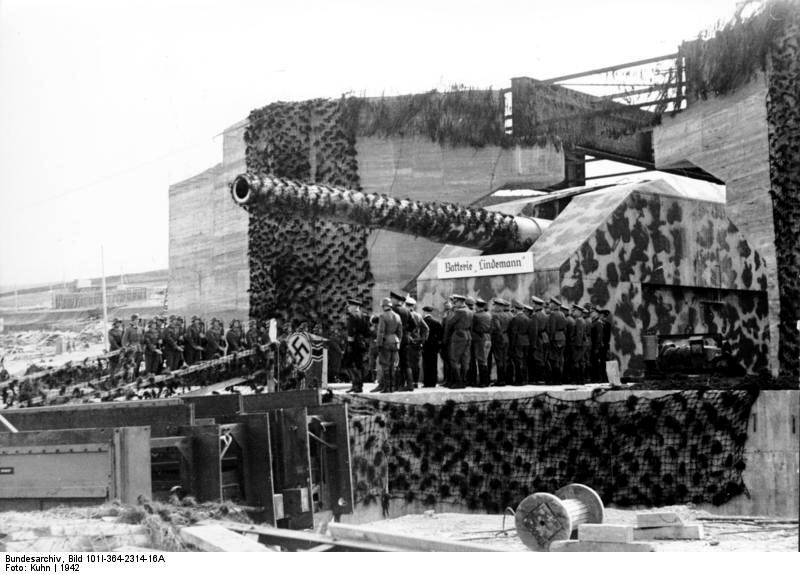
The first construction for what would later become known as the Atlantic walAfter the fall of France (June 1940), the Germans next turned to Britain and began preparations for an invasion--Operation Sea Lion. The first major German coastal construction project was thus not a defensive, but an offensive undertaking immediately following the victory in the West. The placement put them in a position to engage the British Fleet if as it expected it sailed to interdict the expected German cross-Channel invasion. The Germans rushed artillery batteries to Calais. These first batteries were operational as the Battkle of Britain was in progress to prepare for the invasdion (August 1940). The invasion, however, never came, but the preparations for heavy shore batteries were already underway. Hitler ordered the emplacement of huge artillery pirces around Calais, the closest point to England. There were eventually 18 guns ranged from 21-40 cm. After the loss of Bismarck (March 1941), the guns were named the 'Batterie Lindemann', in hinor of the doomed Bismarck's captain. These was the largest guns, the so-called Adolf 40.6 cm guns. The batteries around Calais covered the entrance to the Channel and could not only reach Dover, but 13 miles inshore. The Germans after abandinh their invasion plans instead used the massive guns against shipping in the Channel and to shell Dover. The 'Batterie Lindemann' during the course of the War fired 2,450 shells at Shipping targets in the Channel as well as the British coast off Calais (both Dover and Folkestone). The British as a result named this part of Kent known as 'Hell Fire Corner'. The guns destroyed thousands of homes, but had no military impact. The Batterie Lindemann guns were protected by steel reinforced concrete emplacements 10 feet think. Some 40,000 t of concrete were ued to protect each gun. As the War turned against Germany and it was the Allies than planned to invade, the Calais batteries became the northern ancor of the developing Atlantic Wall. The Germans concluded that it would be at the Pas de Calasis that the Allies would cross the Channel. Allied D-Day mis-information efforts gave a priority to support this view. The Double-Cross effort was very active in this area.
Hitler after the failure of the Luftwaffe to subdue the British (July-September 1940) cast his gaze east and for more than a year was primarily focused on preparing and then executing Barbarossa, the invasion of the Soviet Union. Hitler gambeled that he could gain another quick victory in a massive summer campaign. Everything was premissed for a quick campaihn. The result was that the Whermacht became mired down in the Soviet Union with summer uniforms and lubricants that froze in he Russian winter. Not only was the Wehrmacht stopped before Moscow, but it suffered massive casualties of men and material that it could never fully replace. This necesitated a major rethink of Hitler's war plan. Not only would there be no quick victory, but Germany now faced an Allied coalition of Britain, the Soviet Union, anmd the United States, countries wih far greater resources. And Hitlernn faced what he had sworn never to wage--a two front war. As a result, some thought had to be given to protecting his the western conquests while he fought it out with the Red Army in the East. British comando raids lent some urgency to his concerns. These included Vaasgo (December 1941) and Bruneval (February 1942).
Hitler issued Führer Directive 40 (March 23, 1941). It was titled 'Command Organization of the Coasts' but was essentially the order to construct what would become known as the Atlantic Wall. He instructed his commanders, "In the days to come the coasts of Europe will be seriously exposed to the danger of enemy landings.
The enemy's choice of time and place for landing operations will not be based solely on strategic considerations. Reverses in other theaters of operations, obligations toward his allies, and political motives may prompt the enemy to arrive at decisions that would be unlikely to result from purely military deliberations.
Even enemy landing operations with limited objectives will--insofar as the enemy does establish himself on the coast at all--seriously affect our own plans in any case. They will disrupt our coastwise shipping and tie down strong Army and Luftwaffe forces which thereby would become unavailable for commitment at critical points. Particularly grave dangers will arise if the enemy succeeds in taking our airfields, or in establishing airbases in the territory that he has captured.
Moreover, our military installations and war industries that are in many instances located along or close to the coast, and which in part have valuable equipment, invite local raids by the enemy.
Special attention must be paid to British preparations for landings on the open coast, for which numerous armored landing craft suitable for the transportation of combat vehicles and heavy weapons are available. Large-scale parachute and glider operations are likewise to be expected. "
The Atlantic Wall was the largest defensive, most heavily fortified defensive line ever built. Massive resources were diverted in building it. NAZI propaganda trumpeted Festug Europa--Fortress Europa. This was the Atlantic Wall that the NAZIs bragged could never be breached. Itvfeatured prominently in NAZI movie newsreels. The German focus in 1941 was on Operation Barbarossa, the invasion of the Soviet Union. The Whermacht was shifted east. Despite failing to achieve victory in the Battle of Britain, the Luftwaffe was also shifted east, relieving pressure on hard-pressed Britain. Only after Barbarosa failed and Hitler declared war on America did the Germns begin to conceive of constructing the Atlantic Wall. And large-scale construction projects did nor begin until 1942. This was mostly around the ports. Only when Rommel arrived (November 1943) did the Germans begin to heavily mine the beaches and construct strong points between the major port defenses. .
German military doctrine involved concentrating on port defenses such as Cherbourg abd Brest. Hitller added the Channeln Islands to the priorities for political reasons. At first during 1941-42 the NAZIs concentrated on protecting the harbors. Armies require massive amounts of supplies. Moving in the supplies needed required a deep-water port. Thus the ports were afforded the greatest priority. Many were already guarded with pre-War French fortifications. German artillery, anti-aircraft guns, and armor were positioned beginning in 1942 along the French coast. British Commando raids, especially the Dieppe Raid (August 1942), confirmed the corrctness to the Germans of focusing on the ports. Unbenognst to the Germans, the British took the exact opposite view. hey concluded that the Germans were defending the ports so strongly that it would be too costly to attack there. The British thus came to favir the idea of landing at less heavily defended beaches away frim the ports. And the ide rose of brining ports with them--this was the birth of the Mulberry floating dock projct.
The Atlantic wall defense may sound very simmilar to the French Maginot Line defensive And there were important similarities. There were, however, two major diffrences. First, Hitler extended the Wall from The Spanish Puranees to Norway. There thus was no way of going around the Atlantic Wall as the Germans had done with the Maginot Line. This had, however, significant negative cionsequences. Defending a 3,000 mikle barrier placd enormous strains in German resources. As a result the areas between major strong points werejot heavily defended with eithr men or heavy gubs. Nor were supplies stockpiled in needed amounts. The result was that when the Allies struck in Normandy, 1,500 Germans had to face 100,000 Allied soldiers. And stockpiles of amunition that were susposed to supply he defenders doe 24 hours only lasted a few hours. Second, the Atlantic Wall was not only mean to be a strong defensive shell, but fast moving heavy Panzer fovisions behind the coast were positioned to rush forward and attack any Allied units that managed to establish a beach head. Hitler began transfrring SS Panzer divisions to France. The idea was to use weaker units in the actual beach defensives, inckuding middle-age men, youthful poorly tined men, and Ost Troop formations. The idea was that fighgting from fortified positions was less demanding than mobile operations. It was the powerful, highly trained and motivatred SS-Panzer Divisions that would settle the issue when the Allies invaded. Here there was differences within the German command. Rommel wanted to fight it off on the beaches, in part bcaue he thought Allied airpowe would make it difficult o bring up reinforcements and the Panzers. Von Rundstedt gave more importance to the holding the Panzers in the rear..
The German forces many the Atlantic Wall were divided into four army groups of uneven strength. The 15th Army guarded the Lowlandsand the Pas de Calais. This was the mot strongly defended area, especially the Pas de Calais as it offered the shortest Channel crossing and the most direct route into Germany. Allied deception efforts (Operation Fortitude) succeed in convincing the Germans what they had already suspected that the invasion would come here. The 7th army was the next strogest force. It guarded the coast from the Seine/Caen south to the Louarve River. As this included Normandy, it would prove to be the German units the Allied invasion force would confront on the beaches. The 18th Army covered the Louarve to the Pyranees. The 19th Army Guarded the Frence southern or Mediterranean coast. The German High Command had not seriously considered an invasion through 1943 and the increasingly critical situation on the Eastern Front caused them to redeploy forces in France. The High Command, however, knew that the Allies would strike in 1944, although they were unsure where and when. Hitler issued Führer Directive 51 in which he he announced that German forces in France would have to be reinforced (November 1943). The demands of the Eastern Front and the Allied invasion of Italy (September 1943), however, limited the forces which could be deployed. As work on coastal defenses had not had a high oriority, work would have to be rushed to prepare for the invasion. The Germans by June 1944 had deployed 56 Divisions in the West. The strength of these divisions, however, varied greatly The strongest units were the Waffen S.S. These units were armored divisions equipped with the newest and best equipment. The Waffen SS included Paratroop Divisions and Six Panzer Divisions. The Germans no longer had the capability of making paratroop drops, but the paratroop units were highly trained and motivated. The German tanks were supperior to the American tanks, although the Americans tanks far exceeded the number of German tanks. The Wafen S.S. also were manned by men highly committed to the NAZI cause. One of the Waffen SS units was the 21st Hitler Youth Division. Many were below strength, manned by men who had been battered in the Eastrn Front. Some of thge German units were manned with foreign soldiers from Eastern Europe. (The Germans were afraid to use soldiers recruited in Western Europe, they were deployed in the east.) The Eastern Europeans constituted about 10 percent of the German forces, a not inconsiderable component. Some of these men were committed Fascists. Others had been drafted from from the slave labor camps and had joined only to escape from the dreadful conditions in the camp. Many of these men would surrender at the first available opportunity.
Only with Führer Directivec 40 (March 1942) did serious thought begin on the Atlantic defenses. Barbarossa had taken the Wehrmacht deep into the Soviet Union (June 1941). The Wehrmacht had, however, failed in its primary objective--destroying the Red Army. In addition the Red Army offensive before Moscow (December 1941). Thus rather than a short summer campaign, Hitler now had a two front war on his hands and a Britain fully backed by the United States. The idea has been to destroy the Red Army and then bring the Wehrmacht west for the climatic invsion of Britain. Now with the Wehrmact mired in the East, for the first time defenive thnking had to be considered. Much of the initial work was masive big-gun construction projects arounf Calais and the major ports. The projects received massive publicity in the German newsreels. The Atlantic Wall as portrayed as a triumph of German engineering. Most Germans believed that a massive defensive wall was being constructed all along the Channel coast. In fact while port defenses were being erected, little work was being done in along the beaches were the great streach of the Channel coast.
The Atlantic Wall was largest construction project of World War II. Hitler's Atlantic Wall is perhaps the most massive fortified position in history, far more extensive even than France's Maginot Line. It was a formidable obstacle that Allied planners had to confront. The Germans poured 17 million cubic meters of concrete, strengthened with 1.5 million tons of steel. Steel was a critical war material. The use of such a large quantity meant that steel was not available for other purposes. This is one of many matter explaining why despite the imprtance of the Ost Krieg, the bulk of German industrial output went to fight the War in the West--divered from suppoting the Ostheer. Much of the construction was done by French wokers conscripted from local towns and villages. The concrete went into massive bunkers of up tp 3.5 feet thick which could with stand direct hits. There were also many smaller bunkers and pillboxes of varying size. Construction was ordered by Hitler in Führer Directive No. 40.
It cost the 3.7 billion Deutschmarks in France alone. Had the Organisation Todt paid a real wage to the workers, the cost would have been even greater. The Wall was, however, built with slave and forced labor.
Fritz Todt was a friend of Hitler and an early party member. As a result from a small construction firm with 36 workers, the company became one of the largest companies in Germany. The company got the contract to build the Autobahns (1936). The OT also built the West Wall facing the French Maginot Line and was responsible for virtually all important military cinstruction projects during the War. The first major OT military project was the West Wall. It was thus to Organization Todt that Hitler turned to build the Atlantic Wall. It was not until completing the construction of massive defensive installations on the Channel Islands that work on the atlantic Wall could begin in ernest (late-1943). The work on the Channel Islands wa a huge mistake as it was massive diversion of resources for islands of no real military value. Hitler insisted on it, largekly because of the propaganda value he saw in the Islands. The OT contracted with French construction companies, some of which made considerable profits working with the Germans. [Prieur]
Construction along the dimensuiions of the Atlantic Wall required a larger labor force. The Germans forced thousands of French workers to work on the Atlantic Wall construction projects. The Organisation Todt negotiated an arrangenment with the Vichy Government. One of the workers recalls, "There was no choice about it. We had to go. Naturally we weren't enthusiastic, but it is not as if we had any choice. The conditions were not terrible. We weren't beaten or anything and we got a basic wage. At the start we could go home on Sundays, but after Stalingrad they put up barbed wire and we were stuck inside the work camp. Of course we knew we were building defences for the Germans, and it felt bad." [Lubat] The Germans also employed slave labor outside of the Todt-Vichy Agreement. We do not yet have much information on this, but we know that concentration camp slave labor was used for the construction on the Channel Iskabnds. And here the workers were mistreated.
The French rail system was important for building and once built moving the troops sand supplies needed to man the Ataltic Wall. The French rail system would also be needed to move the reinforcements and supplies needed to repel the invasion once the Allies struck. The problem for the Germans was that the Allies were destroying the Luftwaffe and by 1944 there was no longer a protective roof over either the Atlantic Wall or the French rail system which sustained it.
The Germans had 4 years to build and harden the Atlantic Wall. There were, however, some serious delays. The first was the course if the War. It at first looked kike the Germanshad won the War in which case there would be no need for the Wall. And the first projects were around Calais where they were designed to supprt the German invasion of Britain. Another delay was a priority given to the construction of massive U-boat facilities in Frnch Atlantic ports west of the Channel. The resulting bomb-proof U-boat pens would play a major role in the Battle of the Atlantic. This as a result was militarily justified. The other major delay was not--massive defensive fortifications on the Channel Islands. These ilands had no military value and were fortified only on Hitler's orders. As they were British territory, he was intent on holding on to them, regardless of the cost. Thus the first two years of the occupation was largely wasted by the Germans in terms of constructing the Wall.
A major delay in constructing the Atlantic Wall was the priority the Germans gave to the construction of massive U-boat facilities in Frnch Atlantic ports west of the Channel. U-boats and other vessels of the Kriegsmarine were based in these ports. Direct access to the Atlantic measurably increased the effetiveness of Admiral Dönitz's U-boats. It shortened the sailing time tio get to sea lanes to attavk the convoys and the time they could remain on station. The bomb-proof U-boat pens would play a major role in the Battle of the Atlantic. This as a result was militarily justified.
The Channel Islnds during World War II became the only British territory occupied by the NAZIs. The NAZIs seized the islands immeditaely after the fall of France (1940). After Dunkirk, Churchill realized that the Channel Islands could not be defended. There were fears at the time that Britiai itself culd nt hold out. Churchill declared the islands demilitarised. Jersey islanders had to evacuate to England leaving their homes and family or remain and face the NAZIs. About 10,000 did evacuate and 40,000 stayed. After the French surrender, the Germans seized the islands. When the fortunes of war changed, Hitler unlike Churchill decided against all miltary logic to defend the Channel Islands. Hitler ordered the construction of elaborate fortifications on both Jersey and Guernsey. These military instalations were constructed by slave labor imported by the NAZIs. These workers labored under appalling conditions. The resources devoted to the Channel islands were wasted. The Allies had no intention of invading them. The construction on the islands delsyed the construction of much more important fortifications on the mailand.
German artillery emplacements include guns ranging from 150-406 mm. The giant cannons, including a railroad gun of the Dora class were mounted in concrete and steel turrets. Atlantic Wall strong-points were built and protected with massive quantities of reinforced concrete. Some of the larger gun positions were armed with accurate 66, 75, 88, 115, and 155 mm guns. The larger pieces were naval guns capable of engaing battleships were installed in reinforced concrete bunkers or other strong points (Widerstandsnester). The larger emplacements proved impervious to aerial bombardment.
The British began comando raiding and probing the Atlantic Wall even before the Germans began hardening it. While not the principal purpose, these various raids priovided insights both to the German defenses and to the military reactions. The raids also convinced the Germans to give more attention to coastal defense, especially after the Red Army stopped the Whermacht before Moscow. The British were unable to give much support to the Red Army other than these commando raids and the Western Desert. Primeminister Churchill wanted to strike back at the Germans, but commando raids after the fall of France were one of the few ways which Britain had the capability to strike. Britain carried out 57 commando, mostly targeted French targets (1940-44). Raids were conducted the complete length of the Atlantic Wall, from the Arctic Circle south to the Spanish border.
Britain conducted two poorly executed commanhdo raids (1940). It was not until the next year that British commandos began carrying out effective strikes. The raiders were mostlt British Commandos but the two largest raids (Operation Gauntlet and Operation Jubilee) inckuded Canadian troops. The size of the raiding force varied depending on the objective. The smallest raid involved two men from No. 6 Commando in Operation J V. The largest raid committed 10,500 men in Operation Jubilee--the Dieppe Raid.
The Commando raids varied in effectiveness. Some were disasters with high casualty raids. Otherse of considerable success. The raids so antaginized Hitler that he issued the Commando Order (October 1942). This became one of the Wehrmacht Standing Orders that would lead to the murder of hundreds of thousands of soldietrs. This required Wehrmach commanders to execute commandos captured.
Major-General Robert Laycock, the chief of Combined Operations Headquarters, ended the commando raids as D-Day approached (mid-1944). He concluded that the raids were no longer beneficial and only caused the Germans to strengthen beach defenses. [Messenger, p.251.] In the end the greatest benefits of the probing raids were both the German reaction and the intelligence provided D-Day planners. First the raid caused Hitler to give priority to debnding Norway. While important ti Gernmany's import of iron ore, Norway was not important in the final battles of the War as the Allies and Soviets briought the war home to Germany. AThe battle for Berlin was the final large battle and at the time the Germans had more soldiers in Norway than defending Berlin. Second, the raids (especially the Dieppe Raid) provided a great deal of intelligence to the D-Day planners. Interestingly, the Germans never attempted commando raids of their own across the Channel.
Hitler had seen a two-front war as the primary reason for Germany's defeat in World war I. He pledged to never repeat that mistake. But that is precisely what he did. The Red Army managed to stop Hitler's Whermacht before Moscow (December 1941). This turned the War into just what Hitler had wanted to avoid, a war of attrition. And 1942 proved to be the pivotal year of the War. German victories in ealy 1942 turned into catastrophic defeats in both the East and North Africa. And in 1943 defeat followed on defeat, The Red Army relentlessly hammered the Wehrmacht in the East, defeating the last German summer offensive at Kursk. In the west the Gemans were forced to surrender in unisia and then the Allies took Sicuky and landed in Italy. And if this was not bad enough, it was now apparent that the Allies were massing for their major stroke of the War, a cross-Channelm invasion to reopen the Western Front. There could be not doubt that the Allies would attack as soon as the weather allowe in early 1944. Field Marshal Gerd von Rundstedt had for some time been pushing for more attention to be given to be given tio the West. He submitted a report which concluded that existibng manpower and equipment levels were adequate to defeat a concerted Allied invasion (late-October 1943). The Führer after Kursk had apparently reached the same conclusion. Hitler issued Führer Directive 51 (November 3, 1943). [Wilt] Hitler largely accepted Rundstedt assessment that the western defenses had to be strenhgthened. Hitler saw that the whikle territiory could be lost in the vast East without morally endangering the Reich. This was not the case in the West. Hitler instructed his commanders that THE decisive battkle would be fought in the West. "
For the last two and one-half years the bitter and costly struggle against Bolshevism has made the utmost demands upon the bulk of our military resources and energies. This commitment was in keeping with the seriousness of the danger, and the over-all situation. The situation has since changed. The threat from the East remains, but an even greater danger looms in the West: the Anglo-American landing! In the East, the vastness of the space will, as a last resort, permit a loss of territory even on a major scale, without suffering a mortal blow to Germany's chance for survival.
Not so in the West! If the enemy here succeeds in penetrating our defenses on a wide front, consequences of staggering proportions will follow within a short time. All signs point to an offensive against the Western Front of Europe no later than spring, and perhaps earlier.
For that reason, I can no longer justify the further weakening of the West in favor of other theaters of war. I have therefore decided to strengthen the defenses in the West, particularly at places from which we shall launch our long-range war against England. For those are the very points at which the enemy must and will attack; there--unless all indications are misleading--will be fought the decisive invasion battle. "
And to help carry out his plas to strengthen the Atlanhtic Wall, 2 days later appointed Field Marshal Erwin Rommel was to begin inspecting 'the defensive readiness of the German-occupied coasts' (November 5).
The Atlantic Wall was by far the the largest construction project of the War. This of course involved enormous planning. The French, under duress, provided the manpower to build the fortifications. This meant that the Resistance knew a great deal about the fortifications. Ironically, it was a German officer's desire to have a more imposing office that would betray the German plans to the Allies. The British began planning for D-Day, long before it was deven possible. An imprtant Resistanhce unit was the Caen group in Normandy. It had about 40 members. The Germans failing to destroy the Red zarmy (1941), began building the Atlantic Wall (1942). After the failure at Dieppe landing (August 1942), the British began to realize the enormity of the effort needed to breach he Atlantic Wall. The British Special Operations Executive (SOE) asked Resistance units to obtain information about German construction plans. The Caen group collected all kinds of information many information items, namely about the gateways and the chicanes. Of course this was of special value because it was about the Normandy area. Two members, René Duchez and his wife forged papers that allowed the Resistants to be in the construction area. But the opportunity of a lifetime came when the German Kommandantur advertized for a painter. Duchez applied and while being interviewed, the German commnder left his office momentsarily. On his desk were a heap of dicuments. Incredably, on top were plans for fortifications in the Normandy area. Duchez quickly thinking, rolled it up and hid behind a mirror. A few days later, he was awarded the job. And while painting, he retrieved the plans and hid it with his painting and wallpaper kit. He reported it to the group commnder, Col. Gilbert Renault who got it to Britain on a fishing boat. The result was the Allies had accurate plans on the design and location of the German defenses, shelters, underwater obstacles, beach barriers, passages, phony mine fields, and much more. Gen. Omar Bradley, the American ground commander, acknowledged the importance of Duchez's find.
With defeats in Russia and North Africa and the increasing build up of Allied forces in Europe, Hitler realised that the next blow would come in the West. He had frittered away most of 1942 by wasting resources on the Channel Islands. He now realized that a massive building program would be needed. At the time, it seemed like th Allies could be stopped, in part because the Lugtwaffe was till in tact. Hitler appointed one of his favorite generals--Field Marshall Erwin Rommel, even though Rommel had defid his orders at El Alamein. He ordered Rommel to oversee the buildup of the Atlantic Wall (November 1943). With the defeat of the Afrika Korps, Rommel was left wihout a command. Rommel was appointed inspector of coastal defenses and subsequently commander of Army Group B which guarded the French Channel coast. Only with the arrival of Rommel did the Germans begin building up the beach defenses away from the major ports. Rommel toured the entire length of the Atlantic Wall. And he was shocked with what he found. He quite rightly saw the state of preparations enterely inadequate, often vitually nonexistent. By this time it was clear that the Allied invasion would come in Spring 1944 as soon as the weather offered favorable conditions. Rommel rushed prparations forward. As Army Group commander, Rommel officially reported to the overall commander in chief West, the ageing Field Marshal Gerd von Rundstedt. German newsreels in 1944 showed Rommel inspecting the Wall. He set upon a massive building and mine laying program. [Ambrose] He oversaw the construction of a string of strong points. He sought to harden the gaps between the major defensive positions clustered around the ports. He gave attention to the beaches away from ports. He had reinforced concrete pillboxes built along the beaches and sometimes just inland. These were not the massive gun impacements, but designed to protect infantry units. The pillboxes housed machine guns, anti-tank guns and light artillery. Mines and anti-tank obstacles were planted on the beaches themselves and underwater obstacles and mines were placed in waters just off shore. All this was designed to stop the Allies on the beach. The blood leating at Omaha showed how deadly these instaltions could be. Roomel focused on the beaches because he had experienced the effectiveness of llied air in North africa, an experience that von Rundstedt did not have. While Rommen was gardening the beaches, howevr, the 8th Airforce was destroying the Luftwaffe over Germany. Thus Rommel; beavh defenses would not only hve to contend with Allied air dominace, but with the vutual total abenc of any German air support.
The Wall was replete with with machine-gun nests and pillboxes for the infantry. The beaches were worked with barbed wire, mines, hedgehogs, Belgian gates, log ramps, and wooden posts. There were 0.5 million beach obstacles. Rommel was especially committed to mining the beaches. By the time the landings occurred, the Germans had laid 4.0-6.5 million mines (accounts vary) and were actively laying more to achieve Rommel's goal of 11 million mines. [Ambrose, pp. 109-111.] The Germans staged realistic combat exercises to test the defenses. These beach defenses were designed slow down the landing ships so shorte batteries could more easily engage them. Rommel's asparagus inland was to prevent glider landings.
The Atlantic wall was primarily manned by a motly combination of forces--a far cry from the superbly trained Whermacht with which Hitler had unleased on Europe (September 1939). This included poorly trained youthful conscrepts and middle-age men not fit for service in the East. Men wounded in the East, but cinsidered fit for garrison duty were assigned to the Atlantic Wall. And units sgsttered in the East were posted to Frabce for refitting andc resupply. And there were constant combing of the Atlantic Wall units for men fit for service in the East. The Atlantic wall was also manned by immobile German Ost (East) Battalion troops. The Ost Battalion was made up of large numbers of captured Russian and Polish troops that had agreed to fight with the Germans because they either hated the Communists or wanted out of the concentration camps. Many were ready to surrender to the Americans or British at the first opportunity. Officers and non-coms were Germans. [Ambrose, p. 35.] The NAZIs generally did not equip non-German units with mobile armour. Given the composition of the German defensive formations, it is astiounding the fight that the Germans managed to put up in France. The strFUSAG est German units posted in France were stationed behind the Wall. They were the powerful SS Panzer Divisions. They were to rush forward when the Allies landing and destroy any lodgement the invading troops may have achierved. These troops had bettr tanks than the Allies and were fanatically devoted to the NAZIs and war effort. But unlike the garrison units had to operate in the open and were this exposed to Allied air forces.
The Atlantic Walls had many weaknesses, including the inadequate garrison and supplies for such a massive undertaking as well as the quality of the garrison troops and the loss of airsupport. The single greatest weakness, however, was that the German commanders were largely blind. The German commanders were virtually totaly unaware of what was going in across the Channel. As a result they had no idea what the size of the Allied force was ior where they were positioned. And doubling this weakness, they were not aware of just how blind they were. This was because of the success of the British Double-Cross/Forditude Operation. The British had eliminated German agents at an early point of the war, but inexplicably the Germans were unaware of it. The British suceeded in turning some of the German agents and introducing new ones that the Germans trusted. Thus the only intelligence flowing from Britain was that designed to convince the Germans that the invasion would come at the Pas-de-Calais. And because the Germns had concluded this on their own, the Britiish deception proved very effective. The American FUSAG deception which was monitored by signals analysis just added to the deception. German blindness was not just a matter of a British inteligence success. It was also a Luftwaffe failure. The Allies gained air superiority even over the Reich (January-Match 1944). Allied fighters, especially the suoerb P-51 Mustang, largely destroyed the combat effectiveness of the Luftwaffe. This meant that the Luftwaffe would be incapable of supporting the Atlantic Wall defenses, but it did not mean that the Lufwaffe was incapable of reconisabnce over southern England. The Allied air campaign had not only destroyed the Lutwaffe's combat capabilities, but apparentky its will. And incomprensibly neither OKW or the German commanders in France pushed the Luftwaffe to conduct recionisance. It might have been costly, but the information gained could have proven invaluable to the Germans. One historian writes, "That the Luftwaffe did not carry out minimal reconnaissance of the east coast [meaming Kent wghere FUSAG was staging the Fortitude deception] must rank as acmiracle of thec same dimensions as the destruction of the Armada in 1588." [Cruickshank, p. 186.] Even a cursory reconnaissance would have shown that the Allies were not massing in Kent, but along the southern coast to the west in Dorset, Hampshire, and West Sussex.
It is interesting that thec Germans who had proved the weakness of static defensive lines woulf have built the Atlantic Wall. The Germans lost World war I when the Alies breached the Hindinburg Line (1918). And the Germans had gained their greatest victory in going around the Maginot Line. Yet it would be the Germans wjo would build the most massive defensive line in history. The weakness of the Maginot Line was that France did not have a powerful mobil reserve to attack breaches or in the case of 1940 the German offensive around the Maginot Line. The Germans did have powerful forces and their battel plan was to immediately attack the Allied landing beaches. Te purpose of the Atlantic Wall was to hold the Allies until the mobil reserve could be brought up.
The concept of the Atlantic Wall was flawed from the beginning. The central conceot in defensive warfare is he who defends everything, defends nothing. The resources devoted to the Wall were enormous and could have been utilized in more critical areas. The resources devoted to the Channel Islands in particular were a complete waist. In some areas the Allies walked ashore almost unopposed. Even at IOmaha wgere the fighting was most fierce, the All hekld for only about 4 hours. The chief weakness of a long defensive wall is it spread out equipment and men while the opponent is free to concentrate his resources at the point of attack. The German plan to maintain a strong mobile reserve sounded fine on paper. The Allies had, however, two key advantages. One was complete air superority. And Allied air power could be used to impede German units moving toward the invasion beaches Vom Ruenstadt had never experience Allied air power like Rommel. Which is why Rommel was committed to stopping the allies on the beach. The difference between the two German commanders was aroblem. And even more serious was that neither commander had the authority to commit the powerful Panzer divisions held in reserve far from the beaches. Hitler reserved this decesion for himself. The Allies on the other hand could focus their entire force on one small sector of the Atlantic Wall--Normandy. And inaddition to concentrating the infantry invasion here, the Allies had power air and naval forces to support the invasion. The air and naval forces could be used in the assailt and the air firces could interdict German forces moving toward the invasion beaches. The fact that the invasion was focused on one small area meant that the air and naval firces could be used to great effect. Allied air power plyed a major role in pounding the German fixed defenses, but its most important role was in attacking Germamn units moving toward the beaches. The fixed positions allowed American war ships to engage the relatively limited number in the Normandy sector. When it looked like the landings at Omaha might fail, destryers moved in close to the baech to engage the shore batteries. [Ambrose, p. 386.]
Despite the huge resources committed, the Atlantic Wall was a massive failure. The Atlantic Wall is the greates failure in the history of defensive warfare. The Maginot line at least forced the Germand to go around it. The Allies went right through it. And even on Omaha Beach, the Germans delayed the American assault only a few hours. Here disension between Rommel and Von Ruendstat (and Rommel's absence in June 6) and Hitler's control of the Panzer Divisions in reserve undermined the German defensive plan. Another key factor was the effective of the Allied Fortiude deception plan. The Allied efforts convinced the Germans even after the Normandy landings that the main invasion would come at the Pas de Calais. One aspect of the Atlantic Wall was a success. The Germand heavily fortified the important ports. This denied the Allies landing facilities and supplying the advancing columns became a major problem as the Allies moved through France toward Germany. This of cource could have been done with out the massive construction of the Atlantic Wall.
Ambrose, Stephen E. D-Day June 6, 1944: The Climatic Battle of World War II (New York: Touchstone, 1995).
Cruickshank, Charles. Deception in World War II.
Lubat, Rene-Georges.
Messenger, Charles. The Commandos: 1940-1946 (London: Kimber, 1985).
Prieur, Jerome.
Wilt, Alan. The Atlantic Wall.

Navigate the Boys' Historical Clothing Web Site:
[Return to Main D-Day page page]
[Return to Main geographics operations page]
[Biographies]
[Campaigns]
[Children]
[Countries]
[Deciding factors]
[Diplomacy]
[Geo-political crisis]
[Economics]
[Home front]
[Intelligence]
[POWs]
[Resistance]
[Race]
[Refugees]
[Technology]
[Bibliographies]
[Contributions]
[FAQs]
[Images]
[Links]
[Registration]
[Tools]
[Return to Main World War II page]
[Return to Main war essay page]