|
Allied units on August 19, 1942 raided the French coastal port of Dieppe. The operation was code named 'Operation Jubilee'. The raid proved to be killing ground for the invasion force comprised primarily of Canadians with a smaller force of American Rangers and British Commandos. The cliffs and high ground commanding landing zone provided perfect sites for German gun positions. The stony beach impeded the movement of tanks. The objectives of the raid was announced as to to gather intelligence, test the German defenses, destroy German defenses, and demonstrate to the hard-pressed Russians on the Eastern front that the planning for a "second front" was making progress. The cost was high. About 3,000 of the 5,000 Canadians involved in the operation were killed or captured. About 120 mostly RAF planes were lost. While a sharp defeat, the lessons learned at Dieppe played a major role in the later Allied victory at Normandy. At Dieppe there had been no surprise and no softening of beach defenses by air strikes and naval gun fire. The Allies had not achieved air superiority over the invasion beaches or the rear areas through which reinforcements flowed.
The Dieppe Raid came at a critical tine of the War. The situation in the Pacific was improving The Americans has stopped the Japanese onslaught at Midway (June 1942) and had gone ashore at Gudalcanal a few days earlier. In Europe the situation was very different. Rommel 's Afrika Corps had inflicted serious blows on the Desert Army and had driven them back into Egypt. The sole defensive position left was El Alamein, only some 60 miles short of Cairo and Suez. The situation was even more dire in the East. The Germans had shattered the Soviet armies in the South (May 1942). The German summer offensive in the south came as a complete surprise to the Soviet command. There was a very real threat of losing both Stalingrad and the entire southern part of the country, including the vital Caucasian oil fields. This had to be on the minds of the Jubilee planners. And as Jubilee unfolded, the Panzers were racing across the Steppe toward the Soviet oil fields as well as the the Volga and Stalingrad. The Germans would reach the Volga (August 24) and Stalingrad a few days later (August 27).
Dieppe is a fishing port on the Normandy coast of northern France. It is located between Calais and the Normandy D-Day beaches. It has a deep harbor which is what attracted the Allies in World War II and why the Germans protected it with substantial defenses. The area is known as the Located on the scenic Alabaster Coast. Dieppe has a centuries long seafaring history, dating back to the Vikings vho arrived (8th century AD). The port's name, Dieppe meaning deep, is an allusion to the deep waters. Fishing was always important to the local economy. And even before Columbus, Dieppe fishermen began a distant-water cod fishery off the Americas (Newfoundland). Dieppe sailors explored the waters off Africa as European merchants opened up trade routes to the East. The famously pebbly beach is overlooked by white cliffs. Before World War II, Dieppe not only attracted French tourists, but was a favorite destination for British cross-Channel tourists. Dieppe was not only known for fishermen, but Dieppe sailors explored the globe. The port not only features the beach, quays and restaurants, and now a wonderful Saturday morning market. The Dieppe Beach is very pebbly, something the Allied invasion planners ignored and was a factor in their failure.
The British considered various raids along the Channel coast. The moving force behind Dieppe seems to have been the new Chief of Combined Operations, Louis Mountbatten. One of Mountbatten's principal assistants, Captain John Hughes-Hallett, served as Naval Commander for the raid. Once source says the e actual raid was undertaken without the approval of the Combined Chiefs of Staff. Churchill says in his memoirs that the Combined Chiefs did approve, but that Field Marshall Montgomery opposed it after it was postponed. [Churchill, p. 635.] Churchill backed the operation.
The Allied plan was initially to launch the strike on Dieppe in July 1942. The plan was code named Operation Rutter. The Canadians were chosen to provide the bulk of the assault force. The Canadian 2nd Division began intensive training on the Isle of Wight (May 1942). They were ready by July. The weather was not and the planned landing had to be called off. Allied commanders were still determined to strike the Germans so the operation was rescheduled for August.
Allied units on August 19, 1942 raided the French coastal port of Dieppe. The operation was called "Operation Jubilee". Dieppe, a little north of Normandy, was chosen in part because it was believed to be lightly defended by 'low-category' grade' German troops. [Churchill, p. 635.] The raid proved to be killing ground for the invasion force.
The Canadian Army's first real engagement came at Dieppe on the French coast. The Allied force was comprised primarily of Canadians with a smaller force of American Rangers and British Commandos. About 6,100 men were involved. About 5,000 were Canadians, the rest were over 1,000 British Commandos. A small force of 50 American Rangers also participated. The raid had only light naval support--eight Allied destroyers. There was substantial air cover--74 Allied air squadrons. Eight of these were Royal Canadian Air Force squadrons. The operation was overseen by Major General J.H. Roberts, Commander of the 2nd Canadian Division. Captain J. Hughes-Hallett, R.N. was the Naval Force Commander and Air Vice Marshal T.L. Leigh-Mallory was the Air Force Commander.
The cliffs and high ground commanding landing zone provided perfect sites for German gun positions. The stony beach impeded the movement of tanks.
The objectives of the operation as announced was to to gather intelligence, test the German defenses, destroy German defenses, and demonstrate to the hard-pressed Russians on the Eastern front that the planning for a "second front" was making progress. It was later described as a raid, although the British had hoped for more. The reasons as stated may not have been the real reason for the raid. It is difficult to know which were the most important or what was the deciding reason for the raid. The Americans at the time were pressing for a cross-Channel invasion. It surely showed what a difficult undertaking it was. It was no secret at the time that the war was being decided by the Ostkrieg- the titanic conflict on the Eastern Front. Keeping the Soviets in the War was vital to defeating the NAZIs. To what extent this was important we are not sure. One Canadian historian believes that obtaining intelligence was the major factor. He points out that August 1942 was a critical time in the all important Battle of the Atlantic. The German U-boats had just savaged American shipping along the Eastern Seaboard and had reddened to the North Atlantic in force. Changes in the naval enigma codes had frozen British code breakers out. Jnilee may have been a large cover for a raid on a German intelligence operation where Enigma material was believed to be located. his would make it part of the Ultra effort. A Canadian reader reports,"On Sunday night on the Canadian version of the History channel there was a special and newly made documentary on the Dieppe raid. 70th
Anniversary special.
According to very recently released classified documents that were kept
secret for 70 years it explains the real reason for the Dieppe attack.
It seems that it was mostly planned by Ian Flemming who was working for
a special Intel outfit during the war.
Earlier in 1942 the Germans had changed their Enigma machine from 3
rotors to 4 thus making all the old codes useless but not all places or
ships had the new machine.
The Dieppe raid was to hide in the raid a special 40 man commando team
that was to enter the German Naval HQ in Dieppe and capture what ever
machines and code books they could and then destroy the place to make it
look like the place got ruined during the main attack and the Germans
would not know that the new machines and codes were taken.
They tried 3 times to run an old flat bottom river boat into the main
harbor but were repelled each time so the commandos had to land on the
beach out side of the harbor and try to make their way into town. Only
1 man of that 40 man group survived. This ship was being captained by
the same British officer who was able to ram an old destroyer into the
dry docks at St. Nazaire and blowing it up. He got the VC for that raid." The historian has not yet published his book on the subject, but has laid out his conclusions in a Canadian History Channel documentary. He has since published his book. [O'Keefe]
The battle plan was to attack at five different points along front of about 16 kilometers (km) around Diappe. The battle was to be initiated at dawn by four simultaneous attacks on both sides of Dieppe by the British commandos.
The British were to demolish the coastal batteries at Berneval east of the port
and at Varengeville to the west. Then an half an hour, the main Canadian force would seize the port of Dieppe itself. The Canadians would also attack the cliffs at Pourville 4 km west of the port and Puys east of the port.
The Canadians may have had some success in July when the raid was initially planned. By the time the raid actually occurred the defenders had been reinforced. [Churchill, p. 636.] The British flotilla consisted of about 240 ships. They departed different British ports (night of August 19). They approached Dieppe early the next morning (August 19). The operation quickly encountered problems.
The left flank of the invasion force was No. 3 Commandos. They landed on Yellow Beach. The ships approaching to the east unexpectedly ran into a German convoy escorted by German E-boats. This proved to be a disaster. The E-boats were heavily armed small craft, larger versions of the American PT-boats primarily used in the Pacific. The Germans torpedoed some of the Landing Craft, Tank (LCTs) and the battle at sea alerted the coastal defenses. The Germans were thus able to destroy about 80 percent of the Commando landing force at sea. Only a few craft succeeded in landing a mere 18 Commandos. With this small force they were unable to destroy the German beach defense guns, but galantly laid fine on the gunners which prevented major German fire on the main landing force.
The right flank of the raid was No. 4 Commandos who landed on Orange Beaches. No. 4 Commando succeeded in landing largely in tact. They destroyed their targets. This was the only true success of the entire raid. Most of No. 4 Commandos were able to eventually evacuate back to Britain. Lord Lovat made his name on Orange Beach and would play an important role in the later Normandy D-Day landings.
The main assault in the center was conducted by the Canadians who immediately came under heavy fire.
the Royal Regiment landed at Puys in one side of Dieppe, but was delayed. They thus landed in the daylight without the element of surprise. The well-deployed German held the Canadians on the beach. There was no naval gunfire support to help the landing force break through the beach defenses. The Regiment was cut to shreds, 225 men were killed, 264 surrendered, and only 33 men managed to get back to England.
The South Saskatchewan Regiment and the Queen's Own Cameron Highlanders of Canada landed at Pourville on the other side of town. They landed with only light opposition. he Saskatchewan moved toward Dieppe, but were soon halted. The Camerons made more progress, but were also halted just before reaching their objective. Both regiments began to withdraw, but took heavy casualties as the heavily armed Germans pressed forward. Only the gallant action of the landing craft crews enabled 341 men to get off the beach. Some 141 men were killed. The rest had to surrender.
The largest attack consisted of attacks at three points: the Essex Scottish landed to the east, the tanks in the center, and the Royal Hamilton Light Infantry to the west. This assault was launched 30 minutes after the flanking landings. The men landed on a steep pebble beach. This was an unexpected surprise as the preparations did not include beach assessments.
All the landing forces immediately came under intense German resistance from prepared positions.
The Germans held the Essex Scottish on the beach.
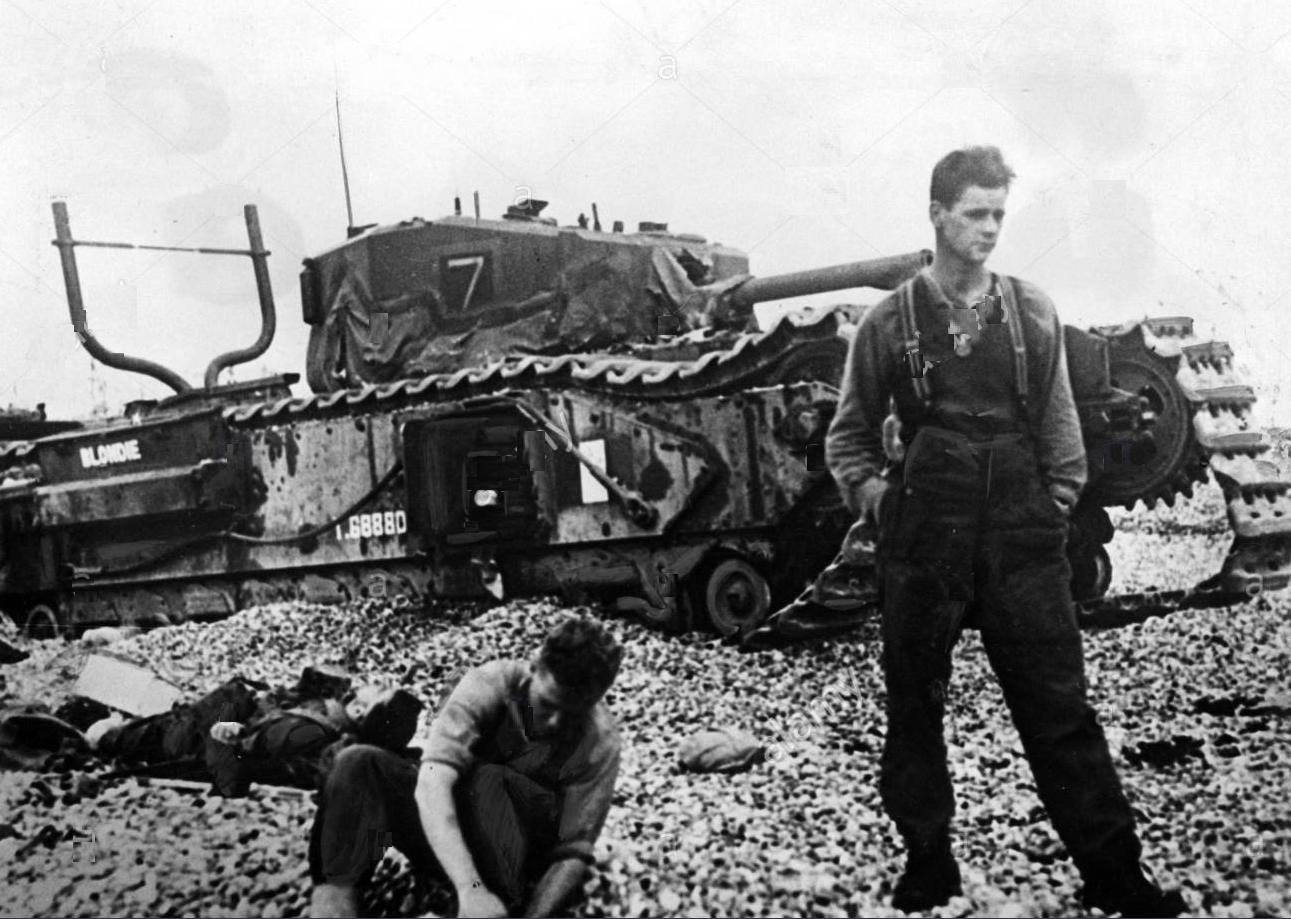
The tank landings were complicated and were too late to support the lightly armed infantry. And wehen finally landed they had trouble moving on the step peebled beach. The British succeeded in landing 27 tanks, but only 15 were able to get traction and were subjected to heavy fire. In the end 6 tanks got off the beach and reached the esplanade, but there were stopped cold by anti-tank blocks and traps. And the Germans were able to destroy them. The tanks on the beach did serve to provide fire support to cover the retreat.
The Royal Hamilton Light Infantry in the west succeeded in establishing a lodgement in a shore-front casino but few of the men were able to advance across the road and they were thus checked there.
Perhaps the greatest tragedy at Dieppe was that poor communication from the Beach caused the British to continue the obviously failed assault by committing the reserves to the carnage (about 7:00 am). .
Les Fusiliers Mont-Royal consisting of another 584 men were fired on as they approached the beach and after landing on it.
Only 125 were able to disembark and make it back to England. No.40 Commando Royal Marine (then called a Commando) consisting of 369 men was the remaining reserve force. They attempted to land on White Beach. Their landing craft immediately drew heavy German fire. Colonel Joseph Phillips, donned white gloves to semaphore signal away other landing craft. This made him a prominent target and he was killed, but he saved many lives. All but one of the second wave recognized the signal and turned around. None of the men who landed advanced more than a few yards.
The British ordered a general retreat (10.50 am). [Stacey]
Virtually anything that could go wrong, did go wrong. The Canadians and British units were badly mauled at the poorly conceived landings. The cost was high, especially for the Canadians. About 3,000 of the 5,000 Canadians involved in the operation were killed or captured. The Canadian assault team totaled 4,963 men. Only 2,210 made it back to Britain, many wounded. The Germans took 1,946 prisoners of war and killed 907 Canadians in the fighting. About 120 mostly RAF planes were lost.
The British expected much more from Operation Jubilee. It was a major Allied failure. Subsequently called a 'raid' to disguise the extent os the failure. But in military operations as in life, we can often learn much more from failures than successes, however painful. Dieppe underscored just how hazardous an amphibious operation was against a prepared, well armed enemy force. The Americans would learn this lesson in the Pacific. In fact at the same time of the Dieppe landings, American Marines had just gone ashore on Guadalcanal. The British would have much experience with amphibious operations. Thus Dieppe would be very important for the British Overlord planners. While a sharp defeat, the lessons learned at Dieppe played a major role in the later Allied victory at Normandy. At Dieppe there had been no surprise and no softening of beach defenses by air strikes and naval gun fire. The Allies had not achieved air superiority over the invasion beaches or the rear areas through which reinforcements flowed. While the Canadians paid nearly, the lessons learned at Dieppe were put to good use in Normandy 2 years later. One especially important lesson was that the Germans would heavily fortify the ports and the Allies would probably not be able to seize an important port with the initial invasion.. Churchill in his memoirs writes, "Honor to the brave who fell. Their sacrifice was not in vain." [Churchill, p. 637.] In contrast to the Allies, the Germans took great comfort from Dieppe, leading many German commanders to believe that the Allies could b stopped and to underestimate the force that the Allies could bring to bear.
Churchill, Winston S. Memoirs of the Second World War (Bonanza Books: New York, 1978), 1065p. Churchill provides a brief assessment of Dieppe. The original books this summary is based on were published in the 1950s when he could not yet mention the Ultra secret.
O'Keefe, David. One Day in August: Ian Fleming, Enigma and the Deadly Raid on Dieppe (Ocon Books: 2020), 496pp. O'Keefe is a Canadian military historian. He has also done a TV documentary on Black Watch Massacre at Verrieres Ridge.
Stacey, C.P. The Canadian Army, 1939-46.

Navigate the CIH World War II Section:
[Return to Main D-Day page ]
[Return to Main Canadian World War II page]
[About Us]
[Biographies]
[Campaigns]
[Children]
[Countries]
[Deciding factors]
[Diplomacy]
[Geo-political crisis]
[Economics]
[Home front]
[Intelligence]
[Logistics]
[POWs]
[Resistance]
[Race]
[Refugees]
[Technology]
[Totalitarian powers]
[Bibliographies]
[Contributions]
[FAQs]
[Images]
[Links]
[Registration]
[Search]
[Tools]
[Return to Main World War II page]
[Return to Main war essay page]
[Return to CIH Home page]