|
The Anglo-American war effort was perhaps the closest military alliance in history. There was close cooperation in both the development of strategy, scientific reserach, and tactical operations. Whenever an American was given a command, his deputy was almost always a British officer. This was the case for D-Day. This close cooperation was in sharp contrast to Axis war planning. The unity in Allied planning was also in contrast to the difference among German commanders in how to defend France. This is of course striking given the stress the NAZIs placed on Führer principle and the advantages the NAZIs believed an all-powerful leader would confer on Germany. Curriously while General Eisenhower after his appointment quickly established his authority, it was the German command was divided. Hitler as part of his gocerning policy used competition among subordinates to maintain power. In France this meant dividing responsibility between Rommel and von Rundstedt. These commanders had different udeas on how to defend against the invasion. Not only was the military command divided, but Hitler reserved the final decession on the commitment of the panzers to himself. As a result of this disagreement and divided opinion, the Allies encountered a much less effective resistance than might have been the case. It was one of the ironies of history that Germany imbued with the Führer principle fought this key battle without a unity of command or direction while the Allies had one single commander fully supported by Churchill and Roosevelt.
The two most important Allied military commandeers were American Army Chief of Staff. General George Marshal and British Chief of Staff Allan Brook. They had very different relationships with their political leaders. Roosevelt went over the head of many senior Army commanders to choose Marshall, largely because he saw a man who would speak the truth to him. Roosevelt closely followed Navy appointments. After selecting Marshall, he would leave Army appointments in Marshall's hands. Marshall was absolutely essential to to the American war effort, but he was absolutely wrong about D-Day, wanting to launch the invasion in 1942 and 43. If the British had not objected, a terrible tragedy would surely have ensued. And Marshall wanted to command the invasion force. There were few differences between Marshall and Roosevelt. The relationship between Churchill and Brooke could not have been more different. There were constant high-volume differences between Churchill and Brooke with Brooke constantly having to restrain Churchill's fertile mind. In fact Brooke got his job because his predecessor, Field Marshal Sir John Greer Dill, could not cope with the tension of arguing with Churchill. Brooke in contrast stayed up late at night, retraining Churchill. He gave as much as he received. Brooke was a first-class military mind. In fairness to Churchill, Brooke dud not see as clearly as Churchill, the need to maintain the Allied coalition and recognize America's growing military power. Even so Churchill ultimately recognized his value and kept him in place throughout the War. Brooke shared Churchill's reservations about a cross-channel invasion, but Churchill offered him commend. For the Americans, It was assumed that Marshall would command. Nether got the nod, but Marshall took the disappointment better than Brooke.
Britain and America were democracies. It had taken some time for the people of both countries to decide to fight the NAZIS. But both peoples were not committed to fighting the War with a unity and ferocity that Hitler had never anticipated. Their leaders had disagreed over the Cross-Channel invasion. They had forged an alliance, but there was consideral disscension between military officers on both sides, including a number of prima-donnas (most notably Patton and Montgomery). Yet General Eisenhowever was given almost dictatorial powers to plan the invasion, becoming a kind of Roman Pro-consul. Nothing he asked for was denined him. The air commandrs (Harris and Arnold) even had to turn over the control of their bombers which had just succeeded in defeating the Wehrmact and were beginning to pulverize German industry. And in large measure because of Eisenhower's leadership skills, there was no discension within the allied command on the major decesions taken and the tactics adopted. The command structure at Supreme Headquarters Allied Expeditionary Force (SHAEF). Was clear cut. American General Omar Bradley ommanded the American landing force. Field Marshall Bernard Montgomery commanded the British/Canadian landing force. Air Vice Marshal Sir Trafford Leigh-Mallory coomanded air operations. British Admiral Bertram Ramsay commanded naval operations.
General Dwight Eisenhower or Ike as he became to be known was the Supreme Commander, Allied Expoditionary Forces Eueope. It had always been assumed that General George C. Marshall would be appointed the Supreme Commander and oversee the D-Day invasion. It was Marshall who had picked Eisenhower out of obsurity to lead the Torch invasion. Ike got the job because Roosevelt could bear to have Marshall out of Wahington. When time came to appoint him, however, Roosevelt grew concerned about directing the war without Marshall by his side. Marshall put aside his personal wishes and acceeded to Roosevelt's request. He suggest that Eisenhower who had commanded Torch and Husky (the inasion of Sicily) be appointed instead. Roosevelt was unsure about appointing such a relatively junior officer, but deferred to Marshall's judgement. Although Cgurchill hd offer th job to Brooke, he ubdersti=ood that after the kndings,hed great bulk of menbd mnrerial would have to come from the Americans. Eisenhower had difficult people to deal with (Churchill, Montgomery, Patton, and others), but he left no doubt that he was in charge. Allied preparations benefitted greatly from this unity of command--in shrp contrast to the Germn command xstructure criss the Channel. (This is irinic give the NAZI docus on one supreme leader.) HHe understood better than any other Allied commander how to wage a coalition war. Eisenhower's performance was impressive, especially his managerial and diplomatic skills was to make him president after the War.
Eisenhower's chief deputy for D-Day was Field Marshal Montgomery, the Eighth Army commander at El Alemain. Montgomery's reputation is primarily based on his victory at El Alemain. We see his role in Overlord as his most important contribution to the War. Montgomery played a critical role in the planning stage. He also commanded Allied grand forces for the invasion. Montgomery is often criticised by American authors. He proved a true test for Eisenhowe;s fabeled diplomacy. American commanders were put off by Montgimery's egotism. They also considered him timid and blamed him for the failure to take Caen, even weeks after D-Day. There is no doubt, however, that Montgomery was a competent commander. His strength lay in meticulous planning and this showed in the preparations for D-Day. After D-Day he quarled with Eisenhower over the broad-front strategy.
General Omar Bradley commanded the American landing forces.
British Air Vice Marshal Sir Trafford Leigh-Mallory coomanded air operations.
British Admiral Bertram Ramsay commanded naval operations.
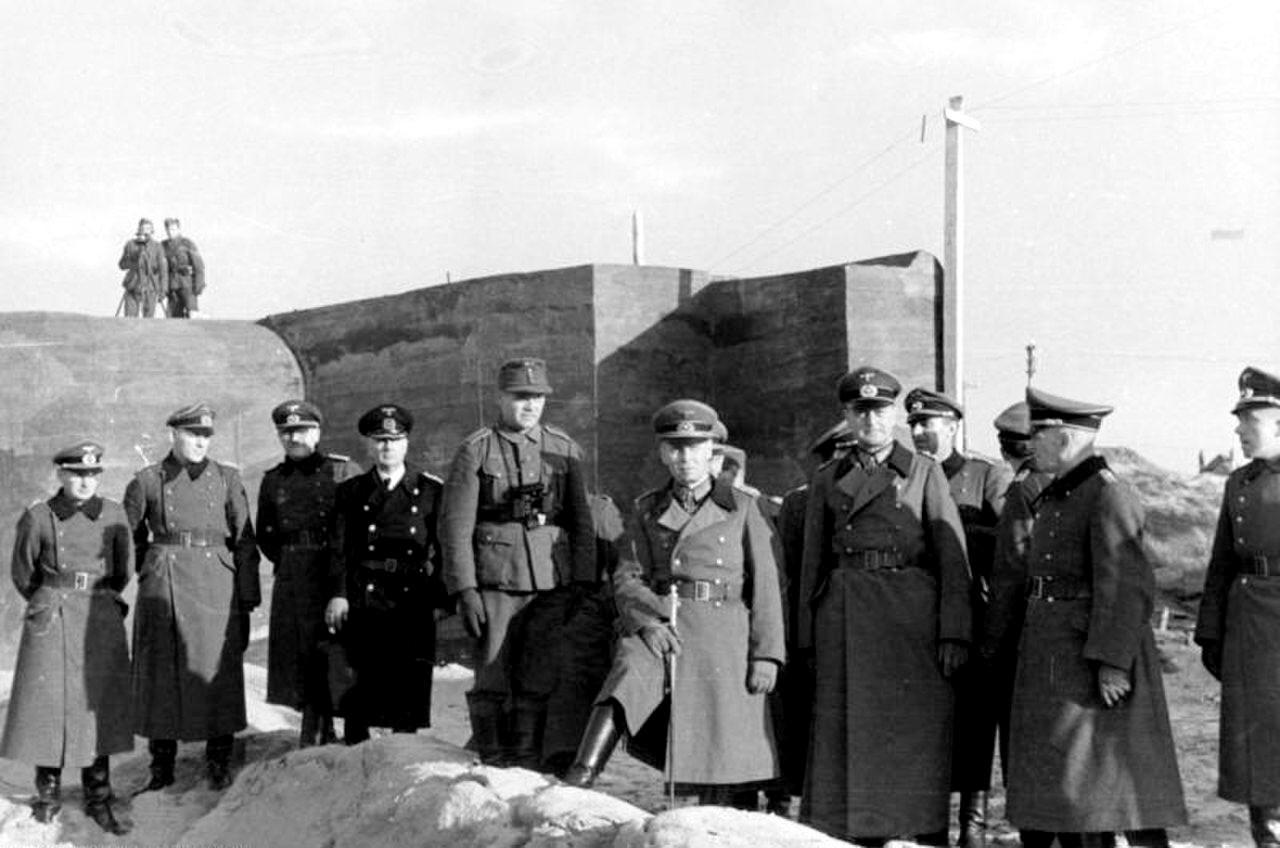
The Fascist Führer principle was premised on the unity of thought and power that can be obtained by a leader unrestructed by democratic debates and questions. The major problem with this is that Hitler by 1944 refused to give his military commanders the authority to plan and fight a major campaign. And by 1944 it was clear that the survival of the Reich hinged on repelling the Allied invasion. There was a central tennant in the German military tradituion of the political leadership giving field commanders the authority to make battelfield decesions without interference. Hitler in the East had long dispensed with this tradition. Not only did he fear to give any commndr such authority. but he was also convinced that his judgement was superior to his generals. To oversee the defense of France, Hitler brought aging Field Marshall Gerd Von Rundstedt out of retirement to command Oberbefehlshaber West (OB West) for a second time (1942). OB West consisted of Army Group B (7th and 5th Armies), Panzer Group West, and Army Group D. But in sharp contrast to Eisenhower, Rundstedt's authority was severly limited. The situation in OB West and Army Group B was in sharp contrast to the clear-cut lines of command in SHAEF. Rundstedt unlike Eisenhower did not have control over naval and air forces which were in the hands of these services. Nor did he have full control over Himmler's Waffen SS which were the most powerful formations in the German order of battle. Nor was their agreement within the Wehrmacht on how to repel the invasion. Rundstedt favored keeping a powerful reserve back from the beaches until the main focus of the invasion had ben identified. Fied Marshall Rommel who had experience trying to operate under Allied air attack insisted on stopping the Allies on the beach. Hitler refused to decide on the preferable apprach and instead decided to hold the Panzers in Panzer Group West under his personal control. This would mean that they would not be available to either Rundstedt or Rommel until Hitler personally released them.
Field Marshal (Karl Rudolf) Gerd von Rundstedt was one of the most respected German commander. He was older and more cautious than Rommel and came from a respected Prussian family. Rundstedt served as an officer in the German invasion of Belgium and France, commanding a division at the Battle of the Barne (1914). He rose to the position of a staff officer. He became one of the officers chosen to lead the Reichwehr after the War. He played a major role in the secret rearmament of the Wehrmact, both before and after the NAZIs seized power. He retired after Munich (October 1938), but was recalled for active service (June 1939). He commanded Army Group South in the Western Offensive against the Low Countries and France. He also commanded Army Group South during Barbarossa reaching the Don River (December 1941). At this time he retired again because of his age. Hitler recalled him against to command Army Group B (OB West) (March 1942). His task was to prepare for the expected Allied invasion. Here he and Rommel disagreed. While Rommel wanted to make a maximum effort at the beach, Von Rundstedt wanted to hold the powerful panzer divisions in reserve in rear areas and only use them once he was sure about the location of the main invasion. But here von Rundstedt did not like Eisenhowe have full authority. He could only use the panzers with Hitler's approval. Von Rundstedt's concept made considerable sence, but did not adequately take into account the extent of Alloied air superiority and the difficulties the Panzers would face at moving up to the beaches under Allied air attack.
Rommel was for a time Hitler's favorite general and he was at first devoteed to the Führer. Rommel had won the Iron Cross in World war I. Rommel commanded the Ghost Division in France (1940). It received that name because it moved so fast the high command never was sure where it was. It was Rommel who first reached the Channel curring off the BEF. Rommel became a legend in the Western Desert, winning victories against superior British forces. Hitler recalled Rommel from North africa, worried about the propaganda value of losing him. He was put in chgarge of organizing the defense of the Arlantic Wall. Rommel organized the strengthening of the beach denfenses. Unlike Von Rundstedt, his nominal commander, Rommel was convinced that the outcome of the battle would be decided on the beach during the first day of the invasion.
Ambrose, Stephen E. D-Day, June 6, 1944.

Navigate the CIH World War II Section:
[Return to Main D-Day leadership page]
[Return to Main D-Day page page]
[Return to Main U.S. World War II page]
[Return to Main military style page]
[About Us]
[Biographies]
[Campaigns]
[Children]
[Countries]
[Deciding factors]
[Diplomacy]
[Geo-political crisis]
[Economics]
[Home front]
[Intelligence]
[POWs]
[Resistance]
[Race]
[Refugees]
[Technology]
[Totalitarian powers]
[Bibliographies]
[Contributions]
[FAQs]
[Images]
[Links]
[Registration]
[Tools]
[Return to Main World War II page]
[Return to Main war essay page]
[Return to CIH Home page]