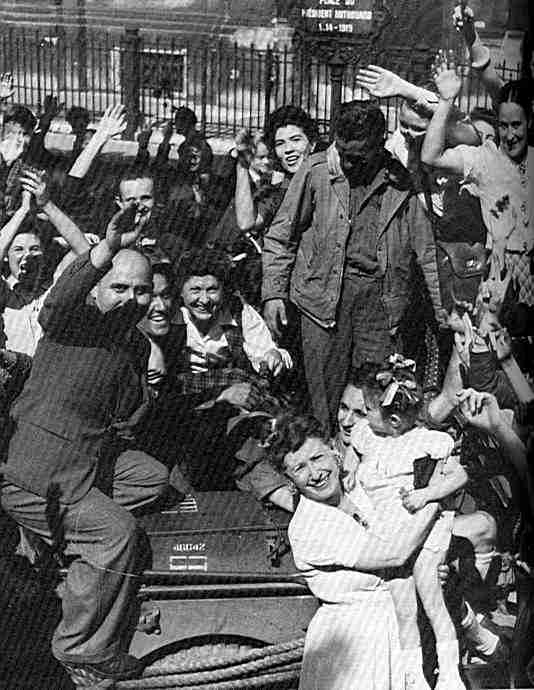
Figure 1.--Americans entering Paris on August 25 were engulfed by jubilent French civilians. Here a GI with a jeep is engulfed by Parisians. Notice the boy behind the little girl who has found a great seat in the jeep. |

|
The French Government had declared Paris an open city as the Wehrmact approached early in the War (June 1940). As a result the city was largely undamaged. After D-Day Hitler had decided to destroy Paris rather than surrender it to the Allies. The Germans had drawn up a plan to do just this. Charges were placed on bridges, major buildings, and historic monuments like the Eifel Tower. The Paris Ressistance rose up against the German occupation forces as Allied armour divisions raced to cross the Seine. The Allies had decided to bypass Paris as they persued the Germans north. French Forces of the Interior (FFI) attacked Germans retreating through the city. The Germans were pulling out of the city, but still had heavy weapons. The FFI was only lightly rmed. There was intense fighting in the city. About 2,000 civilians were killed, mostly the result of snipers. At first the Allies were going to bypass the city. Pleas from out-gunned resistance fighters caused Eisenhower to change his mind. General Bradley gave the Free French Division commnded by Leclerec the honor of liberating the city. Leclerec raced north to join the resistance fighting in the city. Hitler as the Allies approached ordered the city to be destroyed. The German commander refused to carry out the orders. He was concerned that the SS might arrest him before he could surrender to the Allies. Allied forces entered the city (August 25). The city was in chaos. Celebrations were occuring on one corner and a block away fighting was raging.
The Western Allies on June 4, 1944 in a dareing amphibious and airborn operatrion opened the long awaited second front on the Normandy beaches which as become known as D-Day. The invasion of Normandy, code named Overlord, was the single most important battle fought by the Western Allies in World War II. It was made possible by arguably the most successful military deception campaign in history. The opening of the second front finally releaved pressure on the Red army in the east. The D-Day invasion, however, meant much more. On the outcome of the battle hinged no less than the future of democracy and Western civilization in Europe. Failure at Normandy would have meant that the future of Europe would have been settled by the titantic struggle in the East between Hitler and Stalin, cerainly the two most evil men in European history. An invasion of France had been the primary goal of American military planners and President Roosevelt since the entry of America into the War in December 1941. Churchill was less convinced. And largely at urging, the first joint Allied offensive was in the Meditteranean. The invasion was an enormous risk. All Allied victories in Europe were achieved by the weight of overwealing superority of men and material to badly over streached German forces. In France, the Allies faced some of the strongest units in the Gernany Army who would until several weeks into the battle be able to amass far superior forces. The Allies had to plan on naval and air superiority to protect the inital beach lodgements until powerful land forces could be landed and deployed. For over two years the Allies had been building a massive force in England which on June 6 was unleased on Hitler's Fortress Europe. The Allies struck withbthe largest armada ever assembled. First paratroop landings inland and then at after dawn came British, Canadian, and American landings on five Normandy beaches. It was a complete surprise, an incredible accomplishment for an operation of this scope and magnitude.
Forces Françaises de l'Intérieur (French Forces of the Interior--FFI) were the Resistance military forces united under the command of Général Koenig. The FFI was formed after the Allied landings in Normandy (June 6, 1944). The FFI made contact with the Allied military command in Normandy as well as the Free French (Gaullist) Provisional Government. The FFI operated, however, under a separate command structure, in part because the Communists constituted an impoprtant part of the FFI's effective strength. With the Germans on the defensive and forced to focus on the Allied build up, the French partisans to began operating more openly and in larger units.
The British were suposed to take Caen, but as this was the most direct route to Paris, the Germans concentrated their forces nd held Caen. This led to weeks of costly fighting in the Bokage county. The Germans held, but the building Allied forces severly streached the German forces. Finally the Allies prepared breakout. British and Canadian troops under Montgomery struck first with Operation Goodwin. It proved to be a costly battle. They finally captured Caen after a major air attack (July 9). They were unable to break the German lines, however, in part because the rubble created by the air attack in Caen slowed the advance and the Germans were able to regroup west of the city. The German forces were concentrated around Caen which weakened their perimeter to the south. And it was here that the American offensive finlly broke the badly streached Germans--Operation Cobra (July 25). The major break through came further south. Patton's Third Army after a concentrated carpet bombing shattered the vaunted Panzer Lehr Division. The Americans pierced the German lines with armoured thrusts near St. Lô and rapidly fanned out behind German lines. Operation Cobra finally broke the Normandy stalemate and sent the American armies racing across France. [Zaloga and Gerrard] Hitler ordered an offensive--Operation Lüttich (August 6). They attacked toward Mortain. The German tanks were superior, but unlike 1940, the infantry had effective anti-tank weapons. And thanks to Ultra, the Allies were not totally surprised. The simply did not have adequate reserves and attacked with inadequate forces. The result was that it simply put the Germans further west and in a more exposed position. The Americans continued to attack behind the German lines. While American Sherman tanks were inferior to the German tanks, they were faster and more numerous, perfect for rapid maneur. Allied air power made it impossible for the Germans to contain the American offensive.
The German 7th Army devestated and the Americans moved to trap the Germans in a pocket forming around Falaise. German units were forced to abandon their tanks and flee east.
Falaise was the final battle in Normandy. This time it was no longer a battle for Normandy, but a struggle to destroy the two German field armies that had attempted to reduce and then bottkleup the Allies in Normandy. It was the only major Allied encircelent effort until the end of the War. After Falause Eisenhower would pursue a briad front campaign. At Falaise, German soldiers paid the price for their Führer's intransigence as was so often the case on the Eastern Front. The American breakout and the aborted German Mortain offensive drive to the coast led directly to the battle for Falaise. Falaise is on the river Ante, a tributary of the river Dives. It is about 20 miles southeast of Caen. Thus after the British and Canadians took Caen, Falaise emerged as a perfect place for the British and American asrmirs to meet and trap the renmaining German forces in Normandy. Falaise was notable in French and British history as the birthplace of William I the Conqueror who invaded Englanhd and founded the Norman dynasty. After the failure of their Mortain offensive, the Germans attempted to extricate what was left of the battered firces in Normandy. This set up the battle of the "Falaise Pocket". The Americans moved to trap the Germans in a pocket forming around Falaise. American, Polish, British and Canadian troops had nearly cokpleted the encirclement of the German 5th and 7th Panzer armies at Falaise--what has come to be known as Falaise Pocket. Somehow the Germans managed to open an escape gap to the east. While the ground troops tried to close off the Falasise Pocket, air strikes hammared away wreaked terrible carrnage on the Germans in the pocket. As mamy as 100,000 Germans made it out. The Allies encircled and destroyed two Germann armies, killing 10,000 Germans and taking 50,000 prisoners along with some 350 tanks and 2,500 other military vehicles. Generaloberst Hausser who had led the Mortain Counter Offensive stayed with his nmen in Falaise and was severly wounded again and finally evacuated. The Allies, however, failed to close the Falaise pocket in time to complelety destroy the German forces. The Germans troops managed to slip through the Allied encirclement, but had to abandon the heavy weaons that had not been lost in the Mortain offensive. The Americans complained that Montgomery did not act decisively enough. The British insisted that they faced stiffer resistance. Unable to plug the German retreat on the ground, the Allies hammered away at Falaise by air. German resistance in Normandy had been broken and the drive to Paris could start. Two-thirds of the town was destroyed The town was finally taken by a combined force of Canadian and Polish troops. Faklaise was an important Allied victory. It could have been a war winning victory. Had the 100,000 Germans not been able to escape the Allied encirclement, the Germans would have had much more difficulty making a stand at the West Wall and organizing the Bulge offensive. Falaise had to be largely rebuilt and restored after the war.
Before the battle at Falaise was over, the Allies struck in southern France. The Americans and British disagreed over the invsion of southern France, oiginally called Operation Anvil. It was renamed Dragoon--reportedly because the Americans dragooned Churchill into it. The final decession was made after the fall of Rome (June 4) and then the success of Opperation Cobra (July 25-26), the successful Allied breakout from the Normandy bridgehead. The U.S. 6th Army Group (variously known as the Southern Group of Armies and Dragoon Force) was established in Corsica and activated (August 1, 1944). It was commanded by Lieutenant General Jacob L. Devers and included both American and Free French units. The Allies landed on the French Mediterranean coast between Marseilles and Nice (August 15). By this time the Allies wereclosing in on France and destroying the principal German fiormations in France, the 7th Army abd 5th Panzer Army. The German hold on France was broken. The southern campaign is sometimes referred to as the Champaign campaign because they did not meet the tenanous resistance encountered at Normandy. The Germans by August were broken and withdrawing back to the Reich as fast as possibe. Their primary concern was not to get cuff off by the Allied forces moving out if theNormandy Bridgehead. All thoughts of making a stand at the Seine were abandoned. The advancing Dragoon Force encountered German covering forces, but no heavy units
General Eisenhower was a military commander not a politican. The D-Day ‘Operation Overlord’ abnd the Normandy breakour, Operation Cobra, were military operations planned wuithout political considerations. SHAEF's plan as the liberastion of France played out was to by-pass Paris both north and south and move more rapidly through the countryside. The Germans in Paris would be force to either evacuate Paris are become encircled. There was no interest in stree fighting, both because of casuakties and the fact that it woukd slow down the push north. This was the general German tactic in their Blitzkrieg campaigns and the losses in Stalingrad confirmed the advisability of this approach. Thus Eisenhower decided that the best tactic was to envelop not assault Paris which had no real strategic value. The principal objective was to persue the Germans north. The Allies after closing the Falaise pocket were intent on persuing the retreating Wehrmact as closely as possible to prevent them establishing a defensive line. The major Allied concern was to ensure that the Wehrmacy was unable to resestanlish a defensive line at the Seine. Paris was not a major target. The American 79th Infantry Division crossed the River Seine at Mantes (August 20). Patton’s 3rd Army crossed the Sedine west of Paris (August 26). Neither moved toward Paris. The U.S. 4th Infantry Divsion was, however, just to the West of Paris. The Allied commanders had ignored Paris in their planning for this campaign, considering that the risk of intense street fighting and heavy casualties outweighed the city's strategic importance. However
General DeGualle who commanded only a small force relized that while Eisenhower was correct militarily that Paris was in fact of huge importance politically, not only in the war against the NAZIs, but in the upcoming fight for the future of France with the Communists. The fall of Paris had been Hitler'sw great accomplishment. Its liberation was of enormous importance to Allied morale. And liberation by the Allies and not the Communists was of enormous importance politically for the future of France.
Eisenhower wishung to avoild political entaglements such as had occurred in North Africa with Vichy officials did not want to be seen as installing DeGualle in power. His assessment was that as the battle moved northward, what ever happened in Paris would be seen as French domestic policies.
After Dunkirk, the Germans turned south toward Paris. It soon became clear that the Germans could not be stopped. The French Arny did not defend Paris. By this time whole units were surrendeing to the Germans. The French Government declared Paris an open city as the Wehrmact approached (June 1940). The city was not bombed or shelled. As a result, after nearly 5 years of War, the French capital was largely undamaged. Cities throughout Europe was turned into rubble by the Germans. Paris was not yet one of them. Hitler had, however, plans for the city.
Pierre Laval presided over the last meeting of Vichy Ministers. The Germans advised Maréchal Pétain to depart for the East. Laval turned over Paris to the Préfet de la Seine and the Préfet de Police. Fearing seuzure by the FFI and summary execution, he left the Hôtel Matignon with a German escort. Their day of judgement would be delayed, but only for a year. Fernand de Brinon established a kind of pseudo-government in exile at Sigmaringen. Pétain now a broken man, realzing wht he had done refused to participate. The Sigmaringen Government had little or no authority. Unlike the Allied governments-in exile, there was nosupport forVichy in France. In sharp contrast to their populrity following the German invson, they were widely hated as collaborationists. And this despite the fact that few French people understood the full dimensions of the danger tht Vichy represented frorvFrance and Germans plans after they won the war. The Sigmaringen offices used the official title Délégation française (French Delegation) or the Commission gouvernementale française pour la défense des intérêts nationaux (French Government Commission for the Protection of National Interests. Sigmaringen had its own radio (Radio-patrie, Ici la France), newspapers (La France, Le Petit Parisien) and hosted the embassies of the Axis powers, Germany, Italy and Japan. The There were some 6,000 Vichy loyalists at Sigmaringen. They were a mixed bunch of including the best-known collaborationist, journalists, writers (Louis-Ferdinand Céline, Lucien Rebatet), actors (Robert Le Vigan) and their families plus 500 French soldier and 700 French Waffen SS men. With them were POWs and French civilian forced laborers. One of the last battles of the War would be fought here.
Parisians as best they could by listening to the BBC and Free French broadcasts followed the Allied breakout from Normandy. It was clear that the Germans were withdrawing from France and that Allied armies were approaching the Seine east and west of Paris. Thge FFI presence in the city becamne more brazen. The first action in Paris was the Paris Métro, Gendarmerie and Police going out on strike (August 15). The postal workers followed (August 16). Finally a general strike broke out (August 18). Parisians began to mobilize and the barricades began to go up. The mall arms and small amount of amunition. The French resistance without instructions or any coordination. from the approaching Allied commanders launched the liberation of Paris. Parisians had earlier meekly surendered and agreed to collaborate. Now with aaste of German rule, a tortured city once a symbol of freedom withonly arose up to break the chains of occupation and reclain its freedom and dignity. [Neiberg] Allied armies were headed north, but not directly toward Paris. The effort to libeate the city could well have resulted in its destruction.
The Americans and British were primarily focused on the retreating German armies. The French were divided. Political groups competed for cntrolof the Paris resistance. To the South, General DeGualle and he Free French were attempting gain contol of the Resistance and direct it. This was a difficult undertaking given that the Communists were such an important part of it. It was a struggle for who would contro France after liberation from the Germans. As the German army retreated north, heavily armed units in Paris held on to the city.
After D-Day Hitler at first conceived of making Paris a fortess city. He wanted the city defended to the end. In particular he wanted every bridge in the city destroyed. The city would be destroyed rather than surrendered to the Allies. As Allied armies approached, his mind focused more on destruction. Hitler fumed in the Wolf's :Lair,
"Paris will be transformed into a heap of rubble." [Neiberg] This was no idle threat. Hitler had bragged at the beginning of the War after reaking wide-spread destruction on Paris, that he could do the same to any European city. The Luftwaffe was no longer capable of doing this, but Hitler's faithful on the ground were more than capble of doing so. SS men at the very same time were beginning the total destruction to what was left of Warsaw. Many Soviet cities had already been destroyed. The Germans had drawn up a plan to do just as Hitler wanted. Charges were placed on bridges, major buildings, and historic monuments like the Eifel Tower. The Germans threatened to retaliate for Resistance attacks.
Generalleutnant Dietrich Choltitz was the commander of the Germany garrison in Paris.
Choltitz had been the commander of the 84th German Army Corps when the Allies landed at Normandy. Hiler was displeased with his performance, both on D-Day and later when failed to check General Bradley's breakthrough at St Lô in the Operation Cobra break out. HItler replaced Choltitz and assigned him to Paris, a significant demotion. A new commander was needed because the former commander, General von Stülpnagel, was arrested after being implicated in the July Bomb Plot. Hitler thus gave Choltitz control of the city. Choltitz had command of a sizeable garrison.
There were 20,000 German troops outside the city under the command of Lieutenant-Colonel Hubertus von Aulock. Choltitz kept 5,000 men under his personal command in Paris. He had 50 artillery pieces and a company of tanks. It was sufficent to defeat an internal rising because it was well armed with heavy weapons. His iorders were to make Paris a fortress city that would slow down the Allies. At the time Hitler still hoped a denensive line could be resestan\blishged at the Seine. He was ordered to blow the Seine bridges. Choltitz had at his disposal a considerable number of men and heavy weapons which could cope with a rising by the lightly armed FFI. (At the time the Germans were putting down aimilar rising in Warsaw as the Red army held back.) But Choltitz knew that his tenure in charge of the city was only a short one and that it is almost certain he knew that the city would be lost as the Allies advanced. That barely any damage was done to the city by the time it was liberated must be credited to Choltitz who failed to carry out Hitler's orders not only to blow the Bridges, but major Paris landmarks as well.
The Paris Resistance was organized by the French Forces of the Interior (FFI). The Germans were pulling out of the city, but still had heavy weapons. The FFI was only lightly armed.
Skirmishes began when the barricades began to appear (August 18). Allied armour divisions were racing to cross the Seine. Fighting with the Germans begame more serious (August 19). the Communist-led resistance cells rose up against the Germans. The FFI attacked Germans attempting to retreat through the city.
Choltitz's hesitated to supress the rising by force. He agreed to truce with the FFI (August 20).
The more extreme FFI leaders, mostly the Communists, opposed the truce. M Raoul Nordling, the Swedish consul-general in Paris, attempted to maintain the truce. He also managed to save resistance members held by the Germans. Choltitz tried to work out a truce with the Free French, but it broke down as the Commi\unists wanted a fight. Choltitz counterattacked the Maquis with a few tanks at his disposal.
Intense Serious fighting occurred (August 22).
Hitler ordered ordered Choltitz "Paris is not to fall in the hands of the enemy, except as a heap of ruins." (August 23). Choltitz was considered loyal and Hitler expected him to follow orders. But he saw nothing to be gained by destroying Paris. Hitler asked his staff, “Is Paris burning?” They had no heavy weapons and amunition for their light weapons was rapidly being exhausted. About 1,500-2,000 civilians were killed, mostly the result of German snipers.
The Allied Armies whivh landed in Normany were about evenly divided between the Americans and British/Canadians. As reinforcement poured into the Normandy beachead and after the St Lo breakout the force composition became increasingly American.
There was also a small Free French force which fought with the Americans. General Leclerc and the French 2nd Armoured Division after D-Day had landed at Utah Beach with the Americans. It fought with the US 15th Corps. Leclerc assumed that after the Falaise Pocket was reduced that his 2nd Armoured Division would spearhead a drive on Paris. He thought a French unit should be assigned the honor of liberating Paris. When he did not receive the orders, he went directly to General Patton to complain (August 1). Patton's focus was on moving northeast in to Germany. Leclerc had two commasnders. He and the French 2nd Armoured Division had been transferred to American General Gerow's 5th Corps who thought his divisional commanders should follow his orders. Leclerc's other commander was General DeGualle.
At first the Allies were going to bypass the city. The US 79th Division reached Seine River above Paris (August 20). The US Third Army reached Reims and Troyes southeast of Paris (August 21). Eisenhower as usual was focused on the military situation. He concluded that Paris was so large with the Germans could effectively use the city and that street fighting there would slow the Allied advance. He was especially concerned ith possible street fighting in which the mobility of the Allied forces, one of its primary advanyages, ould be loss. Eventually pleas from out-gunned resistance fighters caused Eisenhower to change his mind. De Gaulle and the Free French reportedly threatened to break the Allied command structure and make a dash for Paris on their own.
De Gaulle assured Eisenhower that they would encounter little German resistance in Paris. General Bradley gave the Free French Division commnded by Leclerec the honor of liberating the city. Leclerec raced north to join the resistance fighting in the city. Hitler as the Allies approached ordered the city to be destroyed. There was some sharp fighting with the between the Germans and Leclerc's French 2nd Armored Division, but the Allies had the heavy weapons that the FFI lacked. The resistance and the advancing Allies quickly reduced the remaining collaborationist and German pockets.
The German commander was General Dietrich von Choltitz. He was a dedicated Wehrmacht officer acustomed to obeying orders. He fought on the Eastern Front from theveginning of Barbarossa (1941). He admitted in recorded conversations that he followed orders to kill Jews, saying it was the most difficult he was faced with. [Neirtzel] He advanced in the Whermacht because of his competency and coimmitment to followeing orders.
Von Choltitz fought in the bloody fight to seize Sebastopol in the south of the USSR in June 1942. He served in Italy (1943-44) and was then transferrede to Normandy where he commanded the 84th Army Corps (1944). He fought a competent delaying action, but was replaced by Hitler when the Allies finally broke out from the Normandy beachead. Hitkler appointed him the military governor of Paris. It is likely that Hitler chose him because he believed he would follow orders to destroy the city. By the tome he was appointed it ws just a matter of time before the Allies liberated the city. Allied Armies were rapidly moving north. Soon after von Choltitz took his command in Paris, he began receiving orders to begin detroying parts of the city. German soldiers had layed charges at important buidings all over the city. The first orders were to blow the bridges. He did not follow these orders as well as subsequent orders to reduce the city to ruins. It is impossible to know why he disobyed the orders. When the FFI rose up in the city, he attempted to supress the rising, although there are differences as to just how hard he tried. After the War, Von Choltitz attempted to burnish is image. The most likely assessment is that in the end that he saw nothing to be gained for Germany in destroying the city. After fighting the Allies in Normandy, he was fully aware of the strategic situation and the vast and groiwing power arryed against Germany. He knew it was only a matter of time before Paris fell. The limited damage done to the city is in large measure due to Choltitz who refused to carry out Hitler's orders. He was concerned that the SS might arrest him before he could surrender to the Allies.
It is difficult to assess motives. It seems reasonable that he made the calculation that destroying Paris would not slow down the Allied advance and that the War was already lost. (In this regards it should be noted that much of the destruiction of German cities occurred after the Allied break out and Eisenhoiwer relinquished control of the 8th Aur Force.) And part of that calculation must have been what would come of him after the War if he was the German general who destroyed Paris. Von Choltittz not only refused to give the oders to demolish the city, but begotiated with the Resistance in the city, again disobeying orders to fight it out to the end. Repeated orders from Hitler ordered that Paris "must not fall into the enemy's hand except lying in complete debris".
The limited damage done to the city is in large measure due to Choltitz who refused to carry out Hitler's orders. He was concerned that the SS might arrest him before he could surrender to the Allies. He surrendered after first confirming that he was surrendering to the French Army and not the FFI (August 25).. The surrender took place at the Hôtel Meurice, the headquarters established by General Leclerc. He said later that if there was a strategic reason to destroy Paris he would have followed Hitler's orders. Von Choltitz surrendered the city and the garrison to the Allies. Hitler was furious when he learned of the surrender. Von Choltitz became a prisoner of war and remained so until 1946.
Allied forces entered the city (August 25). Noted America\n photo journalist wrote, :"The sun was in a hurry to rise that morning, and we did not bother to bruish our teeth. The road to Pais was open, and every Parisian was out in the city to touch the first tank, to kiss the first manto sing and cry. Never were there so manywho were so happy so early in the morning." [Capa] The city was jubilent, but in chaos. Celebrations were occuring on one corner and a block away fighting was raging. De Gaulle entered the city. S
De Gaulle moved into the War Ministry on the rue Saint-Dominique (August 25). He delivered a rousing speech to the people of Paris at the Hôtel de Ville. Snipers fire at him from a hotel, but missed. His words were heard around the sorld, “Paris! Paris outraged! Paris broken! Paris martyred! But Paris liberated!” Parisians until then only knew him from his emotional radio broadcasts. They recognized his voice. he liberation of Paris was arguably the most romantic event of the War. Jist as the fall of Paris had shocked the world, the liberatopn of Paris symolized as no other event that Hitler had losdt the War and it was nw just a matter of time before the Allies would reach Berlin. For one bright shining day, the emotions of the Allies and especially the French bubbled over like an uncorcked bottle of chasmpain. Thus the liberation of Paris surpassed all the other great milestones in the relentless Allied moce toward the Rhine. Hitler sennsed this and it was why he wanted the city destroyed. DeGaule alone among the Allied leaders sensed the importance of liberating the city.
The Allies conducted an emense victory parade down the Champs-Élysées the day after the German surrender August 26). A few Germans snipers were still firing. General de Gaulle famously marched down the Champs Élysées and entered the Place de la Concorde. Diehard German snipers who refused to surrender in the Hôtel de Crillon area fired on the crowd. DeGualle marched on to Notre Dame. The Luftwaffe managed to stage a small raid on the city (August 26). Allied troops to the east began crossung the Seine.
DeGualle as military ruler of Paris requested that General Eisenhower permit two American division remain in Paris to help maintain order. Eisenhower reached Paris (August 27). He was not prepared to shift two divisions away from persuing the Germans north. He did agree to a demonstration of force. He ordered the American 28th Infantry Division to move through the center of the city (August 29). A combined Franco-American military parade was thus staged around the arrival of the U.S. Army's 28th Infantry Division. The 28th Infantry Division in full comat gear marched through the city center (August 29). They were not parade ground troops, but men headed north to persue the fleeing Germans north.
Eisenhower wrote later "Because this ceremonial march coincided exactly with the local battle plan it became possibly the only instance in history of troops marching in parade through the capital of a great country to participate in pitched battle on the same day." [Eisenhower] General Bradley stood by de Gaulle on the review stand during the victory parades to symbolize American contributions to the liberation of France.
Joyous crowds greeted the Armée de la Libération and the Americans as liberators, as their vehicles drove down the city streets. Jubilent crowds cheered the American and Free French forces.
Capa, Robert.
Eisenhower, Dwight. Crusade in Europe.
Neiberg, Michael. The Blood of Free Men: The Liberation of Paris, 1944 (2012), 352p.
Neitzel, Sonke. Ed. Tapping Hitler's Generals: Transcripts of Secret Conversations, 1942-1945 (London: Frontline, 2007). This was a conversation taped August 29, 1944, just days after he surrendered Paris. He did not go into detail as to the extent of his involvement.
Zaloga, Steven J. and Howard Gerrard. Liberation of Paris 1944: Patton's Race for the Seine.

Navigate the CIH World War II Section:
[Return to Main liberation of France page]
[About Us]
[Biographies]
[Campaigns]
[Children]
[Countries]
[Deciding factors]
[Diplomacy]
[Geo-political crisis]
[Economics]
[Home front]
[Intelligence]
[POWs]
[Resistance]
[Race]
[Refugees]
[Technology]
[Totalitarian powers]
[Bibliographies]
[Contributions]
[FAQs]
[Images]
[Links]
[Registration]
[Tools]
[Return to Main World War II page]
[Return to Main war essay page]
[Return to CIH Home page]