|
Stalin had built an industrial base, focusing on heavy industry, capable of producing war material on an immemse level. The Germans were not aware of the full Soviet potential, neither the quantity or the quality of Soviet production. Many factories were located beyond the Urals out of reach of the Germans and continued operating even as Barbarossa was unfolding. The Soviets managed to pack up and move whole factories east, where they could not be reached by the Luftwaffe's tactical bombers. Production at these factories was often iunitiated in the open air befotre buildings were erected. Some of these plants were brought to areas of the Soviet Union tht had not been heavily industrialized. A reader in Tajikistan writes, "Some of these plants were set up in Tajikistan durng 1941-42. Many displaced citizens were evacuated to Dushanbe as well. They arrived by train. This substantially increased the ethnic Russian population in Tajikistan and other Central Asian reoublics." Production at many of these factories, however, were not back to full production until 1943. Even so the output of these Soviet factories alone exceeded German production. This was not know at the time outside Moscow and not appreciated by Hitler and OKW. Thus when British and American production were added, it is clear to what extent Barbarossa had changed the strategic ballance netween the Allies and Axis. And it was not just in quantatative terms. Soviet war productin was rationalized. Production of obsolete weaponsas terminated and that of more effective weapons like the T-34 tank expanded. Soviet artillery was of a high standard. While the Red Air Force was devestated at the onset of Barbarossa because of obsolete planes, new planes like the Yak fighters (Yak 1, 7, and 9s) and the IL-2 Stormovek were high quality planes that in capable hands could and fid taken on the Luftwaffe. These planmes were also produced in enormous numbers. More than 37,000 Yaks were produced by the Russians, more than any other fighter in the War. As the Allied air assualt on Germany intensified in 1943 and the Luftwaffe had too pull back to defend German cities, the Germas also began losing their advantage in the air that they had during Barbarossa.
Stalin had built an industrial base, focusing on heavy industry, capable of producing war material on an immemse level.
Russia before the Revolution had an ikportantindustrial base, although unequl to German industry and Tsarist soldiers were poorly armed compared to the Germans in Workd war I. After the Revolution and Civil War, the Soviet economy faltred. Lenin turned to capitalism to save the Revolution--the New Economic Policy (1921-28). Stalin as he seized control of the Soviet state, dramatically change economic policy. The first major program of Stalin's leadership was the First Five Year Plan. Stalin announced a 'revolution from above' (November 1927). Stalin was determined to end the vestiges of capitalism that had been permitted under the NEP. Stalin's goal was to transform the still largely agrarian Soviet Union into an ideologically pure socialist society as well as create a fully industrial economy. Stalin saw with considerable clarity that the Soviet Union's future and military security required industrialization as rapidly as possible. A matter of no regard to Stalin was the human cost of this transformation. The Party now under Stalin's control agreed to the Plan (1928). The goals set by the plan were extrodinary and unobtainable. The Plan involved building whole new industrial centers, especually in the Ural Montains. Before the Revolution, Russian industry was located primarily in western Russia, Under the First Year Plan, new industrial centers were developed throughout the country. Many were located in the poorly developed regions in the Ural Mountains and beyond. These new facilities would prove crucial in World war II as they were beyond the reach of NAZI bombers. The Soviets built thousands of new industrial plants, several of massive size. The unachievable production goals led to a variety of problems. The emphasis on heavy industry led to shortages of consumer goods. The primary pursuit of Stalin's agricultural policy was collectivization. Not only would this give Stalin cintrol over Soviet agriculture, it would also allow him to literaky ztarve the cuntry side and feed the expnding industrial work force. The human cost was immeasurable. Collectivization also damaged the agricultural sector, a failure that would damage the Soviet Union for the rest of its existence. One unanswered question is how Soviet uindustry would have developed in a capitalist economy.
The Germans were not aware of the full Soviet potential, neither the quantity or the quality of Soviet production. Nore did they understand how quikly Soviet production could be resu,ed after being transported beyond the Urals. Whermacht officrs were a first dismissive of Soviet equipment. It was commonly less technolohically advanced as the German equipment, but in battlefield conditions, the more basic weapons are often more reliable and serviceable than more advanced weapons made with fine tolerances which required extensive maintenance. Hitle impeded efforts to make basic low cost weaons. He wanted the German soldier equipped with finely produced weaoons even iwhen it meant that Wehrmacht needs could not be fully supplied.
The Soviets managed to pack up and move whole factories east, where they could not be reached by the Panzers or even the Luftwaffe's bombers. Tsarist Empire industry was largely located west of the Urals in centers like St. Ptersburg, Mosvow and the Don Bas. Lenin after the victory of the Bosheveks sought to diverify Soviet industry. The motivation was a more even economic developmentand no much militarry defense. Lenin used the New Economic Program (NEP) to begin this effort. What ever the goal, it meant that there were substantial industrial capacity beyond the reach of the Germans. The Germans struck with the hammar blow of Barbarossa (June 22). Stalin was shocked. He retired to his dachau and could not be reached by anyone. He suffered what may have been a mental breakdown. Thus for the first 3 days at this moment of crisis, the Soviet Union was without a leader. Stalin had never anticipated a crisis of the magnitude of Barbarossa. One author tells us, "There had been only scant pre-war contingency planning, there were no actual plans for any strategic industrial withdrawl into the eastern hinterlands, where the building of new plants and the construction of new railways had proceeded very slowly. ...the highly centralised state machine was scattered behind the Volga. "[Erickson] Even so, almost immediately upon Barbarossa, the Soviets began moving factories and factory workers east beyond the Urals. Even while Stalin was holed up in shock at his dachau, Soviet authorities put 41 mobilisation production plans into effect (June 23). he Red Army and Air Force was unprepared for a German attack. DSo was Soviet industry. Authorities established an Evacuation Council (June 24). After 3 days, his colleagues came to him. Stalin because he had so misjudged Hitler's intentions, expected to be arrested. But instead of aresting him, they came to plead with him to come with them to Moscow and take control (June 25). Authorities organized the State Defense Committee with Stalin as chairman(June 30). The Germans were rapidly noving east, but the Soviet union is a huge country and after the first few weeks the pace of the German advanced slowed. Much of the rapid advance was in ares seized by the Soviet Unuin (1939-40) and was not in the country's Russian hearland. The Soviet rail system was mobilized for the gigantic task. This operation was given priority on the Soviet rail system. Even as the rail system was needed to supply the Red Army, the most massive industrial relocation in history was carried out: 300,000 railway wagons were moving fctories, equipment, and workers (July 1941), 185,000 rail waggons (August 1941), 140,000 rail wagons (September 1940), and 175,000 rail wagons (November 123,000). The operation ended with the Red army winter offensive before Moscow (December 1941). The Soviets managed to move over 1,503 factories and plants east beyond the Urals. This meant not only could the Panzers not get to them but even the Luftwaffe bombers.
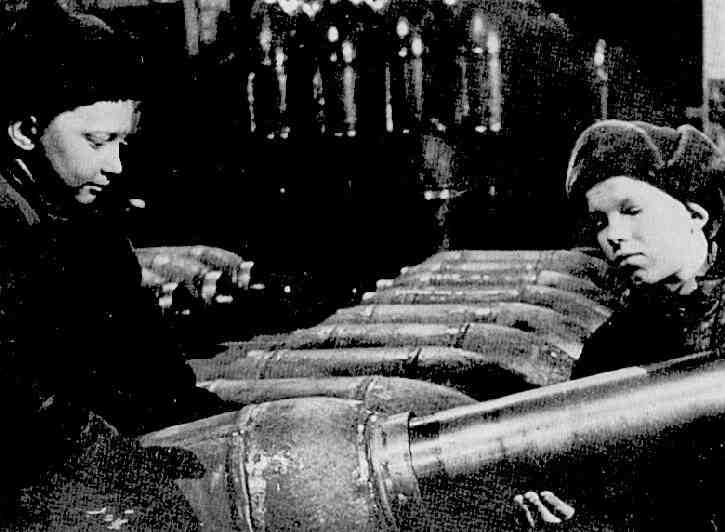
The efforts to get the factories back into operation was also phenomenal. The Soviets reported that before the war it took 2 and a half years to build a steel blast furnace. The Soviets built Furnaces No. 5 and 8 in only 8 monthes at Magnitogorsk. Tank building plant No.183 was evacyuated (Octiber 1941) and had begun to operated (Devember 1941). Tank prodyctiin fell to 4,200 (second half of 1941), but recovered to 11,000 (first half of 1942). Military production in the Urals (increased 180 percent), Volga area (200 percent), and western Siberia (140 percent) (!942). Some 4.4 million industrial workers were trained or re-educated, including many teenagers nd women. The number of women operating forging and press machines rose from only 11% before the invasion to 50 percent (December 1942). The Germans managed to seize or destroy some 31,850 plants, many of which were small plants. Production at therelocated factories was often initiated in the open air befotre buildings were erected. Notice the boys here working in an unheated facility (figure 1). Some of these plants were brought to areas of the Soviet Union that had not been heavily industrialized. A reader in Tajikistan writes, "Some of these plants were set up in Tajikistan durng 1941-42. Many displaced citizens were evacuated to Dushanbe as well. They arrived by train. This substantially increased the ethnic Russian population in Tajikistan and other Central Asian republics." Production at many of these factories, however, were not back to full production until 1943.
[Kravchenko]
Even so the output of these Soviet factories alone exceeded German production. This was not know at the time outside Moscow and clearly not appreciated by Hitler and OKW.
When British and American production were added, it is clear how powerfully Barbarossa had changed the strategic ballance netween the Allies and Axis.
Soviet armamets production was not just changed in quantatative terms as the fctories were moved east and reopened. Stalin had significantly expanded Soviet indistry, but Germany had a massive superiority in heavy industry such as steel production. This should have allowed Germany to significantly exceed Soviet production. But the Soviets manged to out produce the Germns in certain areas such as tank production. one reason was the efficent American designed plants. Also verry imprtant was steps to rationalize Soviet war production. Production of obsolete weapons was terminated and that of more effective weapons like the T-34 tank expanded. Here the Soviets had a huge advantage. Soviet industry identified priority weapon and foused on standarizing them and producing them in huge numbers. The Germans kerpt changing designs, some times with very minor alterations. The Soviets had only one active front--the Ostkrieg. Thus Soviet war industries could be focused on the needs of the Ostkrieg. The Germans in contrast not only had the Ostkriegto contend with, but the War in the West which required a wide range of weaponry beyond the demands of the Ostkrieg. Soviet artillery was of unifomaly a high standard. The major problem at first was a shortage of amunition and the lact of motor vehiclws to move the artillery. Theu used horses which was was a slow way process. The Americans solced both problems. The shipped amunition and provided trucks which could be used to move the artillery. While the Red Air Force was devestated at the onset of Barbarossa because of obsolete planes and Stalin's refusal to permit defensive preparation. New planes like the Yak fighters (Yak 1, 7, and 9s) and the IL-2 Stormovek were high quality planes that in capable hands could and did taken on the Luftwaffe. These planes were also produced in enormous numbers. Again, Lend-Lease shipments from America provided materials in short supply. More than 37,000 Yaks were produced by the Russians, more than any other fighter in the War. This was only slightly higher than the 34,000 Me-109s built. As the Allied air assualt on Germany intensified in 1943 and the Luftwaffe had to pull back to defend German cities, the Germans also began losing their advantage in the air that they had during Barbarossa. A major contrubution to the rationalization of Soviet industry was American Lend Lease. The Americans filled in major holes in Soviet arms production, sych as communicatiion ewquipment.
The German Barbarossa offensive created a huge manpower lossess. The Soviet losses were stunnin. Whole armies were destroted or captured as the German Blitzkrieg swept east--annastonishing 4.5 million men. As a result, every available man, unless involved in a critical activity, was drafted for service at the front. This meant much of the Soviet industrial work force. The workers had to be replaced and the primary replacements were women and youth, bith boys and girls. Women played a major role in the Soviet war effort. Unlike the Germans, Japanese and Western Allies, Soviet women played a not insignificant combat role. Some 0.8 million women served in the Soviet militarry, mostly Red Army medical units. Even so, women were involved in a range of combat roles, including pilots, snipers, machine gunners, tank crews, partisans, and many other combat roles. At first women volunteers wee turned away, but tghis soon changed with the maive losses at the front. Women were accepted in great numbers and prominently featured in Soviet propaganda. As the tide turned jn the Eadt, however, women were no longer seen in Soviet propanganda and at the end of the War were not preent in the Great Moscow Victory Parade. Despite the important military service, it was in industry tht Soviet women made their most important contribution ti the Soviet war effort. Most Soviet women replaced men in industry, transport, agriculture, and a range of other civilian roles. They worked double shifts to maximize the output of the factories which commonly operated 24 hours a day. At the end of the War, women made up over half the workers in heavy industry and some 80 percent of the work force in light industry. [Erickson, p. 53.] The other major group which filled in the places of workers ho volunteered or were drafted for military service were youth, mostly but not enirely teenagers. Here a factor was not just patriotism. A major problem for the Soviets was food supplies. The Germans during the first month of Barbarossa occupied much of the country's best agicultural land. Not only were Soviet citizens starved in German occupied areas, but some 1-2 million Soviets in the unoccupied areas died as a result of starvation and related illiness, and this does not include surrounded Lenningrad. [Collingham, p. 317.] Soviet children during the War received special rations when available, including milk. This changed when the child turnbed 12 years of age. Despite the caloric needs of teenagers, they received the lowest rations of any population group as they were reclassified as 'dependents'. The ration was so low that they faced starvation. The only way to survive was to become a worker. Workers received higher rations, epecially those involved in heavy industry. [Collingham, p. 329.] As a result boys below military age did their best to become industrial workers, especially jobs in heavy industry.
Soviet World War II weaponry contrasted sharply with that of the Germans on the all important Easrern Front. The differences boiled down to technology and philosophy. Germany was an extremely advanced industrial and technological powerhouse. They had the rechnical capability to build advanced, often meaning complex weaponry. The German focus was on performance such as rate of fire and narriw tolerances and clearances. Much less attention was given to maintenance requirements and ability to operate in field conditions. No matter how beautifully crafted a weapon is, if it jams or does not operate when it gets a little dirty or will not operate in the cold, it is not an effective weapon. The Soviet Union was much less technically advanced. As a result, Soviet weapons were often much more basic. Soviet wepons often looked crude in contrast to the finely crafted German weapons which Hitler insisted be built. The Soviet philopsophy was to bulld simple, easy to maintain weapons that functioned under field conditions. This meant that Soviet weaponry continued to funcrion even during winter weather and in muddy or other adverse conditions. Crude looking weaons did not upset Stalin. They also had the advantage that they could be built in huge numbers and at low cost. This put the Germans at a disadvantage. Their smaller industrial plant, especially working on complex weaons, could produce only a fraction of the weaponry produced by the Soviets and Allies. The Soviet T-34 probably saved the Soviet Union, arriving on the battle field at a crucial point of the War and shocked the Germans when their shells bounced off the sloping armor. The T-34 had a fine cannon, but the motor and drive train were wht only an b called primitive. The crew had to use a hammar to change gear. Another nasty surprise to the Germans was the Katyusha multiple rocket launchers (Катю́ша) It was a type of rocket artillery. These multiple rocket launchers delivered a devastating salvo to a target more quickly than conventional artillery, but with less accuracy. The Luftwaffe largely destroyed the Red Air Force at the onset of Barbarossa. Gradually the Red Air Force was reconstituted and the Ilyushin IL-2 Shturmovik developed a reputation as a tank killer on the Eastern Front. Generally Soviet weapons were not noted for high technology. nut their ruggedness and low maintennce requirements giving them the ability to function under battefield conditions. On the battlefield, low-tech was often an advantage because it was less affected by mud and dirt and easier to service. High tech German weapons were more difficult to service and maintain.
American Lend Lease was a huge bebefit to the Soviet war economy. It not only provided valuable equipment and food, it allowed Soviet industry to focus on areas it disell such as produce tanks and artillery and aange of small arms. It pluged in many gaps and weaknesses in the Soviet War economy. Barbarossa resulted in the destruction or capture of large numbers of locomotives. This sih=nificantly crimped Soviet transport system. Rail was rhe orimary way that goods were movedin the iviet Union. The road system s the Germans found as primitive. If Soviet heavy industry had been forced to build large numbers of locomotives, the production of tanks would have been significantlky impaired at a critical time of the War. Anothger major contribution was trucks. While not as glamerous as tanks, trucks are a critical part of modern war. Without trucks, the infantry and supplies can not keep up with the tanks. American trucks gave the Red Army a mobility that the Whermacht could only have dreaned of the height if Blitzkrieg. Lend Lease also provided communications equipment, a significant Red Army weakness at the time of the War. Material was also important, especially aluminum. Without American aluminum, the Soviet production if aur craft would have been significantly impaired. Food was another vital American contribution. American spam was some of limited ration of meat recived by Red arm soldiers driving west after Stalingrad. Food was absoluteky critical vecauseso much of the country's best agriculural land was occupied by the Germans.
Collingham, Lizzie. The Taste of War: World War II and the Battle for Food (Penguin Books: New York, 1962), 634p.
Erickson, "Soviet women at war," in Jon Garrand and Carol Garrand, eds. World War II and the Soviet People (Selected Papers from the Fourth World Congressfor Soviet and Wast European Studies Harrogate, 199, (St. Martin's Press: New York, 1993), pp. 50-76.
Erickson, John. The Road To Stalingrad.
Kravchenko, Col. G.S. (1967).

Navigate the CIH World War II Section:
[Return to Main Soviet war economy page
[Return to Main Operation Barbarossa page]
[Return to Main Soviet World War II page]
[Return to Soviet World War II posters]
[Biographies]
[Campaigns]
[Children]
[Countries]
[Deciding factors]
[Diplomacy]
[Geo-political crisis]
[Economics]
[Home front]
[Intelligence]
[POWs]
[Resistance]
[Race]
[Refugees]
[Technology]
[Totalitarian powers]
[Bibliographies]
[Contributions]
[FAQs]
[Images]
[Links]
[Registration]
[Tools]
[Return to Main World War II page]
[Return to Main war essay page]
[Return to CIH Home page]