|
The Allied Military Government (AMG) was first established in Sicily after the invasion (July 1943). The same basic system was used in Italy after the Armistace and Allied invasion (September 1943). The AMG attempted to cooperate with civilian authorities as much as possible. Article 37 of the Instrument of Surrender (September 29) gave the Allies the authority to establish a military government. The Allies created a Control Commission to administer the AMG (November 10, 1943). As in the rest of war-torn Europe, the economic conditions were very difficult. Italy was treated differently by the Allies than Germany and Japan. It is difficult to say if Italy was liberated or occupied. Before the War, Mussolini's Fascist seems to have had a firm grip on the population. This seems to have disappeared by the time the Allies arrived. Most Italians seem to have seen the Allies as liberators, in part because the Germans had occupied the country. Many Itlalians were also glad to see the allies arrive because as the front moved north it mean essentilly that the war was over. This was somewhat complicated because while the Communists cooperated with the Allies to fight the Germans, they wanted to create a Communist-controlled government after the War.
Although there was no real Resistance movement in Italy before the Resistance, the Communists played a role in the resistance fighting after the Armistice. The guilt for the War was laid on Mussolini and the Fascists and not on the new government established after Mussolini and the Fascist fell from power. There was no elaborate proheam in Italy similar to the De-Nazification effort in Germany. After the War there was a referendum over the monarchy which resulted it its abolisment. The AMG Control Council was closed down after the finalization of the Italian Peace Treaty (1947).
Badoglio announced an armistice with the Allies (September 8). It was in effect a surrender to the Allies. Badoglio knew, however he had much more to fear from the Grmans thn the Allies. Fearing reprisals from the Germans, Badoglio with the King promply fleed Rome to reach Allied lines. The actual Armistice was signed on Malta. Most of the Italian Army was left without orders. A few units managed to stand together. Some went over to the Allies, such as the garrisons of Sardegna and Corsica. Others units stood with the Germans. A virtual Civil occurred within the military and the Fascist Government between pro-Axis cause and pro-Allied forces. The bulk of the Army wanted nothing more to do with the war. The Germans managed to disarm them and ship them north to POW camps in Germany before the Allies could land in force. Fascist Italy was the first Axis partner to fall to the Allies. The Armistice was unusual, because the Allies saw it as surrender, the Italians as an armistace. The most unusual part of it was usually an armistace ends the fighting. For the Italian people it was in many ways just the beginning of the fighting.
Hitler was not fooled by the Badoglio's assurances that Italy would continue the War. The NAZIs also treated Italy differently than the Allies, Hitler ordered Italy occupied by the Wehrmacht which quickly moved south. The German move into Italy seriously depleting the country's strategic reserves. Coming on the heels of the defeat at Kursk, the power of the Whermacht was seriously eroding, but still capable of executing an effective delaying action in the rugged teraune of mountaneous Italy. After Badoglio announced the Armistice (September 8), the NAZIs moved quickly to seize control and disband the Italian Army. The NAZIs gave the Italians soldiers the choice of fighting with the Germans or interment. The Italian Army for the most part did not resist the Germans. The NAZIs killed thousands of Italian soldiers who did not fully cooperate at this time. Large numbers were interned and deported to the Reich.
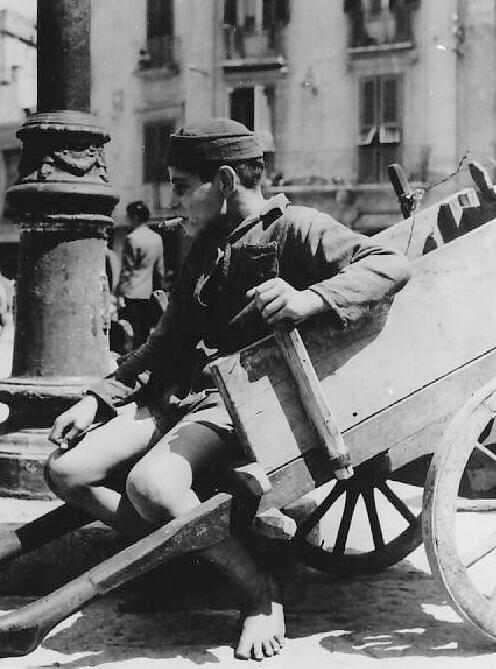
Italy was not a rich country before the outbreak of World War II. The country despite Fascist propaganda to the contrary was not prepared militarily to enter the War or to support an extended War effort. The war was a disaster for Italy. Over 0.3 million Italian military personel were killed or missing. Thre were bombing raids before the Allied invasion (September 1943). Most of the civilian casualties and destruction occured, however, after the Allied invasion. Much of this occurred in connection with Allied assaults on German positions. The Germans set up a series of defensive lines as the Allies pushed then north. The Allies to minimize battelfield losses would use their superority in artillery and air power to heavily shell German positions. As a result of the inaccuracy of aerial bombing at the time, large areas around or near German positions including tows and villages were destroyed. The result was an Italy with large areas devestated by the War. About 70,000 civilians were killed. Such numbers while a tragedy were relatively small compared to other countries devestated by the War. The physical damage in Italy, however, was very substantial. Many towns and villages were heavily damaged or competely destroyed. One estimate suggests that about 10 percent of the physical plant of Italy was destroyed in the fighting.
The story of Italian POWS in World War II is a mixed one. Large numbers of Italians were taken prisoner by the Allies in the North African campaign. The Allies did not take prisoners when they invaded the Italian mainland. Italy just before the invasion quit the war and joined the Allies. Some Italian POWS were shipped to POW camps in America and Canada. Most of the Italian POWS were held by the British. POW camps were set up in America at the request of the British who were having trouble caring for the large numbers of POWs taken in North Africa. The Allied took about 0.6 million Italian prisoners in World War II. Some 52,000 Italians were held in American camps. Here their living conditions were better than before they were captured--an almost unique experience in warfare. For some of the POWs the living conditions (especially the food) was better that at home in civilian life. (Here we are taling of course about nutrition and not cooking.) Something like 90 percent of the Italian POWs in America agreed to support the Allied war effort by joining what would be called Italian Service Units. The POWs were repatriated quickly after the War. Few Itlian POWs died during their incarceration. The Germans after Italy quit the War took large numbers of Italians prisoner. They were transported back to camps in the Reich. There were substantial deaths during the period in which the Germans seized the Italian soldiers and during the period they were encacerated in camps. Mussolini also committed Italian armies to the NAZI campaign in the Soviet Union. Large numbers were killed in the fighting or persished in the Soviet Gulag. Most of the Italians captured by the Soviets were taken during Operation Saturn--the offensive which cur off the German 6th Army in Stalingrad (November 1942). The Germans had used the Italians, Hungarians, and Romanians to protect their northern and southern flanks while they foicused on Stalingrad. The Armata Italiana in Russia (ARMIR) was decimated. The ARMIR consisted of about 235,000 men. The Italians reported 84,830 men missing in Russia. About 30,430 men were killed during the Stalingrad fighting and withdraw. The Soviets reported taking 54,400 Italian POWs. Of these men, 44,315 died in the camps, most apparently during the winter of 1943. The Soviets repatriated 10,085 Itakians during 1945-54. I don't have much information on how Italy treated Allied POWS. They did not have many American and British POWs. (We are not positive if the British taken in North Africa were encarcrated in German or Italian camps.) There were Greek and Yugoslav POWs taken mstly in 1941. We are not sure just how they were treated.
Military government was noting new, even to the United States. The first extensive American experiece was during the Civil War. The U.S. Army's experience during World War II, howver, was novel because of the comlexity, area of territory, and size of the population. The Allied Military Government (AMG) was first established in Sicily after the invasion of the island (July 1943). American and British civil affairs officers came ashore with the combat troops (July 10). This would be the largest undertling of military governmnt outside of Germany and Japan. The training provided AMG personel was very basic. Italy was the first Axis meember to fall, but was not guilty of war crimes on the scale of the Germans and Japanese. Article 37 of the Instrument of Surrender (September 29) gave the Allies the authority to establish a military government. The Allies created a Control Commission to administer the AMG (November 10, 1943). The governing organization was the Allied Conrol Commission (ACC) which established headquarters at the seat of the Italian Government. They also set up a field organiztion to use the Allied armies to assist the civian population. The allied military command assigned five tasks to the AMG: 1) to organize ailitary government to support combat operations, 2) to provide emergency aid to civiians to prevent dusease and ynrest, 3) to prepare a governmental administrative structure to be turned over to civilin control, 4) to supervise execution of the armistice/surrender, and 5) to serve as the sokesman of the united Nations (meaning primarily America and Britain) to the Italian Government. [Fischer, p. 114.] There was a military function, primarily to secure lines of communication. As most Italians welcomed the arrival of the Allies, seurity did not prove a major issue. The AMG found tht it most irgent task was to come to the aid of the civilans, most urgently clean water and food. The major complication was to set up set up non-Fascist local authorities. The AMG chief was was Lord Francis Rodd, 2nd Baron Rennell.
The civil affairs chief was the Colonel Charles Poletti (until February 1944). The same basic system was used in Italy after the Armistace and Allied invasion (September 1943). Dealing with Fascists was largely left in the hands of the Italian civilian govrnment that the AMG helped set up, especially after Mussolini was executed by partisans.
Italy was one of the three major Axis countries, but was treated differently by the Allies than Germany and Japan. It was so different in fact that it is difficult to say if Italy was liberated or occupied. Before the War, Mussolini's Fascist seems to have had a firm grip on the population. This seems to have disappeared by the time the Allies arrived. As a result there would be no major Allied effort to root out Fascism. The Italians did this on their own. This was possible because Mussolini and the Fascists nevervhad the same hold on Tkay that Hutker and the Jaonese militarists had on Germany and Japan. Most Italians seem to have seen the Allies as liberators, in part because the Germans had occupied the country (September 1943) and had behaved as usual behaved ruthlessly. Many Itlalians were also glad to see the Allies arrive because as the front moved north it meant essentilly that the war was over for them. And many Italians had very positive attitudes toward Americans. This was especially true of the peasantry and working class. In the most remote villages it was rare to find Itaians who did not have families or friends with American connections. . The ACC was given five tasks by the Allies military authorities: 1) to organize a military government, 2) to aid the civilan population so as to prevent diseae and unrest, 3) to prepare for a return to civilian rule, 4) to suiprvise Italian compiance with the Armistice and surrender, 5) to serve as the spolesman to the United Nations (meaning at this stage America and Britain) to the Italian Government. [Fisher, p. 114.] The Allies dud not plan war crimes trials and the Italian Government after the Allied invasion of Italy declared War on Germany and joined the Allies. Thus one of the major tasks was coming to the aid of the civilan population, especially to restore the urban water supply and provide ememergency food supplies.
The Italians had somewhat mixed feelings about the British--not hostile, but mixed. The Americans were a different matter. One factor of course was the German invasion. But even more important, Mussolini was one of the few Italians who desired to go to war with America and the declaration of war was forced upon him by Hitler. . Not only were there large numbers of Italian-Americans in the American Army, but many Italians had connections with America. Large numbers of Italians had lived in America or had relaives in America. Italians immigrants were one of the most important immigrant groups entering America during the late-19th abd early-20th century. And Italians were almost unique among the immigrant groups in the number who returned to Italy. Precise numbers are not available, but perhaps half of the Italians returned. Unattached men were particularly prone to compiling a nestegg and then returning to Italy to buy a small farm or store. Many Germans of course also emigrated to America, but over aonger period. . Few returned to Germany and many who stayed lost contct with relatives in Germany. Usually countries are invaded by countries with a history of hostility. This was not the case of the American Army which invaded Italy. The American units entering Italian cities were treated like liberators. As a result, the entry of the American Army into Germany and Japan was very different.
The relationship between the Allies and the resistance movement in Italy was somewhat complicated. Although there was no real Resistance movement against the Fascists in Italy before the German occupation. The Communists played a major role in the resistance fighting after the Armistice. The Communists cooperated with the Allies to fight the Germans. They wanted to create a Communist-controlled government after the War.
The guilt for the War was laid on Mussolini and the Fascists and not on the new government established after Mussolini and the Fascist fell from power.
Italy was among thecountries most devestated by World war II. Italy declared war on Britain and France (June 1940) and invaded Greece (October 1940). Italy had aeak economy even before the war, shifting production to arms and drafting farm workers created shortages even while the War was far away fromthe Italian Peninsula and the Axis was advaning on all fronts. This changed with Allied victories in North Africa (October-November 1942) and the Soviet Union (February 1943). Soon Italy was within range of Allied bombing from North Africa, adding physical destruction to the growing shortages. The Allied seizure of Siclily (July 1943) led to the invasion of southern Italy (September 1943). This lead to apriracted, bloody campaign wged from the toe of Itaky north to the Po River. It took nearly 2 years. Feance after D-Day waas liberared in 3 months, outside of Normandy, the fighting only lasted about a month. There was war damage in France, but the short length of the campihn limited it. Italy was very differnt. There were serious shortages n Italy before the Allies landed. Once the fighting up the Peninsula began the situation became much worse. The physical damage was immense. Basic infrstructure was destroyed by thevGermns. Wgen the allies ebteresed Italian cities there was often no working water systems. Harvests were affected, significantly reducingdomestic food production. And the destruction of the transport system meant that it ws difficult to get what ws harvested into the cities whee it was needed. Italy was a largely agriultura country, but not self-suggicent in food. Germany survived by piligaing occupied countries. Italy militry conquests wee more limited and after surrendering to the allies not existent. Thus the food ituation became deserate. American food distributed through UNRAA prevented starvation in the southern areas liberated. No food was available from the Germans and the food situation in the north became desperate. After the war there were shortages of everything. Without American food, Italy as in Wotld war Iould have starved.
The Fascists governed Italy for 20 years, far longer tha the NAZI era in Germany. And during those 20 years, there was no real resistance to Fascist rule. Yes the Fascists had far less impact on Italian society than the NAZIs in Germany. There was, however, no elaborate Allied program in Italy similar to the De-Nazification effort in Germany. The Allies conducted a massive effort to de-Nazify Germany. The Allies in Italy largely left that to the Italians themselves. I am not sure at this time just how the Italians handled this.
After the War there was a referendum over the monarchy which resulted it its abolisment. The AMG Control Council was closed down after the finalization of the Italian Peace Treaty (1947).
Fisher, Thomas R. "Allied military government in Italy," The Annals of the American Academy of Political and Social Science Vol. 267, Military Government (January 1950), pp. 114-122.

Navigate the Boys' Historical Clothing Web Site:
[Return to Main Italian World War II page]
[Return to Main Axis World War II aftermath page]
[Return to Main World War II page]
[Return to Main Italian page]
[About Us]
[Aftermath]
[Biographies]
[Campaigns]
[Children]
[Countries]
[Deciding factors]
[Diplomacy]
[Geo-political crisis]
[Economics]
[Home front]
[Intelligence]
[POWs]
[Resistance]
[Race]
[Refugees]
[Technology]
[Totalitarian powers]
[Bibliographies]
[Contributions]
[FAQs]
[Images]
[Links]
[Registration]
[Tools]
[Return to Main World War II page]
[Return to Main war essay page]
[Return to CIH Home page]