|
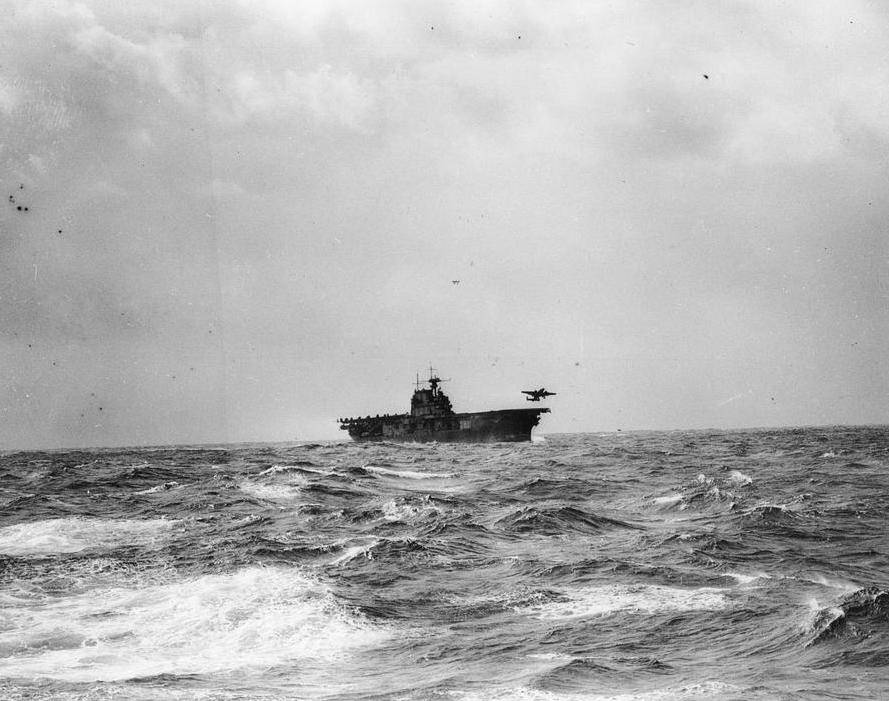
The news from the Pacific was an unrelenting series of disasters. America needed a victory. The only intact offensive force in the Pacific was Americais carriers. Army Air Corps pilot with B-25s trained for carrier take offs. The B-25 was a medium bomber never intended for carrier use. Carrier commander Afm. "Bull" Halsey led a taskforce made up of Hornet and Enterprise. It was a risky operation as it committed half of the Pacific fleet's carrier force to a very dangerous operation. The B-25s took off from Hornet. It was the first blow to the Japanese home islands. The raid was led by Lt. Col. Jimmy Doolittle. The physical damage was inconsequential, but the psychological impact was immense. Most of the Amrican aviators crash landed in China and were helped to reach saftey by Chinese Nationalist guerillas. The Japanese reprisals were savage. A estimated 0.5-0.7 million Chinese civilians were murdered. The Japanese Navy was so embarassed that they rushed forward Admiral Yamaoto's plans to bring the desimated American Pacific Fleet to battle at Midway Island.
The news from the Pacific was an unrelenting series of disasters. Pearl Harbor had been bad enough, but then there had been the loss of Guam and Wake Islands (December 1941). The Americans Air Corps in the Phillipines was also largely destroyed (December 1941). The Americans and Phippine forces retired to Batan and were forced to surrendered at Batan (March 1942). The British fared even worse. The Japanese easily seized Hong Kong (December 1941) Japanse bombers sunk Repulse and Prince of Wales sent to relieve Singapore (December 1941). The Japanese Army frove the British down the Malay Peninsula. Finally the British bastion at Singapore surrendered (April 1942). With little opposition, the Japanese seized the critical oil fields in the Dutch East Indies. America badly needed a victory.
The only intact offensive force in the Pacific was the American carriers. The Japanese carrier force was much larger and better trained with mpre effective planes. The Pacific was, however, emense. Thus Carrier commander "Bull" halsey was able to use the carrier for hit and run strikes on the Japanese Pacific bases. In a major engagement the Japanese had a much more powerful force, but with the size of the Pacific, they could not prevent American strikes on isolated islands. This strategy helped to keep the Japanese off ballance. It also was useful in helping go build combat experience for the American pilots and carriers. These actions had to be very carefully executed. Given the Japanese advantage in carriers, each American carrier was precious.
After Pearl Harbor, there was a widespread desire to bomb Japan. Japan was, however, at the time far beyond the range of American bombers. A Captain Duncan conceived the idea of using carriers. Carrier aircraft had very small payloads, potent for naval warfare, but miniuscle for significant damade to land base targets. Duncan's inspiration was wsing B-25 bombers. He reasoned that carriers could bring the B-25s within range, where they could launch, bomb mainland Japanese targets, and land iat runways controlled by the Chinese Natuinalists. The project went all the way to President Roosevelt who despite the risk, quickly approved it. Army Air Corps pilot with B-25s trained for carrier take offs.
Lt. Col. Jimmy Doolittle was chosen for the operation. James Harold Doolittle was born in Alameda, California (1896). He would become the most famous USSAF commander of World War II, eclipsing even USAAF commander Hap Arnold, primarily because of the famous carrier-based bombing attack on Tokyo (1942). Most American military commanders became famous during the War. Doolittle was famous before the War. At a very young age, the family moved to of all places Nome, Alaska. His father was looking for gold. Jimmy was short even as an adult. Growing up in a rough place around larger boys, he became quite a scrappy kid in part because his mother insusted on doing his hair in curls.
Jimmy found himself geting into fights becuse of hius size and other boys who made fun of his long curls. After his first day of school, Jimmy demanded his mother cut off his curls. but he kept on fighting. He would make a name for himself as boxer until he he came across his first love -- aviation. Doolittle studied as an undergraduate at University of California, Berkeley, graduating with a Bachelor of Arts in 1922. He became one of the best known aviation pioneers, winning many races. His public profile was only eclipsed by Lindbergh. Doolittle took vitiation seriously. He earned a doctorate in aeronautics from the Massachusetts Institute of Technology (1925), the first issued in the United States. Compare this with his main adversary--Luftwaffe Chief Herman Göring who probably never opened a book on aeronautics. In the barn storming eras, he executed maneuvers with planes that others did not believe possible. He won races, set speed and distance records, and pioneered 'blind' (integument) flying. He won th Harmon Trophy which made all-weather airline operations practical. He served as flying instructor during World War I and became reserve officer in the United States Army Air Corps. Out of the seducer, he played a major role in developing 100-octane aviation gasoline on a commercial scale. He had become aviation manager of Shell Oil Company. This would help save Britain in the Battle of Britain and play an important role in Allied air successes during the War. He was recalled to active duty as America began preparing for World War II (1940). His major assignment was to help American automobile companies convert to aircraft production. His claim to public fame came with what will always be known as the Doolittle Raid on Tokyo (1942), which earned him the Medal of Honor presented personally by President Roosevelt.
The men were all volunteers. They began practcing takeoffs on abreviate areas marked off on runways--500 feet. They were not immediately told what they had volunteered to do, but some soon realized that the 500 feet was the length of a carrier runway. Their work established that takeoffs were possible, although the men never practiced actual carrier takeoffs. The crews were not optimistic that they could penetrate the Japanse air defenses, let alone make it to Japan. Even so they were willing.
The B-25 was a medium bomber never intended for carrier use. Some doubted that the operation was even feasible. The planes hd to be moddified for the operation. Here Col. Doolittle's expertise was critical. A 225-gallon fuel tank was placed in the bomb bay, a 60-gallon tank in the lower gun turret, and a 160-gallon tank in the passageway. This extended the range, but reduced the bomb load. It also weakened the plane's defensive fire power. The tail guns were done away with ton lighten the eright. Broomsticks simulated machine guns were placed at the rear of the planes.
It was a risky operation as it committed half of the Pacific fleet's precious carrier force to a very dangerous operation. Moving so far west to bring the B-25s in range, not only exposed the carriers to Japanese naval forces, but to land based attacks. The loss of one of these carriers would have severely weakened the already depleted Pacific Fleet. Loss of both would have meant that the Hawaiian Islands could not be defended and would have opened the way for a Japanese invasion of Australia. It was a desperagte gamble for a largely sumbolic strike on Japan that would have very little impsct on the Japanese war economy.
Adm. Halsey led the battle group made up of Hornet, Enterprise, and escort cruisers. Two carriers were necessary because with bombers lashed to the deck, the Hornet was defenseless. The Enterprise could provide the needed air cover for the battle group. Halsey was America's most experienced carrier commander and had already begun to make a name for himself in the Pacific. The strike force consisted of 16 B-25s. They were loaded aboard the Hornet in secret. They were lashed to the deck and covered. Even the crew did not know a strike on Japan was planned. General Marshall personally saw Doolittle off and wished him good luck.
An American scout plan spotted a Japanese vessel (April 18). The battle group began evasive evasive maneuvers. They then spotted a Japanese fishing vessel. Before the vessel could be destroyed they dected radio signals. [Schultz] Halsey had to assume that the Japanese had been alerted to the raid. As a result, the battle group had to either launch the planes sooner than planned or turn around. Halsey decided to launch. They were 170 miles east of the planned launch point. This made it difficult for the air crews to reach the Chinese air fields as planned.
The Japanese were not ready for an actual raid. Japan as it was out of range of American air fields did not have an effective air defense. The B-25s were not intercepted by the Japanese Tokyo was conducting an air raid drill. It was thus not immediately apparent what had occurred. It was the first blow to the Japanese home islands. The air crews experienced a range if difficulties. Some equipment did not work and there were weather problems. Many air crews went off course. While all but one got to their targets, they were dispersed and coming in from different directins. Thus further confused the Japanese. Many people in the ground never expecting an air attack assumed that they were Japanese planes. Many people even waved at the bombers. Most of the bombers were used to target Tokyo. Three of the B-25s were used to target Yokohama and Yokosuka. The actual targets were military and industrial sites, but some civilian facilities were hit.sites being hit.3).
The physical damage was inconsequential. B-25s were medium bombers with limited bombloads. There was no real impact on the Japanese war economy. The psychological impact was immense. The most notable impact was for Admiral Yamsmoto to move forward his plans to force the American carriers to battle and complete the destruction of the Pacific fleet. What emerged was the most complicated naval battle plan in Japanese history--the assault on Midway atol.
Most of the Amrican aviators crash landed in China and were helped to reach saftey by Chinese Nationalist guerillas. The Japanese ar defenses were ineffectual, but the air crews faced the daunting task of reaching areas controlled by the Chinese nationalist airfields. This woild have been diffcult enough n the best of circumstances, but because they had launched early, they were now short of fuel. In the end of the 80 men pasrticipasting in the raid, the Japanese only captured 8 men. The air crews were firced to ditch or bail out. One plane landed in Vladivostok, Russia. Russia and Japan at the time were not at war.
The other crews were scattered all over China. Doolittle was rushed back to Washington.
The United States quicjly announced that Tokyo had been bombed. There was geberal rejoicing in the American press. It was the first good news from the Pacific. Details of the mission, however, were not announced. The Japanese did, however, broadcast the details. The American air crews were ordered not to reveal details of the mission for security reasons. The Japanese, however, were easily able to piece together what had happened. President Roosevelt joked with reporters that the planes had struck from Sangrala--an illusion to a James Hilton novel that was popular at the time.
American historians generally describe the Doolittle raid as as giving American morale a badly needed boost. Less commonly addressed is the Japanese reaction. Unlike a battle is a far away Pacific atol, the Japanese propagandasts could not ignore the air raid or pretend it did not happen. They could claim that the attacks were not important, but they could not deny that the United States did not have the military power to strike the Home Islands while Japan did not have the power to strike the Continental United States. We have wondered just how the Japanese public and soldiers priocessed this. One historian writes, "Though [Doolittles attack] had been brief and relatively benighn, the attack was interpreted by many Japanese as a ark portent of the future. In their living menories, and even in their written history, the Japanese had no experience of foreign incursions; they have never dared to imagine that their homeland would be violated in such a mannor. The navy fighter piolot Saburo Sakai, stationed in the South Pacific ... [said] that the news 'unnerved' his fellow airmen: 'The knowledge that the enemy was strong enough to smash at our homeland, even in what be a unative raid, was cause for serious apprehension of future and heavier attacks.'" [Toll] Even Japanese schoolboys could read a map. After the Doolittle raid there were no longer reports of new iskands seized where pins could be added to the map. Ans slowly although reports of victories were broadcast over the radio, the ons representing the Americans began to inch toward the Home Islands.
The Japanese showed the wreckage of the B-25 that had crashed. They gave great attention to the civilian targets hit. Unmentioned was the damage to Chinese civilian targets that were routein and had been the case for years. The Japanese reprisals in China were savage--the Zhejiang-Jiangxi Campaign. The China Expeditionary Army of the Japanese Imperial Army commanded by Shunroku Hata
The American planes had landed in the provinces of Zhejiang and Jiangxi (April 18). The American plan was to bomb Tokyo and the other Japanese targets and because they could not land on the carrietrs, proceed on to prepared airfields in unoccupied areas of China. As Doolittle had to launch early, further out to sea than planned, most of the Doolittle flyers ran out of fuel and had crash land along the coast in the Japanese occupied Chinese provinces of Zhejiang and Jiangxi. Most (64) of the airmen parachuted into the area around Zhejiang. Most were sheltered by the Chinese civilians and hid from the Japanese. Japanese and collaboratiinist Chinese picked up eight flyers. Three were executed after a show trial for 'crimes against humanity'. The Japanese army prioceeded to conduct an exhsustive hunt for the other Dooolittle airmen (May-August 1942). In the process they destroyed whole towns and villages, including the people living there, if they believed to have aided the Americans. They executef large numbers of civilians. The Japanese are believed to have killed 0.25 million Chinese civilizns. We have seen higher estimares of 0,5-0.7 million Chinese killed. The Japanese Army also experiments with biological weapons, spreading cholera, typhoid, plague and dysentry pathogens. This may explain the higher desth tolls we have seen.
The Doolittle Raid in the end was more than a moral booster. The Imperial Navy was so embarassed that they rushed forward Admiral Yamaoto's plans to bring the desimated American Pacific Fleet to battle at Midway Island. It was not the largest bsttle battle of the Pacific War, but it would be the most important. The Japanese failed to find the American carriers at Pearl Harbor. The Americans would find the Japanese carriers at Midway, imncluding four of the First Air Fleet's six carriers that had conducted the attack on Pearl Harbor.
Schultz, Duane. The Doolittle Raid (New York: St. Martin�s Press, 1988).
Toll, Ian W. Pacific Crucible: War at Sea in the Pacific, 1941-1942, 640p.

Navigate the CIH World War II Section:
[Return to Main World War II naval campaign page]
[Return to Main World War II page]
[About Us]
[Aftermath]
[Biographies]
[Campaigns]
[Children]
[Countries]
[Deciding factors]
[Diplomacy]
[Geo-political crisis]
[Economics]
[Home front]
[Intelligence]
[Military forces]
[POWs]
[Resistance]
[Race]
[Refugees]
[Technology]
[Totalitarian powers]
[Bibliographies]
[Contributions]
[FAQs]
[Images]
[Links]
[Registration]
[Tools]
[Return to Main World War II page]
[Return to Main war essay page]
[Return to CIH Home page]