
German Fascism: The NAZIs: Ideology and Party Program
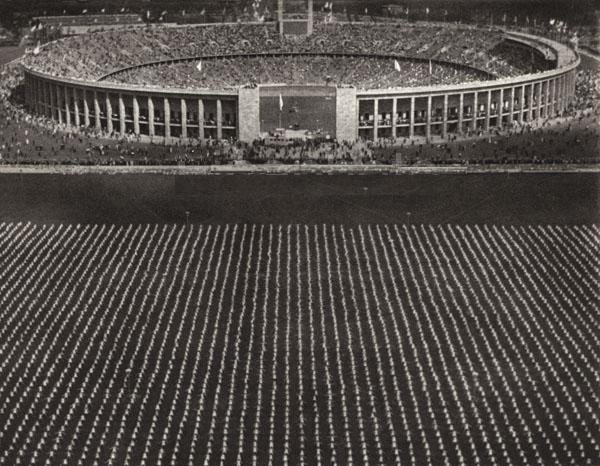
Figure 1.--The NAZIs were one of the totalitarian ideologies that emerged during the early-20th century. The NAZIs were a Fascist variant. They shared many similarities with the Communists. Central to both ideologies were the subordinatin of the individul to the collective--in the case of the NAZIs the Aryan Germanic Volk. All of these totalitarian ideologies reversed the historic arch of Western civilization toward liberal democracy and individual human rights. The best visual representtion of this is the films of Leni Riefenstahl. Here is a scene from 'Olympia' (1938), a NAZI propaganda film documenting the 1936 Summer Olympics. Here we see massed youth giving a exercise demonstration in front of the Berlin Olympic stadium.
|
|
NAZI Party idelogy is not easy to describe. This is in part because what Hitler wanted and whatvthe NAZI faithful wanted was not identical, although therec were many shated interesys. Hitler's ability to bridge or mask these differences are a tribute to his masterful political skills. Thus Hitler adjusted his speeches and writing to the political conditions. The Party he seized control over and the belieffs of the SA faitful was strongly nationalists, but consisted of many working-class members who wanted deep-seated social revoloution. Hitler was sympathetic to this, but saw what Roehm and others did not see, that Germany's industrial establishment and military would never allow such a revolution which seem to close to what the Communists wanted. Thus Hitler carefully crafted his speeches and writing to what was necessary to achieve power. Hitler wanted to create a New Germany, but he also wanted to obtain the loyalty of the indiustrialists and military who he needed for his primary goal--to create a New Europe which Germany dominated and which could only be achieved by war. The New Europe would given Germany the Lebensraum it needed and allow Germany to reshape the ethnic make up of Europe. Here the primary goal was the destruction of the Jews and the enslavement of the Slavs. Hitler was rematkably honest about this in Mein Kampf, although he down played the obvious fact that his goals could only be achieved by war.
The NAZIs of course did not come out of nowhere. They were the culmination of a range of diserate thought arising in the 19th century, including ideas that had been percolating in Germany and other countries for enturies. Anti-Semitism is of ancient originds. Other ideas like eugenics were of more recent origins. The NAZIs are simply the most notable example of the Fascist movement of the early 20th century because they managed to gain control of the German state and Germany's powerful uindustrial and scientific capavility. Mussolini was the first Fascist leader, but neither he or Hitler invented Fascism. Fascist thought developed in the 19th century throughout Europe and it was not particularly strong in either Germany or Italy or for mater the Asian variant in Japan. We see Fascist ideas in writers from many European countries, including Austria, France, Gerjmany, and Italy. It must be recalled that at the time that most of Europe was dominsted by multi-natiinal empires (Austri-Hungary, Germany, the Ottomans, and Russia). Some of the most important early Fascist political authors were Theodor Fritsch, Paul Anton de Lagarde, Julius Langbehn, Jörg Lanz von Liebenfels, Joseph de Maistre, Charles Maurras, and Georges Sorel. The 19th century saw the rise of science and some authors attempted to use the authority of science to support their philosophy, Karl Marx dud the same. Fascist authors included Johann Gottlieb Fichte, Giovanni Gentile, Gustave Le Bon, Friedrich Nietzsche, Vilfredo Pareto, Karl Vogt, and Ernst Haeckel. There were also a range of historians and social thinkers. Some Fascists as well as many progressives were also influenced by eugenics. Eugenics and Social Farwinism became a central tennant of NAZI thought. Each national Fascist movement had its own peculiar excetricities. The NAZIs were influenced by German historical ideas such as the German tribes resustabce to the Ronman Empire and the medieval Teutonic Drang nach Osten.
Army Influence
The Germany Army after the War was still largely royalist. The Allies had refused to deal with the Army and demanded the abolition of the monarchy. The Army's defeat left it no choice to acceot these demands, but the Army was essentially hostile to the Weimar Republic government. Hitler easily convinced some of his Army colleagues to join the Party. The most imprtant was Captain Ernst Roehm. These new recruits, especially Roehm were of considerable importance to the fledgling party. Rohm had access to funds that the Army used for political purposes. These were the first substantial contrubutions to the GWP.
National Socialism (April 1920)
Hitler convinced the Party to change its name. He suggested the National Socialist German Workers Party (NSDAP). Hitkler was not a Socialist. The name for him was a tactical way of appealing to the working-class. Socialism was popular in Germany. Heavily industrisalized Germany had the largest Socialist movement in Europe. Thus adding Socialist and Workers to the Party name was to give it more appeal. For Hitler, however, it was National that was the key word. As fir Socialist, he simply redefined what Socialism meant. Socialist doctrine was of course centered on economics and social equality, but many Socialists also promoted an ideal society with racial and gender equality. This was anathema to Hitler. He stressed that the Party involved National Socialism, meaning equality for those of German Blood (ancestry), but not aliens--especially the Jews. He advocated canceling the citizenship of Jews and other aliens and preventing any future immigration, except for those of Gernan ancestry. This use of the trm 'socialism' confuses younger readers. Thus we get comments like, "Your web pages contend that the Nazi's were Right Wing. Actually, being ardent Socialists, it is more truthful to classify them as Left Wing. Does that mean that they have any connection to todays 'Left' in America? No, of course not. No more than those on the 'Right' do. Both sides should stop using this smear." [Doohan] It certainly is true that Socialists is in the name NAZI. Of course, it is also true that Democratic was in the name of the People's Republics established by Stalin throughout Eastern Europe after World war II. And of course no one would not argue that they were actually Democratic. The word 'Socialist' was included in the Party's name to appeal to workers. There is no real trace of Socialist thought in Mein Kampf. One of the first thing Hitler did on seizing power was to arrest the Communists and many Socialists. Over time many more Socialist were arrested. Socialist thought or at least a desire to move against the industrialists and wealthy was present within the Party. It was most pronounced in the SA. And of course Hitler in his second year in power moved against the SA. There are many similarities between the Communists and NAZIs, but primarily because both implanted a totalitarian police state and attempted to control individuals in a variety of ways. One does not see in NAZI economic policies those featutes most associated with Socialist/left-wing regimes such as collectivization of agricultural and seizure of private enterprise and operation as state corporations and businesses by the NAZIs. There is one connection between the modern left and the NAZIs. That is the heavy hand of regulation and desire to control the economy. Their goals in doing this are different, but the desire to control economic life is very similar. And it was the removal of the heavy burden of regulation a few years after the War is what led to the German Economic Miracle.
The Twenty Five Point Program (February 1920)
the NAZIs published their first Party programe which they called the "Twenty-Five Points" (February 1920). The Party rejected the Versailles Treaty. They in particular objected to privisions of the Treaty which had created new states and given them former German territory. The NAZIs demanded the reunification of all German people, including Austria which under the provisions of the Treaty was prihibiting from uniting with Germany. The NAZIs promoted the idea of equality, but only for those of German ancestry. "Foreigners" and "aliens", and Jews were described as aliens, were to be excluded. There were provisions aimed at the working class, including measure to redistribute wealth, through measures against war profits and advocating profit-sharing, nationalization of monopplies, ncreased old-age pensions, and expanded access to education for working-class families. The new program was announced had a rally attended by 2,000 people (February 24). This was impressive in comparison to the handful of people who had attended earlier meetings.
Adolf Hitler after his conviction for treason as a result of the Munich Beer Hall putch wrote Mein Kampf while confined in Landsburg Prison. He dictated orally which Rudoolf Hess, his secretary, wrote down. This probably contributed to the rambling text. Mein Kampf is a long and rambling book which as a result, the content aside, mskes for difficult reading. Hitler as an avid consumer of crack pot ideas, many of which are exhibited in the book. The essential thesis, however, is very simple. To Hitler the core of the German people is the farmer. The first step in the revival of Germany was the destruction of the Jews who he saw as weakening the Aryan German people. Once the Jews were eliminated, Germany could develop the strength to seize the land needed by the German farmer in the East from the Slavs (Czechs, Poles, and Soviets). The German soldier would then seize the land from the Slavs who would be expelled or enslaved. The land would then be colonized by German farmers. Germany's policies in the Occupied East followed just this perscription. The anti-Semetic aspect of Mein Kampf is often mentioned in connectin with the Holocaust. Less commonly discussed is the Hollocaust for the Slavs which the NAZIs would have persued if they had won the War.
Bamberg Conference (1926)
The Bamberg Conference (Bamberger Führertagung) was convened by NAZI PArty Leader Adolf Hitler in Bamberg (February 14, 1926). He was concerned about growing intra-party differences that had developed while he was in prison . The NAZIs were still a relatively small group. The period between Hitler's release fom prison anf the rise after the beginning of the Depression are known as the Wilderness Years. Hitler met with included some 60 NAZI-Party members--the top leadership of the Party. One of the mjor issues was the disagreement as to just what 'ocolist' in the pasrty nasme meant. There weee both right-wing and left-wing elements in the Party. Quite a number of NAZIs at the time held many economic ideas little different from the Communists. The idea was not to discuus isues, but made it clear what his ideas were and that the leadership were expected to comply. He wanted to tamp down dissent within the Party. He was especilly concerne about growning discent among members in the northern branches. itler made it ckear that there would be party unity based exclusively on the leadership principle (Führerprinzip). He demanded that Party leaders endorse without question his position as the sole, absolute, and unquestioned ultimate authority. His decisions were final and non-appealable. He made it clear that the NAZI party was not in any way a democratic or consensus-based party. He wanted an end to bickering between the northern and southern Party branches over Partyy ideology and goals. And he damanded that Party leaders accept without question his Twenty-Five Point Program as the Party's 'immutable' program.
The Road to Resurgence (1927)
Hitler was less committed to immediate social revolution than Röhm and many of the SA faithful. Here it was in large measure a matter of political calculation. He saw the need to acquire a more moderate image. He understood better than many that he could not take on the military. He also understood that he needed money that the industrialists could offer. In addition he wanted the loyalty of both the military and industrialists for the war he wanted to wage. Both would be necessary if Germany was to wage war. Hitler wrote a short pamphlet entitled 'The Road to Resurgence' (1927). The pamphlets had a very limited run and was not widely publicized, primarily because it would have disturbed many of his SA working-class followers who wanted profound social revolution more on the Bolshevik model. They were distributed to most important German industrialists. Hitler wrote that the NAZIs once in power would not pursue the anti-capitalist measures described in the NAZI 25 Points. Hitler wrote that 'capitalists had worked their way to the top through their capacity, and on the basis of this selection they have the right to lead'. This mirrored his racial arguments. Hitler insisted that National Socialism advocated all people playing the role in society for which they were most capable. And that the NAZIs were no threat to the wealthy. This brought some support and some badly needed financial contributions. The right-wing German Nationalist Peoples Party (DNVP), however, continued to be more successful with German industrialists.
Pagentry was an important art of the spectacular sccess of the movement in Germany. Hitler's speeches and NAZI pagentry were commonly the subject of parody in Britain and Ameruca. In Germany they proved frightingly effective. Hitler grafted a new NAZI mythology on Germany's existing celebrations and holidays. Many German national and Christain holidays simply had NAZI pagentry and Hitler worship added. Most Germans accepted the inovations as the natural course of events. Hitler's birthday (April 20) began a major celebration. I assume that the Kaiser's birthday had been an important celebration during the Imperial era, but need to confirm this. Important NAZI festivities like Hitler's birthday became pagan entravaganzas with spectacular totch-light parades. During the day his picture appeared in shop windows throughout Germany xfraped in laurels. May Day celebrations had the traditional may poles, but along with the dancing the NAZIn added columns of banner waving, unifirmedcworkers and Hitler Youth. The summer solice (June 22) became the occassions for huge bonfires. Celebrants would then toss in wreathes to NAZI heros. Couples then leaped over the fire. The Nuremburg Party Fstival coincided with the Fall equinox. This was the occassion for a week of celebrations. Incorporated in this week were Worker's Day, Hitler Youth Day, Party Leader's Day, and Brown Shirt Day. Closing Day was theclimax with fireworks, tirch light parades, massed bands, banners, andc huge numbers of uniformed men marching.
The NAZIs are often considred to be a conservative force. They are often referred to as a rfight wing group in contrast to the Socialists and Communists on the left. They did indeed receeive support from right-wing forces such as important industrialists and royaliss. Some of the Kaiser's family supported Hitler thinking that the NAZIs would restore the monarchy. Other groups like important elements of the middle-class supported him seeing Hitler as a conservative force. We believe that this is a misunderstanding of Hitler and the NAZIs. They were not a conservative force. Hitler was determined to carry out a through revolution in Germany life, one which he had only partly started when the War began. One of the fundamental goals was a thorogh-going social revolution. And this in part explains the devotion and support he eventually achieved. While the Kaiser resigned after the end of World War I, the Weimar Republic did not significantly change German's social structure. Germany was a class-bound country. Youth from the working-class or farm backgrounds had little chance to suceed in German life. It was hard for them to even enter secondary school. The NAZIs changed this. Under tge NAZIs, family background meant little. In the Hitler youth boys from working-class families competed with boys from families with social status and upper incomes. With the NAZIs political loyalty was all important. Academic opportunity opened up as well as positions in government and other areas. The NAZIs are associated withxenephobic nationalism, racial bigotry, and war crimes, less understood is the extent to which the NAZIs undercut Germany's classbound social system.
National Goals
Often the NAZIs are seen as the conservative far right respmse to the far left or Communism. This is a fundamental misreading of the NAZI movement. The NAZIs were not a conservative force in Germany. Much of the NAZIs political support came from the middle and lower-middle class in northern Germany. This was particularly true after Bruening became Chancellor. It is true that there was string support for ultra-nationlist parties among this group and considerable distrust of the Weimar government. These voters were not conservative in the sence that they were opposed to change or that they supported the existing social structure. They had supported Bismarck in the fundamental changes he brought to Germany, especially the exclusion of Austria and the Hapsburghs and restraints on religious liberty as part of the Kulturkampf. They also had demanded the iladvised territorial aggrandizement against the French after the Franco Prussian War (1870). (Here Bismarck was concerned about the extent of the annexation of Alsace-Loraine, understanding that it would trandorm France into a mortal enemy of Germany.) Hitler's program was in many ways a restatement of the pan-Germanic otogram of liberal revolutionaries in 1848. The NAZI's 25 Points include provisions that can hardly be called conservative.
The 25 Points included protection of Germans in the newly created countries, rural land reform, division of profits, a new German law code to replace Roman law, and the basic principle concerning "the duty of the state to provide for the individual". This included a fundamental challenge to conservative German institutions. The NAZIs sought to open positions of prestige and influence to loyal supporters regardless of social class. As a result, it is a misleading of the regime to see the NAZI state as a conservative force.
The NAZI Party had a great deal to say about the German fanily, including women, children, and the elderly who were at the tome mostly catred for by German families. The overiding concern with the family was population policy. Hitler to fight his wars needed soldiers, yet the birth rate had declined in Germany. How to increase the birt rate was a central policy objctive. How to asccomplish this was a not at all clear. The basic NAZI approach was to improve well being by supporting family stability. Also they wanted to redefine the role of German women by making their primary life goals that of wife, homemaker and mother. And in the NAZI state in was necessary to ensure that the children German mothers had were healthy Aryan children. Theys race policy became part of family policy. Not only were unions with non-Aryans prohibited, but eugenics became important to deal with handicapped children which the NAZIs tend to label as herediytary diseases. Thus the NAZI Party got involved in marriage, divorce, contraception, abortion and welfare measures. Here the Nationalsozialistische Volkswohlfahrt/ (People's Welfare Organization, NSV) played a major role in developing social/family policy and supporting families befor and during the War. Model families were publicized to illutrate the NAZI ideal kinderreich (child rich meaning large families). Undesirable families were also identified and austocized from the national Volks community. In particular. Asocial and Jewish families were to be excluded meaning the socially and racially unfit. [Pine] The NAZIs also addressed child labor and elderly issues. Children were a major focus of NAZI policy. Strong families were needed to create children, but at the same time the NAZIs sought to weaken family control of their children. Hitler did not trust the school system he inherited to do this as it included many anti-NAZIs or luke-warm NAZIs. This task was awarded to the Hiler Youth to exert the NAZI state's control over youth and dilute the influence of the family. Here the NAZIs proved spectacularly sucessful. Young people were fervent NAZIs supporters that brought Hitler to power. And young people in the regimes death throws were many of rge decling number of Germans who were still fervent supporters.
Hitler addressed the question of race at great length in Mein Kampf. He explains that while a young man in Austria he realized that there was a racial, religious, and cultural hierarchy in human society. He saw the Aryans at the master race. Many other races were of intermediate strength. He saw Gypsies (the Roma) and Slavic people at the bottom. At the time he was writing about people he came in contacr with which is why blacks and orientals were not a major concern for him. Hitler was born in Austria and saw the weakness of the Austro-Hungarian Empire as due ti its ethnic diversity. This is one reason that he came to despise democracy because it conveyed power to ehnic groups which in fact out numbered Austrians (ethnic Germans) in the Empire. Hitler's attitudes reflected attitudes toward race that were developed by various authors who addressed the issue of race and German nationality. The principles of social darwinism and eugenics also entered into the ideological mix. Much of this thought came to a head in the aftermath of German''s loss in World War I. German nationalists felt humiliated and the searched for an explanation. The Dolchstosslegende or stab in the back theory helped divert resonsibility from the German military and patriotic Germans. Rather the loss of the War was explained as athe work of domestic traitors--primasrily the Socialists and Jews which in the NAZI world view was largely synnoamous. The Social Denocrats (SD) were accused of "selling out" the nation. The Jews were targeted for a rnge of reasons, because they were connected with both the SD and KDP and charges wre masde of shirking from ,ilitary service and war profiteering among others. The NAZIs charged that Jews not only were not Germans, but that they were a biological threat to the Aryan race. Alfred Rosenberg played a major role in constructing NAZI racial philosophy. He enunciated the Aryan Invasion Theory which traced the ancient roots of the Aryan race. His works is largely pseudo-science, carried out before modern linguistic studies and DNA had been developed which permit researchers to make amazinging advances in understanding pre-histoy. Many important NAZIs were members of the "Thule Gesellschaft" (the Thule Society). The Thule society believe that the German nation and Aryan people were the driving force in history. They lionized the victory of the Germanic tribes over the Roman Legions in the Teutonberg Forest (9 AD). Among the members of the Thule Society was SS Commander Heinrich Himmler. Himmler became a key Hitler associate not only advancing racial theory, but concepualizing policies to using racial theories as a foundation for actual policies and then implementing those policies. Himmler wanted to turn the SS into a new order of knights, an "aristocracy of soul and blood", centered at Wewelsburg castle. It was to be a kind of German Camelot.
After seizing power the NAZIs at first targeted the political opposition. They were quickly silences through control of the police and opening of concentration camps to deal with the recalcitant. Once the political opposition was silenced or eliminated, the NAZIs turned on those they considered to be a biological threat the Aryan race. NAZI supression of the political opposition was reasonably well understood in Europe. Much less well understood was the the obsession with race and the measures the NAZIs were taking. NAZI anti-Semitism was known, but the full extent of NAZI racial measures were less well known and the extent race dominated Hitler's think was much less known. The NAZIs tasrgeted several different groups on racial grounds. While in the first few years of the NAZI regime it was the political opposition which felt the impact of state security, after the Nuremurg Laws were decreed, it was the regime's biological targets felt the impact of state opression. Early on the Gestapo began arresting homosexuals, although there was no systemtic progam persued. Homosexuality was a particular concern to Himmler who established a department in the police to deal with homosexuality and abortion (1936). The NAZIs went after asocials (Asoziale). Heydrish classified "beggars, tramps [largely meaning gypsies], whores, alcocoholics" as well as the "work-shy". [Pingel, pp. 69, 71] Arests of Asocials began in 1937. They were not only arrested, but many were interned in concentration camps. Many were also sterilized because their asocial behavior was seen as genetic based. Repeat criminal offenders were also treated as asocials. Some of the first Jews to be targeed by the NAZIs were those accused of "race defilement", sexual relations with Aryans. Compulsory sterilizations began as early as 1933 and were carried out in the concentration camps, prisons, and "secure"hospitals. Precise statistics are not availble, but it is believed that the NAZIs sterilized about 0.4 million people, mostly Germans. [Bock, pp. 276-80.] Racial courts were established to identify and deal with the handicapped, both mental and physical. Finally state security turned to the Jews.
Gender
The NAZIs saw women's roles to have children and care for children, defend (?) the church and cook the meals" in the spirit of Imperial Germany's motto "Kinder, Kirche, Küche" (children, church, kitchen).
The NAZIs wre particularly concerned with the declining German birth rate and thus having children was especially important. There were a few women that were able to achieve a very high status in NAZI society . Perhaps the best known was Leni Riefenstahl who made Hitler's propaganda movies. Hanna Reitsch was a stunt and test pilot, who at the end of the War flew to Berlin through Russian flak and shells to rescue her beloved Führer. He of course refused and after she managed to leave committed suicide. A totally different person was Elisabeth Schwarzkopf, who started her career as an opera singer during the War.
The English-born Winifred Wagner was in charge of Bayreuth where Hitler was a welcome guest in the Festspielhaus. There were no women, however, that had important Government or Party posts. And the NAZIs moved to reduce access to higher education for women. NAZI gender policy played a major role in the War. Unlike the British and Russians (and America to a lesser degree), Hitler adamently refused to mobilize women. Young unmarried women were mobilized, but not married women. As a result, the NAZIs had to bring foreign workers into the Reich. Some were actually recruited. Others (especially workers in the East) were seized and brutally worked as slaves.
Socialism
Many are confused about the NAZI Party name, especially the use of 'socialist' and 'workers'. And the fact that the NAZIS are commonly seen as a right-wing Fascist party in contrast to left-wing Socialist and Communist parties. The term 'socialism' has since its creation been a subject if debate, not only from the right, but among the Left as well. And this debte continues to this day as the 2015 struggle ithin the British Labour Party shows. Such differences were appeared within the NAZI Party from an aearly point. When the NAZI Party was founded, before Hittler arrived, there was no clear understanding as to what was mneant by 'socialist'. The dominant vision was a left-wing classical view of socialism, meaning state control of the means of production.
One of the first NAZI leaders was Gregor Strasser was saw the Party as a standard socialist party including expropriation of the property of the wealthy. This was not what Hitler wanted. Such iudeas do not appear in Min Kampf. And he made this clear in the Bamberg Congress (1927). This was not the standard vuew within the rapidly growing SA. They not only had their sights set on Jews, but wealthy Germans as well. Hitler at the same time was gaining support from ealthy industrialists as he was proming to supress the Communists. Hitler also unserstood the need to gain support nong the higly- anti-Communist military. Shortly after gaining power, Hitler moved against the left-wing elements in the Party. This was accomplished in the Night of the Long Knives (1934). Both Strasser and SA leader Röhm were assainated. And the Deutsche Arbeitsfront (DAF) set about defining sociaslism along the lines Hitler wanted. The promoted values like labor and a sense of duty towards the Reich and the state. The DAF developed rewards other than wages for German workers. This does not mean, however, that Hitler moved away from socialism. It is true that he did not appropriate the wealth of German capiltalists, other than Jews. But Hitler did in effect seize control of their comanies. Hitler created the Four Year Plan and put Göring in charge of it. This would be the mechcanism through which the NAZIs would control the German economy, including the major companies in the Reich. In effect, the NAZIs were the most socialist party in the world other than the Soviet Union. NAZI propaganda not only attacked the Communists and Soviet Union, but also the American ans British capitalist plutocrats. And in a display of propagandistic gymnastics, conndected both with the Jews. Interestingly, with the outbreal of World War II, the British shifted to more severe war socialism than the NAZIs. This did not change until Hitler appointed Albert Speer Armaments Minister. Even here, however, he encountered severe oppositions from NAZI bigwigs resisting his Mimnistry's controls.
War was an integral part of NAZI ideology. The two most important NAZI Party organizations were the para-military SA and SS. Hitler was very guarded about his devotion to war. Hitler is amazngly forthwright about about NAZI idelogy in Mein Kanpf. Much of what he did is stated with considerable clarity, if muddled syntax, in Mein Kampf. The one aspect that he does not treat with some openess is his desire to lean the German nation in a great war. German was a corporal in World War I and he amazingly described the War as some of the hapiest times of his life. There can be no doubt that war was an integral part of NAZI idelogy. Hitler had to be careful about this because to gain power the NAZIs had to win seats in the Reichstag. And as a result of World War I, no party could have succeeded if it openly expoused war. Any minimal reading of Min Kampf clearly indicated that Hitler meant war. When he discusses the need for Lebensraum in the East, this could only be achieved by war. But for the NAZIs, war is not just a necesary evil, it is positive force for good. Upon seizing power, Hitler launched a massive rearmament program, far beyond Germany's need for defense. War as a pat of NAZI ideology can be seen in many aspects of the NAZI regime. Biology courses in schools strssed the comcept of survival of the fitest and the connection was made between struggles among nations and people. Here a heavy enphasis was given to race. Military service was lauded. The Hitler Youth was essentially an orgamization designed to militarize the new generations of Germans. Hitler Youth boys were pitted in often savage wide cames. Military service was launed as the epitome of human endevor. Boys would hold mock finerals for comrades who had died in battle. After the Hitler Youth boys would do a year of Labor Service which was a highly militarized experience Finally they would enter the military itself.
Sources
Bock, G. "Racism and Sexism in Nazi Germany: Motherhood, Compulsory Sterilization and the State," in R. Bridenthal, A. Grossman and M. Kaplan (eds.) When Biology became Destiny: Women in Wimar Germany and NAZI Germany (New York: 1984).
Davidson, Eugene. The Unmaking of Adolf Hitler (Univesity of Missouri: Columbia, 1996), 519p.
Doohan, William. E-mail message, May 20, 2012.
Hanby, Alonzo. For the Survival of Democracy.
Hitler, Adolf. Mein Kampf.
Pine, Lisa. Nazi Family Policy, 1933-45 (Bollmsbury: 1999), 256p.
Pingel, F. Häftlinge unter SS-Herrschaft: Selbstbehauptung und Vernichtung im Konzentrationslager (Hamburg, 1978).
CIH

Navigate the CIH World War II Pages:
[Return to Main NAZI page]
[Return to Main totalitarian page]
[Biographies]
[Campaigns]
[Children]
[Countries]
[Deciding factors]
[Diplomacy]
[Geo-political crisis]
[Economics]
[Home front]
[Intelligence]
[POWs]
[Resistance]
[Race]
[Refugees]
[Technology]
[Totalitarian powers]
[Bibliographies]
[Contributions]
[FAQs]
[Images]
[Links]
[Registration]
[Tools]
[Return to Main World War II page]
[Return to Main war essay page]
[Return to CIH Home page]
Created: October 3, 2003
Last updated: 7:26 PM 11/24/2016