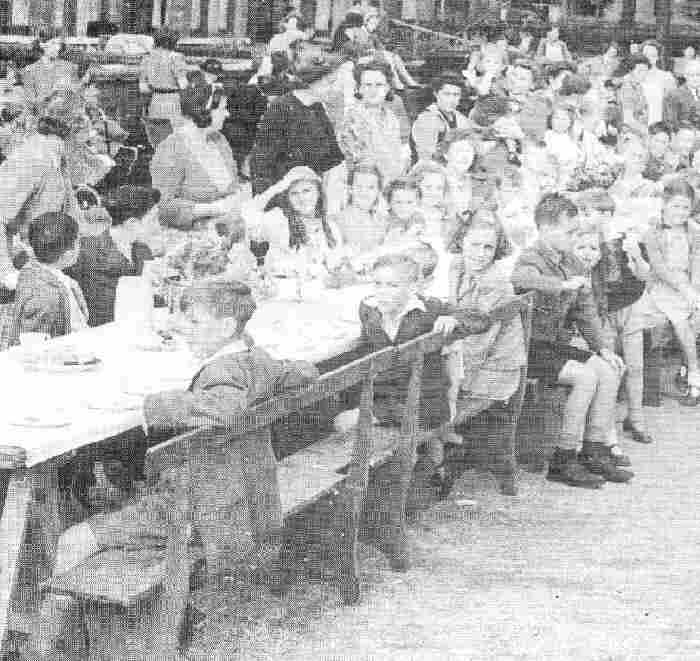
Figure 1.-- Ther were big official celebrations. There were also smaller neighborhood celebrations. In communities throughout britain there were outdoors banquets called street parties. This one was at Lytham St. Annes. |
|
The Wehrmacht by April 1945 was shatered and no longer able to offer effective resistance to the Allies. The Western Allies raced through Germany from the west during April 1945 as the Soviet Red Army surrounded Berlin. American and Soviet forces made the long anticipated link-up at the Elbe River on April 25. The Red
Army fought a massive engagement to take Berlin. Hitler insisted that the SS and Wehrmacht forces in the city, reinforced by the Volkstrum (Hitler Youth boys and older men) fight so that he might live a few more days. As Red Army soldiers approached his bunker, Hitler shot himself and named Admiral Karl Doenietz as the
new Führer. The last raid of the strategic bombing campaign took place on April 25 when the Skoda armament plant at Pilsen, Czechoslovakia were bombed. The American Air Corps began shifting to mercy missions. Flights were dispatched to feed civilians in northern Italy and the Netherlands who were near starvation. Priority was also given to evacuting prisonors of war (POWs). Doenitz ordered General Alfred Jodl to General Eisenhower' Headquarters--Allied Expeditionary Forces (SHAEF) detachment in Rheims to seek terms to end the fighting. Jodl signed the unconditional surrender of German forces on allfronts At 2:41 a.m. on May 7, which was to take effect on May 8 at 11:01 p.m. Thus NAZI Germany surrendered unconditionally, as President Roosevelt had insisted. Celebrations ensued throught Europe--except Germany. Ther were big official celebrations. There were also smaller neighborhood celebrations. In communities throughout britain there were outdoors banquets called block parties that were family celebrations (figure 1). For many of the children it mean that daddy would soon be headed home.
Terrible scenes from the NAZI concentration camps began reaching the press a few weeks before the War ended. SS headquarters had ordered camp commanders not to let survivors be liberated by the advancing Allies. Survivors of the camps in the East and West were transported or driven in dreadful death marches to camps within the Reich. The Western Allies after crossing the Rhine (March) began over-running concentration camps in the Reich (early-April). The SS had cleared most of the camps in France and the Low Countries as well as Poland before the Allies arrived. This was not the case with the camps in the Reich. There were efforts to move prisoners o cmps further away from the Allies, but here options were increasingly limited. Now there was no wherelft ton move them. These were not the Death camps, they were located in the East and the NAZIs tried to dismantal them befor the Red Army reached them. But the camps the Western Allies liberated were terrible enough. The British reached Bergen-Belsen (April 15). The situation was horrendous. Most Brits and Americans believed that The NAZIs were evil, most had no idea just how evil they were. Eisenhower brought in the press to see NAZIism in its most brital manifestation. He also ordered German civilians living near the camps be forced to witness the horror as well as GIs. He wanted to make sure that the Germans could never deny what the NAZIs had done. This has not stopped anti-Semites (mostly outsude of Germany) of doing just that.
The Wehrmacht by April 1945 was shatered and no longer able to offer effective mobile resistance to the Allies. The principal battle at the end of the war was for Berlin. There was also static resistance by diehard units, often the SS or Hitler Youth boys ordered to resist. By April the primary concern of the Whermacht was to move west so as many soldiers as possible could surrender to the Western Allies. The Western Allies raced through Germany from the west during April 1945 as the Soviet Red Army surrounded Berlin. American and Soviet forces made the long anticipated link-up at the Elbe River south of Berlin (April 25).
The Red Army fought a massive engagement to take Berlin. The Allied strategic bombing campaigned had already devestated the city. Hitler had depleted the defenses of the city by committing SS armoured divisions to defend Budapest. Two massive Soviets armies moved toward the city. Hitler was momentarily elated to learn that President Roosevelt had died, believing that he was saved. Here he harkened back to how the death of Catherine the Great had saved Frederick the Great in the Seven Years War. He soon learned that President Truman was just as committed to unconditional surrender. The Soviets launched the assault on Berlin (April 16). Hitler insisted that the SS and Wehrmacht forces in the city, reinforced by the Volkssturm (Hitler Youth boys and older men) fight so that he might live a few more days.The result was one of the most horific battles of World War II. On his birthday the Allies launch a 1,000 bomber assault on the city (April 20). After the raid Hitler emerges from his bunker to decorate Hitler Youth boys who had been fighting the Soviets. Hitler railed in his Bunker how the German people had failed a genius like him. In fact, there are few insttances in history where a people so loyally supported a national leader through such adversity. In gratitude, Hitler spent much of his last months tryomg to turn Germany in to a wasteland which could no longer sustain civilized life. Hitler's generals had been trying to convince him to leave Berlin and fight on in the Alps. Finally Hitler decided he will stay in Berlin (April 20). Hitler married Eva Braun and then dictated his last will and testanent (April 29). He urged the German people to continue the struggle against the Jews. Ar this time he learned what had happened to Mussolini. As Red Army soldiers approached his bunker, Eva Braun took cyanine and Hitler shot his bride Eva Braun and then himself (April 30). Giebells 2 days later kills his children and then he and his wife took cyanine. Red Army seized the Reich Chancelry (May 1). It was at this time they found Hitler's body, but Stalin ordered this be kept a secret. The press were brought into see the bodies of Goebels and his children.
The first great Germn surrender occurred in northern Italy. The Allies in a biterly fought 3-month campaign during the Spring of 1945 drove across the Po Valley. As German resistance crumbled, the Allies made spectacular advances. Columns of German soldiers were desperately trying to reach the Reich. Partisans captured and executed Mussolini as he was trying to flee with the Germans (April 28). The first surrender came in Italy without authorization. SS General Karl Wolff had been engaged in prolonged and unauthorised negotiations with the Allies. Wolff and the Commander-in-Chief of the German Army Group C/10th Army, General Heinrich von Vietinghoff on their own authority signed the terms of the surrender at Caserta (April 29). General W. D. Morgan, representing Supreme Mediterranean Commander [Harold] Alexander, signed for the Allies. The ever suspicious Stalin saw this as the beginning of a separate Allied peace with the NAZIs. Hitler as the Red Army troops neared his Berlin bunker, finally committed suiside (April 30). With Hitler's death, the way was clear for NAZI Germany to finally surrender. Hitler designated his successors. Karl Dönitz as the new Reichspr�sident ("President of Germany") and Joseph Goebbels as the new Reichskanzler (Chancellor of Germany). Goebbels and his wife, however, committed suicide after killing their children (May 1). This left it to Dönitz to arrange the surrender of the Third Reich. The two German commanders as already planned ordered German armed forces in Italy to cease hostilities (May 1). The surrender document provided that all German forces in Italy to surrender unconditionally to the Allies (May 2). On that same day, the commander of the German Army Group G north of Italy began communicating with Major General Jacob Devers. The surrender of Army Group G was made effective beginning (May 6). Some 0.5 million German troops along with some Italian Fascists were taken into custody.
Admiral Karl Dönitz commanded the Kriegsmarine U-Boat fleet which came very close to victory in the North Atlantic. He is widely credited with conceiving the tactics that almost defeated the Allies. Less commonly mentioned is his inflexibility. Unlike the Allies he did not adapt to Allied counter measures. The tactics Dönietz employed at the start of the War were the same he used later when the U-boats were decisively defeated (1943). Because of the failure of the German surface fleet and the fact Dönitz was an ardent NAZI, Hitler replaced Adm. Reader as commander of the entire Kriegsmarine with Dönitz. Then Hitler before shooting himself, named Dönitz as the new head of state. Goebbels appears to have been Hitler's first, but as he was in the bunker with his family and preparing to commit suiside himself, Hitler had to reach outside the bunker. And both Himmler and Göring had disgraced themselves. Hitler did not, however, did not want the title Führer used by anyone else. Instructions in Hitler's last will and testament named Hitler's successor as Staatsoberhaupt (Head of State) with the title of Reichspr�sident (President) and Supreme Commander of the Armed Forces (April 29). This was the arrangement underv the old Weimar Constitution. Dönitz set up his new government at Flensburg near the Danish border. He used the Naval Academy at M�rwik, a suburb of Flensburg. It thus became known as the Flensburg Government. He formed a new cabinet which he tried to populate with technocrats, although NAZI technocrats. Dönitz appointed the Reich Finance Minister von Krosigk as the head of the new government. The best known individual was Armaments Minister Albert Speer. Himmler who at first came to Flensburg was told that his services were no longer needed. As an ardent NAZI and senior Wehrmacht officer, Dönitz had detailed information on the Holocaust. As far as we know he never expressed any reservations about such matters. We know he liked to distribute the booty from the Jews murdered at the death camps, such as pocket waches, to his U-boat crews. Dönitz had no illusion about the military situation. His only task as Führer was to arange Germany's surrender and to get as much of the Wehrmnacht west as possible so they could surrenderto the Western Allies rather than the Soviets. The NAZIs seemed to have leaned where the post-War occupation zone boundaries would be drawn. The Allies were fully aware of the the Flensburg Government. And while they didn't officially recognize it, allowed it to function for 2 weeks. It was useful in getting far flung NAZI units, including U-boats to surrender. Dönitz still had some illusions about driving a wedge between the Western Allies and the Soviets. The Allied Control Commission dissolved the Dönitz government and arrested its members at Flensburg (May 23). The Allies were unable to try Hitler at the Nurenberg War Crime Trials, but they did try Dönitz. He was not tried for his brief stint as Führer, however, but for his war-time activities as U-boat commander. This proved complicated, however, because of the American submarine campaign in the Pacific. Additional information has surfaced about Dönitz after the Nuremberg Trials.
The last raid of the strategic bombing campaign took place on April 25 when the Skoda armament plant at Pilsen, Czechoslovakia were bombed. The American Air Corps began shifting to mercy missions. Flights were dispatched to feed civilians in northern Italy and the Netherlands who were near starvation. Priority was also given to evacuting Allied prisonors of war (POWs) that had been held by the Germans.
Dönitz who was in northern Germany attenpted to surrender to Montgomery rather than the Red Army. Montgomery refused to accept his surrender, but agreed to accept the surrender at the forces facing his front line. Doenitz finally ordered General Alfred Jodl to General Eisenhower's Headquarters--Allied Expeditionary Forces (SHAEF) detachment in Rheims to seek terms to end the fighting. Jodl expected to be treated as a professional military man and to negotiate the terms of surrender. He was informed there would be no negotiation, only unconditional surrender. He returned to Dönitz who realized there was no alterative. Jodl signed the unconditional surrender of German forces on all fronts at 2:41 a.m. on May 7, which was to take effect on May 8 at 11:01 p.m. A second surrender ceremony was held with the Soviets. Thus NAZI Germany surrendered unconditionally, as President Roosevelt had insisted. Jodl after signing praised the suffering of the German military and people and expressed the hope that the German people would be treated with generosity. He made no reference to the NAZI treatment of the countries which they had overrun. General Eisenhower signaled Washington, "The missuon of this Allied command has been accomplished on May 7, 1945." With that the most terrible conflict in European history was over.
The Soviet Military Liaison at Eisenhower's Headquarters in Reims was General Ivan Susloparov. He had no authority or instructions concerning the acceptance of the German surrender and had no way to immediately obtain such instructions from Moscow. He was uncertain what to do, but decided to sign the surrender document for the Soviet Union. He was afraid that if he did not sign that this would be misinterpreted as the Germans surrendering to only the Western Allies. He did stipulate that the suurender would be replaced with a new version. And this in fact was what Marshal Stalin wanted. Upon learning of the German surrender in Reims, he insisted that the Germans surrender to the designated representative of the Soviet Supreme command in Berlin. Thus the Soviets considered the Reims surrender document preliminary. Thus a ceremony was held in Berlin where Marshal Zhukov's had his headquarters. The actual ceremony was held in a manor in the Karlshorst suburbs of Moscow. The ceremnony was held late at night on May 8. It was so late that it was May 9 Moscow time. Field-Marshal Wilhelm Keitel as at Reims signed the surrender document for the Wehrmacht. Stalin explained, "Today, in Reims, Germans signed the preliminary act on an unconditional surrender. The main contribution, however, was done by Soviet people and not by the Allies, therefore the capitulation must be signed in front of the Supreme Command of all countries of the anti-Hitler coalition, and not only in front of the Supreme Command of Allied Forces. Moreover, I disagree that the surrender was not signed in Berlin, which was the center of Nazi aggression. We agreed with the Allies to consider the Reims protocol as preliminary.� The Soviets celebrated VE Day a day late on May 9 with a massive parade in Moscow. The Soviet people had paid a terrible price for the victory over the NAZIs. The celebration of that victory continues to be an almost religious event in modern Russia. It is celebrated on May 9 as Victory Day or Great Patriotic War Remembrance Day.
News of the German surrender was immeiately broacast around the world. Celebrations ensued throught Europe--except of course Germany. Celebrations occurred in the major Allied countries. Massive demonstrations spontaeously appeared in London. It was the British definance of Hitler that played a major role in his defeat. More than a million people flooded the streets of London to celbrate. There was a carnival amospher to the celebration which was celebrated by Londoners of all ages. The British still had to make do with rationing which in fact would last several more years even afer the War. But this was their day. The British people and Londoner in particular had eaned this day which was long in coming. The celebration took place in the very city that had defied Hitler's Blitz. Huge crowds appeared in Trafalgur Square and throungs crowded The Mall to Buckingham Palace. Here King George VI and Queen Elizabeth joined by Prime Minister Churchill appeared on the Palace balcony to the cheers of Londoners. Churchill told the cheering crowds, "My dear friends, this is your hour. This is not victory of a party or of any class. It's a victory of the great British nation as a whole. We were the first, in this ancient island, to draw the sword against tyranny. After a while we were left all alone against the most tremendous military power that has been seen. We were all alone for a whole year. ..." Absent from the balcony were Princesses Elizabeth and Margaret. They managed to convince the King to allow them to join the cheering throng where they celebrated anonymously with the people of London. There were big celebrations in the dwn town areas. There were also smaller neighborhood celebrations. In communities throughout britain there were outdoors banquets called block parties that were family celebrations (figure 1). For many of the children it mean that daddy would soon be headed home.American reporter Edward R. Murrow broadcast from Piccadilly Circus just as he had broadcast to America during the Blitz.Joining in on the celebration were large numbers of American service personnel in London. A key part of the victory was the Anglo-American alliance--the most important militry alliance in history. Joyous celebrations occurred in Paris with a parade up the Champs-Elys�es. The VE celebrations in America lacked one great figure--President Roosevelt who had played such an important role in being about the Allied victory. President Roosevelt suffered a heart attack shortly before VE Day. President Truman in a radio address to the nation dedicated the victory to the memory of the former president. More raucous celebrations occured in major American cities, especially Chicago, Los Angeles, Miami, Philadelphia, San Francisco, and especially in New York City's Times Square.
VE-Day or Victiory Day as it is known in te Soviet Uniion nd Russia today is celebrated on May 9, dayb later than in the West. This is because Stalin was not at allmpleased that the Germans had surrendered in the West. Tghere was aoviet General who participared in the reims surrender, but he did not clear it with Stalin and giot into a lort of triuble. Staklin wanted the surrender in Berlin to Zukov and other imoprtnt Sovier commanders. Thus the second signing of the German Instrument of Surrender occurred in the evening on 8 May 1945 (9 May Moscow Time). We aor not sure what occured in Moscow or other Soviet cities on May 8 or 9. The Soviets are not big on spontsneous demonstration. In gavt you could possibly go to the Gulag for spntneouly demonstrating. Rather the Soviets staged a massive victory parade in Moscow (June 24). Stalin was to lead the parade on a white horse. The horse, however, proved rather 'spirited' and Stalin at the last minute decided not to ride it when he actually saw the horse. Thus it was Marshal Zukov wah actually rode the horse in the victory parade. Stalin approved this, but in fact was deeply resentful of this. The incident and Stalin's furthur resentment of Zukov's popularity affected the famed Marshal's career after the War. Zukov was to popular fir even Stalin to arrest, but he was eventually sent to Mongolia. The parade proved to be the longest and largest military parade ever held on Red Square. It involved 40,000 Red Army soldiers. The onkly foreign soldiers wasc a Polish color guard. The soldiers prticipting were choseen to represent all the fronts (army groups), a People's Commissariat of National Defense combined regiment, the Soviet Navy, military academies and schools, and troops of the Moscow Garrison and Military District.There were 1,850 military vehicles and other military hardware. This involved enormous planning and logistics which ius why it was held over a month after VE-Day. There was a practice before the actual parade. The parade itsself lasted over two hours on a rainy (June 24, 1945). The Soviet people had paid a terrible price for the victory over the NAZIs. The celebration of that victory continues to be an almost religious event in modern Russia. The 2023 cekebration was, hiwever, muted because of the ongoing nightmare in Ukraine. Not because of the brutal Russian agression or loss of life, but because of the poor performance of the Russian military. .
The United States along with Britain and France oversaw an occupation with changed the nature of West German society. Most Germans readily admitted their country's responsibility for the War and ther honredous acts of the NAZI regime. The Allies instituted a thorough going denazification process, a process which continues to this day in Germany. The Allies also attacked the militarism of the old Prussian junker class which the united German state was built around in 1870. The Allies completely dismantled the NAZI regime and during military occupation reconstructed an entirely new political structure. In some ways the process was simplified by the NAZIs who although
opposed to democracy had gone a great way toward the breaking down of class barriers and weakening the power of the Prussian junkers. The Germans were not without a tradition of democracy and parlimentary politics. Given the NAZIs success in dominating the German people and the thorouness of that domination, it seems perhaps surprising how readily the Germans adopted democracy. Perhaps the totality of the NAZI defeat and the spector of Soviet totalitarianism looming accross the border were major factors. What ever the reasons, the German took to political democracy and free-market economics. A relationship with America was forged in the Berlin Airlift (1948) and four decades of resistance to the Soviers and Warsaw pact. The results by all practical measures have been an
overwealming success. Germany today is one of the most prosperous and democratic societies in the world. Germany unlike Japan was also occupied by the Soviet Union. The Soviet occupation policies in eastern Germany were very different than those persued in the wetern occupation zone. Austria was separated from Germany after the War and occupied by the Soviets and Western Allies.

Navigate the CIH World War II Section:
[Return to Main World War II essay page]
[Biographies]
[Campaigns]
[Children]
[Countries]
[Deciding factors]
[Diplomacy]
[Geo-political crisis]
[Economics]
[Home front]
[Intelligence]
[POWs]
[Resistance]
[Race]
[Refugees]
[Technology]
[Bibliographies]
[Contributions]
[FAQs]
[Images]
[Links]
[Registration]
[Tools]
[Return to Main World War II page]
[Return to Main war essay page]