|
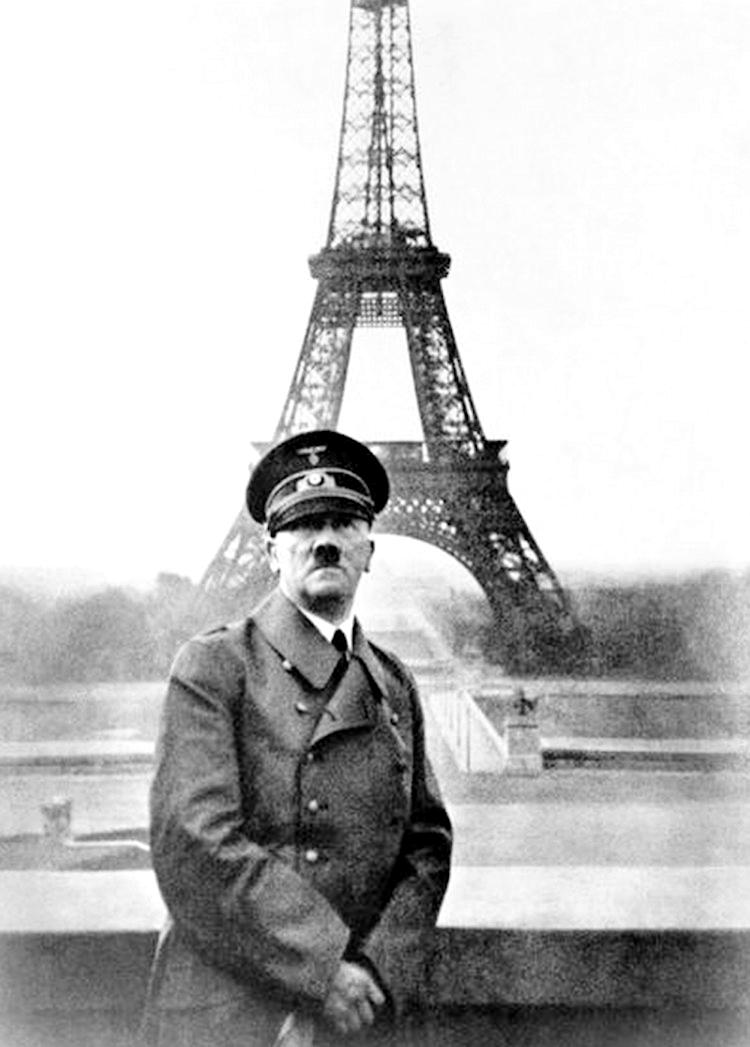
Hitler in the first year of the War proved remarkably astute. In fact he was lauded by the NAZI press as the greatest German of all time. Something appears to have changed with the great success in France (May-June 1940). And almost immediately failures began. He failed to destroy the British Army at Dunkirk and therefore was unable to compel the British to seek terms. Even so Hitler's personal assessment of himself was unchanged. Hitler not only saw himself as a visionary strategic war planner, but as a great tactical commander and as the War progressed played an increasingly important role in Wehrmacht operations. Historians debate Hitler's effectiveness as a war leader. His basic strategic concept was to divide his enemies and defeat them one by one which was the same tactic used in domestic politics. Here his mistake was failing to defeat the British but then going forward with the Soviet invasion with the British still undefeated in his rear. His grasp of political situations proved more insightful than that of the military and was responsible for the startling success of the Germans early in the War. His actions in the Rhineland, Austria, and Czechoslovakia were all at first opposed by elements of the Germany military. He played key roles in the campaigns against Poland, Norway and in the West against France and he was proven correct against more timid military commanders. Jodl based on these campaigns called him "a great military leader" even after the War. [Schramm, p. 1721.]
After the early military victories, his value as a military leader declined precipitously even as, he played an increasing important role in German planning. Historians generally concede that he was absolutely correct when he insisted on holding in the Winter of 1941-42 before Moscow, while the Generals recommending the contrary would only have succeeded in losing most of the heavy equipment without gaining anything in improved defensive posture. With this exception, in general, however, after the success in France based on his adoption of von Manstein�s Sichelschnit Plan, his decisions were almost always wrong. These include a long litany which we will discuss below.
Hitler achieved success by developing a private army (NAZI SA) of estranged Germans, many radicalized by the Depression and the desperation of unemployment. The SA Storm Troopers caused havoc throughout Germany. Election success made the NAZIs Germany's largest party in the Reichstag, but not a majority party. President Hindenburg and his advisors decided to appoint Hitler Chancellor thinking that this would cause him to moderate his policies and in the end fail like previous chancellors. This proved to be a huge mistake as Hitler turned to extra-juridical processes to create a dictatorship. All of the established German politicians with fine educations and from mostly well-to-do families under-estimated Hitler and the SA bully-boys. Hitler out maneuvered them all. His primary strategy was to concentrate on one opponent at the time. And defeat them one by one. And after he was appointed Chancellor, he had the authority of the state behind him, a powerful force because he was willing to ignore all legal constraints.
Hitler's actions in the Rhineland, Austria, and Czechoslovakia were all at first vehemently opposed by elements of the Germany military. The failure of the Allies to oppose him greatly strengthened his position in Germany. His successes greatly increased his popularity. It undermined the charge that Hitler would cause another War. Hitler was able to achieve the popular goal of undoing the Versailles Treaty without war. And his successes undermined the faction in the military which opposed him. Some authors argue that if Chamberlain had stood up to Hitler at Munich that the military would have removed him. We are not at all sure about that, but it is absolutely true that these peaceful, bloodless victories greatly increased his stature both within and outside the military. As a result, at the time of World War II Hitler's position was greatly strengthened (September 1939). At the end of the French Campaign (June 194), Hitler's position was unassailable,
One of the major charges in the political campaigns before Hitler and the NAZIs seized power was that he would launch another war. There were still many terrible memories of World War I. Hitler at first pursued a moderate foreign policy while launching a vast new rearmament program. And as Hitler began to pursue a more aggressive foreign policy, the results were spectacular. The German people were elated with the success of Hitler and the NAZIs in regaining the Saarland (1935), re-militarizing the Rhineland (1936), uniting with Austria--the Anschluss (1938), and finally reclaiming the Sudetenland (1938)--all without war. It is unquestionable that Hitler was enormously popular with the German people. Had he stopped with the Sudetenland, there would have been no War and Hitler would have been the most popular German statesman since Bismarck. Hitler had assured Chamberlain that he wanted no Czechs in the Reich. He was, however, actually disappointed at Munich. He felt that Chamberlain had denied him his war in 1938. He kept his plan to launch a new war from the German people whose martial spirit in early 1939 disappointed him. There are many indications that there was no desire for war among the great bulk of the German people. War, when it finally came, at first resulted in spectacular German victories with very limited casualties, although the loss of material especially tanks and other heavy weapons was greater than understood at the time and would eventually tell against him. This added to Hitler's popularity. Germans, even many doubters, began to believe increasingly in Hitler and his program. Hitler for his part was an extraordinarily effective politician. He did not want to be a politician, he wanted to be a great German war leader and he was determined to go down in history as the greatest German war commander of all time who would reshape Europe and history itself.
Quite a number of historians have misjudged Hitler, seeing him as just another German imperialist such as Chancellor Otto von Bismarck. [Taylor] These historians tend to focus more on the German military and its Prussian officer class. President Roosevelt and many others at the time tended toward this view. This was of course before the Holocaust was fully understood. Or the fact that Wehrmacht commanders were much more cautious than Hitler and less than enthusiastic about launching the War. Or the social gulf between the NAZIs and the Prussian officer corps. Modern historians are increasingly drawn to the view that a racial struggle was not an ancillary part of Hitler's makeup, but was central to his world outlook. And remaking the ethnic map of Europe was the key objective in the war that he and Stalin had launched.
Historians debate Hitler's effectiveness as a war leader. Here his basic strategic concept was to divide his enemies and defeat them one by one which was the same tactic used in domestic politics. Here his one failure was the failure to defeat the British and then going on with the Soviet invasion with the British still undefeated in the rear. Historians debate Hitler's effectiveness as a war leader. His basic strategic concept was to divide his enemies and defeat them one by one which was the same tactic used in domestic politics. Here his mistake was failing to defeat the British but then going forward with the Soviet invasion with the British still undefeated in his rear. His grasp of political situations proved more insightful than that of the military and was responsible for the startling success of the Germans early in the War.
Hitler in the first year of the War proved remarkably astute. In fact, he was lauded by his NAZI controlled press as the greatest German of all time. He played key roles in the campaigns against Poland, Norway, and in the West against France and he was proven correct against more timid military commanders. Jodl based on these campaigns called him 'a great military leader' even after the War. [Schramm, p. 1721.] Hitler was a soldier in World War I and that War was central in formulating his military strategy. There were two principal strategic mistakes to which Hitler attributed Germany's defeat in World War I. Hitler of course never admitted he made ANY mistakes! First was fighting a two front war. Imperial Germany had the strongest army in Europe, but was unable to concentrate its attacks on any one enemy. Second was underestimating how quickly the potential power of the United States could make itself felt in Europe. Defeat in World War I, of course, also a part of the long list of matters he accused the Jews of -- in this case the Stab in the Back calumny. Thus we at first see Hitler in World War II pursuing war policies designed to avoid both major World War I mistakes. This is why the NAZI-Soviet Non-Aggression Pact was so important. And why he avoided a confrontation with the United States despite major American provocations. He even ordered U-boat commanders to avoid attacks on the U.S. Navy. Here he was quite consistent. His war strategy on 1) avoiding a two-front war and 2) avoiding fighting America. His attitude on both , however, began to change after the fall of France.
Something appears to have changed with the great success in France (May-June 1940). After successfully adopting von Manstein's Sichelschnitt plan, he began to claim he was the greatest field Commander of all time (Gr��ter Feldherr aller Zeiten). And almost immediately failures begin. He failed to destroy the British Army at Dunkirk and with it the ability of compelling the British to seek terms. Even so Hitler's personal assessment of himself was fundamentally unchanged. Hitler not only saw himself as a visionary strategic war planner, but as a great tactical commander. He initially listened to his generals. After France this began to change. As the War progressed, Hitler played an increasingly intrusive role in Wehrmacht operations. He saw the victory in France as his personal achievement rather than the competent leadership of military visionaries like Manstein and Guderian. As a result after France, Hitler began lecturing the generals not only strategy, but tactics as well. This would be a factor in the Battle of Britain, It would be a far greater factor in the Soviet Union. There is some difference of opinion about both his and Stalin's thinking after the fall of France. There is no doubt what what he wanted--it was undoubtedly the East--meaning the Soviet Union. Stalin's thinking is more in doubt. One might think that Hitler would have seen some of the disasters he caused as a reason to listen to his generals. He never did. In fact, he listened to his generals in planning Barbarossa less than in the planning of Case Yellow (Western Offensive) and as the war in the West developed he listened less and less. And in his mind, the failures were not due to his flawless strategic and tactical leadership, but to the failure of the military to carry out his orders.
After the early military victories, his value as a military leader plummeted even as he played an increasing domineering role in German planning. The one exception was his insistence on holding in the Winter of 1941-42 before Moscow. In general, however, after the success in France, his decisions were almost always wrong. These include a long litany:
the switch of tactics in the Battle of Britain to bomb London, the invasion of the Soviet Union (this is debatable), the division of the army in the Soviet Union in both 1941 and 42, and most egregiously,
his declaration of war on the United States, the failure to allow Von Paulus to break out at Stalingrad, the use of reserves to bolster the Afrika Corps after Alamein and Torch, the failure to promptly attack the Normandy bridgehead in force, the Mortain Offensive in France leading to the Falaise pocket, various unsuccessful stands in the East, the deployment of SS Panzer divisions to defend Budapest leaving Berlin essentially undefended, and finally the decision to fight on the west side of the Rhine. Jodl does agree that after the tide turned against Germany, Hitler increasingly interfered in operational matters which disrupted the military, some times disastrously. [Schramm, p. 1721.] Hitler also had a major role in German armaments development and priorities. Here he had some successes such as the selection of the anti-tank gun used in Soviet campaign. [Picker, p. 96.] He made, however many huge mistakes. He delayed the German jet program and then insisted that the Me-262 be used as a bomber. Huge resources were devoted to the V-1 and V-2 programs which had little real impact on the War. [Alexander 1] He constantly went for massive projects like the Bismarck or tiger tank when more numerous smaller systems would have been more effective. [Alexander 2] Here Hitler appears to have over-emphasized the psychological impact of weapons. It was his idea to install sirens on Stuka dive bombers and he ordered several terror bombing raids. He also greatly over emphasized the power of the will--especially in Russia. He consistently demanded more of the German troops there than was physically possible. [Halder, p. 489.] Hitler threw away his last opportunities for victory in France, the seat of his greatest triumph. The Germans prevailed in 1940 by concentrating their armor for the breakout through the Ardennes, at the Schwerpunkt. Hitler's decision to contest the Allied cross-Channel D-Day invasion was to disperse armor, even placing key units in southern France, ensuring that they could not reach the invasion beaches in the critical first days.
The major German operation orders for World War II came from the Führer, often issued through OKW. Most of the important ones were titled Führer Directives. There were also Führer Orders and other various titled orders and directives late in the War. We do not know at this time why these different orders had various titles. In part some were not directed at the military, but the Party, security forces, and government agencies. These various orders are useful in following Hitler's major decisions and conduct of the War. Also important to discuss is the difference in Auftragstaktik (mission oriented or operational orders) and Befehlstaktik (detailed specific task orders). Hitler largely forbade the use of Auftragstaktik after France, depriving his commanders of the flexibility that was so important in the Prussian military model. {Alexander]
Suggesting the War was lost in NAZI Germany was enough to get you arrested ans sent to a concentration camp. In the later months of the War it could mean summary execution. At the end of the War in his Berlin Bunker, Hitler actually addressed the subject (February 1945). And his faithful scribe, Martin Bormann, took notes so that prosperity would not be denied his leaders wisdom. [Genoud] Of course his assessment is primarily to absolve himself from the failure, but they are interesting for two reasons.
First, to provides some insight into the workings of his demented mind.
Second, because of his focus on the War in the West rather than the Ostkrieg which Russians today are convinced was the only campaign of importance and the War in the West was a 'side show' of little or no importance. In assessing Hitler's rambling thoughts, there seem to haven six major reasons that he believed caused Germany to lose the War. Note that the Ostkrieg is not one of them.
First was Czechoslovakia (1938). He particularly contemptuous of Prime-Minister Churchill. He believed that he should have kept his nerve and invaded Czechoslovakia, defying Britain and France. He convinced himself that such a demonstration of German military power would have caused Britain and France to have backed away from any further military confrontation with Germany. Germany could have then concentrated on preparing the Ostkrieg without any distractions from the West. Interestingly, many in the West believe that Britain and France should have defied Hitler at this point and backed the Czechs..
Second was his cultivation of Mussolini. He told Bormann, "anything would have better than having [Italians] as comrades in arms." This was the Balkans. It was Mussolini who drew Germany into both North African the Balkans when the priority was the Soviet Union.
Third was the Balkans. The Balkan campaign delayed Operation Barbarossa. Hitler saw that he should have launched Barbarossa in May which would have bought 5 more weeks of dry weather.
Fourth was fighting two-front war. He placed an emphasis on this. Here he blamed Britain's 'stupid chiefs', meaning primarily Churchill. And by implication Roosevelt who sustained Britain in the War.
Fifth, he began to think that Adm. Raeders's Mediterranean strategy should have been given more thought, beginning with Gibraltar and sweeping east to the oilfields of the Middle East to undermine British resistance. He mention that Stalin might have taken advantage of this.
Sixth, of course he ultimately blamed Germany's failure on the Jews He saw America as the 'bastion of the Jews', and President Roosevelt as 'the elect of the Jews'. He told Bormann that "If we lose the War it will mean that we have been defeated by the Jews." Notice the 'if', still in February 1945. One can't help but wonder how it must have felt to be defeated by the people he so viciously targeted. Also interesting to consider is that if the German military had done better, the Reich would have ultimately have been subjected to atomic attack, made possible by the very people he saw as worthless and drove out of the Reich and into Allied hands.
Alexander, Bob. Personal communications (August 1, 2019). 1) Bob does not believe that the V weapons could have any impact. We agree that V-2 without a nuclear warhead was pointless. We think, however, that the much less costly V-2s if not delayed by the Strategic Bombing camapign could have had an impact on the Normandy invasion by focusing on the British invasion ports. 2) Bob argues that the Super tanks were a realistic effort to outmatch the Allies in quality since he had no chance of matching them in production quantity. He does beliece that number of U-Boats that could have been produced with the steel that went into Bismarck and Tirpitz and the effect those U-Boats could have had if deployed in 1939.
Genoud, F. Ed. Testament of Adolf Hitler: The Hitler Bormann Documents, February-April 1945. (London: 1961).
Halder, Generaloberst Franz. Kriegstagebuch ed. Hans-Adolf Jacobsen, 3 vol (Stuttgart, 1962).
Picker, Henry, ed. Percy Ernst Schramm. Hitlers Tischgespräche im Führerhauptquartier, 1941-42 (Stuttgart, 1963).
Schramm, Percy Ernst., ed. Kriegstagebuch des OKW iv: 1944-45 (Frankfurt-on Main, 1961), pt. 2.
Taylor, A.J.P. The Origins of the Second World War (1961). Taylor is perhaps the best reprsentative of the historians who see Hitler as just another German imperialist and focuses more on the German Army as the primary cause of the War. Note his book was published only a few years after the War.
Wistrich, Robert. Who's Who in Nazi Germany (Macmillan Publ.: New York, 1982).

Navigate the CIH World War II Section:
[Return to the Main Hitler biography]
[Return to the Main World War II biographies page]
[Biographies]
[Campaigns]
[Children]
[Countries]
[Deciding factors]
[Diplomacy]
[Geo-political crisis]
[Economics]
[Home front]
[Intelligence]
[POWs]
[Resistance]
[Race]
[Refugees]
[Technology]
[Totalitarian powers]
[Bibliographies]
[Contributions]
[FAQs]
[Images]
[Links]
[Registration]
[Tools]
[Return to Main World War II page]
[Return to Main war essay page]
[Return to CIH Home page]