|
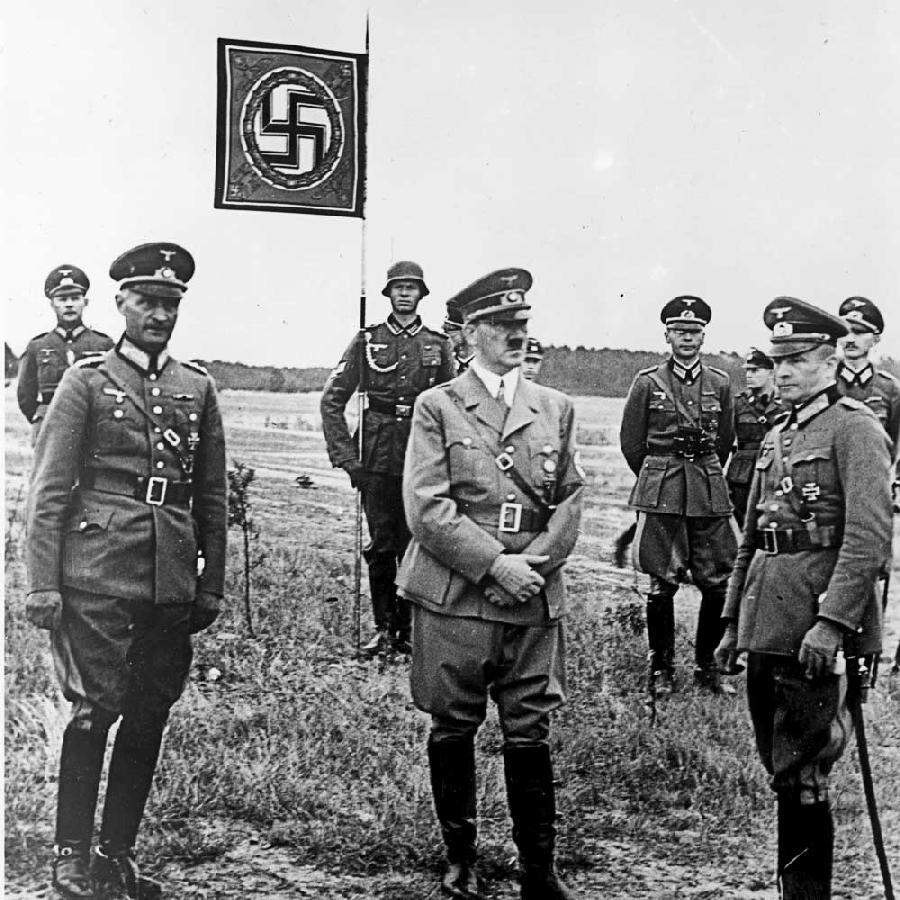
The major German operation orders for World War II came from the Führer, often issued through OKW. Most of the important ones were titled Führer Directives. There were also Führer Orders and other various titled orders and directives late in the War. We do not know and this time why these different orders had various titles. Most were aimed primarily at the military, but the Party, security forces, and government agencies were also involved. These various orders are useful in following Hitler's major decesions and conduct of the War. Early Führer Directives were largely written by staff officers and approved by Hitler. As the War progressed, epecially with Barbaroissa, Hitler increasingly reflect his own's output.
Hitler issued nine Führer directives in 1939. They dealt with: 1) the invasion and partition of Poland, 2) plans for the next step, meaning the campaign in the west, and 3) economic measures. Hitler was very aware as to how economics had undermined the German homefront in World War I. He was determined to precent this in his war and to use economic tactics against the Allies.
Führer Directive 1 was issued August 1, 1939, the day before the invasion of Poland. It this had no real value in directing military operatios. All this was carefully worked out well before the invasion. Thus we are not entirely sure just what the purpose of the formal directive was other than to give the formal go ahead to his commanders. The details were laid out in Case White and of course military forces had been pre-positioned along the Polish border in East Prussia, the Reich proper, and occupied Czechoslovakia. Hitler is still cautious in the sence he did not want military operations in the West. He instructs the Whermacht that hostilities with Britain and France were to be left to them to initiate, leaving onnus for the War on them, at least in the mind of the German people. He writes, for example, "In the West it is important to leave the responsibility for opening hostilities unmistakably to England and France. Minor violations of the frontier will be dealt with, for the time being, purely as local incidents." This would later be used for German propaganda in occupied France. It is interesting to note that about half of the directive is devote to Britain and France even though Poland was to be invaded. What he does not mention is the fact that the invasion had already been worked out with the Soviet Union and the partition of Poland. We suspect that Hitler was not anxious for his alliance with the Soviets to be given any prominance in the historical record. Historians citing the testimony of Hitler's intimates insist that Hitler was expecting Britain and France to back down again. He was thus surprised when they declared war, but he was essentially correct, there was no Allied offensive in the West. He had been disappointed after Munish, believing he had been denied his war. This time he woud not be placated. He would have his war. Politics no longer interested him. He wanted to achieve the status as a great war leader.
After the victory in France (June 1940), only Britain remained to resist the Germans. The Channel had stopped the Panzers. After the fall of France, Hitler persued initiatives aimed at gaining British acquiesence in his Continental gains.Hitler hoped that the British would realize the futility of further resistance. His goal was a British Vichy and was prepared to accept generous terms. Hitler's focus was on Europe. He had wahat he wanted in the West. Now he wanted to focus on his primary onjective--the East. He was willing to allow the British to hold on to their oceanic Empire. Britain could keep the Empire in exchange for giving Germany a free hand in Europe. In fact he thought it would be useful to have the Btitish continued to control the colored races he so despised. At the same time he was offering Stalin India. (Hitler was very good at offering allies other people's territories.) He had no desire to humiliate Britain. Here a major factor was race. He considered the British as a people with Teutonic blood. Of course the British had experiences with Hitler's guarantees and it was obvious that Britain could never be independent once Hitler had conquered Europe. Some in the British Government were prepred to accept. Churchill and the British people understoof after Munich the value of Hitler's commitments. Hitler issued Führer Directive 16 (July 16). It was "Preparations for a landing operation against England". It is unclear how serious he was about an invasion. His primary interest may have been to force the British to the bargaining table. The Wehrmact began assembling trops in Channel ports and preparing craft for the Channel crossing. After Dunkirk, virtually the only fully armed Divisin in Britain was the First Canadian Division. President Roosevelt rushed arms to the British. British arnms factories worked non-stop. But for several months, the defense of Britain would depend on a handfull of RAF pilots. The issue would be seteled by the Battle of Britain.
Frustrated with Churchill's continued unwillingness to accomodate him, Hitler prepared to bend Britain to his will. An invasion necesitated the Luftwaffe achieving air superority over the Channel and southeast England. After the French capitulation. the Luftwaffe rushed to move into French airbases along the Channel and opened new fields. Führer Directive August 1 ordered the Luftwaffe to "overpower the English air force with all the forces at its command in the shortest possible time." The result was the critical Battle of Britain. Luftwaffe chief Herman Göring flush with one spectacular victory after another was convinced that this could be accomplished in days. The Luftwaffe was not a strategic, but a tactical force. This weakness would become apparent for the first times in the skies over Britain. Hitler was furious and the Reich Marshal disgraced. It would be the first German defeat of the War. Hitler dismissed its importance as his foicus was already on the East. Although not apparent at the time, it was a defeat of epic proportions. The British would eventually open 1,000 air bases and the Americans build more than 400 additional fields. And from these British bases, the Allied would methodically demolish German cities. The tonnage of bombs would dwarf what the Luftwaffe droppedon Britain. The Luftwaffe's failures forced Hitler to "postpone" Operation Sea Lion (October 12).
After the cancellation of Operation Sea Lion raised the question of how to defeat the British if invasion was not possible. Hitler met with Mussolini at the Brenner Pass (October 4). The two discussed how to best defeat the British. The outcome was a plan to redraw the map of the Mediterranean. Italy would get Tunisia, Corsica, and Nice. (Corsica and Nice had been Italian in the 19th century.) Spain would get French North Africa. France would be compensated with British West Africa. (Hitler was very good at achieving his goals by offering up other people's territory.) Mussolini had the previous month invaded Egypt from Libya and this effort to seize Suez backed by the powerful Italian fleet still had prospects for success. Admiral Raeder strongly recommened an offensive to seize Gibrralter which would have made Royal Navy operations in the Mediterranean untenable. Hitler traveled to the French-Spanish border on his official train Amerika and met with Franco at Hendaye (October 23). He wanted to draw Spain into the War. What transpired was one of the most celebrated meetings of the War. Hitler who had in large measure enabled Franco to prevail in the Spanish Civil War, expected a grateful Franco to willingly aggree to cooperate in the NAZI war effort. Instead he found a not particularly grateful Franco who had significant doubts about going to war with the British. Franco had been warned by of all people Admiral Canaris (commander of the Abwehr) that Hitler was focused on the Soviet Union and that German military operaions against Spasin were unlikely. Backed up by Foreign Minister Serrano Suñer, Franco stonwalled Hitler. The Führer was furious. He told intimates that he would have rather had four teeth pulled. Hitler and Franco would never meet again. Despite the rebuff, Hitler still believed that Franco could be persuaded. He ordered OKW to prepare plans to seize Gibraltar--Opperation Felix
After the aborted meeting with Franco, Hitler traveled on to meet with Marshal Pétain (October 24). Hitler admired Pétain's military reputation and bearing. The meeting went better. Pétain did not dismiss Hitler's proposals out of hand. He was, however, uncommital. Despite the British attack on the French Fleet at Oran, Pétain was not going to go to war with Britain. He was willing to cooperate in Hitler's New Order, but short of war. I am not sure to what extent North Africa was discussed. Hitler ordered OKW to draw up plans to seize the unoccupied zone if France proved recalitrant. The result was Operation Attila. And it would be executec by the Germans after the Vichy forces in North Africa failed to adequately resist the Allied Torch landings (November 1942). One of the primary objectives was the French fleet. The French true to their word, however, scuteled the fleet at Toulon before the Germans could get to it.
After meeting with Franco and Pétain, Hitler still on his train Amerika traveled on to meet with Mussolini. Before arriving he learned that Italy had invaded Greece from its new Albanian bases. As was the case of the German invasions (1939 and 40) as well as the Japanese attack on Pearl Harbor (1941), there was no coordination among Axis partners. Hitler was furious
Upon meeting Hitler at the train station and giving a Fascist salute, he exclaimed, "Führer we are on the march." Mussolini felt left behind by the stunning German successes. He justified the invasion as premting British intervention. In reality he wanted some of the military glory that Hitler had acquired. Thinvasion was a military and diplomatic disaster, Not only did the Greeks repulse the Itlians, but it rined Hitler's diplomatic offensive to peacefully bring the Balkans into the Axis fold. This did not help with his efforts to lull Stalin into thinking that cooperation was possible with the NAZIs. And the immediate impact was have just the opposite affect as intended, it forced the Greeks closer to the British. The British responded by occupying Crete abnd Lemnos (Agean island) and transerring RAF units to southern Greece. This not only brought southern Italy within range of the RAF, but also the vital Ploesti oil fields. Thus Hitler ordered OKW to prepare plans to invade Greece--Operation Marita.
Führer Directive 21 or Operation Barbarossa was perhaps the central decision of World War II. Hitler's orders to the German military read, "The German Armed Forces must be prepared, even before the conclusion of the war against England, to crush Soviet Russia in a rapid campaign ('Operation Barbarossa'). Hitler orders set in motion the greatest military campaign of all time in which tens of millions would die. The War would be won or lost on the vast plains of the Soviet Union. Historians generally assess this as Hitler's key mistake. Hitler despite the dizzying victories in the West did not see time as on his side. Britain was undefeated and with America support, the Germans had not way of defeating them. America was rearming and growing stronger as was the Soviet Union. He certainly had other options. Admiral Raeder and others advised a Mediterranean strategy. But Hitler from the earliest days in Bavaria had cast his eyes east on on the resources and Lebensraum available in
Russia. Invading the Soviet Union was a huge gamble, but never would the ballance of forces be more in Germany's favor. Certainly the failure of Barbarossa was the central reason why Germany lost the War. But the failure of Barbarossa was not preordained. Here opinions vary greatly. Some historians believe that the failure of Barbarossa lies in Hitler's refusal to allow his generals to conduct the campaign without his interference. Others believe that Barbarossa failed because of Hutler's decesion to wage a gastly rascist war of anilation which turn potential allies, anti-Bolshevick elements against the Germans. There were many Soviet citizens, especially the Ukranians, but also Russians who were willing to fight with the Germans against the Bolsheviks and Stalin. By turning the War into a genocidal campaign, Hitler left the anti-Soviets Slavs little choice, but to fight with Stalin. The strength of the anti-Bolshevik sentiment was such that even with NAZI barbarity, some Russians and Ukranians decided to fight with the Germans.
Führer Directive 24 is a fascinating document because it tells us just how Hitler is thinking about Japan and the dichotomy in Japanese and German thinking. The Ditrctive appears to have been issued in prparation for a visit by Japamese Foreign Minister Yosuke Matsuoka.
For the Japanese the primary concern was the United States, the only country with imprtant naval and air forces in the Pacific. The Germans on the other hand were primary interested in additional pressure on Britain which they naively assumed could be applied without brining America into the War. The two countries were not openly dissussing the war plans with each other. The Japanese did not share their focus on the Americans and the Germans the fact that they were only 2 months away from launching Barbarosa--what was at the time the greatest military assailt in history. Even a glance at the map would tell any one that what should have been dicussed with Japan and a Jao\panese attack in the Far East. This discussion never took place, incredibly \wgat was discussed was Singapore. This borders on insanity. Incredably, Hitler believed it would be the another short summer campaign. Hitler explains "It is important to defeat England quickly and so keep the United States out of the war, that is our joint object." This is expressed the essential logic needed for a German victory, focusing on one enemy at a time. Yet his actual behaviot was muddled. At the time he was rushing forward with plans for Barbarossa without defeating Britain first. He specifically mentions Singapore. The British bastion was seen as the fulcrum of the British position in Asia. "The capture of Singapore, which is the key position of England in the Far East, would be a decisive achievement in the war effort of the three powers. "Beyond that, attacks on other bases of British sea power - and of American only if the entry of the United States into the war cannot be prevented - will serve to shatter the war system of the enemy." Here a basic flaw is revealed in German and Japanese thinking. Hitler saw the Japanese as instrumental in undermining the British Empire. Further Japanese aggression in Asia, however, was likely to bring America in the War, something Hitler had hoped to avoid until first the British and then later the Soviets were defeated. The Japanese in signing the Tripartate Treaty (September 1940) had hoped to disuade America from unfrienfly acts. In fact in hardenened the Roosevelt Administration's policies toward Japan by linking them with the NAZIs. Japanese Foreign Minister Yosuke Matsuoka was in Germany at the time Hitler issued this directive. On his way back to Japan through the Soviet Union, he signed a Russo-Japanese Non-aggression Treaty (April 1941). Japan honored the Treaty during the War. But coming as it did just before Barbarossa, the Soviets in declaring War on Japan (August 1945), cited it as an act of treachery.
Göring desired to redeem himself in the Führer's good graces after his Luftwaffe's failure over Britain. He repeated asked for a chance to prove the effectiveness of the Luftwaffe. Hitler gave him the go-ahead in Führer Directive 28. The operation would be known as Operation Merkur (Mercury)--the air assault on Creete. General Student was given command of the operation. Approval came with a major reservation, "The transport movements must not lead to any delay in the Strategic concentration for Barbarossa." The Allies picked up the German plans in Enigma intercepts. Even so, the German paratroop assault on Creete suceeded--although at great cost. Hitler was horrified and never again ordered a major paratroop assault. More importantly, Creete proved of little use to the Germans. Many historians consider it the "wrong island". Had the paratroopers been used against Malta, they would have had a far greater impact on the War.
Preparations for the period after Barbarossa. The Germans were still optimistic at this stage of the campaigm. Other than the Soiviets, only the Britain (and the colonies) continued to resist the NAZIs. America was still neutral, although Lend Lease had been approved and was essentially financing the British war effort.
Directive 32 was codenamed Operation Orient. It begins, "After destruction of the Soviet Armed Forces, Germany and Italy will be military masters of the European Continent, with the temporary exception of the Iberian Peninsula. No serious threat to Europe by land will then remain." Hitler than proceeds with expansive plans about the future conduct of the War. The capture of Iran, Afghanistan and India were, however, never carried out. The military plans envisaged in Directive 32 were based on a successful whirlwind conquest of the Soviet Union which did not unfold as Hitler had hoped.
Continuation of the War in the East. The Wehrmacht successfully completied the initial phase of Barbarossa in engagements along the western border of the Soviet Union. Now Hitler issue orders for pushing further east to take Lenningrad and Moscow. Included in these orders was plans to bomb Moscow which was now within range of Luftwaffe bombers.
The German Wehrmacht in the first month of Barbarossa had fought and sweeping victories. They haf destroyed huge quantities of Soviet military equipment and captured are destroyed major elements of the Red Army. They had also penetrated far east into the Soviet Union. Even so the Soviet Union was not collapsing as anticipated. And Hitler acknowledges that Soviet resistance was actually strenthening.
Barbarossa had been complicated by Hitler's interference, facilating between objectives and moving units between the the Army Groups. There had from the beginning been some ambiguity in tghe olans for Barbarossa, rising from the fact that OKH and OKW had both developed plans for the offensive. Hitler's incessant tinkering only added additional ambiguity. Finally with Führer Directive 35 he instructed Army Group Center to drive on Moscow. There is a discussion of the overall Eastern Front, but the focus here is on final victory to be achieved by the drive on Moscow. The objective was not only to seize Moscow, but to destroy the Red Army units that would oppose the drive. This was the heart of the Red army that had survived Barbarossa. It was assumed that they would stand and fight rather than let Moscow fall and this thus provided the opportunity to essentuially destroy the Red army and end the War. Field Marshall Von Bock's rmy Group Center was to be strengthened for this purpose. The 2nd and 3rd Panzer Armies were to be reinforced with the 4th Panzer Army which had be fighting with Army Groyp North on the Lenningrad Front. The drive on Moscow was to be the final stoke ending the war in the East.
We notice an order from OKW dated October 20, 1941 when Barbarossa was reaching a critical stage. It dealt with the defenses of the Channel Islands. The Channel Islands were of no military significance, but as Hitler plungd deper and deeper into the Soviet Union, they were becoming an obsession with him. Unable to invade Britain, he was prepared to hang on t these bits of Britain at any cost. Vast sums were allocated to build massive firtifications on these island which proved to be of no military vlue. Führer Directive 36 was instructions for winter operations in Norway.
Führer Directive 37 focused on operations against the Soviet forces in the far north and coorination with the Finns. The Ditective begin with a reference to favorable developments. There was a mention of preparing for winter operations.
Führer Directive 38 dealt with operations in the Mediterranean and North Africa. There is instructions about moving Luftwaffe units 'no longer required' in the East to the Mediterranean. There is no indication that OKW had the least inckinatiin that atorm was about to break in the East with the Red amy counteroffensive before Moscow.
Führer Directive 39 meerly recognized what Armny Group Center had already done, shifted to thec defensive, first because of the weather and then because of the Red Army offensive before Moscow. The Führer blamed in on the weather that had come early. Some commanders wanted to withdraw the men back to Poland, abandoning their heavy weapons. Hitler calculated that without their weapons the Wehrmacht would be unable to fight in Poland. Army Group Center was esentially ordered to stand and fight in Russia at lines that could be estanlished. There they would wait until the weather changed and the offensive could be resumed.
Hitler after the failure of the Luftwaffe to subdue the British (July-September 1940) cast his gaze east and for more than a year was primarily focused on preparing and then executing Barbarossa, the invasion of the Soviet Union. Hitler gambeled that he could gain another quick victory in a massive summer campaign. Everything was premissed for a quick campaihn. The result was that the Whermacht became mired down in Russia with summer uniforms and lubricants that froze in he Russian winter. Not only was the Wehrmacht stopped before Moscow, but it suffered massive casualties of men and material that it could never fully replace. This necesitateca major rethink of Hitler's war plan. Not only would there be no quick victory, but Germany now faced an Allied coalition of Britain, the Soviet Union, anmd the United States, countries wih far greater resources. And he faced what he had sworn never to wage--a two front war. As a result, some thouhht had to be given to protecting his the western conquests while he fought it out with the Red Army in the East. British comando raids lent some urgency to his concerns. These included Vaasgo (December 1941) and Bruneval (February 1942). Hitler issued Führer Directive 40 (March 23, 1941). It was titled 'Command Organization of the Coasts' but was essentially the order to construct what would become known as the Atlantic Wall. He instructed his commanders, " In the days to come the coasts of Europe will be seriously exposed to the danger of enemy landings. The enemy's choice of time and place for landing operations will not be based solely on strategic considerations. Reverses in other theaters of operations, obligations toward his allies, and political motives may prompt the enemy to arrive at decisions that would be unlikely to result from purely military deliberations. Even enemy landing operations with limited objectives will--insofar as the enemy does establish himself on the coast at all--seriously affect our own plans in any case. They will disrupt our coastwise shipping and tie down strong Army and Luftwaffe forces which thereby would become unavailable for commitment at critical points. Particularly grave dangers will arise if the enemy succeeds in taking our airfields, or in establishing airbases in the territory that he has captured. Moreover, our military installations and war industries that are in many instances located along or close to the coast, and which in part have valuable equipment, invite local raids by the enemy. Special attention must be paid to British preparations for landings on the open coast, for which numerous armored landing craft suitable for the transportation of combat vehicles and heavy weapons are available. Large-scale parachute and glider operations are likewise to be expected. "
Führer Directive 41 was a continuation of the highly successful offensive in the south. Hiter and OKW provided instructions for the German summer offensive on the Eastern Front. There was a general realization after the mauling before Moscow (1941-42) and the entry of the United States in the War that the future of the Reich would be settled on the Eastern Front in 1942. Hiler had decided on war and the War had now reached a deciding point. The Wehrmacht was now deep in the Soviet Union on a tenuous supply line facing a numerically superior and vastly improved adversary. There was no thought of turning back. Hitler's staff created a draft which Hitler largely rewrote. The directive from the beginning was widely devoid from reality. "The winter battle in Russia is nearing its end. Thanks to the unequaled courage and self-sacrificing devotion of our soldiers on the Eastern front, German arms have achieved a great defensive success. The enemy has suffered severe losses in men and material. In an effort to exploit what appeared to him to be early successes, he. has expended during the winter the bulk of reserves intended for later operations." In fact it was the Wehrmacht that had been severly mauled and left without sizeable reserves. The Red Army was rapidly rebuilding and forming new divisions. The Whermact as a result of major sucesses in the Crimea and Kharkov, now held most ofthe Ukraine. Hitler identfied the destuction of the remainin Soviet formations and Caucauses as next major objective. The lure in Caucauses was oil. The weakest point in the German war econmy was oil and Soviet oil field could fill the enomous war-time needs. Thus Hitler directed the Wehrmacht, "... all available forces will be concentrated on the main operations in the Southern sector, with the aim of destroying the enemy before the Don, in order to secure the Caucasian oilfields and the passes through the Caucasus mountains themselves." Never befre hada Germany Army been committed so far from Germany, but Vlue wa another departure from German military history. German commanders had always been permitted unprecedented independence. Hitkler and Hadler now decided thais could no longer be tolerated. And the Wehrmacht did nt have concetrated in theater all the forces needed. Thus Blue was to unfold in four tightly coergraphed stages, Blue I, II, III, and Iv. [Ciano, p. 182.] Directive 41 is notable for its lack of focus on Stalingrad. Hitler noted, "In the first instance, units of our allies will he used to hold the Don front, which will become longer and longer as the attack proceeds. ...
Allied troops will be mainly disposed so that the Hungarians are farthest north, then the Italians, and the Rumanians furthest to the southeast." Note the disposition. The Italians had to be placed in between the Hungarians and Romanians so they wouldn't fight each other. And of course as the campaign development, the Allied forces on the German flank would become the first Soviet target. Military historians have criticised Blue for a range of reasons. Hitler was, however, probably correct that it was win now or never. And the plan developed despite its many faults was probably as good as could have been devised with the foces avalable. As one military historian comments, "For all then spilled over its fuamental defiencies, there was nothing wroing with Blue--its complexity, its size, its maneuver scheme--that a thousand or so extra tanks would not have fixed." Blue was not an assessment of what the Wehrmacht could accomplish. It was rather an assessment of what was needed to win the War and the Wehrmact was ordred to accomplish it with the forces available. It was in short a recipie for disaster.
A major objective of Operation Blue (Directive 41) was to suuround and cut off the mass of Red Army forces in the south. Despite spectacular manuevers by the Wehrmcht, the Red Army in the south slipped from their grasp. There were no gigantic Kessels, largely because there was a massive retreat east--actually more of a flight east. This was all the more remarkable because of Stalin's order, "not one step back". The Wehrmacht despite massive efforts had come up with a series of Luftstoss (blow in the air).
Hitler blamed von Bocks for the failure to cut off and destoy Red Army forces and dismisses him (for the second time). He gave command to von Weichs. He then personally drew up the next plan which would commit the Wehrmacht even further into the Soviet Union. Despite the failure to destroy the Red Army, Hitler began the new directive, "In a campaign which has lasted little more than three weeks, the broad objectives outlined by me for the southern flank of the Eastern front have been largely achieved. Only weak enemy forces from the Timoshenko Army Group have succeeded in avoiding encirclement and reaching the further bank of the Don." The orders he issued was to divide the already underforce Wehrmact units into two groups. Army Group A, the strongest force, in Operation Edelweiss would take Rostov (for the second time) and then drive south into the Caucasus. Army Group B Primarily composed of the 6th Army) in Operation Fischreiher would head east for Stalingrad. While the caucasus was the principal objective, the original plan was to first destroy the Red Army southern forces and establish a blocking position on the Volga in the Stalingrad
area. Now the Whermacht drove south having achieved neither prequisite. And Stalingrad itself still did not loom large in OKW's asessment. Spliting their forces is generally seen as Hitler's findamental error.
It is fascinating to note how the NAZIs complain about the actions of their enemies. Goebbels in his diaries was constantly complaing about those who resisted the NAZIs. Often actions such as bombing when entirely acceptable when employed by the Luftwaffe, but an outrage when Allied bombs fell on the Reich. Now after launching the most barbaric campaign in modrn history, a campaign premised on genocide and targeting civilians, Hitler is outraged when Soviet civilians resist. Wih the Wehrmact committed deep in the Sovirt Union, the long tenous supply lines became a vulnerable target for Soviet partisans. And these attacks also complicated the Reich's ability to ship looted food and raw material back to the Reich. The Partisans by 1942 were becoming better organized and supplied. German barbarities had only increased the their ranks. Hitler thus instructs the German military, "In recent months banditry in the East has assumed intolerable proportions, and threatens to become a serious danger to supplies for the front and to the economic exploitation of the country. By the beginning of winter these bandit gangs must be substantially exterminated, so that order may be restored behind the Eastern front and severe disadvantages to our winter operations avoided."
1943
Directive No. 50: Concerning the preparations for the withdrawal of 20th Mountain Army to Northern Finland and Northern Norway (September 28, 1943)
Directive No. 51 (November 3, 1943) - Preparations for a two-front war Hitler had seen a two-front war as the primary reason for Germany's defeat in World war I. He pledged to never repeat that mistake. But that is precisely what he did. The Red Army managed to stop Hitler's Whermacht bedfore Moscow (December 1942). This turned the War into jyust what Hitler had wanted to avoid, a of attrition. And 1942 prived to be the pivotal year of the War. German victories in ealy 1942 turned into ctraotrophic defeats in both the East abnd North Africa. And in 1943 defeat followed on defeat, The Red Army relentlessly hammered the Wehrmacht in the East, defeating the last German summer offensive at Kursk. In the e=west the Gemans were forced to surrenderv in unisia and then the Allies took Sicuky and labded in Italy. And if this was not bad enough, it was now apparent that the Allies were massing for yheir msjor stroke of the War, a cross-Channelm invasion to reopen the Western Front. There coukld be not doubt that the Allies woukld attack as soon as the weather allowe in early 1944. Field Marshal Gerd von Rundstedt had for some time been pushing for more attention to be given to be given tio the West. He submitted a report which concluded that existibng manpower and equipment levels were adequate to defeatv a concerted Allied invasion (late-October 1943). The Führer after Kursk had apparently reached the sane conclusion. Hitler issued Führer Directive 51 (November 3, 1943). [Wilt] Hitler largely accepted Rundstedt assessment that the western defenses meaning the Atlantic Wall had to be strenhgthened. Hitler saw that the while territiory could be lost in the vast East without morally endangering the Reich. This was not the case in the West. Hitler instructed his commanders that THE decisive battle would be fought in the West. "
For the last two and one-half years the bitter and costly struggle against Bolshevism has made the utmost demands upon the bulk of our military resources and energies. This commitment was in keeping with the seriousness of the danger, and the over-all situation. The situation has since changed. The threat from the East remains, but an even greater danger looms in the West: the Anglo-American landing! In the East, the vastness of the space will, as a last resort, permit a loss of territory even on a major scale, without suffering a mortal blow to Germany's chance for survival.
Not so in the West! If the enemy here succeeds in penetrating our defenses on a wide front, consequences of staggering proportions will follow within a short time. All signs point to an offensive against the Western Front of Europe no later than spring, and perhaps earlier.
For that reason, I can no longer justify the further weakening of the West in favor of other theaters of war. I have therefore decided to strengthen the defenses in the West, particularly at places from which we shall launch our long-range war against England. For those are the very points at which the enemy must and will attack; there--unless all indications are misleading--will be fought the decisive invasion battle. "
And to help carry out his plas to strengthen the Atlanhtic Wall, 2 days later appointed Field Marshal Erwin Rommel was to begin inspecting “the defensive readiness of the German-occupied coasts” (November 5).
1944Führer Order No. 11 Commandants of Fortified Areas and Battle Commandants (March 8, 1944) Operation Order No. 7 Directive for further operations by Army Group A, Army Group South, and Army Group Center (April 2, 1944) Order of Chief of OKW concerning preparations for the defence of the Reich (July 19, 1944) Reorganisation of command authority in the area of Army Group North (July 23, 1944) Decree of the Führer on the exercise of command in an area of operations within the Reich (dated July 13, 1944 and issued on July 24, 1944) Decree of the Führer on cooperation between Party and the Wehrmacht in an area of operations within the Reich (dated July 13, 1944 and issued on July 24, 1944) Circular Letter by Dr. Lammers regarding the second decree on the powers of command in an area of operations within the Reich (September 22, 1944) Second decree of the Führer on cooperation between the Party and Wehrmacht in an area of operations with the Reich (dated September 19, 1944 and issued on September 22, 1944) < Second decree of the Führer on powers of command in an area of operations within the Reich (dated September 20, 1944 and issued on September 22, 1944) Führer Order on the exercise of command in units which are left to their own resources (dated November 25, 1944 and issued November 28, 1944)
1945The Führer on command and control of the Wehrmacht (January 21, 1945) Employment of the Volkssturm (January 28, 1945) Transport of refugees from the East to Denmark (February 5, 1945) Demolitions on Reich territory (March 20, 1945) Führer's Order on the organization of command in the separated areas of Northern and Southern Germany (April 15, 1945)
Order of the Day (April 15, 1945) - To the Soldiers on the Eastern Front
SourcesCitino, Robert M. Death of the Wehrmacht: The German Campaigns of 1942 (Lawrence: University of Kansas Press, 2007), 431p. Ferraro, Vincent. Ed. Documents of World War II. Trevor-Roper, H.R. ed., Blitzkrieg to Defeat: Hitler's Wartime Directives 1939-1945 (New York: Holt, Rinehart and Winston, 1964. Wilt, Alan. The Atlantic Wall
CIH
Navigate the CIH World War II Section:
Created: 6:06 PM 1/30/2007 Last edited: 4:47 AM 7/21/2013
|