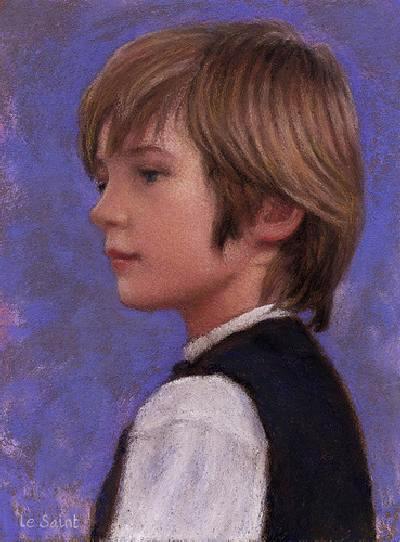
Figure 1.--The Celts were a pre-literate people. Thus all written accounts are left to us by their enemies--such as the Romans. They have left artistic treasures, but not pictoral art until after the Christian era. Thus we have no contemprary images of the Celt. Other than arecheology, linguistic studies have been one of the few sources of information on the Celts. Modern DNA studies are providing another valuable source. A modern artist has created this painting of a Breton boy.
The Greeks called the Celts living to the north of them the Keltoi, but the origin of the term is unknown. It does appear to be origin of the modern term Celt. The geographical and ethnic origins of the Celtic people of Europe are largely unknown. They are believed to have appeared in Europe during the 2nd millennium BC. Most historians believe that they were one of the more war-like Caucasian tribes. The original Celts appeared to a have conquered and merged with existing non-Indo European tribes. The Celts became the dominate force in north-central Europe. Celtic language , customs, religion, and traditions were gradually adopted by subjected peoples. There are thought to have been about 150 distinct Celtic tribes, among
which the Britons and Gauls are today the best known. Toward the end of the 2nd millennium, the Gauls became increasingly dominant in north central Europe. The Gauls from the 5th-2nd century BC expanded their area of influence, moving south of the Alps into Italy, even sacking Rome (390 BC). They also moved into Spain, Greece, and Turkey. At the end of the 2nd century BC, these wide spread deployments had weakened their power in central Europe. The Gauls wee less able to resist pressure from German tribes east of the Rhine. The Roman Gaius Marius defeated the Gauls south of the Alps. Caesar defeated the Gauls, especially the Belgae north of the Alps (58-50 BC). Within the Empire, slowly Latin replaced the Celtic language.
The Celts unlike Roman men wore trousers and the word breaches, the first form of trousers worn by European men.
National Terminology
The names of countries is a fascinating topic as is the different names used in different countries. The names of countries in Western Europe is especially interesting. The Greeks called the Celts living to the north of them the Keltoi, but the origin of the term is unknown. It does appear to be origin of the modern term Celt. The Romans used a different term--the Gallia. The two modern terms Celts and Gauls are often used synonomously. Neither are terms actually used by the Celts themselves.
Belgium
Modern Belgium takes its name from the Belgae, a Celtic tribe defeated by Caesar in the 1st century BC.
Very little is known about the early inhabitants of the British Isles, although archeological work has unearthened some fascinating information in recent years. The Celtic peoples appear to have begun migrating to Britain at about the time Rome began to emerge in Italy (about 600 BC). There is some evidence that the Celts integrated the existing population. The Celts were a pre-literate society. Thus there are no written records. In fact, the first written accounts of Celtic Britain are provided by Julius Ceasar during his military expeditions (55-54 BC). Ceasar learned a good bit about the Britons and Celts while in Britain. The British war techhnology was more advanced than he anticipated. He was surprised to find the Britons had war chariots. He was also astonished to find that the Britons would rub their bodies with woad before going into battle. He picked up usefil information about the Gauls. King Commius of the Atrebates, who founded a dynasty in modern Sussex and Hampshire, was a source of information. Celtic legend was that he Druids, Celtic priests, had originally come from Britain and not Gaul itself. Caesar's assessment was that the Britons, much like the Gauls, were a quarrelsome tribal society. Even with the Roman Army in Britain, the various tribes seem primarily concerned with long standing tribal differences. Cassivellaunus appears to have been the most powerful of the Celtic tribes in southern Britain. Mandubracius, chief of the Trinovantes, north of the Thames in East Anglia, was attacked by Cassivellaunus and sought Ceasar's protection. Ceasar did not fully understsand the tribal relations, in particular whether the warring Britons were separate tribes or sub-groups of the same tribe. Very little is known of the Britons at this time because there are not British written records. One of the few sources of information or coins minted by the various British tribes. Many of these coins had the names of the tribal chiefs. Archeologists have found coins from the Dobunni (Gloucestershire), Durotriges (Dorset), Iceni (East Anglia), and Corieltauvi (Leicestershire, Lincolnshire).
France
One of the countries most associated with the Celts is France. The Celts called it Argos before the Roman conquest. Within the Empire, the land was called Gaul. The term 'Gallia' to the Romans
sounded like the 'Land of the Roosters', because Gallus is Latin word for rooster. As a result, the rooster became the emblem of the French nation. The actual name of France was derived from The Franks, a Teutonic tribe which crossed the Rhine around 500 AD and pushed the Celts to the far fringe of Europe. In France, the Breton Peninsula (Brittany) was one of the areas where Celtic influence survived.
Germany
The Germans have never called themselves German nor is German even a German word. Ir. appears to come from a Celtic root meaning 'neighboring', very close to the Latin word "Germanicus" which meant
'having the same parents'. The Germans use the term Deutschland, which means 'Land of the people' from the Gothic root Deudisko, meaning 'people'. The French use Allemagne for Germany. The term was
derived from Alemani--a tribe from the Black Forest. Many used to to look on the Germans as Prussians because it was Prussia which unified Germany and dominated many of the institutions of the German Empire
after unification. Prussia is a contraction of Borussia.
Russia
The modern Russian nation was in large measure forged by
Scandinavia, especially Swedish, Viking traders. They were first called Rus by an Arab diplomat during the 10th century.
Origins
The Celts were an Indo-European group, which also included Germanic, Greek, Persian (Iranian) and Slavic people.
The geographical and ethnic origins of the Celtic people of Europe are a matter of considerable debate. here are no traces of the Celts in the Caucasian area where the are believed to have originatd. They are genberally belieces to have come from the Pontic-Caspian Steppes. The Proto-Indo-Europeans migrated north and south to Europe, Central Asia, and South Asia (4000 BCE onwards). A factor here was metalurgy and the devekiomenbt oif bronze technology providing them advanced weaponry.
Most historians believe that they were one of the more war-like Caucasian tribes. The Proto-Celtic people are believed to have moved through the Balkans and into Central Europe around (2500 BC). Horses from the Steppe and bronze weapons gave the Celts an early military advantage. The Celts' early development of iron weapons gave them a military advantage and
enabled them to conquer the stone age European population. Thus the Celts established their sway from Eastern Europe west to Iberia and the British Isles. The Celts appeared to a have conquered and merged with existing non-Indo European tribes. DNA studies suggest that the Celts migrated in several destinctive waves. The Celts became for an extended period the dominate force in northern and central Europe, both in the East and West.
Central Question
Perhaps the central historical question about the Celts is the degree to which they saw themselves as a people meaning aelated cultural group in the way the Greeks and Romans did. We know for example that the various Celtic tribes had a long hitory of fighring each other. Only at the end when Caesar invaded Gaul do we find the beginning of some form of unity. Vercingetorix was able to forge a degree of niity. And other Celtic tribes trie to rekieve the Roman seige of Alesia. Even this beginning stage of unified action was not the pattern for the Celts through much of their history. Most historins believe that the Celts woulf not have recognized tht term or any other national designation. One historian provides a better way of voewing the Celts --"... a widespread group of people who shared a common material culture, language, and symbolism, but had distinct regional differences." [Urbanus, p. 46.] The problem in assessing the Celtic world view isthatthey wre a pre-literate people and left not records. Much of what we know about the Celts is wht their enenies (the Greeks and Ronabs said about them.
Tribes
Celtic language, customs, religion, and traditions were gradually adopted by subjected peoples. There was never one unified Celtic nation. This is one factor in Caesar's ability to conquer Gaul with a military force smaller than the forces available to the Celts. There are thought to have been about 150 distinct Celtic tribes, among which the Britons and Gauls (each divivided into numerous tribes) are today the best known. There were
substantial differences among the various Celtic tribes, although the nature of these differences in not well understood today.
Location
The Celts have been described as the archetypal Iron Age cultural group in Europe. Today we think of the Celts as a people who live on the Atlantic Western fringe of Europe. This may be the case today, it was not for centuries of European history. They dominated much of central and western Europe, from the Pyrenees and British Isles east to Galicia (Poland) and Romania, even reaching into the Balkans and Anatolia. While the Celts were dominant in Northern Europe, they not only pressed south against the Romans, but blocked the entry of the Germanic tribes into Western Europe. Caesar's conquest to Gaul in the 1st century BC destroyed the Celts as a major military power and meant that Rome now had to contend with the Germanic peoples pressing west. Historians studying the Celts see them emerging out of two early Iron Age cultures: Hallstatt and La T�ne. Hallstatt (C88-475 BC) is named after a village in Upper Austria north of the alps where importnt remains have been found, primarily a vast necropolis. Thalater T�ne (450-100 BC) is bsed on lake bed finds in Switzerland. The artifacts found there are more in line with people we now see as the Celts. [Ubanus, p. 46.]
Archeology
A major problem in understanding the Celts is the paucity of an archeological record. This is notable for such an important and widespread people. We know much more about smaller and older groups. But for the Celts there are only two important archeological sites, one at Hallstatt in Austria and the second at T�ne in Switzerland. The reason for this is that their dwellinds were made in materials that quickly deteriorated and thus left no trace for modern archeologists to find. The Celts were skilled metal workers, and much of what we know about them, other than from Greek and Roman accounts, comes from pieces of their metal work which have survived.
Language
Celtic was a major European language for a millenia. There were many forms. Just in modern Britain there are five forms (Cornish, Gaelic, Irish, Manx, and Welsh). The forms spoken over most of Euroipe must have been even more diverse. Unfortunately for historians, the Celts were a pre-literate people without a written language. This meant that there are no accounts written by the Celts themselves. There was no written Celtic language which has left many voids in our understanding of these intriguing people. The Celts had, however, extensive relations with neighboring people that have left written records such as Greece and Rome. These historical accounts as well as archeological work has helped evidence as well as historical accounts from other cultures has helped to build a basic understanding of the Celtic people. The Roman record is especially important, but it also acts as a filter. This is one reason that the Celts are often seen as barbarians, because we are often looking at them through Roman and Greek eyes. Curiously for such an important people and language, Celtic had very little impact on the languages that suceeded the Celts. Within the Empire, slowly Latin replaced the Celtic language. By the 4th century AD, Celtic had virtually disappeared from the Continent. Celtic continued to be spoken in Britain an Ireland. Surprisingly the language left only a minor impact on Old English and English in general. This eas assumed to have reflected the war of extinction waged by the Anglo-Saxon tribes that invaded Britain after the departure of the Legions (5th and 6th centuries). DNA work, however, suggests that the idea of a war of extinction is overstated. The Anglo-Saxon conquest largely displaced the Celtic language if not the peoples.
Social Organization
Celtic civilization like most groups at the time was hierarchial. Each tribe had a chief and his imprtant suporters, the tribal chieftans. The land was distributed to overlords who versaw estates of various sizes. Land ownership was the foundation of social and economic status. The ordinary Celt worked on one of these estates. And in return for the overlord's protection, adult male Celts served in what might be called a militia. The status of women is interesting. The Celts like most other ancient people were a male dominated society. Women were dominated by first their fathers and then their husbands. But there were differences. The parents of both the vride and groom contributed to dowries. And when a husband died, his wive received the family property and could hold it as long as she was unmarried. This right to propert elevated the status of women abobe many women in the ancient world. And women were noit cinbfined to the home. They were free to go about in public. Perhap because of the reltively rural settlement pattern dominated by hamlets, there was litte differnce between the public and private sphere in Celtic society. Most Celtic women were responsible for maintaining the home and cooking, but they also produced textiles and wrked in the fieds when needed. Th exceotion if course wre nobel women. And a major difference with ither ancient socities was that daugters if theiur were no sons could inherit the status of tribal chiefs. There were Celtic qyeens with real power. British readers will of course know of Boudica. And the Irish annals mention queens. We know most about the Iriush Celts because here on what became known as the Celtic Fringe, the Celts survived into the medieval era and with Christianization acquired writing skills. Vut the role of women is believed to have been similar throiughout the Celtic world.
Settlement
The Celts were farmers and they lived in hamlets meaning a small village set amonst the agriculturl fields they were tending. The major crop was grains. The sites chosen had to have a source of water. There neded to be fertile ground fr farming or pasture for the animals. The hamlet would ve suronded by a ditch and bank, perhaps even a waddle (clay and mud) fence. These were not defensive structures, but more meant to keep intruders and maurding animals like foxes out and the hamlets' domestic animals (cows, pigs, horses, goats and sheep) inside the enclosure. The actual houses were for extended families. They were built within the hamlet enclosures and were round. They were supported by timbers or stones. The walls were waddle and daub, meaning a structure created by weaving twigs and filling then in with clay and mud. The roof was thatch done with reeds and straw in a conical form. A fire burned in thge center for bth cooking and warmth. Well to do families might have docrative 'fire dogs' which the fire was built between, perhaps meant as homage to a god or goddess.. Carpentry skills were poorly developed. There was little furniture in a Celtic home, perhaps a primitive timber table. The people slept on pelts spread on the ground floor. In additional to the houses were communal storage facilities, pits for legumes and an elevated granery where par-baked bread was kept for the winter, In addition to these largely undefended hamlets were hillforts. This as where the chieftain and his family, a few professional soldiers, and skilled craftsmen lived. Elevated sites were chosen because they were more secure, easier to defend. Steep slopes provided a natural defense, a wall ditch wer built to provide a densable barrier. These were effective against small raiding parties from the north or other Celtic tribes, but not the organized Roman armies. By the late Celtic period, cities began to form. They were riugh places compared to Roman cties, but cities none-the-less. This was particularly notable in Gual and was the cituation Caesar found when he ijnvaded Gaul.
Ecomomy
The Celts were an agriucultural people. Most worked the land either as farmers or pastoralists. They grew grain (barley, millet, oats, and wheat). Livestock included cattle, goats, horses, pigs, and sheep. Horses in particular were prized by the Celts. To supplement their production they huntes, mostly deer and wild boar. There were also fishermen who used small wicker coracles. There was mining and metal working to produce the objects for which the Celts are best known today. The Celts practiced the crafts of the day. There were boat builders, carpenters, coopers, potters, tnners, and wheelrights. Especially imprtant to the Celkts werethe smiths and metal workers. Women were primarily involved with textile production, dying, spinning and weaving. The Celts were also traders, important trade goods included animal hides, grain, hunting dogs, metals, slaves, and textiles. They might trades for amber, coral, exotic fruits (figs), fine pottery, jewelry, leatherwork, olive oil, purple glass, salt, wine and much more. This depended on the particular tribe and where they were located. This was imprtant because it varied what wa produced locally and also what could be moved in trade. Many products such a wine and olive oil could not be moved profitably long distances ecxept by sea. They traded with the Mediterranean centered classical world (Etruscans, Greeks, and Romans). The breath of the trading network is shown by the presence of Chinese silk in the burial sites. The Celts used coinage as a medium of exchange. They also bartered. Here livestock was especially important.
Diet
The Celts lived mostly on grain (barley, millet, oats, and wheat) porriages and bread. Some variety was added by berries, mushrooms, and nuts. Live stock (cows, goats, and pigs) were slaughtered for special occasions. There was also fowl. They dark beer and to aesser extent wine.
Military
The Celts had a reputation of fearsome warriors throughout the classical world. The Celts had a long military history even before Rome was founded. They had chariots like many ancient people. And they put their metalurgic skills to work in eqyuipping their armies. It was the Celts who invented chainmail (around 300 BC). The Celtic metal helmets were adopted by the Roman legionaries. Celtic swords and shields were comparable in quality to that of the Romans. A Celtic warrior carried an iron-tipped spear and shield. Spears were relatively inexpensive to produce and thus more commin than swords. They could also be used with less training. The nobility and wealthy families would arm themselves with swords. They would also have bronze and leather helmets, but not made in uniform styles like the Romans. The ordinary Celtic wrrior unlike the Romans did not wear much body armor even though their metal workers invented chainmail. They were known to paint their bodies and fight naked. The Celts wwere the most deadly enemy that thge Romans faced, evem more of a thret than Habibal and the Cathegenians. The Celts crossed the Alps before the more famous Hanibal and seized northern Iyaly betwwn the Appeninne mountains and the Alps (around 400 BC). They even mnaged to sack Rome (390 BC). Even Alexander the Great a this time did not want war with the Celts He signed a peace treaty before attacking east and destroying the Persian Empire (335 BC). After Alexanbder died, the Celts renewed the war with the Greeks. Huge amounts of treasure from the defeated Perians fojnd its way back to Greece. The Galatian Celts invaded Macedonia (281 BC). They sacked Delphi (279 BC). The Celts did not, however, have a trained, professional army. Rather when needed, the militias organized by overlords were called up. The men had little or not military training or discipline. They were tough and armed, but they were more of am armed mob than an army. Their defeat against the Romans was mainly due to their lack of military traig and duscipline and the lack of unity. There was never a Celtic empire, but rather a huge area conquered by separate an often antagnistic Celtuv tribes. The Celts had a long of tradition of inter tribal warfare. That was difficult to ovcercome even when threatened by the Romans.
Education
We know nothing about Celtic education. As there was no written language, formal schools were not required. Training was needed to become a druid, craftsman, or bard, but this was probably provided by fathers and appretice-like training. The bards were important in passing down oral traditions as was the case in other civilizations. This wa, for example, the cae in Greece with Himer. Only no written language developed to set diwn the oral traditions.
Slavery
At the bottom of Celtic society were slaves. Celtic slavery is not well documented, again primarily because the Celts were a pre-literate society. The most noted account is that of Patricius, a British Roman captured by Irish slave raiders (4th centyry AD). [Patrick] He was from a comfortable middle classed family and sold to be used as a slave shepherd. He suffered terribly with little or no clothing and food provided by his master. It is likely, although from relativly recent times, this is how Celtic slaves were utilized and treated in earlier periods. There were some similarities to the well-documented practice in the classical world (Greece and Rome). The Celts acquired slaves in war, and raids. There was also domestic penal and debt servitude. Slave status is believed to have been hereditary, although the illtreatment Patricius describes argues against extensive coupling and offspring as was the case in the classical world. Manumission was possible, but the prevalence is unknown. Some sources suggest tht it was discouraged by law, perhaps because of the value of slaves. The Irish Celtic word word for a female slave (cumal was also the term for a generic unit of value. [Kelly, p.96.]
The Celts although had some slavery practices similr to the clasical world, unlike the Greeks and Romnans they were not a slave society. Slaves existed, but they did not do most of the work. This was domne by ordinary free Celts. And the numbers involved seem relatively small. The nobility and rich jndividuals may have had some slaves. The ordinary Celt did not. There is consiuderable indication that the principal purpose of slavery was as an export item. The Celts exported slaves to the Romans. [Siculus] Etymologists believe that the Old Irish word for slave (cacht) and the obvously related Welsh word caeth seem derived from the Latin captus meaning captive. This is part of the evidence supporting the slave trade as part of the contact between Latin and Celtic societies. [Simmons, p. 1615.]
History
Toward the end of the 2nd millennium, the Gauls became increasingly dominant in north-central Europe. The Gauls from the 5th-2nd century BC expanded their area of influence, moving south of the Alps into Italy, even sacking Rome (390 BC) and controlled in for over 40 years. Until the Germanic invasions of the 5th century AD, this was the worst defeat ever inflicted upon Rome. The Romans were forced to pay a huge tribute in gold. They also moved into Spain, Greece, and Turkey. At the end of the 2nd century BC, these wide spread deployments had weakened their power in central Europe. The Gauls were less able to resist pressure from German tribes east of the Rhine. The Roman Gaius Marius defeated the Gauls south of the Alps. Caesar defeated the Gauls, especially the Belgae north of the Alps (58-50 BC).
Julius Caesar while campaining in Gaul launched two expeditions accross the Channel (55 and 54 BC). Ceasar decided against a major military expedition. It is not enirely sure why. His focus at the time was on Gaul. Presumably he concluded the conquest would not justify the expense, especially when the situation in Gaul itself was not yet settled. Ceaser did, however, report on these explots to his adoring public back in Rome. The subsequent Roman invasion came a century later. Roman attempted to bring Britain within the Empire through diplomatic initiatives. By the time Rome initiated the conquest of Britain, Gaul had been firmly Romanized. Rome's new emperor, Claudius (43 AD), athorized The invasion. It was Claudiu's first foreign expedition. Successful military expeditions were important in establishing a prestigious reputation. Claudius assigned Aulus Plautius to carry out the invasion. The Britons were a Celtic people, related to the tribes of Gaul which Ceasar had conquered. The British proved to be a substantial military challenge, taking several decades to accomplish. Eventually Roman armies subjugated the British Celts and the era of Roman Britain began. The Roman conquest of Brition was characterically brutal. It took longer than Caesar's conquest of Gaul.
Very little is known about the early inhabitants of the British Isles, although archeological work has unearthened some fascinating informatin in recent years. The Celtic peoples appear to have begun migrating to Britain at about the tme Rome began to emerge in Italy (about 600 BC). There is some evidence that the Celts integrated the existing population. The Celts were a pre-literate society. Thus there are no written records. In fact, the first written accounts of Celtic Britain are provided by Julius Ceasar during his military expeditions (55-54 BC). Ceasar learned a good bit about the Britons and Celts while in Britain. The British war techhnology was more advanced than he anticipated. He was surprised to find the Britons had war chariots. He was also astonished to find that the Britons would rub their bodies with woad before going into battle. He picked up usefil information about the Gauls. King Commius of the Atrebates, who founded a dynasty in modern Sussex and Hampshire, was a source of information. Celtic legend was that he Druids, Celtic priests, had originally come from Britain and not Gaul itself. Caesar's assessment was that the Britons, much like the Gauls, were a quarrelsome tribal society. Even with the Roman Army in Britain, the various tribes seem primarily concerned with long standing tribal differences. Cassivellaunus appears to have been the most powerful of the Celtic tribes in southern Britain. Mandubracius, chief of the Trinovantes, north of the Thames in East Anglia, was attacked by Cassivellaunus and sought Ceasar's protection. Ceasar did not fully understsand the tribal relations, in particular whether the warring Britons were separate tribes or sub-groups of the same tribe. Very little is known of the Britons at this time because there are not British written records. One of the few sources of information or coins minted by the various British tribes. Many of these coins had the names of the tribal chiefs. Archeologists have found coins from the Dobunni (Gloucestershire), Durotriges (Dorset), Iceni (East Anglia), and Corieltauvi (Leicestershire, Lincolnshire).
The Celtic Fringe
The Celts once dominated much of northern Europe. They were a major threat to the Romans before being driven west and conquered by the Romans. The Celts survived on the western fringe of Europe--the Celtic fronge.
Britany
Cornwall
Ireland
Scotland
Scotland was not initilly a Celtic area. It was dominated by the Picts and other tribes. After the Roman Legions left Britain (407 AD) and the Anglo Saxon invasions. The Romanized and Celtic Britons were pushed west and north, some into Scotland. There was also an invasion of the Irish Celts.
Wales
Customs
The Celts have influenced Western civilization in countless, often
unrecognized ways. Modern Christmas celebrations, for
example, originated in the ancient Celtic celebrations of the Winter
solstice. Many Celtic practices like decorating dwellings winter winter greenery such as mistletoe and holly originated in practices promoted by the Celtic Druid priests as part of winter religious rites.
Information on Celtic costume is very limited. Northern Europe is not like the Egyptian desert where textiles might be preserved for long periods. There are a few artifacts such as the Danish bog people which may have been Celtic or Teutonic. Primarily information on Celtic dress comes from how the people they came in contact with described them, especially the Greeks and Romans. There is reason to believe from some textile finds such as at a mine near Salzburg, Austria that the celts had well developed weaving technology. [Barber, p. 204.] The garment most associated with Celtic culture, at
least Scotland and Ireland is the kilt. In fact, there is no evidence that the ancient Celts wore kilts. The kilt of Scottish legend is a much more recent development. The kilt (a breacan feile or belted plaid) appears very late in Celtic history, probably about 1550-1600 AD. Scottish and Irish Celts throughout most of their history wore a
linen or wool tunic (leine) and in cold weather a large cloak (brat) with or without breaches. [Riley and McGann.] In fact, while Roman soldiers wore a kilt-like skirt, Celtic warriors more commonly wore breaches. (Some Celtic warriors went into battle naked, but this appears to have been on exceptional occasions. Celtic soldiers and calvary wore trousers and colored cloaks and tunics. The breaches worn by Celtic men appear to have varied considerably over time and in different locations. [Dunleavy, p. 17] The skirt wearing Roman legions viewed these Celtic breaches as an example of their barbarity. It is Ironic that a millennia later, the kilts adopted by the Celtic Highland Scots were seen as barbaric by the well-breached English and Scottish lowlanders. The wealthy Celts might have worn their beaches with gold and silver plaited belts. [Duffy, p. 88.] The Celts unlike Roman men wore trousers called bracae which was the origin of the English word breaches, the first form of trousers worn by European men. [Duffy, p. 88.] Another source reports that Celtic men wore tunics with and without breaches.[Riley and McGann.] Women also sometimes wore trousers. Women primarily, however, although tight-waisted skirts were more common. [Duffy, p. 113.] Another source suggests Celtic women were influence by Greek fashion. [Riley and McGann.] Both men and women wore leather shoes and sandals. Both men and women wore tunics at lengths from the waist to the knees. Most sources agree that the tunics worn by Celtic men were colorful. One source describes the tunics as having narrow to the wrist, but also short sleeves. Decoration at the wrist and neck was common. [Riley and McGann.] Covering these tunics in cold weather might be a cloak which fastened with a broach. Wealthy Celts would have very fancy broaches. The cloaks could also be fancy and were a sign of rank and social status. [Duffy, p. 113.] There appears to have been some similarity among the different Celtic tribes. The Romans that invaded Britain found that the Celtic Britons dressed and behaved much as the Gauls. [Duffy, p. 113.] There must have been differences, however for a people whose history spans such a long period and inhabited such a large area. We do not have any information specifically on Celtic children's clothes.
Ornamentation
The Celts both male and female wore jewelry if they could afford it. And their metalurgical skills produced beautiful pieces. They made jewlery in bronze, silver, and gold. The items produced included neck bands (torques), anklets, bracelets, belts, and rings. Nobelmen even decirated their beloved hrses with such items as harness rings. Smoths also broduced a variety of brooches and pins as buttons were not yet invented. This is why Highland dress includes these items, althiug today mostly for decorative purposes.
Surely the most striking aspect of the Celts is red hair. Both the Greek and Romans mentioned this. Ireland and Scotland has a high proportion of red haired people in comparison to the rest of the Western world. And it appears to be primarily due to Celtic origins. The Vikings may have also been a factor, but Celtic origins appear to be a primary factor. One source explains, "Red hair is caused by V60L allele – 'the ginger gene'. Some experts say it developed up to 50,000 years ago when humans left Africa and arrived in Europe.
The days were shorter and colder which meant that people had less time in the sun and absorbed less Vitamin D. During this time fair skinned ginger people thrived as they were able to absorb Vitamin D at a faster rate than people with darker skin and hair." The Celts, both men and women wore their hair very long. Lengths down past their shoulders was common. Roman writers often commented that the Celts were extremely vain about their hair. The Celts, again both men and women, commonly plaited (braided) their hair. The affluent might attach hollow gold balls to the end of their at the ends of their plaits. Men appear to have rinsed their hair in limewater to both brighten the color and stiffen it. Their hair was then pulled back from the forehead to the top of the head and then further back to the nape of the neck. This style was likened to the manes of horses. We do not know how boys wore their hair or if it differed from that of adult men. Normally most men shaved, some let small beards grow. Ranking officials are said to have only shaved their cheeks. Women's hair styles could be elaborate and secured by intricately styled pins. One indication of how important their hair was to the ancient Celts was virtually everyone, and not just women, appear to have carried a comb bag. This is suggested by numerous
archaeology digs. These comb bags might be carried by warriors going into battle wearing little else. [Thompson]
Religion
The Celts like most ancient people were polythists. They worshipped some 400 different gods and godesses, perhaps better called spirits. The spirits were associated with the natural world, basically a form od animism. The spirits were believed to favor streams, rivers, bogs, lakes, hills, oak groves, and other natural features. These sites were tended by Druids, a priesly class. This is why Celtic metal works have been found in bogs and lakes, votive offerings to the spirit world. There were certainly other offerings and human sacrifices, but the metal work has survived best. The bogs may not have been as important as suggested by archeological finds, but the conditioins in the bogs have meant that they offeings have survived best there. The human sacrifuces turned into munnies by the bogs are an especially fascinating look into not only Celtic religion, but many other aspects of Celtic life. Most of the big bodies are Celtic, although a few pre-date them. The Romans criticized the Celts for human sacrifice and the bog finds show that it indeed occurred, but the prevalence is not known. In addition to the bog mummies, severed heads (mostly young males) have been found in various locations including a London stream which have been dated to 800 BC, perhaps offerings to a river diety.
Music
Dance
Sources
Barber, E.W.J. Prehistoric Textiles (Princeton University Press: Princton, 1991).
Duffy, Kevin. Who Were the Celts (Barnes and Nobel: 1996).
Dunleavy, Mairead. Dress in Ireland (Homes & Meier Publishers, Inc.: New York, 1989).
Kelly, Fergus. Guide to Early Irish Law (Dublin Institute for Advanced Studies, 1988), 358p.
Patrick. Conession.
Riley, M.E. and Kass McGann. Clothing of the Ancient Celts (1997 and 2002).
Siculus, Diodorus. Siculus was an important Greek historian.
Simmons, Victoria. In John T. Koch, ed. Celtic Culture: A Historical Encyclopedia Vol. I (ABC-CLIO, 2006).
Thompson, Heather. "Clothing" An Ceangal Mara Foundation website, 1999.
Urbanus, Jason. "Eternal banquets of the early Celts," Archeology (November-December 2015), pp. 45-49.