
Specific Diseases: Polio
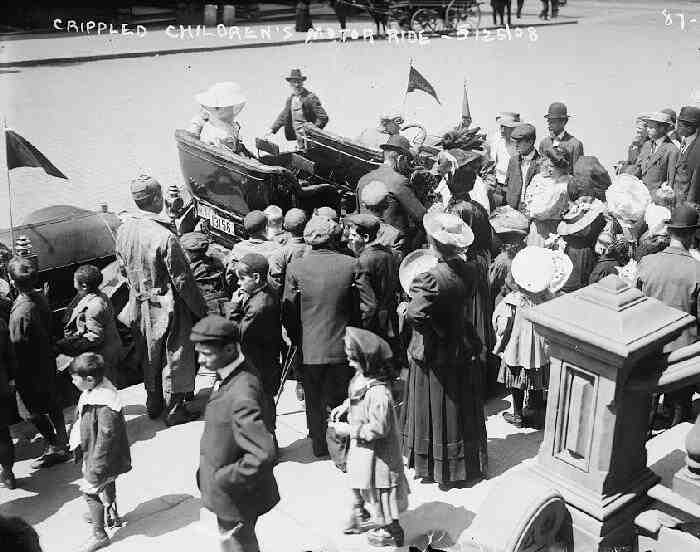
Figure 1.--Polio by the turn-of-the-century had become a major problem. The randomness of outbreaks and the way it struk children made it a particularly fearful disease. There was no way of preventing or curing it. Procedures developed often did more harm than good. Charitable efforts were organized for crippled children. Most of these children at the time would have beem polio victims. Here we see auto rides being organized for the children in New York City on May 25, 1908. Image courtesy of the George Grantham Bain Collection (Library of Congress).
|
|
A disease particularly associated with children is polio. Ironically in an age making great strides in science and medecine, it was a disease that seemed to appear at the turn-of-the 20th century. It had a huge impact on children in Europe and North America. This and its randomness made it an especially feared disease. Polio (poliomyelitis) is a disease modern children have thankfully probably never even heard about. It is
certainly one their grandparents know all too well. It has a unique history. It was almost never reported
before the 20th century and then after the turn of the century, quickly became one of the most feared
diseases. Certainly the disease existed before the 20th century. Ironically poor sanitation may have
exposed children to it so that they developed an immunity. Improving sanitation in the early 20th century
seems to have reduced this natural immunization process. The disease was particularly feared because it was
so poorly understood, struck randomly, and most insidious of all mostly affected children. By the 1930s-50s
huge numbers of children were being stricken by polio. Horrific images of children clinging to life in iron
lungs haunted parents with small children. Medical studies suggest that millions of children were affected.
There are about 0.6 million living survivors in the United states alone. Finally Dr. Jonas Salk developed an
effective remedy. Polio no longer strikes children in American and other developed countries and a worldwide
eradication is underway.
A disease particularly associated with children is polio. Ironically in an age making great strides in science and medecine, it was a disease that seemed to appear at the turn-of-the 20th century. For many in such an optimistic age, it seems inconceivable that a seemingly new disease would strike the most advance socities in the world. Americans and Europeans were acustomed to reading about dread diseases in Africa and Asia, not in their own neigbothoods. It had a huge impact on children in Europe and North America and it seemed to be getting worse and worse. This and the randomness of the disease made it an especially feared disease. Polio (poliomyelitis) is a disease modern children have thankfully probably never even heard about. It is
certainly one their grandparents know all too well. Not only did many children die, but the twisted bodies of the innocent suvivors were one of the horrors of the 20th century. Children were not the onlyindiiduals affected, but they were by far the most numerous and the individuals who wrenched the public consciousness.
Polio has a unique history. It was almost never reported before the late-19th century. Then after the
turn of the century, polio quickly became one of the most feared diseases. Certainly the disease existed
before the 20th century. Sanitation is effective in preventing many illnesses. Ironically it was modern
improvements in sanitation that appear to have turned polio into a major public health problem. Polio in
Europe became known as the Swedish disease. Sweden which made substantial progress in public sanitation was
one of countries most severely affected by polio. Some of the earliest research on poliomyelitis (polio) was
conducted by Swedish scientists. Researchers disagreed on whether polio could prevented by a vaccine. Some
thought polio to virulent to addressed by inoculation. Finally after decades of research, Dr. Jonas Salk
in the 1950s developed an effective vaccine.
Clothing
An additional subject pertinent to HBC is the special kind of clothing made for crippled people. For
instance, did boys who suffered from the deformations of polio continue to wear knee or short pants that
would expose their leg braces? A reader writes, "I have recently noted a HBC
page that shows a boy in knee pants with a brace on one leg. Did boys with polio more often wear long
pants to hide the braces? These are just a few of the issues that occur to me. I suppose it would be argued
that a boy with polio would want to be dressed the same as other boys of his age, even if this meant letting
the braces show."
Franklin Roosevelt
Polio is of course most associated with children. Adults can, however, also contract the disease. The
most famous person to be struck by polio was the adult Franklin Roosevelt (FDR). He was at the time a
prominent Democratic politician who ran on the 1920 Presidential ticket as the vice-presidential candidate. No one really knows why he was struck as an adult. We do know that he was called before very difficult
Congressional hearings during the height of of a Washington summer. Afterwards he headed to be with the
family at Campobello Island, the family retreat on a Canadian island off Maine. The last photographs of FDR
walking unassisted are with the Scouts. It is likely that it was here, surrounded by so many children, that he picked up the virus. Arriving at Campobello, he immediately engaged in strenuous activities with his children. In part because he so enjoyed this and in part because he was so depressed from the Washington hearings. He went sailing and swimming in the cold water of the Bay of Fundy. Returning to the cabin he spent sometime answering letters in a wet bathing suit. It is now believed that strenuous exercise increases opportunity for the disease to spread. This combined with remaining in a cold bathing suit may exoplain why he was so severely affected. But this is only speculation. FDR is not only the best known victim of polio, but he played a major role in defeating the disease through his role in the March of Dimes. It is likely that had he not reentered politics when he ran for governor of New York (1928) that his life work would have been the fight against polio and the March of Dimes.
We are most familiar with the Unitd States. But the same terrible tragedy was repeated in the major European countries as well. Our information at this time is limited. A British reader tells us of his experiences. An additioal tragedy was visited on German children who cotracted polio. During the NAZI era, children who were severely disabled werte in many cases brought before the NAZI genetic courts. In some cases they were srerilized. Other children were euthenized. This could be done not only without their parents approval or even when the parents objected to such actions.
The name iron lung became popular for a mechanical respirator. The machine assisted people to breathe
when disease impaired muscle control that regulated breathing. The proper name is a negative pressure ventilator. The first practical respirator was developed by Harvard medical researchers Philip Drinker and Louis Agassiz Shaw (1927). They were very large machines designed to exerted a push-pull motion on a person's chest. The first iron lung was set up at Bellevue hospital in New York City. Another source indicated Children's Hospital, Boston (1928), They were in great demand because of the large number of polio victims with chest paralysis. John Emerson developed an improved version that was less expensive to build. People needing help breathing are placed inside a central chamber. Individual machines were built as
cylindrical steel drums. Some larger facilities had banks of drums because of the number of patients
involved. Only the person's head protruded from the machine. An airtight seal is formed at the neck. Pumps
regulate air pressure within the chamber. And by rhymthically brining the pressure within the chamber above
and below outside air pressure can drive air in and out of the lungs. Many of course were children.
Patients varied as to the intensity of their breathing impairment. Thus some children needed to be placed
in the lungs only periodically and for short periods. Other were confined to the lungs most of the day and
for extended periods. Hospitals in the 1930s began acquiring these machines. Major hospitals had wards with
large numbers of iron lings during the 40s and 50s, large numbers of polio victims were confined to these
machines. Parents shuddered at the site and children were terrified. Polio vaccination programs rapidly
reduced the number of new children affected virtually eradicating the disease. There have also been a
variety of advanced breathing therapies developed, but the machines have not yet entirely disappeared.
The March of Dimes was for a time the best known charity in the United States. It played a crucial role
at a time that government did not fund medical research, even research in major public health threats like
polio. The story began in Warm Sprngs, Georgia. FDR was desperately seeking ways of curing the disease which paralyzed his legs. He came to Warm Springs because of the warm water which he believed might have
therapeutic value (1924). He purchased the property (1926) and made it available to others.
He then with the assistance of Basil O'Connor, his former law partner, founded the nonprofit Warm Springs
Foundation. This was the genesis of the March of Dimes. President Franklin Roosevelt eventually concluded
that fighting polio was a much larger task than he could accomplish with his own private Foundation at Warm
Springs. He founded the March of Dimes with the considerable publicity afforded by the presidency (January
1938). (You might notice FDR's image on the modern dime.) He probably did not do this earlier, because of
the concern over the potential political impact of widespread public realization that he was crippled. The
formal name of the organization was the National Foundation for Infantile Paralysis. The objective was find
a cure or way of preventing polio and to raise funds for those stricken by the disease. The Foundation
revolutionized charities in America. Before the Foundation, charities were the work of wealthy
philanthropists. Individual seeking to found a charity would try to find a few wealthy individuals willing to donate a million dollars or so. The concept of the March of Dimes was for the general public to make small donations, even a dime (10 cents). This began with a radio appeal in which everyone in America were asked to contribute a dime to fight polio. The "March of Dimes" was not originally used when the organization was founded. The term was coined by popular entertainer Eddie Cantor who was making a play on the newsreel feature shown at the movies--"The March of Time". Cantor and other popular entertainers of the day helped to make the March of Dimes a major American institution. And it was the March of Dimes that funded the research effort that ultimately defeated polio. The Foundation not only revolutionized charities in America, but they conducted one of the most impressive research efforts in American history. This included finding the most effective researchers working on the disease, including Jews and women which ignored still strong prejudices within the American medical and research establishment. Both Jonas Salk and Albert Sabin (who despised each other) were Jews. Women like Dorthy Horseman at Yale and Isabel Morgan at Johns Hopkins were also funded. It was Horseman who found that the virus was transmitted in the blood stream before it entered the central nervous system. [Oshinsky] This was a major discovery because it meant that antiboddies built up in the blood stream could prevent the virus from reaching the nervous system. While President Roosevelt founded the March of Dimes, he was not involved in its day to day operation. The work of the Foundation was largely in the hands of two remarkable individuals. Basil O'Conner worked for 30 years without salary and laid the foundation. He helped organize chapters around the country. The system O'Conner organized was that the local chapter would keep half of the funds raised to support local victims of the disease and half of the funds would be sent to the national organization for publicity nd to fund research. The other key person at the March of Dimes was Harry Weaver. He was the director of research who made sure that the finest researchers got grants and insisted that their work be focused on developing a vaccine. He developed a system of long term grants and also a system of providing additional funds along with grants for the basic costs to operate research labs. [Oshinsky]
Many scientists worked on polio. A major step in identifying the cause of polio was made by Austrian and
German scientists (1909). Austrian researcher Karl Landsteiner (1868-1943) Prosector at the Royal-Imperial Wilhelminen Hospital in Vienna (who later emigrated to America) and German pathologist Erwin Popper were able to induce signs of polio in a rhesus monkey, using a homogenate from the brain and spinal cord from a child who had been afflicted by the disease. Researchers disagreed on whether polio could be prevented by a vaccine. Some thought polio too virulent to addressed by inoculation. Finally after decades of research, success was achieved. The final stages of the research was conducted in the United States, financed with the massive funding made available from the March of Dimes. The leading researchers were Dr. Jonas Salk and Dr. Albert Sabin. The two were rivals pursuing different approaches. Salk worked with the killed polio virus. Sabin set out to developed a weakened or attenuated form of the virus. One note here is that early work on the vaccines used children in orphanages and mental health facilities--practices which would not be acceptable today. Salk was the first to develop a vaccine that was ready to test (1954). This was in part because it was easier to kill the virus than developed a safe, attenuated form of it. Salk as the Federal Government began to be more involved in public health had to undergo a security investigation. Like many New York City Jews, he was involved in left-wing groups during the 1930s. He almost did not get his clearance as the investigation took place in the Red Scare era of the late 1940s. (Salk thus wound up with an enormous FBI file and FBI Director J. Edgar Hoover advised President Eisenhower not to invite Salk to a White House ceremony after the success f his vaccine.) The March of Dimes began the largest public health experiment in American history. [Oshinsky] Two million Americans children were inoculated in a double-blind test using Salk's still unproven vaccine. This is also unimaginable today in a society that questions vaccines which have a very low rate of adverse reactions. The fact that such a large number of parents would have their children inoculated in this test is an indicator of the fear at the time over polio. Salk, who was convinced of the efficacy of his vaccine, was opposed to the double blind test because it left half of the children unprotected. It took a year for the results to be determined. The test was an enormous success. The Salk vaccine was found to be safe, potent, and effective. The rate of polio by 1956 was dropping dramatically in America. With so many children innoculated in America, Sabin whose vaccine ultimately proved even safer and more effective, had to go to the Soviet Union. Salk was never admitted to the National Academy of Sciences, essentially black-balled by Sabin and his supporters. [Oshinsky]
Modern Situation
Polio no longer strikes children in American and other developed countries in any significant way because
of the vaccination program. Polio still is, however, a very very dangerous disease.
Press reports described a polio outbreak in Minnesota. An Amish baby had contracted polio and so had two
other Amish children. It seems that the Amish are reluctant to be vaccinated. Also the baby has an low
ability to fight illness. There is concern that polio could return via infecting such children and in the
process change its structure so that current vaccines will not be effective in curtailing polio. There is a
concern that children who have immune deficiency problems could possibly be carriers for polio. [New York
Herald] Overall the vaccination has been a tremendous success. Since the 1960s polio is now very very rare. But it still exists in the world. And parents who do not get their children vaccinated are irresponsible.
A worldwide eradication is underway which has made great progress. An outbreak has occurred in Nigeria which
spread to other neighboring countries. U.N. officials reported in 2005 that it has been contained in those
countries through a vaccination program.
Sources
Oshinsky, David. Polio: An American Story.
"Eradicated, but Polio returns to the US," New York Herald (Paris edition, November 9, 2005), p. 2.
CIH

Navigate the Children in History Website:
[Return to the Main Specific Disease page]
[Return to the Main Disease page]
[About Us]
[Introduction]
[Biographies]
[Chronology]
[Climatology]
[Clothing]
[Disease and Health]
[Economics]
[Freedom]
[Geography]
[History]
[Human Nature]
[Ideology]
[Law]
[Nationalism]
[Presidents]
[Religion]
[Royalty]
[Science]
[Social Class]
[Bibliographies]
[Contributions]
[FAQs]
[Glossaries]
[Images]
[Links]
[Registration]
[Tools]
[Children in History Home]
Created: 5:19 AM 11/11/2005
Spell checked: 5:18 AM 2/10/2009
Last updated: 1:27 AM 11/11/2018