
Europe: Germanic-Latin Cultural Divide
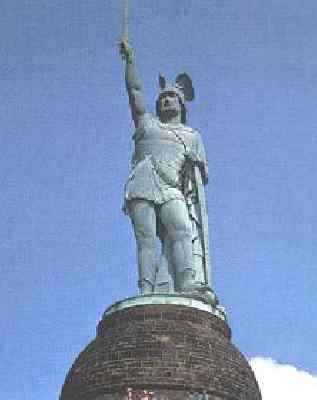
Figure 1.--Armenius was the master mind behind the defeat of the Roman legions in the Teutoburg Forest. He is known in Germany as Hermann. We do not have any images of Armenius as a boy. This sculpture of Armenius was created by Josef Ernst von Bandel (1800-76) between 1838-75 and erected on August 16, 1875.
|
|
A vibrant united Europe is a development that has come about in our post-World War II. Many remember the Cold War which divided Europe after World War II. In fact, there have been many political and cultural fissures that have divide Europe for millennia. Perhaps the most significant is the cultural divide between the Latin West and the Germanic East. That division came about as a result of a battle little-known outside Germany, but arguably is one of the most significant in all of European history. A youthful German tribal leader, Arminius, smashed three entire Roman Legions trying to subdue Germanic tribes east of the Rhine in the Teutonburg Forest. While Varus failed to unite the Germans, his brilliant military victory established the Rhine as the border between the civilized Roman Empire and the barbarous Germanic tribes. The Rhine, a geographic barrier of immense proportions, came to be a major cultural divide which played out in our modern age as the clash between France and Germany.
One of the most significant European battles in European history, the Battle of the Teutoburg Forest took place in 9 AD. It is little remembered today, in part because it was a catestrophic Roman defeat and the Romans did not chose to dwell on it. The Germans at the time were a pre-litterate people and had no written history. The Roman defeat was probably the greatest military disaster ever suffered by Rome--certainly the graetest since the struggle to the death with Hanibal. The Battle occurred during the reign of Augustus (27 BC-14 AD). Julius Ceasar had defeated the Grermani in Gaul and persued them accross the Rhine. Other Roman commanders during the reign of Augustus had considerable military success against the Germans east of the Rhine and a considerable area was in the process of being Romanized. Publius Quinctilius Varus, Roman Proconsul, had made a name for himself in Africa, bringing important tribute back to Rome. Varus was not a military man, he was more a lawyer and administrator. Augustus appointed Varus governor of Germania province (7 A.D.). Varus set about attempting to further expand Rome's frontiers beyond the Rhine to a generate the same kind of income and tribute that now flowed from Gaul which had been subdued by Ceaser. He dealt with the Germanic tribes as if they had been subdued and were vassal states. When the Germans did respond militarrily and received Varus peacefully, inspired trust. Varus concluded that the Germans would accept the Roman domination without a punative militafry campaign. The German leader was Arminius (sometimnes referred to as Hermann) who was the youthful leader of the Cherusci (a Germanic tribe). Arminius knew the Romans. He was raised in Rome and had served in the Roman army (1-6 AD). He had been granted Roman. Arminius had returned to Germany in 7 AD with Varus. Varus in 9 AD led three legions (XVII, XVIII, and XIX), six cohorts and three squadrons of cavalry (alae) in a military campaign aimed at Germanic tribes to the east that had risen in rebellion. This was an emense military force and a substantial part of Rome's army at the time. Armenius and the Cherusci pledged to assist Varus. In fact they were already gathering soldiers and preparing to ambush him. Armenius managed to lead Varus into the Teutoburg Forest where the poorly organized Roman colum was hacked to pieces in the dense forest and bogs. About 20,000 Roman soldiers were massacred. Varus fell on his own sword and his head was sent to Augustus. When Augustus heard of the disaster, he is reported to have screamed. "Quinctilius Varus, give me back my legions!". No other Roman legions were ever named the XVII, the XVIII or the XIX. Varus' expedition was the largest ever mounted to subdue the Germans. Rome never again mounted such a massive expedition. The Rhine and the Danuble to the south became in effect the boundary between civilized Rome and the barbarous Germanic east. Germanicus Ceasar led a retalitory campaign accross the Rhine, but from 9 AD, Roman policy toward the Germans along the Rhine was basically one of continment.
Armenius
Armenius was the master mind behind the defeat of the Roman legions in the Teutoburg Forest. He had been raised in Rome. We have few details on him at this time and no images of him as a youth. There are no contemporary images, but you would think that some German artists or illustrators might have created an image of the young Armenius. He also served in the Roman Army. He was thus familair with Roman military tactics. He is known in Germany as Hermann. Americans of German ancestry have organized the Order of the Hermann Sons, a fraternal lodge. This lodge was founded in 1840 in New York City by Americans of German descent. The first Hermann Sons lodge in California was established in San Francisco in 1870. Hermann Sons lodges are everywhere in the U.S. In California alone there are today still 21 such lodges. There is a city, Hermann, in Missouri where they have an exact replica of the Hermann statue in the Teutoburg Forest (Teutoburger Wald). The warrior with his sword, ready for the attack. There’s a Hermannsdenkmal on the Grotenburg a 386-meter hill southwest of Detmold, Germany (figure 1). It was created by Josef Ernst von Bandel (1800-76) between 1838-75 and erected on 16th August 1875. Its heigh is 53.46 metres. Some later said it was a gesture directed at the French (especially as it was erected right after the Franco Prussian War). But it has also been said that over the Rhine lived Gauls belonging to the Roman Empire. A HBC reader adds that the Germans didn’t had these winged helmets as they would have been useless for fighting.
Historical Assessment
A German reader disagrees with the thesis we have saketched out here. He contends that by the time of the creation of the Holy Roman Empire with the crowing of the Emperor Otto (800 AD) that there was no significant differences between Eastern and Western Europe. Now we think that is true economiclly, although the rich agricultural land and warm climate of France gave it an important advantage. But culturally we believe there were differences, roghly based on the Rhine River, the historic divie between the Roman Empire and the Germanic peoples to the West. This has famously come down in mnodern German history to the 19th century poem and army marching song, 'Watch on the Rhine'. We think that the exoistence of two destinct cultural areas, Latin and Germanic shows up throughout European history. I agree that there were not substantial economic differences (this came much later), but cultural differences are a different matter.
Now I will admit that I do not have the detailed knowledge of German culture to be able to prove this contention that the limits of the Roman Empire had lingering cultural impacts that help explain what occurred in the 20th century--in essence creating two distinct cultural areas. This would require a much more thorough study of German history and culture than I am able to muster. And I think our German reader's objection is a fair comment which I think needs to be aded to our assessment of this issue.
My assessment is based on how European history developed more than causality. Causality is important and necessary to prove my contention, actually more of a theory. And I would be interested in any academic research on the subject of causality. And heartily agree that my theory can not be turned into a proven fact without work on causality.
First let me say that any one looking at Europe in the year 800 AD would assume that the continent would be dominated by the Germans. The Holy Roman Empire (HRE) included the heart of Europe, in fact the largest area and the Germans were the most populace ethnic group (except for the Slavs which I am not sure how to quantify). The only reason that the Germany did not dominate Europe is that the HRE never coalesced into a nation state and the Emperor never had the power of the European monarchs.
Now the reason that I think that there was a cultural difference is that most of the major movements that have made Europe were spawned within the borders of the Roman Empire, namely the Renaissance, Enlightenment, capitalism, democracy, and the industrial revolution. (Not to say that Germany did not participate, but Germany did not LAUNCH these movements.) This all occurred with the Roman Western cultural area of Europe. Now I know one obvious response is, what about the Reformation? The Reformation was launched in Germany. Now I happen to think that the Reformation was of immense importance, not because of the religious issues, but because of the consequences. For the Germans the major consequence was was the growth of nationalism. West of the Rhine the Reformation fed into the development of capitalism and democracy.
Of course where all of this is headed is what occurred in the 19th and first half of the 20th century. After the Napoleonic Wars Europe entered into its golden age. It was a period of relative peace and huge economic development along with the advance of democracy. The one discordant trend was Germany which in the mid-19th century launched a series of wars beginning with the Danish War (1864) and of course ending with two attempts to dominate Europe my military force--World War I and World War II. Now there are other explanations for what occurred, but I think the historical cultural divide between the Roman and German areas worth considering.
CIH

Navigate the Boys' Historical Clothing Web Site:
[Return to the main Main Essay page]
[Return to the main Main Ancient Roman page]
[Return to the main Main Ancient German page]
[About Us]
[Introduction]
[Biographies]
[Chronology]
[Climatology]
[Clothing]
[Disease and Health]
[Economics]
[Freedom]
[Geography]
[History]
[Human Nature]
[Law]
[Nationalism]
[Presidents]
[Religion]
[Royalty]
[Science]
[Social Class]
[Bibliographies]
[Contributions]
[FAQs]
[Glossaries]
[Images]
[Links]
[Registration]
[Tools]
[Children in History Home]
Created: May 8, 2002
Last updated: 6:21 PM 10/13/2017