|
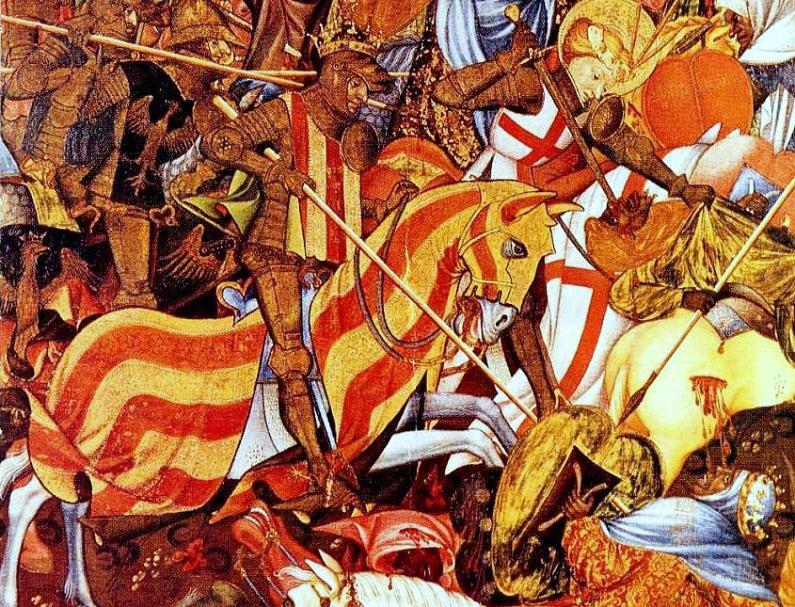
The Arab armies fired by Islam reached Western Europe in the 8th century, sweeping over the Iberian Peninsula, but turned back by the Franks at Tours. One small Christian kingdom remained unconquered--Asturias. Here the Visigothic claimant held out. What followed was the reconquest of the Iberian Peninsula by a long series of Christian kings. It is a complicated story. It is not entirely clear why the Moors tolerated a Visigothic Christian kingdom south of the Pyrenees. But within only a few years, Asturias established itself and expanded to an extent that the Moors were unable to dislodge it, What followed was not a war between Christians and Moors. Several Christian kingdoms emerged (Asturias, Castile, Catalonia, Navarre, Leon, and Portugal). King Sancho of Navarre united most of the Christian kingdoms, but they did no stay united. The Iberian Peninsula at the time was very different than the intolerant regime dominated by the Inquisition. Iberia was the most tolerant and progressive area of Europe where the people of the Book lived in close contact and harmony with one another. Spanish universities were rare centers of learning in the European medieval Dark Age. The Reconquista was not a simple straightforward matter. Not only were their wars between Moors and Christians, but wars among Moors and Christians. Also both Moors and Christians sought allies from their co-coreligionists as well as princes and nobles of the other faith. Finally with the growing power of Castile, Christians moved south and one Muslim principality after another fell. The last Muslim kingdom to fall was Granada (1492).
Early indications of human inhabitation on the Iberian Peninsula are the stunning cave paintings in the area of the Bay of Biscay and and the Western Pyrenees. Very little is known about the neolithic people who made these energetic paintings, but theywere done with stunning skill. What is especially remarkable about these paintings is that they exhibit a skill and energy not equalled in figurative art for millenia. Subsequently we note another neolithic culture in the south, the Almerians (3000 BC) which appear to have been culturally related to prehistoricn Africans. The Iberians, a North African people, appear in the Iberian Peninsula (1000 BC) and of course lent their name to it. The Iberians dominated the Peninsula for centuries. They were confronted by Celts migrating over the Pyrenees from what is now modern France (600 BC). We know little about this confrontation, the Celts having left us no written language. The Celts to a large part absorbed the native Iberians in central and northern Iberia, but a lesser extent in the northern moubtains. The resulting people are referred to as the Celtiberians and are the people encountered by colonizers from the east.
The seafaring Phenicias are the first eastern Mediterranean know to history people to have encountered Iberia at around the same time of the Celtic migration (about 1000 BC). These contacts are of some importance because there are actual legends and writtin accounts which are unavailable from the Celtiberians. Seafaring traders from Rhodes and other Greek city states established colonies along the Mediterranean coast. These seafaring people also entered the Atlantic through the Pillars of Hercules (Straits of Gibraltar).
Carthage was the first colonial power to move away from coastal colonization. Hamilcar Barca conquered much of the Iberian Peninsual (237-228). It was Carthage which founded modern Barcelona. Another important Cathaginian City was Carthago Nova (New Carthage). Cathaginian expansion in Iberia was looked upon with concern in Rome. A breaking point ocurred when the famed Carthaginian general Hanibal destroyed Saguntum (Sagunto) which violated a treaty limiting Carthaginian territoty (219 BC). This resulted in the Second Punic War. One of the results of the Roman victory in the War was that Carthage had to withdraw totally from the Iberian Peninsula (206 BC).
Rome after the Carthaginian withdrawl began the conquest of Iberia. The Romans divided Iberia into two provinces, Hispania Citerior (valley of the Ebro) and Hispania Ulterior (the plain of the Guadalquivir River) (206 BC). The modern name of the country Spain (Espa�a) comes from the name of the Roman provinces. The northern tribes remained independent of Rome for nearly new centuries, finally sucuming (19 BC) after Ceasar conquered the Gauls north of the Pyrenees. After this the Romans reorganized Iberia iinto Lusitania (modern Portugal), Baetica (southern Spain--western Andulusia), and Tarraconensis (central and northern Spain noth of Cartagena). Iberia was one of the richest Roman colonies. Spain was an important source of grain for Rome as well as mines which produced (copper, iron, gold, lead, and silver). The silver was especially important. Silver of course was not as valuable as gold, but was available in much larger quantities. It was vital for the eonomic life of the Empire and used to pay the all important Legions.
Teutonic tribes crossed the Pyrenees and pillaged Iberia (409 AD) decades before Rom was sacked. Alans, Vandals, and Suevi swepy over the entire Peninsula, devestating the formerly prosperous Roman colony. The Romans in an attempt to establish some kind of order in the chaos of their former colony, in part caused by the Vabndaks, appealed to the Visagoths who were under pressure from the Franks. The Visagoths entered Iberia (412 AD) and within 7 years established themselves as the dominant power in the Peninsula. The Visagoths established the Toulouse Kingdom, only nomally subject to the emperor in Rome (419). The Visigoths helped drive the Arian Vandals who had settled along the southern coast to North Africa, creating a whole new set of problems for the Western Empire. The Kingdom at its peak streached from Gibraltar north to the Loire River. Although Teutonic in origins, the Visigoths built on the earlier base of Latin (Roman) culture and eventually implanted Christianity. Euric ruled as king (466-84) at perhaps the peak of Visogothic power in Iberia. He codified of Roman and Gothic law. Leovgild (569-86) finally conquered the Suevi tribes and united Romans and Visagoths into a single people. Reccared (586-601) made Roman Christianity the state religion.
One of the fascinating aspects of Islam is how the new religion of the Arab tribes sp rapidly became one of the major religios of the world and the dominant religiom from Noth Africa west to central Asia. The common concept iun the Wesr is that Islam was spread by the sword. This is an important element in the success of Islam, but it is hardly the only factor. There are a range of economic and social factors which contributed to the success of Islam. Thecweakness of Byzantine Christianity was a major factor. As was the after the conquest, the obvious economic advantages of converting. There were other factors involved. And these factors varied over time and in the different areas in which Islam became the domininant or principal religion. Another interesting question is the strength of Islam in the modern world.
A decade after smashing Byzantine power in North Africa at Carthage (698), the Arabs had not only reached the southern shores of Europe facing Gibraltar, but launched an invasion of Spain. Arab armies had defeated Byzantine armies in the East, but the Byzantines still prevented an Arab invasion of Eastern Europe. That invasion wiukld come in the West. After the conquest of North Africa, the Arabs and their Berber Allies looked across the Strait of Gibraltar at the weak Visigoth kingdom of the Iberian Peninsula. Here a small Germanic ruling class had governed since the fall of the Roman Empire. Musa bin Nusayr, the governor of Muslim North Africa, dispatched his general, Tarik, and his largely Berber army on an expedition across the Strait (711). The defection of Count Julian in Ceuta made this possible. Tarik's army consisted of Muslims of varying origins. Accounts vary. Some sources say the Moorish army was predominately Arabs, but included Berbers, Syrians, and others). Others emphasize Berber origins. The Visigothic King , Roderick, assembeled an army to repulse the Tarik who he thought commanded a small mercinary army. Tarik landed at Gibraltar, the name of which comes from the Arabic Jebel-al Tarik. Roderick proved to be an ineffectual commander. One historian describes him as 'Weighed down by a golden crown, a heavy robe, archaic jewelry, and an ivory carriage drawn by two white mules" [Fuentes, p. 51.] The weakness of the Visigothic kingdom was displayed in Roderick's stunning defeat at Guadalete / R�o Barbate, (July 19, 711). It is believed that Roderick and much of the Visigothic nobility was killed in the battle and aftermath. Tarik swept north toward Toledo, the Visigothic capital, facing no futher strong resistance. Visigothic Spain passed into history. The Moors moved through the Visigothic Kingdom (sometimes referred to as the Toulouse Kingdom) destroying any armed resistance. Over the space of only a few years, the Moors almost totally dominated the Peninsula. The only Visagothic victiory occured at Covadonga in the mountaneous northwest (718). Here a surviving Visigothic chieftan named Pelayo stopped a small Morish fiorce. The cost of coquering the rugged moutaneous area proved not worth the effort for the Moors. Ratger their interest turned north to the ruch lands beyond the Pyranees. Muslim armies then ventured across the Pyrenees and established a foothold in southwest France. A furtgher move north was defeated at the Battle of Poitiers by a Frankish army under Charles Martel near Tours (732). While only a relatively minor military scirmish, along with avictory in the East of Byzantine Emperor Leo III ended the phase of rapid advance by Arab armies. The Moors then withdrew south of the Pyrenees. They never again seriously threatened France. Charles Martel would go on to found a powerful state, the foundation of modern France. The Moors were left in control of almost the entire Iberian Pensinsula except for a few small Christian enclaves in the rugged northhwest.
The Arabs who dominated the Moorish conquest administered the Iberian Peninsula as part of Province of North Africa which was subject to the Caliphate of Damascus. The caliph began appointing emirs to rule Spain in his name (718). Spain was the most distant extension of the caliph's domians. Little communication was possible in the 8th century between Iberia and Damascus. The emirs often abused their authority, distant as they were from the watcheful eye of the caliph. Word did eventually get back to Damascus and the result was considerable instability. One report suggests that there was 20 Spanish emirs in a 40 year span. The situation was further complicated by the struggle for power in Damascus between the Ommiads and Abbassides. Yusuf, the last Spanish emir, supported the Abbassides, but many local officials supported the Ommiads. The Ommiads chose a family member Abd-er-Rahman to replace Yusuf and rule Spain. Abd-er-Rahman proceeded to found an independent emirate which was to develop into the caliphate of C�rdoba (756). Abd-er-Rahman was the greatest of the Moorish rulers. C�rdoba under his rule became the most splendid city in Western Europe, second only to Constaninople in all of Europe. The level of civilization during the Moorish acendency in Spain was far above that of the rest of Europe. Schools were establish, including schools for poor children, presumably boys, although I have few details on these schools. The first European universities were established in Moorish caliphate of C�rdoba, not in Christain Europe. These universities pursued medicine, mathematics, philosophy, and literature. These universities collected translations of Greek and Roman manuscripts. Aristotle was read by Moorish scholars before he became well-known in Christian Europe. Strangely the Caliphiate was a conduit of classical literature to th West before either the Crusades or Renaissance. At a time when most Christian rulers were illiterate or unread, some of the C�rdoba caliphs becme noted poets and architects. The Ommiad caliphiate of C�rdoba were progressive rulers, encouraging trade and commerce and sponsoring vast irrigation works in southern Spain. The Caliphiate after Hisham III died split into independent kingdoms (1031).
The Moors with the disolution of the Caliphiate, like the Christians split into several small, often warring kingdoms. The kingdoms included: C�rdoba, Granada, Lisbon, Murcia, Saragossa, Seville, Toledo, and Valencia. The disappearance of a strong central Moorish power provided an opportunity for the Christians who conquered some of the kingdoms and made others tributary states. The Abbadid kings of Seville (1023-91) attempted to restore a united Moorish state. King Alfonso VI of Castile and L�on marched against the Moors and took Toledo (1086).
The Moors never succeeded in totally subduing Christian forces. A small Christain kingdom. Asturias, was established in the north by Pelayo, a surviving Visogothic chieftan who was the successor to the defeated Roderick (718). As the Moors sent an army across the Pyreneees, we are not sure why they allowed this small Christian kingdom to survive south of the Pyrenees. Pelayo's son-in-law Alfonso the Catholic during his reign (739-57) using Asturias as a base, managed to recaptured most of modern Galacia and L�on. He was crowned king of L�on and Asturias. These victories were in part the result of a weak series of Spanish emirs and the disorder in the Islamic world caused by the conlict between the Ommiads and Abbassides over control of the Caliphate. Thus only a few decates after the Moorish conquest, an important Christian kingdom was established in northern Spain. A descendent of Alfonso the Catholic, Alfonso III, greatly extended the territory of the Kingdom.
Asturias was after the Moorish invasion (711-19) the single surviving Christian kingdom on the Iberian Peninsula. Charlemagne estanlished the Spanish March (800) which became Catalonia. The Christian territory gradually grew and divided into independent kingdomes. Sancho I ( -967) established Navarre. The kings of L�on and Asturias pushed their territory east and took Burgos. Impressive castles built there gave rise to referring to the area as Castilla and gradually Castile. Count Fern�n Gonz�lez (910-70) became powerful enough to assert his independence of L�on and declared himself king of Castile (932). Sancho III of Navarre suceeded in not only recapturing much of Aragon from the Moors, but also in taking Castile and L�on. (The Reconquista was not a simple straightfoeward matter. Not only were their wars between Moors and Christaians, but wars among Moors and Christians. Also both Moors and Christains sought allies from their co-religionists as well as princes and nobels of the other faith.) This gave Sancho control of Christian Spain. Sancho imposed his son as king of Castile (1033). Christian Spain did not, however, remain united. Sancho on his death divided his territory among his sons. Ferdinand I received Castile. Ramiro I receiced Aragon. Garcia received the Basque country and the region north of the Pyrenees in France. Ferdinand acquired L�on (1037) and conquered the remaining Moorish area of Galacia which became kjnown as New Castile. He also establish a vassal county in what is now northern Portugal. This placed northern Spain solidly in Christain hands. Ferdinand proclaimed himself Emperor of Spain (Hispania), referring to the old Roman term for Iberia. The Reconquista is often dated from Ferdinand's proclamation (1056).
I should not be thought that Christians and Moors fought for incesently for 8 centuries. Actually there were long intervals of peace are more acurarely arnmed truce puctuated by occassinal battles. One observer writes, "Chritians and arabs gazed at each otyher across twilightv frontiers, doing battlebut alo mingling, trading culture, blood and passion, knowledge and language." [Fuentes, p.52.] And it was not a sinple matter. Just as Count Jukian joined the Moors. Some Moorish war lords fight for the Christias and visa versa. Even thec renounded El Cid was not unwilling to fight for the Moors if the price was right. Gradually the Cghristian oushed into central Spain (Castille) from Aasurias and Leon. The key variable seems to have been thec Moors. When a strong Moorish state existed, the Christians were stopped or even were pushed back north. When the Moorish states divided into small fiefdoms, the Christians made norable gains.
The Caliphiate after Hisham III died split into several independent kingdoms (1031). Like the Christians kingdoms, these small kindoms often warred with each other. The Moorish kingdoms included: C�rdoba, Granada, Lisbon, Murcia, Saragossa, Seville, Toledo, and Valencia. The disappearance of a strong central Moorish power provided an opportunity for the Christians who conquered some of the kingdoms and made others tributary states. The Abbadid kings of Seville (1023-91) attempted to restore a united Moorish state. King Alfonso VI of Castile and L�on marched against the Moors and took Toledo (1086).
Abbad III of Seville, faced with defeat at the hands of Alfonso, asked for aid from Muslim North Africa. The Almoravides dispatched military assistance. They not only defeated Alfonso (1086), but deposed Abbad III and the other rulers of the Moslem kingdoms. The Almoravide ruler soon controlled Moslem Spain (by 1100). Another Muslim army, the Almohades invaded Spain from North Africa (1145) and had within 5 years replaced the Almoravide dynasty.
One fascinating question is why Spain after several centuries of Muslim rule was njot Islamivized as was the Levant, Anatolia, Mesopotamia, Persia, and North Africa. This might be undetstanable if Moorish rule was brief, but the Moors ruled much of Spain for several centuries. And it was an enormous economic anmd cukltural success. Al Andalus was the cultural hot spot of pre-Renaissance Europe. It was through al Andalus that classical scholarship in the form of Arab translations began to reach Europe.
The decisive point of the Reconquista was the battle of Las Navas de Tolosa known to the Arabs as the Battle of Al-Uqab (July 16, 1212). The Moors reinforced from North Africa inflicted important defeats on the Christians. The situation was so serious that the Pope Innocent II declared a crusade. And the competing Cgristian monrchs were concerned emough to come together. King Alfonso VIII of Castile was joined by the armies of his rivals, Sancho VII of Navarre, Pere II of Aragon and Afonso II of Portugal to form a mighty army. Fighting between contending Moorish armies had weakened the Moorish forces. The forces of Almohad rulers of southern Iberia were led by Caliph himself, al-Nasir (Miramamol�n in the Spanish chronicles). The Almohad army, included men fron throughout the Almohad empire, including many from North Africa. The decisive battle for the future of Spain was fought on the open plain in front of Toledo. The old Visogothic kingdom, Toledo, is located in the geographic center of Spain. (The city of Toledo sits on a rocky prominannce rising in the midst of a flat virtually treeless plain.) The united Christain forces decisively defeated the Moorish army and expelled the Almohades from Spain (1212). This broke the power of the Moors in Spain. The decisive Christian victory put the Christians on the path south to final victory. All that was left of Moorish Spain was the isolated Moorish kingdom of Granada.
The Moors held on in ports around Cadiz and the Kingdom of Grenada in the extremne south. Although small in size, Grenada was until its fall, the most splendid of the Spanish kingdoms. HBC does not normally deal with historical fiction, but we do recommend a lovely little book, The Most Beautiful Mosque by Ann Jungman for younger readers. Spain after the Battle of Toledo (1212) consisted primarily of two Christian kingdoms--astille abd Aragibn. Castile and L�on dominated the west and included Asturias, C�rdoba, Estrmadura (home of Cortez and Pizarro), Galacia, Ja�n, and Seville. Aragon dominated the east and with the union with Catalonia included Barcelona, Valencia, and the Balearic Islands. Somewhat complicating the picture was Portugal and the Moorish regions in the south. Spain during this era was a very different from what we commonly think of Spain, an image forged duing the colonization of the Americas, the armada, the Inquisition, and the attempt to subgegate the Dutch. Spain before unification was a country of diversity and relative tolerance, at least compared with what was to come with the Launching of the inquisition. Spain was a land with diverse languages and peoples. Modern Spanish is basically Castillian, but there were many variants spoke on the Iberian Peninsula, not to mention Basque in the north. Catalan is one of those various and is still widely spoken in Catalonia today. The population was a mixture of Christians, Moors amd Jews commonly living in relative harmony. There was also a complexity of political forms in the different provinces of each kingdom. This was a level of diversity unknown any where else in Western Europe. To us with our modern politically correct sensabilities, this seems a impressive interlude in Spanish history. This changed in the 15th century and the principal force here was Isabella la Cat�lica, Queen of Spain. To the Catholic Church and Isabella the diversity in her realm was an intolerable affont to God. To Ferdinad suppression of the Moors and Jews was a convenient method of financing his wars.
Queen Isabella I of Castille anf King Ferdinand II married (1469). Castille at the time was the dominant force in Spain. The marriage thus made substantial forces available to Ferdinand, beyond the polential of Aragon. The marriage was one of corulers. Isabella did not defer to Ferdinad in matters of state, but was in every sence a ruling monarch. Upon their marriage, Spain did not become a unified state. Rather each monarch continued to rule in their own state. The marriage, however, began the process of unification. The first step was to centarlize administration. Isabella covoked a great Cortes (insipient parliament) at Toledo, which was at the time the seat of government (1480). The Cortes recodified and reformed the judicial system. Through the process Ferdinand and Isabella with considerable success worked to make the Spanish themselves absolute monarchs and reduce the power of the Spanish nobility. This seems to have been achieved to a far greater extent than in many other European countries with guarelsome nobility. There was no civil war in France resisting the monarchy's efforts as there was in other countries (the Fronde--France, Thirty Years War-Germany, and the Civil War--England). We are not entirely sure why this was, but the Inquisition must have been a factor. Surely Spanish Inquisitors saw royal absolutism under Isabella an oportunity to tarnsform and purify the Spanish people. Isabella the Cat�lica was fanatical about the Christain religion promoted the adoption of repressive measures against the Jews by the Cortes which helped to fill the monarchy's coffers. She established the nortorious Spanish Inquisition (1478) which was to operate under her authority rather than that of papacy which had earlier created the less fanatical Inquisition. After the meeting of the Cortes, Aragon and Castille were politically joined. Ferdinand's armies took Grenada, the last Moorish kingdom (1492). In the same year, Isabella and Ferdinand expelled the Jews from their kingdom. It was a fateful year. It was also the year Columbus discovered the Americas. Partly with the loot extracted from the Jews, Ferdinand invaded and conquered much of southern Italy. Ferdinand also obtained Navarre south of the Pyranees.
The Granada War (Guerra de Granada) was the last campaign of the Reconquista (1482-92). Like much of the Reconquita is was not 10 years of fighting, but a series of military campaigns beginning in 1482. Te fifgting was geenerally conducted only in thSoring and Summer. The Catholic monarchs (Isabella I of Castile and Ferdinand II of Aragon) wage war against the Nasrid dynasty's Emirate of Granada--the last Muslim stronghols in Spain. The Emirates effort were hampered by interrnal divisions The Soanish werre avle to weaken the Emirate economically. As a result, of past defeats, the Emirate had to pay tribute to Spain. The Spanish had begun to acquire artillery that the Emirate could not counter. This resulted in victories that earlier would have meant long, costly seiges. Finally,
Muhammad XII of Granada (King Boabdil) surrendered the Emirate of Granada, the city of Granada, and the Alhambra palace to the Castilian forces. The Spanisg victorry ended the convivencia ("live and let live") that had characterized the relations between the the faiths of Iberia. These chnges were led by the Inquisitionthat had been established decades earlier. The Jews were forced to convert to Christianity or be exiled (1492). The terms of Grenada's surrender garnteed toleration to Muslims -- the Alhambra Decree Treaty. The city's Muslim inhabitants, known as Mud�jars, were to be allowed to practice of their faith and traditiinal customs. Cardinal Francisco Jim�nez de Cisneros a major figure in the saonaish church and state and Grand Inquisitor, assumed that the Mulims when exposed to the True Faith would quickly abandon Islam. This did not happen. As a result, the first archbishop of Granada, Hernando de Talavera, adopted a program of forced Christian baptisms, creating the Converso (convert) class for Muslims and Jews. Granada's Muslims were forced to convert to Christianity, become slaves, or be exiled. This approach gradually spread to the rest of Spain. The New Christians (conversos) were eventually accused of crypto-Islam and crypto-Judaism. Spain would model its national aspirations as the guardian of Christianity and Catholicism and eventually lead the Catholic camapign against the Protesant Reformation.
Clolumbus' discovery of the Americas opened the creation of an expansive overseas empire. Portugal had began this overseas expansion, but Spain with its greater resources was to soon dominate. Spain did not at first understand that Columbus had discovered a new continent. At first the colonia effort was limited to the Caribbean which because Columbus believed was India, was called the Indies. Income was at first limited. Rumors of vast rich native American kingdom drew conquistadores to the mainland. There Diego Cortes conquered Mexico (1519-21) and Francisco Pizarro conquered Peru. In both instances a huge booty of gold and silver flowed into the royal coffers. Besides the Americas, Spain's colonial empire included the Philippine Islands and the East Indies (the Moluccas and Malaca). These were important outposts both for spices and the China trade. Spanish campaigns also made some of the Barbary pirates (Oran, Bougie, and Tripoli) tribute states (1509-11).
The dynastic history flowing from Isabella and Ferdinand to Philip II is somewhat complicated. Isabella and Ferdinand had three children, two daughters (Catherine and Juana) and a son John. They swredly planned their children's marraiges. Both marriages of their daughters seemed at the time good marriages. John was expected to inherited the crown of a United Spain.
Their only son John was expected to inherit the crown of a united Spain. Here events began to go wrong. John died before his mother.
They married Catherine to first Prince Arthur and on his death of Prince Henry (future Henry VIII) of England. This of course proved to be one of the most contriversial marriages in history. Henry divorced Catherine to marry Anne Boylen and launch the Protestant Revolution. Catherine's daughter Mary became queen as Mary I, better known as Bloody Mary for her efforts to reimpose Catholocism.
Juana whose mental health was fragile was married to Philip, the Hapsburg Archduke of Austria. Both seemed at the time good marriages and their only son John was expected to inherit the crown of a united Spain. Here events began to go wrong. John died. Then Isabella died (1504). This left Juana as heir to the crown of Castile. Isabella and Ferdinand never joined their two crowns. Ferdinand citing Juuana's madness attempted ton gain control of a regency. Juana's husband Philip, however, managed to obtain the support of the Castilian nobels. Then Philip died shortly thereafter (1506). Rumors suggest that he was poisoned. Ferdinad then managed to assume control over Castille and ruled until his death (1516). Ferdinand was suceeded by his grandson (son of Philip and Juana) and was the first ruler of a united Spain. He was later elected Holy Roman Emperor and is better known to history as the Emperor Charles V. After failing to either united the Holy Roman Empire into a German kingdom or to stamp out Protestantism in Germany, Charles turned over Spain to his son Philip II.
The final episode of the Reconwquista is of course the Spanish Inquisition. This was the effort of their modst Catholic magesties, Ferdinand and Isabella and the Spanish Church to finally and irrevocably root out any lingering Islamic and Jewish influence in Spain. It is a sad conclusion to the gistory of the one corner of Europe where religious toleration and cultural openess existed over such a long period.
Fuentes, Carlos. The Buried Mirror: Reflections on Spain and the New World (Houghton Mifflin: New York, 1992), 399p.
Jungman, Ann. The Most Beautiful Mosque (2004). This is a lovely little book of historian fiction for younger readers. It the story of a Christian, Islamic, and Jewish boy who after the fall of Cordoba to the Christians plead for the Mosque's preservation. It is a reminder of an era of Spanish history when toleration ruled and a good beginning with children who will have to confront the quetion of intolerance in our modern age.
Wells, H.G. The Outline of History: The Whole Story of Man (Doubleday: New York, 1971), 1103p.

Navigate the Children in History Website:
[Return to Main early war page]
[Return to Main medieval page]
[Return to Main Spanish history page]
[About Us]
[Introduction]
[Biographies]
[Chronology]
[Climatology]
[Clothing]
[Disease and Health]
[Economics]
[Freedom]
[Geography]
[History]
[Human Nature]
[Law]
[Nationalism]
[Presidents]
[Religion]
[Royalty]
[Science]
[Social Class]
[Bibliographies]
[Contributions]
[FAQs]
[Glossaries]
[Images]
[Links]
[Registration]
[Tools]
[Children in History Home]