War and Social Upheaval: The Hundred Years War (1337-1453)
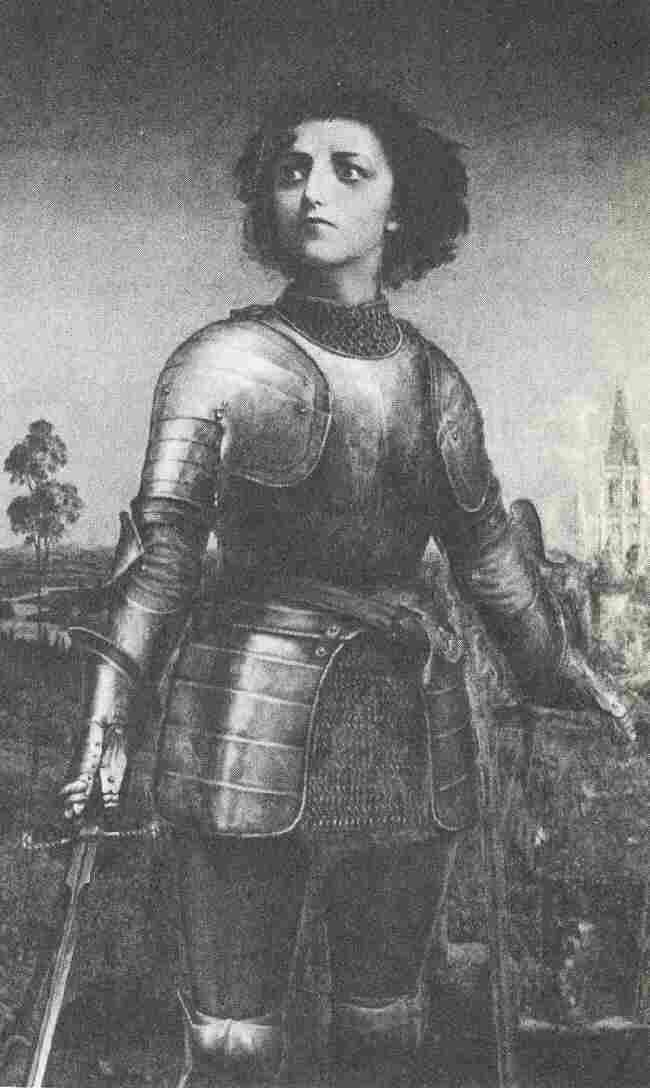
Figure 1.-- This is a painting by Gilbert A. Pawnall of the English actress Mary Kingley in the role of Joan of Arc (much idealized). The date of the painting is 1914. The production of "Henry VI, Part 1" which inspired it is slightly earlier, I think. The Shakesperian plays are interesting because they provide a glimpse of how the characters were being depicted in the 16th century.
The Hundred Years war is in fact a series of wars interpersed with truces of varying duratioion during 1337-1453. The central issue in the War was the claim of the English king to the French throne. The war was almost entirely fought in France.
Edward with his many French possessions refused to do homage to King Philip VI of France.
Edward had aclaim to the French crown through his mother. Hostilities erupted and continued over 100 years. Edward III of England announced that Philip VI of France was an ursurper (1337). Edward's motives are not entirely known, but chief among them must have been that Philip's incresing power over French nobels might deprive Edward of a fiefdom he held in France--Guienne. Philip had angered Edward by supporting Scotland in its war with England. There were also economic issues as both countries were ibterested in dominating the trade with Flanders. This was especially important for England as Flanders was the principal marke for wool--at the time the chied English export. The War is commonly divided into two phases. The French suffered some serious defeats in the early years of the war, Cr�cy (1346) and Poitiers (1356). At Poitiers French King John the Good was captured by the English Black Prince. Under Charles V the struggle became a war of attrition. He relied on Bertrand du Guesclin to engage the marauding Free Companies, marauding mercenaries. Charles V by his death had
stabilized the struggle (1380). Charles VI's mental instability and feuding princes undermined the French position. John the Fearless, duke of Burgundy, had the king's brother, Louis of Orleans murdered (1487). This left France deeply slipt between Armagnacs and Burgundians. Henry V seized the opportunity. The result was the most disastrous French military defeat until Napoleons defeat in Russia. Henry destroyed the cream of French nobility at Agincourt (1415). Henry forced Charles VI to acknowledge him as the legitimate heir to the French throne. France was split between the powerful John Duke of Burgundy and the Dauphin, Charles, son of Charles VI and Isabella of Bavaria. Gradually the Dauphin aided by the young peasant girl Joan of Arc built his power. He was crowned Charles VII at Reims, recaptured Paris, and recovered Normandy (1450). Charles then took Guienne (1453). With the the victory of Castillon, France had effectively defeated the English and united the country.
Causes
The central issue in the War was the claim of the English king to the French throne. The war was almost entirely fought in France. Edward III of England announced that Philip VI of France was an ursurper (1337). Edward's motives are not entirely known, but chief among them must have been that Philip's incresing power over French nobels might deprive Edward of a fiefdom he held in France--Guienne. Philip had angered Edward by supporting Scotland in its war with England. There were also economic issues as both countries were ibterested in dominating the trade with Flanders. This was especially important for England as Flanders was the principal marke for wool--at the time the chief English export. Flanders was the center of the European weaving industry at the heart of the Medieval economy in northern Europe.
Provinces
Two provinces, Armagnac and Burgundy, played key roles in the Hundred Years War. Burgundy dominated northern France and Armagnac southern France.
Armagnac
Armagnac first appears in history as Civitas Ausciorum durung the Roman era. During the early medieval period it associated with both Aquitania and Gascony.
Over time three great territorial lords developed un the south: the Count of Armagnac, the Count of Foix, and the Lord of Albret. The counts of Armagnac manage to gradually increase increased their territory through a range of expedienrs, including marriage and purchase.
In the opening phase of the Hundred Years' War the southern part of France, the French monarch was forced to cede much of southern France, including Armagnac to the English as part of the Treaty of Bretigny (1360). Edward, the Black Prince was entrusted with administering the region for his father, King Edward III.
The Black Prnce rapidly alienated the >Armagnac nobles leaving a heritage of abti-English feeling.
He granted privileges to the towns and levyed heavy taxes. Until the arrival of the Blacl nPrince, Armagnac had remained effectively independent by shredly shifting alliances. The Black Prince permanently aliented the province from the English. The count of Armagnac appealed to the French monaerchy for assistanhce (1369). He submitted himself to King Charles V of France. This enabled noble families like the Armagnacs to retain their positiins and lands, but permanently tied thecduchy to France. Count Bernard VII of Armagnac ( -1418) married his daughter to Duke Charles I of Orleans (1410). Allies of the Duke of Burgundy had killed Charles' father, resenting Orleans' influence on the king. With the marriage, the Armagnac family became allied with King Charles VI. The Armagnacs had for some time been anti-English. They now became anti-BUrgundian. The royal faction became knowen as the Armagnacs. When Burgundy allied themselkves with the English, the animosity between the two parties intensified, developing into a civil war that was not ended until the the Peace of Arras (1435). Denied of their allies, the English position in France had become untenable.
Burgundy
Burgunday dominating northern France was a major factor in the War. Burgunday rivaled the rest of France in size and power. The dukes of Burguny condired establishing themselves as an independent country. The English significantly improved their position by fighting the war as part of an alliance with Burgundy. John the Fearless, Duke of Burgundy, had the king's brother, Louis of Orleans murdered (1487). This left France deeply slipt between Armagnacs and Burgundians.
Major Figures
Edward III
Edward III initiated the Hundred Years War with France (1337). Edward with his many French possessions refused to do homage to King Philip VI of France. Edward had claim to the French crown through his mother. Hostilities erupted and continued off and on for over 100 years.
Charles VI
French King Charles VI is perioducally incapacitated by madness. Rival factions, Burgundians and Armagnacs, taking advatage of the monarch's decline, vied for power.
Charles VII
Charles VII was the Dauphine tht Joan fought for and who forgot her after he was crowned. With a competent king on the theone, the English position in France disintegrated.
Henry V
Henry V was one of the great English warrior kings. He began his military campaigns when he was only 14 years old by engaging the Welsh comanded by Owen ap
Glendower. He comanded his father's (Henry IV) forces in the battle of Shrewsbury when he was only 16 years old. After succeeding his father, he supressed the Lollard uprising and an attempt to assasinate him by a group of nobles loyal to Richard II. Henry is best known for his adventures in France. He attempted to marry the Frnch Princess Catherine (1415) and insisted on the former Plantagenet provinces of Normandy and Anjou as a dowry. Frenck king Charles VI rejected the offer. Henry declared war, in fact a continuation of the Hundred Years' War. Henry V seized the opportunity. The war for Henry offered two prospects. Henry could gain land that had been lost to the French. It also helped to deflect his cousins' royal ambitions. Henry achieved one of the great English victories over the French at Agincourt (October 1415). Agincourt was the most disastrous French military defeat until Napoleons defeat in Russia. Henry destroyed the cream of French nobility at Agincourt. Henry's small English army defeated and killed a vastly superior French force. The cream of the French airistocracy was killed at Agincourt, many after the battle. Henry forced Charles VI to acknowledge him as the legitimate heir to the French throne. He then launched on a methodical subjecation of Normandy (1417).
Henry's son who suceeded him was only 1 year old when his father died. Henry was the subject of one of Shakespeare's historical plays--Henry V. France was split between the powerful John Duke of Burgundy and the Dauphin, Charles, son of Charles VI and Isabella of Bavaria. Gradually the Dauphin aided by the young peasant girl Joan of Arc built his power.
Joan of Arc (Jeanne d'Arc) was called la Pucelle (the Maid) and has become the very symbol of the French nation. She was a peasant girl who was born at Domremy in Champagne, about 1412. The village was loyal to the French king. Domremy was part of the territory of the Dule of Burgandy. The Burgundians were nominal subects of the French King Charles VII, but who allied with the English, desired to set up an independent kingdom. At age 13 in the summer of 1425, Joan became conscious of supernatural manifestations,
whose she came to call her "voices" or "counsel." Joan carrying an ancient sword entered Orl�ans on April 30, 1429 which had been threatened by the Burgundians and English. Her presence changed the course of the fighting. Within a few days, English encircling the city were captured and the siege ended. A campaign was launched in the Loire ending on June 18 with a great victory at Patay, where English reinforcements were routed. Jean led forces which took Reims and on July 17, 1429, King Charles VII was solemnly crowned, Joan standing by with her standard. She was eventually captured and burned at the stake
by the English in 1431. Charles VII proceeded to recaptured Paris, and recovered Normandy (1450). Charles then took Guienne (1453). With the the victory of Castillon, France had effectively defeated the English and united the country.
Phases
The War is commonly divided into two destinct phases, one dominated by Edwaerd III and the other dominbated by Joan of Arc and Henry V.
Phase 1 (1337-80)
Edward III declared himself the rightful king of France and invaded. Edward attacked from the north. There were no decisive land battles, but the English fleet defeated the French off Sluis (the Netherlands) (1340). This gave the English virtually total control of the Channel exposing the coast of France to attack. The two monarchs signed a 3-year truce (1343), but Edward attacked again (1345). The French suffered some serious defeats in the early years of the war, Cr�cy (1346) and Poitiers (1356). At Poitiers French King John the Good was captured by the English Black Prince.
Another English victory followed when Calais was taken after an extended siege. A series of truces followed (1347-55).
During the truces John II suceeded Philip. The English resumed the War and under the Black Prince (Edward III's son) took Bordeaux (1355). With Bordeaux in their hands, the English plundered large areas of southern France. The Black Prince achieved another grat victory--the Battle of Poitiers (1356). Not only did the Black Prince decisively defeat the French army, but he captured King John. The Peace of Br�tigny ended the fighting and left the English in control, of large areas of France. Charles V succeeded John II (1364) and renewed the War (1369). Charles appointed Bertrand Du Guesclin to klead his forces. Du Guesclin adopted new tactics. He avoided pitched battles with the English and instead sought to cut off their supply lines. This increased the cost of the War to the English who had to deploy forces to maintain their supply lines. The English War effort was hampered by the strong leadership that had been an asset earlier. Under Charles V the struggle became a war of attrition. He relied on Bertrand du Guesclin to engage the marauding Free Companies, marauding mercenaries. Charles V by his death had stabilized the struggle (1380). England's Richard II seeme willing to settle the differences. Charles VI's mental instability and feuding princes undermined the French position The Black Prince died (1376) and then his father Edward III (1367). Edward was suceeded by his grandson Ricgard II. As a result of the new French tactics and the power vacuume in Engkand, the French succedded in winning back much of the teritory ceeded to England in the Peace of Br�tigny. Actual fighting ended (1386) although a formal peace treaty was not signed until several years later (1396). That truce was inteended to last 30 years.
Phase 2 (1414-53)
French King Charles VI experienced periodic episodes of insanity. France lapsed into civil war between the houses of Burgandy and Orl�ans over control of the regency. English King Henry the V seeing the opportunity to regain lost territory decided to use the opportunity afforded by civil war to reasserted his claim and renewed the War (1414) [Barker] Henry invaded France by first capturing Harfleur. Then in one of the great battles of the age, with a numerically inferior force, Henry defeated a massive French force in the Battle of Agincourt (1415). The French assembled a seemingly unstopable force of heavy calvalry. The stunning English victory has been attributed variously to the choice of terrain, the English long bow, and the muddy ground--probably all important factors. What is not questioned is that the flower of French aristocracy died at Agincourt. The French army was not meerly defeated. It was desimated. It seems likely that realtively few French knights died on the battlefield, but instead were killed after the battle. This may have occurred at the hands of the English bowmen unschooled in chivalry. One of the reasons that knights wore their coat of arms was to identify who would make lucrative hostages.) Others speculate that Henry ordered the French knights to be killed because he was unsure how to deal with so many French prisoners. The Burgundians decide to ally themselves with the English. And with the French army removed from the field, Henry seized all of France north of the Loire River--including Paris. Perhaps only the realtively small size of Henry's Army prevented him from going further. Henry forced Charles VI to recognize Henry as his heir and regent of France in the Treaty of Troyes (1420). Charles declared his own son Charles, the dauphin, as illegitimate and repudiated him. Henry was declared regent during Charles' life time. Upon Charles; death, Henry and his heirs would inherit the French crown. The Dauphin Charles rejected the treaty and continued the War. This mean that Henry would have to fight to enforce the terms of the treaty. [Barker] It would prove to be an endless struggle beyond the capabilty of England to pursue to a conclusion.
This Henry attacked south accross the Loire. The Dauphin's armies would rely hevily on Scottish mercenries [Barker] The Scotts kill Henry's brother, the Duke of Clarence, at Baug� (1421).
The conduct of the War was affected with the death of both Henry V and Charles VI in the same year (1422). Charles death was not unexpected. Henry was a relatively young, vigorous man and his death was unexpected. Had he lived, the English may have well completed the conquest of France. Henry's son, Henry VI, was proclaimed king, but as he was an infant, a regency was established under the Duke of Bedford.
Bedford took revenge on the Scotts at Verneuil (1424). It was a bloody ebcounter, some times called a second Agincourt. After his father's death, the Dauphine proclaimed himself Charles VII and continued the War, but with little success. The English reduced many French strongholds. One of the last important French strongholds was Orl�ans itself, to which the English layed seige (1428). Orl�ans located on the Loire was the seat of Armagnac power. It was, however, on the outer limits of the area the English could control with their available manpower. Next came an unexpected turn of events. A peasant girl name Joan had vissions which inspired the French soldiers. Led by Joan of Arc, the French releaved the siege of Orl�ans and scored a series of victories driving the English north. The French score a great victory at Patay, a battle fought without Joan (1429). This allowed Charles VII was crowned in Reims. He forgot Joan who was captured by the Bugundians and sold to the English. She is burned at the stake (1431). Bedford died (1435). Charles deftly negotiated an understanding with the Burhundians known as the Peace of Arras (1435). Denied of their allies, the English position in France had become untenable. Charles retook Paris the following year (1436). A period of military inaction followed (1436-49), but the French resumed the War, taking Normandy (1450) and Guienne (1451). Fighting ended leaving the English in possession of only Calais and the surrounding area (1453). Fighting ended at this time. There was never any formal peace treaty. France did not obtain possession of Calais until another 100 years (1558).
Results
The Hindred Years War had relatively little effect on England. To some extent in strengthened Parliament. If Henry had succeeded in making himself king of France, future English kings would have been less dependent on Parliament for funding. The major impact, however, was on France. There was great loss of life and destruction of property over an extended period. The most important impact, however, was the development of a sence of french nationalism and feeling that a string monarch was needed for national well being. An important social consequence was the death of large numbers of the French nobility, especially at Agincourt. This was an important factor in the rise of the French middle class.
Shakespeare
Several of Shakespeare's plays are set in the same time as the Hundred's Years Wars, especially the plays concerning Henry IV, Henry V, and Henry VI. There are even scenes set in France depicting battles in the War. The most famous of course is Henry V's band of brothers speech. Shakespere wrote thesse plays two centuries after the actual events. His plays are thus not useful historical source material. His plays do, however, provide some insight as to England's outlook in the 16th century. More importantluy they have largely determined how the historical figures involved are viewed in the public mind, except for Joan of Arc.
Sources
Barker, Juliet. Conquest (Harvard, 2012), 485p..
Wells, H.G. The Outline of History: The Whole Story of Man (Doubleday: NewYork, 1971), 1103p.