War and Social Upheaval: The Dutch War for Independence (1568-1648)
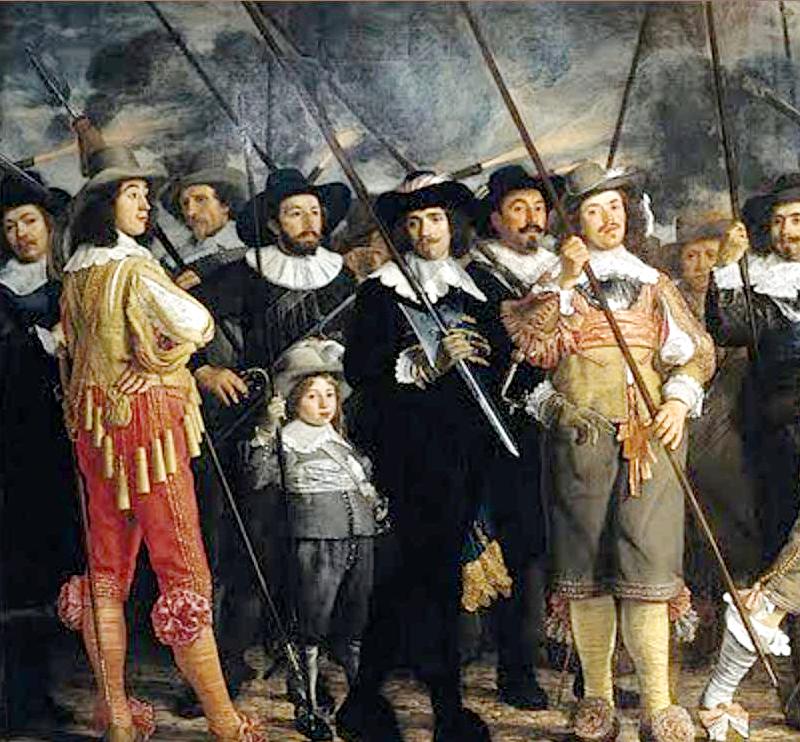
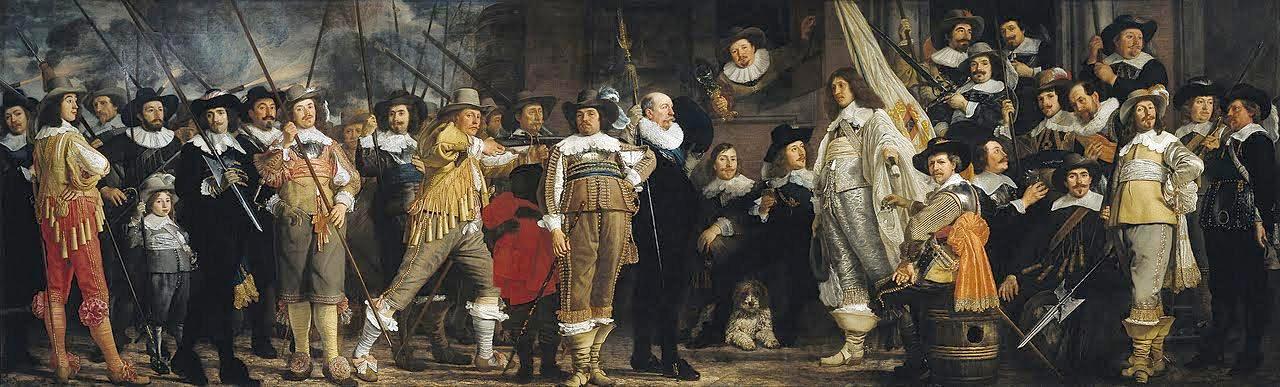
Figure 1.--This is detail from one of the Dutch units that in the War of independence. It was painted t the end of the wa, bout 1640 before the signing of the Peace of Wesphalia (1639). They were the company of captain Roelof Bicker and lieutenant Jan Michielsz pained outside the De Haan brewery in the Lastage district of Amsterdam. It was painted by Dutch master Bartholomeus van der Helst who painted himself in at the left. The canvas was huge, he image was huge. And we know the names of the individuls. We are not sure, however, who the boy is or why he was included. A little to the right is another boy, an African slave boy. (The Atlantic slave trade was just beginning.) Helst did not bother painting his face. Each of these individuls would have set for their individual portraits. Perhps his master did not bring hm for the sitting. Notice that most of the men are armed with pikes (which dominated European warfare for a mellennium)
rather than muskets, although in the background muskets are being fired. Put your cursor on the image to see the portion to the right, but the paining goes on and on to the right. To see the entire canvas
click here..
One of the most inspiring stories in European history is the struggle of the tiny Dutch Republic to gain its independence from the Spanish Empire -- the superpower of the day. The Dutch War of Independence is also known as the Eighty Years’ War (1568–1648). The War and Dutch independence is intrinically linked with the Protestant Revolution launched by Martin Luther (1517). The Reformation began to spread in northern Europe as part of both areligious movement as well as a politival movement of German states to achieve independenc fom the Hapsburg Empire. The War for independence began with
Prince William I of Orange's efforts to seize control of the Dutch provinces to protect them from King Pjilips plan to destoy Protestantism. He financed mercinary invasions (1568 and 1572). Both failed.
It was Geuzen raids, irregular Dutch land and sea forces, tht sized control from the Spanish (1573). They completed the Reformation in Holland and Zeeland and firmly established Calvanist theology. The other provinces joined the revolt (1576) and a political union was forged. The Roman Catholic Walloon provinces defected which weakened the union (1579). Philip with vast sums available from its Empire launched a major effort to stamp out Ptrotestantism. He financed a huge army and sent it into the Low Lands and the Great Armada to conquer England (1588). The Armada was to ferry the Spanish army commanded by Alessandro Farnese (the Duke of Parma) for the invasion of England. The Armada faled, but Parma reconquered the southern Low Countries (modern Flanders in Belgium) for Spain and prepared move against the new Dutch Republic to the north. The Dutch were able to fight off the Spanish, in part because Philip was also fighting England and France. The Dutch at the time were building a substantial merchant fleet that had military capabilities. They also received aid from Englad. This was a complicated relationship because both countries had competive merchant fleets. Thus the English at times aided the Ditch and at other times would fight them. Ultimaety the
the Twelve Years’ Truce establihed the Dutch frontiers were secured (1609). Fighting resumed as part of the Thirty Years War (1621). The Spnish gained some importnt victories, but Prince Frederick Henry of Orange managed to s=core some important Dutch victories (after 1625). A Franco-Dutch alliance proved the turning point in th conflict. The war ultimately led to independence from Spain and the separation of the northern and southern Netherlands. The French managed to seize the Spanish held Walloon provinces and drove into Flanders. The Dutch and Spanish growing concerned with the rising French power concluded a separate peace (1648). This became part of the Peace of Westphalia. As part of the peace, Spain recognized the United Provinces of the Netherlands (the Dutch Republic) accpted independence.
Medieval History
The medieval history of the Netherlands was complicated, but led to an independent spirit which led the Dutch to resist first Spanish and then French rule. The Germanic tribes which inhabited the Low Lands were largely conquered bt Ceasar and Augustus (1st century BC). As Roman power began to wain, the Franks began their conquest of thecarea (3rd century AD). The area was conquired by Charkemaign, but after his death as his Empire begfan to desintegrate, the Lowlands became part of the territory of Holyb Roman Emperor Lothair I and subsequently became known as the Kingdom of Lorraine (9th century). The area was contested by the East and West Franks and eventually became part of the Duchy of Lower Lorraine under a German overlord. It is at this time that Vikings raids on Western Europe began. The Lowlands like England and Scotland were the areas most exposed to the Norsemen. It was local authorities in the Lowlands that fought off the Norsemen which made them powerful local lords and a force for their nominal feudal ducal overlords to deal with. Gelders, Holland, and Brabant were able to exercise a degree of local autonomy. As the pace of commercec quickened, city communes organized by the bourgeoisie began to challenge feudal lords throughout the rapidly developing Low Lands. The Northern Provinces became part of Burgandy (14th and 15th centuries) Burgandy and with it the Low Lands passed into the hands of the Spanish Hapsburgs (16th century).
Spanish Rule
The Northern European Lowlands are a region of Europe between the Central Highlands and the North Sea
The term Low Countries was the heart of the area and that comprise the modern Netherlands, Belgium, and Luxembourg. It ws populated by the Dutch and Flemish as well as the French-oriented waloons. In the late-medieval era this was the most prosperous area of Europe and played a major role in the development of the modern European economy. The Low cojuntries were renoumed for their textiles and had a ready supply of English wool. As part of Europe's complicate dynastic history, the Low Countries were acquired by first the German Hapsburgs and than assigned to Philkip II and the Spanish Hapburgs. t this time they becmeknown as the Spanish Netherlands. The Spanish monarchy was unfamiliar with the degree of autonomy that the Dutch and other people of the Low Lands had over time obtained. The Dutch found Spanish rule oppressive. The Dutch were also early converts to the Protestant Reformation. The Dutch and the Flemish in large numbers turned to Calvinism. This was unacceptable to the Spanish monarchs who were strong supporters of the Catholic Church and the Counter Refornation. The French-oriented French Waloons to the south, however, remained firmly Catholic. The Dutch oriented Flemish were up fir grabs. nd many negn to turn to Protestantism.
br>
Dutch Navy
Private individuls, mostly merchants, began building what became the Dutch navy. Wealthy merchants aided by local authorities in the ports of the Low Countries laubched ships as the technological advances in naval construction and navigation enabled shipping to conduct long distnce trade (15th century). They could trade goods obtained from the European interior over the Rhine with goods obtained from northern Europe. Gradully the range of Dutch merchant shipping expnded. As they carried valuavle cargos, merchants begn torm them to ward off pirates, privaters Lgalized pirates, nd competitos. There was no central direction to these developments. Other defensive measures included sailing in a convoy. This gave the ships a military capability and Dutch cptains began taking advantage of this, sometimes taking other ships by force. Local Dutch authorities actually supported this acivity because of the value of the catgos seized. They handed out letters of marque, allowing Dutch captains to legally attack and possible capture foreig ships and their cargoes. This activity became endemic causing diplomtic problems. The Hapsburg authorities attmpted to intervene. The Emperor Maximilian of Austria attempted to control it (1488). He essentially created what would become the Dutch Navy, giving the private ships a legal status. The resonsibility to defend what was then the Austrian Netherlnds at sea was givn to the Admiral of Flanders, sunsequently the Admiral of the Netherlands. The Admiral was by the sovereign (Maximillian, Chrles V, and Philip II). The Admiral was never able to control Dutch shipping. Many provinces secretly created their own small navies of their own andid not inform the admiral. The Dutch revolt (1568) began with the revolt of the Beggars and their most effective military forcewas their navy.
Erasmus strongly promoted reform of the Catholic church during the years leading to the Reformation. The Netherlands was by the early 16th century a non-German possession of German Hapsburg Emperor Charles V. The Emperor within the Holy Roman Empire (Germany) attempted to resolve the dispute with Luther and his followers diplomatically. His approach outside the Empire in the provinces where he ruled directly, he was not prepared to compromise and invoked the full force of the Inquisition. he University of Leuven (Louvain) condemned Luther's theses (1519). Emperor Charles appointed van der Hulst as the Inquisitor General to supress the Protestants in the Netherlands (1522). He applied the full force of the Inquisition and within a year there were executions. Count Alba's brutal methods in the southern Netherlands appered for a time to have succeded in destroying the Reformation in the Netherlands. Imperial forces were in control in the south. Alva when he left the Netherlands, however, was a hated man as was the emperor (1573). The Count was, however, was unable to completely eliminate Protestantism. To many people in the Netherlands had cinverted. Despite supression in the south, rebellion flared in the north. The provinces of Holland and Zeeland rose in revolt (1572). The most repected nobleman in the Netherlands, William of Orange-Nassau, had serious differences ith the Imperial government (1568). The fighting became a bitterly fought war and excesses and atricities were committed by both sides. The creation of Union of Utrecht brought on one of the longest struggles in European history--the Dutch War of Independence. It was foiught by the Dutch againt local Catholic forces and the Spanish. (Upon the death of Emperor Charles V, the Netherlands became a Spanish territory.) Fighting continued until the Peace of Utrecht (1648). The Dutch made Calvinim the sate religion or confession. They looked on Catholics with great suspission, although they were not arrested for their faith. Other religioins were tolerated, this included not only other Protestants, but the Jews as well. This made the Dutch the most tolerant people in Europe and the Netherlnds a refuge for those facing religious persecution. This was an element in the Dutch become the most prosperous people in Europe.
Philip II with his decission to send the Armada against England waisted vast amounts of wealth. The gold and silver from the Americas proved in the end a curse. (Not unlike many modern oil producing countries.) Spanish manufacture suffered as it was easier to ourchase rather than make products. In addition the religious persucution led by Holy Office of the Inquisition which expelled the Jews acted to supress though as well. Thus Spain did not share in the European Renaisance which was in the 18th century to lead to the Industrial Revolution.
Open Revolt
The domestic situation in the Netherlands became explosive after the imperial government refused to negotiate with the Calvanists. Hedge semons increased over a wide area of the Netherlands. Domestic conditions in the Netherlands became explosive when grain prices rose to high levels. This was unrelated to the Reformation and caused by the outbreak of the Dano-Swedish War (1563-70). Iconoclastic riots occured throught the south. Open rebellion occurred in Tournai (1566). The imperial government prepared to supress treason made more henious in Philip's view because it combined with heresy. Philip issued a new sales tax of about 10 percent to finance the military expenditures.
Supression in the South (1566-1567)
The Calvinists bracing for Imperial military action raised an army. The Imperial forces first restored authority in Tournai (1567). The Imperial forces defeated the Calvinists at the Battle of Mokerhei (1567). The Emperor replaced Margaret of Parma as Governer General with Fernando Alvarez de Toledo, the Duke of Alva. The Duke created the Council of Troubles to root out the Calvanists. The Council known by the Dutch as the Council of Blood acted with great severity. The Council sentenced about 3,000 suspected Calvanists to death, including nobels like Counts Egmont and Hoorn. Here we do not have details on what happened to the families involved. We believe that most of those sentenced were men. We do not know what happened to the families. Men were of course the family providers. Often in such actions, property was also taken. We hope to eventually acquire details on this. It looked like the Reformatioin had been extinguished in the Netherlands.
Revolt flared again led by William the Silent of the House of Orange (1568). William and the House of Orange are commonly seen as Dutch. They did not, however, begin in the Netherlands. In fact both were German. William was born in Hesse. He received both Protestant and Catholic teachngs as a boy.
And William was a faithful sevant of Emperor Charles V who rewarded him at a young age for his military service. Chrles in return appounted him stadtholder of the counties Holland, Zeeland, and Utrecht. From this position he played a key role in the formation of the Dutch nation. It was the beginning of which the Dutch call the "tachtig jarige oorlog"--the War for Independence which lasted for 80 years. It was a dreadful, vicious war as religious wars often are. He was a deply religious, but not sectarin. And when Phulip II began to supress the Dutch, William came to their defenseand an imprtant part of the Dutch Revolt. The War for independence began with Prince William I of Orange's efforts to seize control of the Dutch provinces to protect them from King Philips plan to destoy Protestantism. He financed mercinary invasions (1568 and 1572). Both failed, supressed by the Duke of Alva. It was Geuzen raids, irregular Dutch land and sea forces, that sized control from the Spanish (1573). They completed the Reformation in Holland and Zeeland and firmly established Calvanist theology. The other provinces joined the revolt (1576) and a political union was forged.
Dutch Rebellion in the North (1572-79)
Count Alva's brutal methods in the southern Netherlands appered for a time to have succeded in destroying the Reformation in the Netherlands. Imperial forces were in control in the south. He failed, however, to supress the rebellion in the north where he encountered much more effective resistance than he anticipated. Alva when he left the Netherlands, however, was a hated man as was the emperor (1573). The only Spanish words Dutch children learned were "Es nada". The Duke of Alba was supposed to have said that when confronted with more Dutch resistance than he expected.
The Count was, however, was unable to completely eliminate Protestantism. To many people in the Netherlands had converted. Despite supression in the south, rebellion flared in the north. The provinces of Holland and Zeeland rose in revolt (1572). The most repected nobleman in the Netherlands, William of Orange-Nassau, had serious differences with the Imperial government (1568). The fighting became a bitterly fought war and excesses and atrocities were committed by both sides. Imperial forces faced stiff opposition. The Dutch knew what awaited them if they failed. The Dutch De Geuzen took the town of Gorcum and nine Catholic priests were masacred. De Geuzen (or Watergeuzen, because they moved on the rivers by boats) were a group of Protestant Beggars (with a capital B), who were very much admired in Holland for their courage and patriotism, even when they had slain some priests. The Spnish commonly executed Protestant clerics as well. The priests became known as the Martyrs of Gorcum. Philip's Spanish troops wavered. After the Pacification of Ghent (1576), poorly supported often hungry Spanish troops that had seemd invincible, mutinied. Dutch Calvinists insisted on expelling the Spanish solders and that the Estates General should rule. The Spanish took advantage of the strong variation between the northern and southern provinces, playing local aristocrats against each other. The Roman Catholic Walloon provinces defected which wakebed the union (1579). Alba ws anle recapture the Southern provinces in Flanders. The north continued to resist under the Estates-General of the United Provinces. Cities throughout the Netherlands, especially in the north, ousted the Imperial city council and replaced it with Calvinist sympithizers (1578). The French-speaking southen territories established the Union Of Arras which confirmed the acceptance of Tridentine Catholicism. The Dutch speaking provinces formed the Union of Utrecht (1579). (One can not equate this division with the modern Netherlands and Belgium. Belgium of course includes Dutch speaking Flanders.)
Union of Utrecht (1579)
The creation of Union of Utrecht brought on one of the longest struggles in European history--the Dutch War of Independence. It was fought by the Dutch againt local Catholic forces and the Spanish. (Upon the death of Emperor Charles V, the Netherlands became a Spanish territory.) The Union of Utrecht upon its establishment abolished religious persecution (1579). Religion was to be determined by the constiuent territories. Archbishop Frederik van Schenck van Toutenberg died and at that point Calvinism was introduced in Utrecht (1580).
Independence (1581)
The seven United Provinces eventually declared their independence from the Spanish king in 1581 following the Union of Utrecht of 1579. The Dutch in areas they controlled introduced a Calvinist state confession. This began a protracted, bitter, and bloody war for independence. William stadtholder of the counties Holland, Zeeland and Utrecht played a key role in the formation of the Dutch nation. It was the beginning of which the Dutch call the "tachtig jarige oorlog", the war for independence which lasted for 80 years. It was a dreadful, vicious war as religious wars often are. Every Dutch child knows (or is supposed to know) that "the Father of the Fatherland", William of Nassau, Prince of Orange, was the liberator of the Netherlands from the Spanish occupation. He was born in Germany in 1533 and assassinated by a Catholic religious fanatic in Delft, Holland (1584). William was also called William the Silent because he could keep a secret. As aresult of William's leadership and that of his discendents William II and William III, the House of Orange became the royal of family of what began as the Dutch Republic.
Flanders
Dutch speaking areas under Spanish control (roughly Flanders in modern Belgium--Noord Brabant, Limburg, and eastern Gelderland) experienced conversion at the hands of the Counter Reformation and were compeled to accept Tridentine Catholicsm. Here we do not yet have details on the actual process.
War (1581-1609)
Over the course of the war, control of these provinces swayed back and forth. The Dutch upon taking any of the Vatholic areas in the south looked on them as occupied enemy territory. Politically they were established as Lands of the Generality. They were denied representation in the Dutch Estates General. Catholics were prohibited from holding public office.
Religious Developments
Jean Taffin published his book Marks of God's Children (1585). It was a sensation among Dutch and French Protestants. He offered encouragement to those engaged in spiritual warfare. The Dutch Government founded th University of Leiden as a Calvanist institution (1575). It became a noted center of Calvanist teaching. It was also center of a debate which developed among Calvanist threologians. Jacobus Arminius and Gaomarus were leading figures and taught differing interpretations of scripture. The followeres became known as Remonstranten (Arminius) and Contraremonstranten (Gaomarus). Upon the death of Armminius, Calninists split into rival groups (1609). Many of the city councils were Remonstranten. Stadholder, Maurice of Orange-Nassau supported the Contraremonstranten. It was the Contraremonstranten and Stadtholder Maurice who emerged victorious. Remonstranten supporter Johan Oldembarneveld, Pensionary of Holland, was tried and executed. The Council of Dordt (Dordrecht) condened the Remonstranten or Arminian interpretatioin. The Canons of the Council of Dordt are today still used by Calvanist theologiands around the world. The Calvanists published their vesion of the Bible, the Statenbijbel (1637).
Queen Elizabeth decided to aid the Dutch and Belgians hard-pressed by the Spaish Army and Philip's onsession of eradication Catholcism (1585). This led to the Spanish Armada built at enormous cost. Philip haf access to vat sums as a result of the Spanish conquests in the New World. And Philip II was willing tp spend lavihly to finance an effort to put an end to Protestantism in both England and the Low Lands. The purpose of the armada was to ferry the Duke of lba's Army that was fighting Protestnt in the Low Lands go England to depose the Protestant Elizabeth nd return the country to Cthocism. Philip wanted to erpetute Queen Mary's campaign against Pritestnts. The sizeof the armada and ngland's lakof a stading army seem to guarantee Philip's success. It of course was not to be. Not only ws the Armada unable to bring Parma's army to englnd, but much of it would be destroyed. The destruction of the Great Armada was a huge blow to the Spanish effort. Philip could not understand why God had not supported his holy crusade on Protestantism.
The Twelve Years Truce (1609-21)
Spain and the northern provinces of the Netherlands negotiated a 12-year truce (1609-21). The Truce provided an important interlude givung the Dutch the ability to prepare and organize military forces, especially naval forces. The expanding Dutch merchant fleet which could be use for military purposes as well proved a key element in the Dutch struggle for independence.
Spanish Problem
The Spanish had a substantial military capability which if it could be brought to bear was far beyond that of the United Provinces. The problem for the Spanish was bringing those forces to bear on the Dutch. Without the ability to transport their forces by sea, the Spanish war effort was crippled. Spain was preparing a new offensive against the Dutch when the truce ended. The problem for Spain was how to support military operations in the low countries. The rise of a Dutch navy made it difficult to send troops and provisions by sea. Reaching the Dutch by land was also difficult. France stood between Spain and the Netherlands. And the French were not about to permit Spanish troops to pass through their country. It suited French purposes at the time to have an independent Netherlands even though they were Protestant. Thus the Spanish would have to send their forces along a circuitous route from Spain to Italy by sea and then through the Alpine passes to the the Rhine River Valley. The Rhine than led to the Dutch. This was a very long and difficult march for any body of troops and needed equipment and supplies, especially given the nature of roads at the time. The key to the route was the Rhineland. This was a contested area. The Spanish hoped to acquire Alsace which Ferdinand had promissed for supporting his imperial candidacy.
Resumed Fighting (1621-48)
The Spanish resumed their efforts theirvefforts to supress the Dutch. Three decades of fighting ensued, but the Dutch often assisted by the English were able to hold off the Spanish.
Economic Developments
It was the Dutch who invented capitalism in close, not always friendly, association with England. And it is the underlying econimic strength of the Netherlands that gave rise to capitalism in the end that made it possible for the tiny Dutch Republic to fight off the emense powe of the Spanish Empire--th superpower of the day. The Low Countries were at the time the wealthiest area of Europe. The wealth did not come as in Spain from the ememse wealth obtained in the Americas, but through manufacture and trade. The manufacture of high-quality textiles underlay the economy of Flanders. The Dutch profitted from in market traffic during the late-medieval era. Here gepgraphy was an importat factor giving the Dutch a unique opportunity to participate in the quickening of econmic activity in the late-medieval era. Seaports gave them access to northern Europe. And the Rhine gave them access to the Europeamn interior. The Dutch begn to devlop a market economy. Market exhanges grew not only for goods, but also for land, labor and capital (15th century). Oneresearcher discuses, "why it should bethat the market form of exchange arose so early here specifically [the Netherlands]; how marketswere organised as institutions and how they functioned. It will be demonstratedthat the markets here had a favourable organisation, with low transaction costs, a high level of integration of the markets and a large degree of certainty forparties entering these markets. There were some negative consequences, but the economic strength gve the Dutch the ability to fight off the Spanish armies. It was in theNetherlands that Europeans first made the leap from Feudalsm to Capitalism. The economic issues began to become increasingly apparent during the Twelve Year Truce. The Spainish Government after the death of Philip II increasingly came to the conclusion that the Truce had been ruinous to the Spainish econoy. They concluded that the Dutch gained an unequal advantages in the trade with the Iberian Peninsula and the Mediterranean bcause of their superior merchant fleet. The result was a permanent trade deficit for Spain with the Spanish Republic. In mercntilist terms, this was unacceptable. And during the Truce the Dutch largely relaced the Portuguese (at the time rled by Soain) as the principal power in the Eaat Indies. This only added to Dutch power and ability to finance its defense--including expanding the army and navy. A Dutch naval expedition under Joris van Spilbergen raided the West-Coast of Spanish South-America (1615). [Israel, pp. 3-7.]
The Dutch-Portuguese war figured into the Dutch War for Independence. The Dutch incursions into Brazil proved the greatest threat to the Portuguese. The Portuguese became involved with the Hapsburg attmpt to supress the Reformation in Germany and the related rebellion of the Dutch. A succession crisis in Portugal led to a personal union under the Habsburg rule after the War of the Portuguese Succession, Spanish King Philip II of Spain thus controlled Portugal as part of the Iberian Union (1580). This meant that Portugal and Brazil became involved in the Dutch War of Independence (1581-1648). Philip II prohibited trade with the Dutch (1581). The Dutch were at a disadvantage in land warfare with the Spanish, but their expanding naval fleet gave them the ability to strike at the colonies. The result was the Dutch–Portuguese War (1602-61). The War was waged by the Dutch East India Company and the Dutch West India Company against the Portuguese Empire. The War primarily involvedDutch privateers attacking Portuguese colonies in the Americas, Africa, India and the Far East. The war was essentially an extension of the Dutch War for Independence, sometimes called the Eighty Years War, fought in the European Low Countries by Spain. The conflict provided the opportunity for the Dutch to gain an overseas empire and weaken the Portuguese. English forces aided the Dutch to an extent, but also fought a series of naval wars with the Dutch. Spanish forces aided the Portuguese. And the sugar wealth of Brazil was an attraction. Brazil did not have a navy as such, but they conducted naval war with privateers. Queen Elizabeth in England did the same, but focused more on the Spanish. The Dutch, an important 17th century naval power, seized Bahia for a brief period. Dutch privateers began plundering the largely unprotected Brazilian coast. They sacked Bahia and even captured the capital Salvador for a brief period (1604). The Dutch also attacked the Portuguese African possessions.
One of the ironoies of history is that as freedom, both representative democracy and capitalism, were beginning to reach modern forms, that the Atlantic slave trade was beginning to involve increasingly large numbers of captive Africans. The Dutch along wth the English led the way in the evolution of modern freedom. They also lwere deeply involved in the development of the slave trde as a huge economic enterprise. This same irony can be seen in ancient Greece where freedom was born. This of cpurse is not to say that the Dutch and English were uniquely involved in the slave rade. The Catholic powers (France, Portugal, and Spain) as well as the Muslims powers (Arabs, Ottomans, and Persians) were also heavily involved. Ot is interesting, however, how people so committed to undependence and freedom can countenance slavery. It is also important that the later ca,paign against slavery came from the Protestant powers, primarily America and Britain where the abolitionist movement developed.
Treaty of Westphalia (1648)
The Treaty of Westphalia was the major European peace settlement ending the horrible 30 Years War which devestated Germany. The Treaty of Munster, Westphalia, not only meant the end of the 30 years war in Germany, but at the same time it was the end of the 80 years war between the Netherlands and Spain. One of the many issues addressed in the negotiations was the United Provinces. Finally under the Treaty of Westphalia the Spanish were obliged to ackowlege that they had failed to subdue the recalitrantvDutch and recognize the sovereignty of the Dutch Republic.
Religious Toleration
Fighting continued until the Peace of Utrecht (1648). The Dutch made Calvinim the sate religion or confession. They looked on Catholics with great suspission, although they were not arrested for their faith. Other religioins were tolerated, this included not only other Protestants, but the Jews as well. This made the Dutch the most tolerant people in Europe and the Netherlnds a refuge for those facing religious persecution. This was an element in the Dutch become the most prosperous people in Europe.
Traditional Celebrations
It is a tradition that every October 3rd of Dutch people eat mashed carrots and potatoes
commemorating the liberation of the city of Leiden. As the Dutch forces approached, the Spanish soldiers left in a hurry, leaving behind in their camp kettles full of the above-mentioned food. They were quickly consumed by the hungry Dutch soldiers and citizens. A Dutch reader tells us, "As schoolchildren we sang two songs commemorating the 80 years war with Spain. One was the capture of Brielle in 1572 by the rebel Watergeuzen, the other one was the victory over the Spanish Armada by Admiral Piet Hein, the Dutch naval hero."
Sources
Israel, Jonathan. Empires and Entrepôts: The Dutch, the Spanish Monarchy, and the Jews, 1585–1713 (Continuum International Publishing Group: 1990).
Van Bavel, Bas. 'The Medieval Origins of Capitalism in the Netherlands' MBGN Opmaak Special indd 80 (May 7, 2010).