
War and Social Upheaval: The Seven Years War (1756-63)
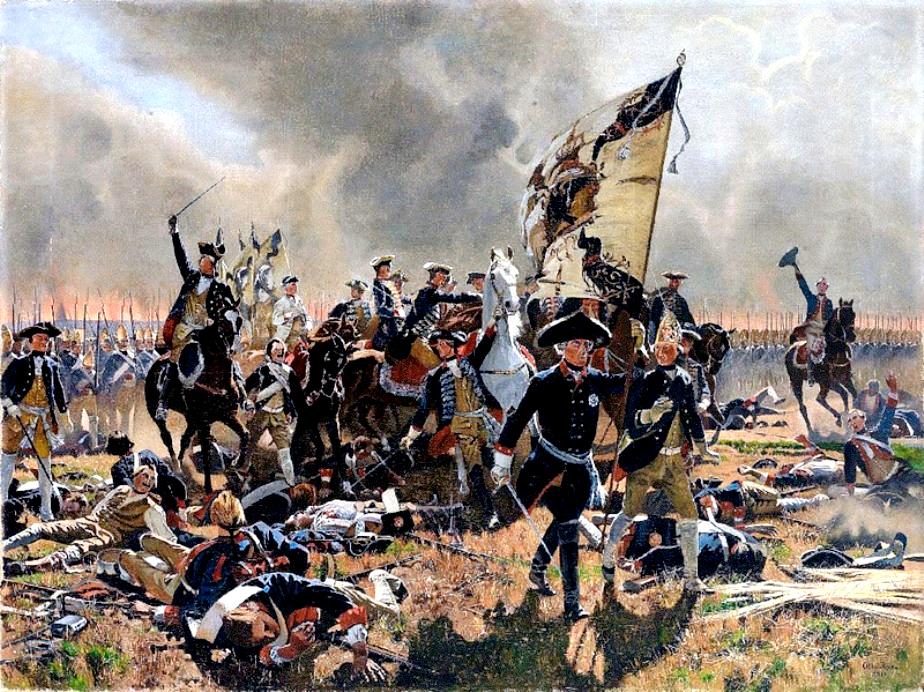
Figure 1.--This dramatic painting depicts Frederick the Great at the Battle of Zorndorf (1758). Frederick commanded Prussian forces fighting Russian troops commanded by Count William Fermor. The painting was the work of Carl Röchling painted more than a century later during the German Imperial era. Röchling was one of the most popular artist depicting historical scenes in Imperial Germany. This no doubt was the image that Kaiser Wilhelm II had in his head when he made the decisions that led to World War I. Of course the Kaiser unlike Frederick made no battlefield appearances.
|
|
The Seven Years War may well have been the first world war in that it was fought simulataneously in Europe, North America, and India.
King Louis XV concluded an alliance with Austria in 1756, and the two went to war with Great Britain and Prussia in the fateful Seven Years' War (1756-63), one of the most disatrous in French history. The War was actually precipitated with a young colonel in the Virginia militia, George Washington, chanced accross a French military force in the disputed territory west of the Apalachens. Louis' commitments to the Austrians prevented him from concentrating on the colonial struggle with Britain. The fighting in North America is commonly called the French and Indian War and the fighting began in North America when a Virginia militia unit commanded by none other than George Washington ventured into French territory. The fighting in India determined who was going to dominate the sun-continent and emerge as Europe's primary colonial power. The fighting in Europe was on a much larger scale and centered on control of Silesia an area of Poland involved in the partitions of that country and coveted by both Prussia and Austria. In the end Prussia was almost destroyed, but rescuced at the last minute by the death of Tsarina Elizabeth. While Prussian miraculously emerged in a strong position from the War, France did not. France by 1763, France had lost to Britain almost all her colonial possessions in North America and India. Later, the failure of his secret diplomacy resulted in the near elimination of French influence in central Europe. The French defeat was so crushing that it stirred a desire for revenge, a major factor in Louis XV's grandson, Louis XVI's decission to support the colonists in the American Revolution.
Background
North America is a big place. When the first Englush colonies were founded along the Atkantic coast (17th century), they were far away from the Spanish colonies to the iouth. And when France began founding colonies down the St Lawrene, New France (Canada) was also separated by hundreds of miles of wiledrness. Slowly these colonies expanded and claims began to overlap in the south, west, and north. War fflared in the Caribbean because of the value of the sugar islands, but on the North American continent, the vast expanse of wildreness meant that conflict was avoided. Gradually in the mid-18th century the wilderness areas became less inpasable and conflicts began to develop. The countries involved had conflicts in Europe and the Caribbean which only hightened the securuty issues in North America. Eventiallyb it would be an encounter between British abnd French forces in thev middle of the American wildreness would set off the largest war of the 18th century.
The War of Jenkins Ear (1739-48)
The War of Jenkins' Ear was the limited conflict between the Spanish and British over the land between South Carolina and Florida. The dispute lasted for nearly two centuries. It was a diplomatic issue until Britain founded the Georgia colony (1733). The Spanish objected to a colony in the disputed territory, Georgia's survival was at issue. Fidhting broke out (1739). The priomary issue was the disputed territorial claims. There was fighting on land and at sea. Privateers from both sises preyed on merchant shipping. One of these privateer incidenrs gave the confrontation its name. A Spanish privateer during a seizure severed British captain Robert Jenkins's ear as a punishment for raiding Spanish ships. Jenkins scooped up his ear presented it to Parliament. Parliament. The outraged British public demanded retribution. British and Spanish diplomts had been trying to settle the territorial issues. They made little progress and actually intensified feeling. The ear incident madevit imposibke to end the War diolomatically. When Britain and Spain entered that continental War, the War of Jenkins Ear merged into the War of the Austrian Secession.
The War of the Austrian Succession was an early world war. Some European rulers refused to recognize the Pragmatic Sanction of 1713 and thus Maria Theresia's right to rule. These included Augustus III of Poland and Saxony and Charles Albert of Bavaria (later Emperor Charles VII). Both had married nieces of Charles VI and thus had dynastic claims to the Hapsburg lands. They and otheres, especially Frederick II (the Great) saw the opportunity to benefit from the succession of Maria who because she was a woman they assumed would be weak and inefectual. Maria Theresa succeeded her father Emperor Charles VI as ruler of his Hapsburg dominions (1740). The war began with the invasion of Hapsburg Silesia by Frederick the Great of Prussia (1740). Within a year nearly all the powers of Europe were involved in the conflict. The hear of the War was the struggle between Prussia and Austria for Silesia. Battles were also fought in southwest Germany, the Low Countries and Italy. Major battles were also fought between Austria and France. France and Prussia were supported by Spain and Bavaria. Austria was supported by Britain and the Netherlands. Sardinia and Saxony also at times supported Austria. The war was ended by the peace of Aix-la-Chapelle (Aachen) (1748). It was embematic of the difficulties faced by continental powers. A huge amount of treasure and countless lives were expended and all that changed was the possession of Silesia--an important but hardly vital province. And Prussiae cistly wars to hold it. Today it is in Poland.
Knowles Riot (1747)
The American colonists fear of the French and Spanish threats was a powerful force guaranteeing loyalty to the King and Empire. Even at this time, however, there were simmering sentiments in the colonies that would come to the surface after the French and Spanish were defeated. The Knowles riots in Boston was an early view of this. Not enough British seamen volunteered to man Royal Navy ships, especually in time of war. And Britain was at war in the 1840s, bith the War of Jenken's Ear and the War of the Austrian Secession. The addiditional needed crew members to crew Royal Navy ships were obtained through press gangs.
The press gangs were primarily active in British ports, but were also utilized in any British colony, including the North American colonies. There was little resistance to these press gangs, but they were particularly unpopular in America, in part because American sailors were mostly part time workers who also had other jobs on shore. As a result, seaside ports resisted the press gangs in various ways. The most violent reaction to the British press gangs occurred in the American colonies--Boston, Massachusetts. It was set off by Admiral Charles Knowles who needed men when he entered Boston harbor (1747). The Boston Knowles Riot was the most serious disturbance against British imperial authority in the mainland American colonies until the Stamp Act crisis following the French and Indian War.
Ironically it was the Royal Navy that played a major role in defending the colonists from the French and achieving the British victory. One historian goes even further, that the Royal Navy played a key role in forging a common English-speaking Atlantic world. And impressment played an important role in manning the ships that achieved the British victory and building an English Atlantic community. But it was the Royal Navy impressment of merican colonists that created a great deal of ill-will two decades before the Stamp Act crisis.
The fighting in North America is commonly called the French and Indian War and the fighting began in North America when a Virginia militia unit commanded by none other than George Washington ventured into French territory. The French and India War can be seen as part of the Seven Years War, but they are major differences. The Seven Years War was essentially a combined European War to limit the aggressions of Prussia's Frederick the Great. The French and Indian War was a war over colonial control of North America. They are related in that France was deeply involved in both wars and they occurred at roughly the same time. the French and India War was fought by Britain and its North American colonies against France and its Indian (Algonquian) allies. France's North American colonies had evolved differently than the British colonies. The more limited French emmigration and differing attitudes toward Native Americans enduced the Algonquians to fight on their side against the British.
Fighting in Europe (1756-63)
The Seven Years War (1756-63) was the third and longest war over control of Silesia a contesyed area of Poland involved in the 18th century partitions erasing Poland from the European map. The War was, However, turned into a much larger conflict involving all of the major European powers, except Britain, against Prussia. The British played a minor role in the European battles, but did distract the French from fulling their full weight against Prussia by engagements in North America and India. The fighting in Europe was on a much larger scale and centered on control of Silesia an area of Poland involved in the partitions of that country and coveted by both Prussia and Austria. In the end Prussia was almost destroyed, but rescuced at the last minute by the death of Tsarina Elizabeth. Emperess Maria Theresa of Austria had earlier been involved in other matters to seriiusly resist Frederick the Great's seizure of Silesia. By the mid-1750s she began to seriously address the recovery of Silesia. Frederick was prepared for the Austrians and made a premtive attack in Saxony, seizing Dresden (October 1756). He was defeated at Kolin (June 1757), but later defeated the French at Rossbach. He scired a great victory a numerically superior Austrian force at Leuthen (December 1757). The fighting swayed back and forth in 1758, but by the end of the year Prussian controlled both Silesia and Saxony. Figting in the fourth year of the conflict went disterously wrong for Prussia when the Russians and Austrias were able to join forces against him (1759). Fredericj in the fifth year of campaigning swas able to regain Saxony (1760). In the sixth years the French were decisively beaten by Duke Ferdinand at Villinghausen (July 1761). The combined forces of Austria, Russia, and the other allies after several years of fighting began to serious reduce Prussia's military power. It looked like Prussia and Frederick would be totally defeated. The death od Tsarina Elizabeth rescued Frederick (January 1762). Elizabeth was replaced by Peter III. Peter was a Danish princling who had been adopted by Elizabeth. He hated Russia which he considered barabaric. He had idealized Frederick and Prussia from childhood. He withdrew Russia from the coalition that was about to defeat Prussia and induced Sweden ti withdraw as well. Frederick was then able to concentrate his forces against Austria. The Prussians took the Austrian stronghold at Burkensdorf and then defeated Daun Reichenbach (August 1762). He then recovered Silesia by taking Schweidnitz (October 1762).
Fighting in India (1756- )
The fighting that broke out in North America spread to Europe and eventually India. This is why some authors call the Seven Years War the first world war. The fighting in India determined who was going to dominate the sun-continent and emerged as Europe's primary colonial power. The fighting in India was a commerial conflict undertaken by the French and British East India Companies. Tonprotect their interests on the Subcontinent, both companies receuited an armed their own military forces which included local epoy units. Fighting first broke out in Bengal (1756). Both sides had began reinforcing their trading stations. This disturbed the local Nawab, Siraj-ud-Duala, who demanded that these military preparations cease. When the British refused, the Nawab's forces seized the British East India Company's stations, including Calcutta. After the Nawab took Fort William in Calcutta, the Nawab's officers hearded British prisoners into a tiny prison--the 'Black Hole of Calcutta'. Many of the British prioners died from heat exhaustion and suffocation. The British East India Company moved quickly to restabklish its position in Bengal. Colonel Robert Clive was put in command of a force from Madras.
Fighting in the Caribbean (1759-62)
There were also important engagements in the Caribbean. Sugar made the Caribbean islands enormjously valuable at the time, even the smaller islands. Possession of a small island could generate more income that large trascts of North America. Haiti was France's most valuable posession. Here the Royal Navy would proved decisive. Both the British and France saw that the sugar islands were not only emensely valuable, but were also potentially valuable bargaining chips. This affected the conduct iof the War. There was no desire to destroy enemy sugar plantations. Rather the goal becanme to to capture enemy islands. As a result, both the British and French sent thec largest naval forces to the Caribbean that the region had ever seen. The battles there, however, were sporadic. The scope of thec War meant that British abnd French resources were streached thin. Abnd there was a seasonal dimension. Neither sidec wanted to exposec theur valuable naval squadrins to hurricanes. Privateers were, however, active even when major navakl squadrons were absent. The British were the furstr to strike. William Pitt ordered a Royal Naval squadron to attack Fort Royal (now Fort-de-France) on Martinique (January 1759). When the squadron failed they attacked Basse-Terre on Guadeloupe.
After taking Guadelope, British attentions focused on Canada. Only after victoryv there did the British return to theCaribbean in force. Troops from Canada seized Dominica with little resustance (1761). Admiral George Rodney arrived in Barbados (November 1761). Rodney with 13,000 soldiers launched an attack on Martinique (1762).
British troops sieged Fort Royal and thec Frenchv surrender after 3c weeks.
The British then took St. Lucia and Grenada. Other than Hispaniola (Haiti), the British took all of the major French sugarvislands in the Caribbean. St. Vincent and Tobago were had only small French camps.
The Spanish feared the British gaining total control of the Caribbean. They did not delkare war, but negitiated secretly with the French on an anti-Bruitish alliance. Even while at peace, however, they sufferedfrom British privateer attacks.
The British did not sit back and allow the French-Spanish alliance to coalese. The British declared war on Spain (January of 1761 nd dispatched a naval squadron with 15,000 to Havaba, Cuba.
The Spanish surrendered aftw a 2-month seige (August 1762). The Caribvean was becoming a Spanish lake. .
Peace Treaties
After the Russians and Swedes withdrew from the War in 1762, Prussian victories induced France to retire from the conflict, signing peace treaties with both Prussia and Britain. Losing her allies also forced Emperess Maria Theresa to make peace with Frederick. The treaty between Prussia and Austria was the peace of Hubertsberg which recognized Prussian control of Silesia (February 1763). The treaty between Britain and France was the treaty of Paris which included important provisions concerning overseas possessioins, primarily Canada and India (February 1763). The Treaty of Paris recognized British control of Canada (including Cape Breton, Acadia, and Louisana east of the Mississippi, except New Orleans. The French retained fishing rights off New Foundland and to facilitate that were provided theislands of St. Pierre and Miquelon. Britain returned to France several Caribbean island seized during the War (Marinique, Guadeloupe, Maria Galante, Belle Isles, and St. Lucia). At the time these islands were much more important than today. They were sugar islands generating very substantial income. Britain returned Havana to Spain. In return, Spain ceded Florida to Britain. Under the terms of an earlier treaty between France and Spain, the island of Orleans and French North American territory west of the Mississppi, what was then called Louisiana was ceded to Spain (November 1762). The French were willing to do this, calculating that the British would demand Louisiana as part of a peace treaty.
Concequences
There were extensive consequences from the Seven Years War for all combatant nations.
Europe
North America
In North America the issue of who would domiante the continent was resolved. North America would be an English-speaking extension of Europe. This was in the 20th century to have profound consequences for Europe in the 20th century. (Ironocally France would be resucued by English-speaking North America in two great world wars.) The British were also affected in that the War changed the relationship with their colonies, at the time the primary overseas colonies. The expulsion of France from North America had the unintended impact of making the English colonists feel, less dependent on the Britain for security. In addition the struggle had shown many colonists the inadequacies of British colonial administration, the effectivness of colonial militias, and the need for cooperation among colonies. The colonies cooperated to some extent in dealing with the Native American tribes. The links established would be useful as the indepndence movement began to grow. The British failed to understand these developments, feeling that the colonists should be gratful that they had been saved from the French. The War had been costly and the British began to devise was of taxing the Americans to support the cost of the colonial administration. These taxes established without any consent by the Americans helped to fuel anti-British feeling. The American Revolution was to break out a little more than 10 years after the signing of the Peace of Paris. Ironically the only part of North America to remain loyal was still largely French Canada.
India
CIH

Navigate the Children in History Website:
[Return to Main specific 18th century war essay page]
[Return to Main military style page]
[About Us]
[Introduction]
[Biographies]
[Chronology]
[Climatology]
[Clothing]
[Disease and Health]
[Economics]
[Freedom]
[Geography]
[History]
[Human Nature]
[Ideology]
[Law]
[Nationalism]
[Presidents]
[Religion]
[Royalty]
[Science]
[Social Class]
[Bibliographies]
[Contributions]
[FAQs]
[Glossaries]
[Images]
[Links]
[Registration]
[Tools]
[Children in History Home]
Created: January 28, 2004
Last updated: 6:57 AM 7/14/2017