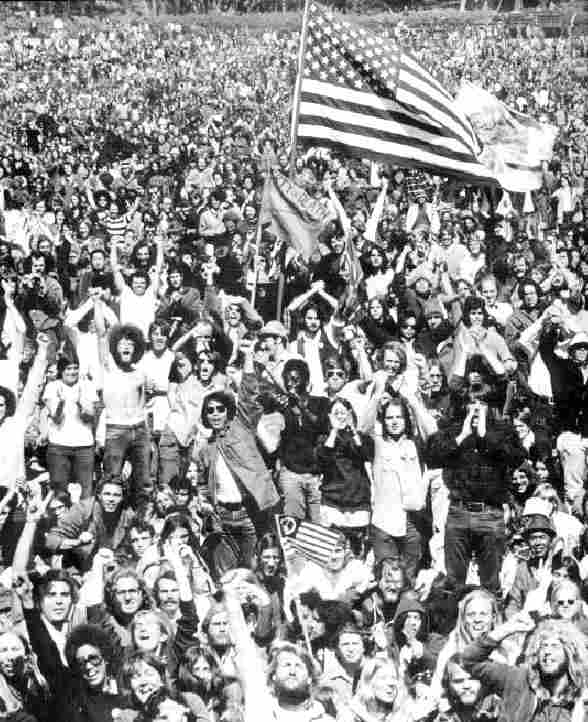
Figure 1.--Opposition to the War began with young people and appeared first in college campuses. These were the young people most affected because they were the age group being drafted. Policies on college deferments varied as the War progressed. This protest was held in San Francisco.
Vietnam is the most controversial war in American history. Even after several decades the debate over the war continues. President Eisenhower refused to come to the aid of the French as they attempted to reimpose colonial rukle.
He did support low levels of assistsance to non-Communist South Vietnam. American Presidents Kennedy and Johnson committed American combat troops primarily as part of a Cold War commitment to fighting Communism. The reality in Vitnam was much more complex. American officials failed to perceive the nationalist dimmensions of the War. The developing fisures in the Communist world were also not appreciated. Perhaps the most serious miscalculation was the military assessmnent of the ability of North Vietnam to resist American military power. The role of the American press is one of the most intensely debated aspects of the War. Presiden Nixons strategy in nwith drawing from Vietnam had also beem inteensely debayed. The war was waged at great human and material cost. The impact on the American economy was significant. There was also a powerful impact on American culture and society.
French Indochina
French Indochina was the Southeastern Asian provinces of the Second French colonial empire constructed after the Napoleonic Wars in the 19th century. It was a federation of three Vietnamese regions (Tonkin, Annam, and Cochinchina) and Cambodia (1887). Laos was subsequently added (1893). The capital was at first established at Saigon (Cochinchina). The French then moved it to Hanoi (Tonkin) (1902). After the German invasion of France During World War II the colony was administered by Vichy authorities. Vichy did not, however, have the military capability of protecting Indochina from the Japanese. The Japanese moved into Indiochina to cut off supplies to the Nationalist Chinese and as part of a build up of military forces to seize what they referred to as the Southern Resource Area.
The Japanese move into southern Vietnam which brought them within range of the Phillipines, Dutch East Indies, and British Malaya triggered an American oil embargo. The Japanese as a result, launched thePacifi War wih aarrtier attack on Pearl Hsarbor.
The Allies during the War supported the Vietminh, a communist guerrila force which resisted the Japanese occupation.
Viet Minh
Inodchina War
When France attempted to restablish their colonial authority after the Japanese defeat, the Vietminh led by Ho Chi Minh, launched a revolt which developed into the French Indochina War (1946). The French granted a level of independence to a government led by former Emperor Bảo Đại (1949).
Geneva Acord (1954)
After the French defeat at Dien Phen Phu the Geneva Accord split Vietnam into a Communist North and a
non-Communist south (1954). The Vietminh became the government of North Vietnam. The Bảo Đại government continued to rule in the south. The French colonial administration of Annam (central Vietnam) was dissolved (1955). Annam was divided between North and South, as detailed in the Geneva Accord.
American Commitment
Vietnam is the most controversial war in American history. Even after several decades the debate over the war continues. American Presidents Kennedy and Johnson committed American combat troops. The major commitment was made by President Johnson. There is a diference of opinion as to what President Kennedy would have done. There is still no national consenus about the War, although most mericans today believe that it was a great mistake. There is no consenus as to why it was a mistake. There are even some who believe that the effort was not a mistake. Walter Rostow suceeded Bundy as National Security Adviser defended the American involvement until his death. [Appy] Some were dubious about the undertaking from the beginning. James Thompson, assistant to Mc George Bundy on the National Security Council staff describes his deepening sense of impending doom. [Appy] Kissinger blames what he describes as the reckless liberalism of Kennedy and Johnson for envolving America in Vietnam. [Kissinger]
Motivation
The American commitment was made primarily as part of a Cold War mentality to fight Communism. The reality in Vitnam was much more complex. American officials failed to fully perceive the nationalist dimmensions of the War. North Vietnam was Communist, but the Psarty was not controlled by Moscow or Bejing. This was somewhat of an anomaslly because at the time most Communist parties around the world were controlled by Moscow or to a lesser extent Bejing.
World Communism
The developing fisures in the Communist world were not well appreciated by American policy makers. At the same time many Americans who opposed the War did not appreciate or chose not to recognize the fact thast the War was a North Vienamese invasion of the South and not an indigenous peasant rising in the South.
Once in control of North Viet Nam, the Communists began their effort to seize control of the south. Laos' future was determined in large measure by this much larger struggle--the Vietnamn War. A 14-nation conference was convened in Geneva to end the Laotian Civil War. The outcome was an agreement to create a neutral Laos under a unified government (1962). A provisional coalition government with representatives of all the different factions was set up with Prince Souvanna Phouma as premier. The attempt to unify the three separate military units failed. The Pathet Lao began attacking the neutralist forces. Open warfare brokeout (1963). Only the North Vietnamese were willing to commit combat troops to Laos. Strengthen by Norrth Vietnamese troops and supplies, the Pathet Lao was able to gain control over much of northern an eastern Laos. This was important because it gave the North Vietnamese access to unimpeded supply routes to support Viet Cong operatiojs in South Vietnam. Military leaders disturbed with the Pathet Lao and Vietnamese incursions staged a coup (1964). They attempted to force Souvanna Phouma to resign. The United States and the Soviet Union refused to recognize the coup leaders. Souvanna Phouma thus retained the premioership, but with a right-wing neutralist government. It is at this time that President Johnson decided tgo intervene heavily with combat units to support South Vietnam. He also ordered the bombing of North Vietnam, primarily to limit supplies reaching the Viet Cong in the south (1965). The CIA conducted a largely secret para-military operation in Laos resisting Communist control of the country. The operation was largely successful until the American withdrawl from Vietnam. [Helms] Walter Rostow who suceeded Bundy as National security Adviser insited that the United States could have ended the War quickly if it had moved into Laos to cut the supplies flowing south over the Ho Chi Min Trail. [Appy] As a result, Pathet Lao guerrilla activity decreased. The American bombing also targeted the Ho Chi Minh Trail. This was the North Vietnamese supply route in eastern Laos just west of border of North and Sout Vietnam. The bombing at first targeted eastern Laos, but not the extendion on into Cambodia. Communist pressure increased during 1969 when the Viet Cong launched the Tet Offendive. Pathet Lao forced aunched several major offensives against South Viet Nam (early 1970). South Vietnam responded with incursions into Laos to cut the Ho Chi Minh Trail (early 1971). The North Vietnamese fell back to safer areas deeper into Laos making the country another battleground of the Vietnam War. The United States targeted the Vietnamesec with air raids deeper into Laos. The United states entered the war in Lsos in several ways. First the United States provided military and economic aid to the Laotian government. Secpnd, it armed the Hmong tribes who wwre strongly opposed to the Vietnamese. The Hmong also fought in South Vietnam. Third, the United States also financed Thai mercenary troops. Their numbers reached 21,000 men (1972). The Pathet Lao, supported by North Vietnamese supplies and combat troops, achieved major victories and exerted control over more than two thirds of Laotian territory, but only about a third of the country's population. Heavy fighting fighting occurred for several years. A cease-fire was finally negotiated (February 1973). An agreement between the Government and the Pathet Lao was concluded (September 1973). This was the same time the Paris Peace accords ending the Viet Nam War were and enablong the withdraw of American combat firces were approved. The agreement involved the formation of a coalition government under Souvanna Phouma (April 1974). The agreement orivided for the stationing of an equal number of government and Pathet Lao troops in both capitals. Another provision was the withdrawal of all foreign troops and advisers.
The Mekong Delta is a complex maze of waterways and the rice bowl of Vietnam. The Mekong is one of the great rivers of the world. It rises in the Tibetan Himalayas and wind in way southeast Asia (Laos, Thailand, and Cambodia before enteing Vietnam south of Saigon. The Vietnamese call the region Cu Long (Nine Dragons), meaning the network (seven major channels) through which tyhe Mekong empties into the sea. Here it fans out creating avast alluvial plain. The result is countless canals along which the Delta residents live.
The Delta is Vietnam's extremely productive rice bowl, helping to make Southeast Asia one of the most productive rice growing areas. The Mekong deposits rich soil which nourishes the countless rice paddies. As a result, there are bustling river markets, natural canals lined with coconut palms, and a variety of floating homes. The
The Vietnamese were relative newcomers to the Delta. The region was dominated by the Khmer until the 18th century, when The Vietnamese began moving into the region. Tensions between Cambodia and Vietnam over the Delta persisted inro modern times. reaching a climax when Vietnam invaded Cambodia to depose the Khmer Rouge regime in Cambodia (1979). The people of the Delta are thus a fascinating mix of Vietnamese and Khmer, along with some smaller numbers of Chinese and Chàm. The Delta is very flat and rainfall dependent on the monsoons. As a result, area of land covered by water is highly seasonal. The complex channels and lack of roads means that the aeea was difficult for the French to control. The first nationalist revolt against the French in the name of the king was launched in that Delt. The French in the First Indochina War used their “Dinassaut” on waterways. During the Second Indochina War (Vietnam War), the Delta was the scene of fighting between the Viet Cong (NLF) guerrillas and units of the United States Navy Mobile Riverine Force which deployed swift boats and hovercrafts (PACVs).
There was a religious dimension to the Vietnam War. The Vietnamese most opposed to Communism were those families thas converted to Christiasnity, primarily Catholocism, during the French colonial period. After the French defeatat Dien Vien Phu at the partition of the country (1953), Catholics in large numbers attempted to reach the South fearful of their future under Communism. The msajor Vietnamese religious trasdition was Mahayana Buddhism, but many Vietnamese visited the shrines of other religions with little difficulty. The Communists generally were less inclined to move agaiunst Buddhisdts unless they critized them. South Vietnamese President Ngo Dinh Diem and many officialls were Catholics, often refugees from the North. Budhists in the South resented the importance of Catholics in the Diem's authoritarian regime. One of the iconic images from the Vietnam War resulted from this religious divide. Thich Quang Duc, a Buddhist monk from the Linh-Mu Pagoda in Hue to protest the Diem Government, burned himself to death at a busy intersection in downtown Saigon (June 11, 1963). Duc and at least two fellow monks calmly got out of the car, assumed the traditional lotus position and the accompanying monks helped him pour gasoline over himself. He personally ignited the gasoline with a match burned himself to death. The event was widely covered by the American media. David Halberstam, a reporter for the New York Times wrote extensively about the incident. The general impression was that the South Vietnasmese Government was repressive which was basically true. Little of the coverage addressed the issue of religious freedom in Vietnam or specific actions by the Government to restrict religious freedom. Also not widely covered is the absence of religious freedom in the North.
Eisenhower Administration
President Eisenhower refused to come to the aid of the French as they attempted to reimpose colonial rule.
He did support low levels of assistsance to non-Communist South Vietnam.
The Việt Cộng was the name used by the Western Media for the National Liberation Front (NLF) in South Vietnam. North Vietnam founded the NLF (1960) for the task of launching an insurgency in the South. The Việt Cộng's core members were largely volunteer 'regroupees'. They were southern Viet Minh who had fought against the French amd then moved to the Communist North after the Geneva Accord which divided Indochina (1954). The Nort Vietnamese army provided the regroupees military training and sent them back south. The NLF was the political organization. It's military force was the People's Liberation Armed Forces of South Vietnam (PLAF). After the Frech left Indochina, Vietnam was divided between a Communist north and a non-Communist south. Many non-Communists south fled the north to the south. After taking over in the south, theCommunists conducted widespread executions of land owners, anti-Communists, Catholics, and others. NLF was from the beginning a creature of the Communist north. The PLAF had both guerrilla and regular army units. They also organized a network of cadres who organized peasants in the rural areas over which it establshed cntrol using tactics perfected by Mao in China and then Ho in North Vietmam. They used patriotic appeals as well as socialist teaching. For those who resisted terror was also used. The South Vietnamese Goverment attempted to appeal the peasatry as well, but with less success. Communist forces were under a single command structure set (1958). [MHIV, p. 68.] In the United States as the War in Vietnam developed, attempted to portray the Viet Cong insisted the Việt Cộng as an indigenous insurgency in the south. There is little evidence of this. From early stages it was fomented, organized and supplied by North VietNam. The supply line from the North became known as the Ho Chi Minh Trail and a major issue in the War. The NLF program called for southern Vietnamese to 'overthrow the camouflaged colonial regime of the American imperialists' and to make 'efforts toward the peaceful unification'. The South Vietnamese Army (ARVN) wa hard pressed to defeat the Viet Cong until the United states intervened in frce (1965). The PLAF's great military action was the Tet Offensive (1968). This was a country-wide on the more than 100 South Vietnamese urban centers. This included the U.S. embassy in Saigon. The Tet Offensive caught the attention of world's media and portrayed in virtual every American living room via the evening news. The result ws that the PLAF was virtually destroyed. This was not what American journalists told the American people. The media message was that the American military had failed and that the Communists were as strong as ever. In fact, the fighting after Tet was largely carried by the North Vietnamese Army (NVA). After the American withdrawl and the U.S. Congress ended military suport to South Vietnam, The NVA defeated ARVN (1975). The NLF was disolved after North and South Vietnam were officially unified under a Communist government (1976).
Military Assessment
Perhaps the most serious miscalculation was the military assessmnent of the ability of North Vietnam to resist American military power.
The Media
The role of the American press is one of the most intensely debated aspects of the War. Some charge the liberal media's antipaty to Nixon for undercutting the administration's policies. [Kissenger]
Alarge number of indivudals in addition to the thousand of men and women who did the fighting played important roles in the Vietnam War. We have not yet gone into the biographies of these individuals in detail, but hope to do so a HBC expnds. The Vietnmese effort was led by the Communist leader Ho Chi Minh and the military commander Gen. Võ Nguyên Giáp. Imprtant South viemnamese leaders included Ngô Đình Diệm and Nguyễn Văn Thiệu. Several American presidents were involved from Preidents Eisenhower to President Ford. The most important American commander was Gen. William Wesmoreland. American politicans leading oposition to the war included Denators Robert Kennedy and Eugene McCarthy.
American Sectretary of State Henty Kissenger played a role in finally ending the War. Key roles were also played by American journalists, especially TV jounalists like Dan Rather and Walter Cronkite. Hollywood figures also got involved including Jane Fonda.
Opposition to the VietnamWar began with young people and appeared first on college campuses. The first demonstrations occurred were noted (1964). They were at first small in scale. Young people most affected because they were the age group being drafted. Policies on college deferments varied as the War progressed.
College students were soon joined by mothers of draftees or potential draftees, and anti-establishment types like hippies. The demonstrations targeted President Johnson with chants like, "Hey, hey, LBJ,. How many kids did you kill today." The opposition to the War grew into a broad social movement critical of wht became known as 'the establishmnt' and American society in general. Opposition gradually developed among many other groups.
Church groups became increasingly vocal as the War continued. Civil rights groups became involved, led by Dr. Marin Luther King. Other groups becong involved included the women's movement, the Chicano movements, and part of organized labor. Prominent educators, clergy, academics, journalists, lawyers, physicians (such as Dr. Benjamin Spock), and military veterans joined the movemnent. The tactics of the movement were mostly peaceful, nonviolent events. Perhaps the most notable violent action were protests at the Demorcatic National Convention (August 1968). The police response was sharply criticed by the press. The most serious incident involved the NationaL guard at Kent State Univrsity (May 1970). The nationl debate over the War became a deeply polarizing political issue by the end of the decade. The Viet Cong (VC) Tet Offensive (January-Fevruary 1968) stunned many Americans who thought that VC had been defeated. In fact the VC was essentially destroyed in the Tet Offensive and re rest of the War would be fought primarily by the regular North Vietnamese Army. This was not fully understood at the time. President Johnson became so unpopular that he was defeated in the New Hampshire primary by a relatively unknown sentaor--Eugeme McCarthy of Minnesota (March 1968). The President decided not to run for reelection. Teach ins and small demonstrations eventually led to major demonstration on university campuses and then cities. Only months after being elected president, the demonstrations began targeting President Nixon when he did not immediately end the War. An estimated 0.7 million people demonstrated in Washington, D.C. against the War (November 1969). It was the largest demonstration ever held in Washingtin up to that time. By this time the Anti-War Movement had convinced most Americans that the War was a mistake and had to be ended.
Johnson Administration
Major Battles
There were several major battles in the Vietnam War War. Most occurred in South Vietnam, but there ere als battles in Laos and Cambodia. They ere mostly land engagements. Some of the most important land battles are Ap Bac (January 2, 1963), An Lão (December 7-9, 1964), Bình Gia (December 28, 1964), Ba Gia (May 28-31, 1965), Ia Drang (November 14-18, 1965), Bong Son (January 28-February 12, 1966), A Shau (March 9-10, 1966), Ap Bau Bang II (March 19-20, 1967, Ap Gu (March 31 - April 1, 1967), Dak To (November 3-22, 1967), Khe Sanh (January 21 – April 9, 1968), Ban Houei Sane (January 23, 1968), Tet Offensive (January 30 – March 28, 1968), Coral–Balmoral (April 1968), Binh Ba (June 6-8, 1969), Ban Dong (February 8 - March 20, 1971), An Lộc (1972), and Ban Me Thuot (March 18, 1975). One of on going battles occurred at Plekiu in the Central Higlands). There were also air and naval engamements.
The Montagnards or Degar were the indigenous tribal people. who inhabited the central highlands near the Cambodian border. They are of Mon-Khmer origin. There history traces back to the ancient Champa Kingdom. They were once notable for their skills in domestication of elephants. Montagnard is a French term for "mountain Peoples". It was a political term during the French Revolution without any relevance to Vietnam. The Vietnamese use the term thurong for "highlanders", but this includes other ethnic groups as well. They were largely Christianized during the French colonial period. The Montagnards allied themselves with the Americans during the Vietnam War. This reflected in part because of their Christisn beliefs and thus opposition to Communism. Many Vietnamese did not like them, viewing them as uncivilized. They were recruited by the Americans. They paid a heavy price when the United States withdrew from Vietnam. Many Montagnards were killed during the War. Others were targeted by the victorious Communists after the War. The central highlands were once dominated by the Montagnards, but this is no longer the case becazuse of the descimation of the Montagnard people. The Communists arrested many Montagnards after the War, suffering imprisonment, torture and religious persecution. The Communist Government even carried out a program of forced sterilization. Some Montagnards have found refuge in the United States, many in North Carolina.
The North Vietnamese launched their General Offensive-General Uprising
(Tet Offensive) in 1968. It is generally considered to be the turning point in the War. American forced were caught largely by suprise. There were, however, warnings. American intelligence noted unusually large quantities of supplies moving down the Ho Chi Minh Trail. The North Vietnamese (NVA) was carefully planning a major offensive. Three North
Vietnamese Division Headquarters and seven regiments (about 15,000 men) arrived in the Khe Sanh area, north of Hue. U.S. analysts did not fully appreacitae the Viernamese preparations. Tet is the lunar new year and the most important fectival in Vietnam. Many South Vietnam Army (ARVN) units gave large numbers of men home furloughs and when the NVA struck were at half strength. The NVA struck during the night of January 3, 1968,at South Vietnam's five most important cigties as well as 36 provincial capitals, 64 district capitals, and 50 hamlets. The attack on the northern city of Hue was especially feroious. The NVA attacked with 8 battalions and solated the U.S. Advisory team. There were also carefully coordinateds attacks in Saigon, including some of the key U.S. facilities in Vietnam: 3 U.S. military barracks, the Presidential Palace, the city radio station, Ton Son Nhut Air Base, and the newly constructed U.S. Embassy. Tet was the first major action fought in Vietnamese cities. The U.S. military reacted immediately. Small units resisted stubbornly until major unit actions could be organized. The most prlonged battle was in Hue where fighting continued for a month. NVA losses were substantial. They are believed to have lost 45,000 men, more than half of the force committed. NVA units did not stage another majot attack untikl 1970. The American public watched nightly graphic images nightly on the evening news. Many who had believed that that great progress was being achieved in Vietnam began to question the Johnson administration and the War itself. As with the War itself, there is a wide range of opinion about Tet. Some believe that if the military had been allowed to followup on the devestating defeat inflicted in the NVA during Tet that the War could have been won. Many others believe that Tet demonstrated that the U.S. Forces depite a huge involvement had made little progress and that the War was unwinable.
The 1968 presidential election was determined by the Vietnam War. It was clear by 1968 that the American people wanted out of the War. The Viet Cong Tel Offensive was a military fiasco. But because of the way it was covered by the media, it decisively convincecd manyAmericans that the War could not bed won. President Johnson's loss in the New Hampsire primary made this clear. The Presidebt decided not to run for reelection. Thisd through the Democratic nomimnstion wide open. Liberal stalwart Vice-President Hubert Humphrey was nominated by the Democratic Party after the assassination of Senator Robert Kenndy. Many Democrats, however, did not support Humphrey because as President Johnson's vice president, he was assiciated with the War. President Nixon who claimed he had a secret plan to end the war, won in a close election.
Nixon Administration
Presiden Nixon's strategy in withdrawing from Vietnam had also beem intensely debated. President Nixon was elected in 1968 with a pledge that the had a plan to end the War. Nixon faced a Congress that was increasingly moving toward cutting the funding of the War. His problem was to get back the American POWs while building up the South Vietnamese so they could resist the Communist north Vietnmese. Nixon used an expansion of the War into Cambodia and Laos and intensified bombig to threaten the Vietnamese and American withdrawl and economic reconstruction aid to interest the Vietnamese in peace. [Kisinger]
Nixon and Kissinger
President Nixon was in a difficult situation upon becoming president in 1969 just as the North Vietnamese Tet Offensive was unfolding. As a stalwart anti-Communist and Cold War warrior, he wanted to support South Vietnam against the Communist North. He recognized, however, that the American public wanted an end to the War and unless he ended it or at least made progress towatd ending it, his Administration would not be viable. The plan that he and Kissenger developed was to escalate the bombing to force the North to the peace table while reducing American ground forces to placate the growing anti-War sentiment. Here there was some success. The Paris Peace Accords were signed (January 1973). This did allow for a American withdrawl from Vietnam. The POWs wre returned. Pres ident Nixon proclaimed that he had achieved "peace with honor". The Peace Accords, however, were flawed, as they left North Vietnamese units in South Vietnam. In the end the South Vietnamese collapsed only a little more than 2 years after the American withdrawl (1975). Some historians judge Nixon and Kissenger harshly, maintaining that they betrayed Vietnam and achieved neither peace or honor. [Kimball and Berman] Some of these judgements seem unduly harsh. While not achieving victory in Vietnam, Nixon and Kissinger were hopeful that American military assistance might maintain the South and the threat of renewed bombing might restrain the North. Here some argue that the develooping Watergate scandal left Nixon powerless to fully support the South and eventually forced his resignation (1974). At any rate what real options were there? It was clear from the 1968 election and the public response to the 1969 Tet Offensive that the American public would not tolerate continued American casualties and many wanted out of the War altogether. This left Nixon and Kissinger with few options on the War. It is not clear just what Nixon's critics would have had him do. He perhaps could have admitted defeat in 1969 and withdrawn American ground forces. This would have prevented many American and Vietnamese casualties. About 20,000 Americans were killed in Vietnam during what one hjistorian calls Nixon's "peace charade". [Berman] Ending the War meaning withdrawing in 1969 would also have meant betrayal of America's South Vietnamese allies. Of course some historians argue that this is what Nixon finally did in the 1973 Paris Peace Accirds. [Berman]
The North Vietnamese Easter (Nguyễn Huệ /Chiến dịch Xuân hè) Offensive was a military campaign conducted primarily by the People's Army of Vietnam (PAVN) with some Viet Cong support against the Army of the Republic of Vietnam (ARVN) and the United States military forces. It was fought from March 30-October 22, 1972. It was the largest military campaign fought since the Korean War when since 300,000 Chinese 'volunteers' crossed the Yalu River into North Korea (1950). It was also the longrst military campaign of the War, It was a major change in PAVN tactics. As the United States was withdrawning forces from Vietnam, the PAVN was beginning to turn the war into a more convengtionasl conflict.
The North Vietnamese unlike the Chinese in 1950 did not plan a campaign to win the War. They knew that this was not posdible as long as the United states had substantial forces deployed. Rather they attacked an area largely held by ARVN forces with the goal of destroyoing ARVN divisions and seizing territory to improve their bargaining position at the Paris Peace Conference. American commanders had been anticipating a North Vietnamese offensive for this expressed reason. They had not, however, anticipated the size and scope of thr PAVN offensive. It was the First North Vietnamese invasion of South Vietnam since the Tel Offendive (1968). The North Vietnamese attacked simulataneously with almost all of the PAVN on three different fronts. The popular image is that the Vietnam War was the well-armed Americans fighting lightly armed Viet Cong peasant guerillas. Nothing could be different from the Eastern Offensive. The PAVN commited its divisions with modern arms, including Soviet battle tanks, to the fight. Soviet weaponry excdeot when electronics wa involved, was evdery bit as good as American arms and in some cases better. Many PAVN divisions were better armed than ARVN divisions. The North Vietnamese were surprised at the extent to which the ARVN units stood and fought. Commiting their divisiins to convention battles exposed them to American airpower resulting in heavy casualties. The North Vietnamese, however, accomplished theur goals. They gained territiry bin South Vietnam which could be used for future attacks as the American withdrew. They also improved their bargaing position at the Paris Peacec Talks.
Pol Pot and the Khmer Rouge, after years of struggle, defeated the Cambodian military and seized the Cambodian capital of Phnom Penh on April 17, 1975. What followed was one of the most sinister and senceless acts of genocide ever committed by a government on its own people. The Khmer Rouge's first step was to force all the inhabitants of Phnom Penh no matter what their age or health into the country to work in labor camps. Their goal was to create a Cambodian state of pure communism. One step to achieve that goal was to eliminate all class enemies, maening virtually every Cambodian with any kind of education. Not only were the adults killed, but also their children. Some were killed outright in infamous prisons and the work camps. Most of the murders occurred in the countryside. Victims were taken singly or in groups usually at sunset and executed at nearby killing fields. Some were shot or suffocated with plastic bags. Others had their skulls smashed with shovels, hoes, and iron bars. Documentation of these mrders, if it ever existed, has disappeared. Men and women suspected of serious crimes and accused of treason were brought from the countryside and imprisoned in secrecy at the infamous S-21 prison. There weere also children executed at S-21
Cost
The war was waged at great human and material cost. The impact on the American economy was significant.
Participants
Many of the key decession makers involved in the War have left accouts in their memoirs or individual bboks. There are also anthologies. Some include comments from the average men and women involved in the War. Some of these include both American and Vietnamese accounts. One of the best here is Christian Appy's Patriots.
Children were affected in many ways by the War. And given the nature of the conflict, children and other civilians were especially saffected. Until the later phases of the War and the American withdrawl, it was a counter-insurgency struggle. And in such struggles civilians become an integral part of the struggle. Children were involved in various ways. They were caught in the crossfire between the various combatants. Some civilians were targetted because they supported the other side. Many had parents killed and were orphaned. Homes were destroyed and lives disrupted in various ways. Some children or youths were involved in the actual struggle. And of course after the War they were among the Boat people.
There will probably never be a precise accounting of the casualties resulting from the Vietnam War. This is normany seen as casualties during the era of American involvement (1965-73). This was not by any means when most people died during the era of fighting in Vietnam. By far the most deadly period was during World War II when the Japanese caused a deadly famine in the north (1941-45). The smallet number of casualtiesoccurred during Furt Vietnam War when the French after World War II attempted to restablish control of Indochina (1946-53). After the Japanese famine, the next most deadly period was after the American withdrawl and the North Vietnamese. The Communists dealt sevely with their opponents. This is because adequate records are not available. Another factor is that casualty counting was highly politicized by all sides. The Communisist wanted to minimize their casualties and actions against civilians. The American military wanted to maximize the body count of Viet Cong and North Vietnamese soldies and minimize civilian casualties. The anti-War movement in America wanted ti maximize civilian casualties as a result of American action and ignore actions against civilians by the Communisys. In particular, the anti-War movement largely ignores the killing and other repressive measures taken by the North Vietnamese after their victory. Sorting through all of this is a a daunting undertaking. Added to this is the lingering impact of chemical defoliants and land minds. There is a fairly accurate accounting of the American casualties, over 58,000 soldiers. American allies also suffered losses (South Korea - about 4,500, Australia - 500, New Zealand - 30, Thailand - 350). The number of ARVN soldiers killed was probably about 1 million. The Vietnam Ministry of Labor, War Invalids and Social Affairs published an accounting of War casualties. The number of fighters killed between 1954-75 was 1.1 million. Many observers believe this this is a low estimate. The Vietnamese estimate that about 2 million civilians in the north and the south. This is a much more difficult figure to assess. Some estimates of civilian deaths run as high as 4 million. THee come from ideolically motivated sources, determined to paint as high abody count as possible. One knowledegeable observer estimated 3.2 million. [McNamara] In recent years casualty estimate from non-ideologically motivated sources have been substantially reduced. The most detailed demographic study yet compiled calculated 0.8-1.1 million war-related deaths for all of Vietnam. [Hirschman] Another 0.2-0.3 million Cambodians died in the war and les than 0.1 million Laotians. Not accouted in the official Vietnamese statistics and largely ignored by the American anti-War movement are the actions taken by the North Vietnamese after their military victory. There were executions, often by firing squad, torture, concentration camps and "reeducation". There is no precise accounting of the number of people killed by the Communists. Some believe it probably totaled about 1 million people. Those injured by the War of course ivolve even larger numbers. But here there are even more difficuties in estimating the numbers of people involved. And the Communist reactionnin CAmbodian was even more horrendous in Cambodia with a deth toll reaching an estimated 1.7 million people.
After the 1975 Communist victory in Vietnam thousands of South Vietnamese attempted to flee their cointry. As this was only possible by sea, they have become known as the boat people. Again assessments of these refugeess is controversial and often affected by views in the War. Many believe that the refugees were fleeing the Communists and and their repressive measures. Some believe that the Communists killed about 1 million people. Others suffered lengthy detention in concentration camps an reducation centers. Other refugees were fleeing the economic disaster that resulted from the Communist victory. Both were almost certainly important. Anti-Communists tend to emphasize the former. The anti-War movement tend to focus on the latter, referring to the boat people as economic refugees. Emigration laws vary from country to country, but political refugees are generally accorded greater protection than economic refugees. I am not sure how many people were involved, but it was cetainly in the hundreds of thousands. Many attempted to reach Hong Kong which at the time was still a British territory. Some managed to eventually emigrate to countries like Australia, Canada, Frnce, and the United States which all have sizeable Vienamese communities.
Impact on America
The Vietnam War had a powerful impact on American culture and society.
Assessment
Now years after the War, there is a general consensus in America that the War was a mistake. There is no consensus, however, on just what that mistake was. Some liberals argue that there was a faulty analysis of the Vietnam situation and that the War was a Civil War and not part of the the spread of Soviet or Chinese Communism as part of an international condsporacy and thus should not have provoked American intervention. That intervention resulted in untold suffering on the part of the Vietnamese people and 70,000 American deaths. Some conservatives argue that the War was fought on a limited basis and that if America had fully used its force, the North Vietnamese could have been defeated. Some believe that the North was near defeat when America decided to scale back the War and withdraw. They contend that the withdrawl was a betrayal of the Sout Vietnamese and resulted in great suffering of the Vietnamese under a dictaorial regeme which has made Vietnam one of the poorest countries in Asia. This debate is ongoing, although and may in fact never be resolved.
Military Conclusions
While the public at large has not yet come to terms with Vietnam, the American military was profoundly affected by the War and did draw many conclusins. Some of the most important were: 1) Never enter a war with out clear objectives, 2) Develop weapons that can be used without exposing forces, and 3) Develop a professional rather than a conscript force. Men like Colin Powell and Norman Swartzkoff who served as junior officers in Vietnam were to play important roles in developing the new more proifessional post-Vietnam military.
Sources
Appy, Christian G. Patriots: The Vietnam War Remembered from All Sides (Viking), 574p.
Berman, Larry. No Peave, No Honor: Nixon, Kissinger, and Betrayal in Vietnam (Free Press, 2003), 334p.
Helms, Richard with William Hood. A Look over my Shoulder: A Life in the Central Intelligence Agency (Random House, 2003), 478p.
Hirschman, Charles, et al. "Vietnamese Casualties During the American War: A New Estimate," Population and Development Review (December 1995).
Kimball, Jeffrey. Nixon's Vietnam War.
Kissinger, Henry. Ending the Vietnam War: A History of America's Involvement in and Extrication from the Vietnam War (Simon & Schuster), 563p.
McNamara.
Military History Institute of Vietnam (MHIV). Victory in Vietnam: The Official History of the People's Army of Vietnam, 1954–1975 Trans, Merle L. Pribbenow. (University Press of Kansas: 2002).
(2002)