|
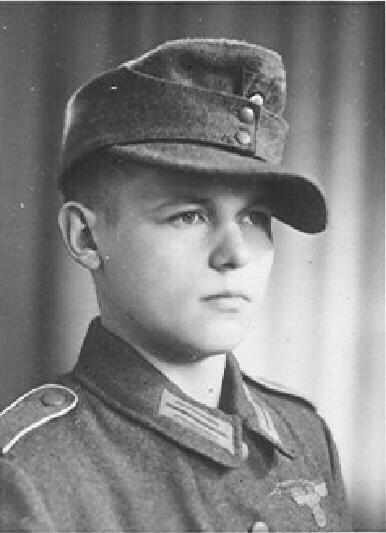
Hitler with massive allied armies poised on the German eastern and western frontiers authorized Himler to form the Volkssturm (November 1944). Boys and old men were inducted to shore up Germany's crumbling defenses. The Soviets in the east gathered their forces for an all out attack on Berlin. The Western Allies had reducded the Bulge and solved their supply contraints (February 1945). Hitler prepared for the Allied on-slaught by issuing the "Nero Order" (March 19). For Germans that were still under the illusion that Hitler had any real interest in the the welfare of the German people, these actions make clear his total lack of concern. Hitler issued a series of orders designed to destroy the infrasture of Germany, creating a virtual wasteland. The Americans and British began to cross the Rhine, a forbidable challenge, but made easier by the capture of the Remagen Bridge in tact (March 7). The Allies rushed accross the Rhine and a few weeks later at many other sites with landing craft and pontoon bridges. This was followed by Operation Varsity a massive paratroop drop on the German side of the Rhine (March 24). Within weeks the Ruhr, Germany's industrial heartland was surround and huge numbers of Germans soldiers surrendered in the Ruhr pocket. The Rhine was the last significant geographic barrier. Allied forces then began a race accross Germany toward the Russians pressing west.
The NAZIs suffered a series of disatrous military debacles in mid-1944. Thec Allies took Rome (June 4, 1944). Two days later the Allies landed at Normandy (June 6, 1944). After D-Day the Allies crushed the German armies in France, although part of the army escped from the Falaise pocket, leaving their equipment behind. The Allied campaign was so overwealing that the Germand were unable to make a stand at the Seine leading to the liberation of Paris (August 25, 1944). Eisenhower annunces the mext day that the German 7th Army has been destroyed (August 26). Allied armies rolled through Paris in hot pursuit of the retreating Wehrmact. Mongomery and Patton argued for thrusts into Germany, but Eisenhower decided on a broad front campaign. [Chalfont, p. 258.] The success of the Allied campaign in France led to the liberation of Belgium and the southern Neterlands. It Also mean that the Allies were approaching the Reich's western frontiers (September 1944). The failure of Operation Market Garden meant that the Germans could prepare a stand at the Rhine. The situation on the Eastern Front was even more devestating. The Soviets launched an offensive to prevent the NAZIs from concentrating forces agaisdt the Normandy bridgehead. Operation Bagration was timed to begin on the same day the NAZIs invaded the Soviet Union (June 22) 3 years earlier. The target was the Wehrmcht's Army Group Central in Byelorussia. Bagration in many ways was a replay of Barbarossa, only in reverse. The Red Army in a massive 5 weeks campaigm suuceeded in moving the front line west to Warsaw, liberating much of Poland. Army Group Center was shatered. The Red Army completely destroyed 17 Wehrmacht divisions and heavily damaged the combat effectivness of more than 50 other German divisions. Army Group Central was shattered. It was the single greatest defeat suffered by the Wehrmacht in the War--worse them the disaster at Stalingrad. The Wehrmact sffered greater casualties than at Stalingrad. [Zaloga] Bagration not only smashed Army Group Central, but drove the Germans back into Poland. This meant the Red Army was also approaching the frontiers of the Reich.
Once the invasion had succeeded and the liberation of France in Progress, the Allied renewed the strategic bombing campaign with a unimaginable ferrocity. Eisenhower in prearation for the D-Day Landings and to support the beach head had authority over both RAF Bomber Command and the American 8th Air Force. Neither Harris or Spaatz appreciated their limitations on their operations. They wanted to as soon as possible resume the strategic aifr campaign against Germany which they both were convinced was the quickest way to end the War. German cities enjoyed a respite as the Allies prepared for D-Day and then the battle for France raged. After the liberation of France and with Allied armies moving through Belgium and approaching the bondary of the Reich, the fortified Western Wall, Eisenhower released them (September 14). More than half of the bombs that fell on Germany would fall in the next 6 months. German cities would be devestated and the goals of the stratstegic bombing campaign woukld be realized--the German capacity to make war would be destroyed.
Hitler launched the War wth a fraction of the manpower of the nations that he wanted to conquer and destroy. Vivtory would require a series of perfevtly managed German campaigns and military competence on the part of his adversaries. This is what occurred at the start of the War, but beginning after the fall of France (June 1940), Hitler began making serious errors. And invading the Soviet Union he began to wrecklessly commit Germany's limited mapower. Refusing to allow the 6th Army to break out of Stalingrad was just one such insane of German soldiers and refusal to listen to competent military professionals. This insane waste meant that Hitler would have to turn to poorly trained and equipped boys and oldmen to defend the Reich in thee final desperate months of the War. Hitler and top NAZIs were deperate to stop the oncoming Allied Armies. Hitler was under no illusions of what would happened if Germany fell. Some of his associates like Himmler and G�ring deluded themselves with the idea that negotiation might be possible, but they were well aware of their complicity of the enormous crimes committed in Germany's namre. with massive Soviet and Allied armies poised on the German eastern and western frontiers, Hitler authorized Himmler to take two desperate measures, form a Home guard to defend the Reich (the Volkssturm) and form a resistance group (the Wehrwolfs). Hitler had long ago lost confidence in his generals and was rapidly losing confidence in even his closest assoiciates. For both of these actions he turned to Himmler.
German propaganda thrumpted new secreat weapons that would defeat the Allies. There actually were such weapons and the Germans began to use them in 1944. It proved, however, too late to affect te course of the War. The V weapons were impressive technical achievements and terribly destructive, boy the V-1s and V-2s. The Allies had delayed these programs by the bombing of Peenemunde, the German missle development program. The first to be used was the V-1 unpiolted jet bombs, an early cruise missle. The British called them buzz bombs because of the destinctive sound of their ram jet engines. The Germans focused on London after the D-Day invasion. The Allies were able to find the launching ramps and attack them by air, but the Germans prefected easy to errect launchers. Many V-1s were also shot down by both ground artillery and Allied fighters. Had the German focused on the V-1, however, tey my hhave been able to disrupt the D-Day landings. After the Normandy breakout the Allies over run the launch sites. It was at this point the Germans began launching the V-2s. They were the first balistic missles ad even more frightening than the V-1s. Because they traveled faster than the speed of sound, there was no advanced warning--just a massive explosion. British press reports helped fool the Germans about targetting. While frightening and desructive, neither weapon seriously affected the Allied war effort. By late 1944, destroying London homes and shops was not going to prevent Allied armies from invading the Reich. The payloads were small and accurate targeting impossible. The jets introduced by the Germans could have had an significant impact on the War, but Hitler's interference both delayed development and prevented efficiet deployment. As a result, fespite massive commitment of resources, the much-vaunted German secreat weapons played no significant impact in the War, not even the air war over the Reich.
Allied armies had reached the borders of the Reich by late-1944. Hitler concentratted the last few German reserves for the Bulge offenive in the West. His generals had varied opinions. Some wanted to use thise reserves to stop or aeast slow down the Soviet juggernaught in the East. The failure of the Bulge offensive meant that by 1945 therecwere no longer any reserves and arms production was plummeting becaise of the allied statehgic bombing campaign. With reserves gone, the remaining German forces were badly outmanned and outgunned an all fronts. The Allied air strength and the lack of petrol mean that the Germans also had no capabllity to maneuvr. The Soviets had approached the borders of East Prussia at the end of 1944. The Western allies drove to cross the Rhine in Operation Market, but the British were unable to hold the rnem brudge over the Rhine. The Americans had reached the West Wall at about the same time, but supply problems meant that they were unable to mount a major offensive into the Reich. In the south the Germans stoped the Allies in the Po River Valley abd hrld them there during thge winter. With the new year the drives into the Reich befan in earest. In the East, the Soviets smashed into East Prussia and after taking Warsaw preoared for thge assault on Berlin. In the West, the Americans drove into the Rhineland in preparation for crossing the Rhine itself. In the south, the Americans and British finally crossed the Po and began the drive north toward Austria.
The Allies became very concrned about a 'National Redoubt' that die-hard NAZIs were reporting preparing in mountains of Bavaria, Austria, and northern Italy. The Allies were concernd because well-armed and supplied troops might be able to hld out in the maountain for 1-2 years and cause enormous Allied casualties. There was some thought among NAZI leaders to build such a redoubt, but the necessary preparations were never made bcause Hotler never gave the orders to do so. His intimates such as Bormannand Goebbels wanted him to do so to get away from the Russians. They tried to convince Hitler to leave Berlin. Hitler was determined to end the War in Berlin apparently seing an alpine Retreat as defeatism when it was still possibke to prepare one. And to work on a redoubt might be seen as defaetism which could bring about severe punihment. The reports found their way into the Allied popular press in the last months of the war. One press report read, "But what of the top Nazis who cannot hide? With a compact army of young SS and Hitler Youth fanatics, they will retreat, behind a loyal rearguard cover of Volksgrenadiere and Volksstürmer, to the Alpine massif which reaches from southern Bavaria across western Austria to northern Italy. There immense stores of food and munitions are being laid down in prepared fortifications. If the retreat is a success, such an army might hold out for years." [Time Magazine] Allied intelligence picked up scattered German reports. And these reprts greatly concered SCHAEF. It was a factor in Gen. Eisenhower's decesion not to make for Berlin.
Three rivers are espcially important in German history. Surely the most impotngt is the Rhine which became th border betweem the German tribes and the Roman Legions in Gaul. The Danube became anothrer border between the Germans and Roman Empire. The Elbe is the third River, perhaps not as storied as the Rhine and Danube, but important none the less. Ostsiedlung (East settling) is the term for the Medieval migration of ethnic Germans into and beyond the territories at the eastern periphery of the Holy Roman Empire. The Emperor Charlemagne united much of Western and Central Europe (8th and 9th centuries). He created numerous border territories called marches (Marken) where a substantial portion of the Ostsiedlung would occur. Many were locted est of the Elbe. Over time the Elbe became more of a river in central Germany. Today it is best rembered as part of the Iron Curtain border between the democracies of Western Europe and the puppet states of the post World War II Soviet Empire. The Americans began crossing the Rhine at Remaagen (March 8 1945). A month later, the Americans reached the Elbe (April 12). The Germans began blowing the bridges s they had doine the Rhine bridges. This was the same day President Roosevelt died. The Ninth U.S. Army probed crossed the Elbe River near Magdeburg, located some 50 miles from Berlin. They also probed a little further south (April 13). The Germans nustered enough strength to force the Americns from the northern bridgehead (April 14). Only week Americn units had crossed. Gen. Eisenhower had already mde the decision not to cross in force. He had authorization to cross if probing forces did not encounter serious opposition. Eisenhower was not prepored to fight a major battle for territory that was to be turned over to the Soviets. And his concern was further south where he was afraid that the NAZIs were preparing an Alpine redoubt and ajusted U.S. troop movements. As a result, the Third U.S. Army pushed spearheads inside the Czechoslovak frontier the day the war ended. The occupation sectors had alredy outlined and the Elbe was to be an importabnt part of the boundaries of the Soviet sector. The United States and Britain had agreed on the main proposals at the Quebec Conference (September 1944) and agreement with the Soviets had been schieved at Yalta (February 1945). While the Germans had blown the Elbe bridges, shortly after their comcern was less stopping the Americans than escaping the Soviets. The Americans and Soviets would soon link up long the Elbe to the south at Torgau (April 25).
The Soviets in the east gathered their forces for an all out attack on Berlin. The battle for Berlin fought in April 1945 was one of the most horific engagements of World War II. Stalin ordered the Red Army to take Berlin. After the Americans seized the Remagen Bridge and crossed the Rhine, Stalin ordered the time tble speeded up and at the same time lied to Eisenhowser that he was preparing to take the German capital. Losses on both the German and Russian side were enormous. Russian losses were in part due to the fact that Stalin had
ordered that Berlin be seized bfore the Americans could reach it. Stalin's ordered resulted in a race to Berlin by Marshal Zukov and Koniev, both wanting the victor' laurels. It has always been wonderd why Stalin was so obsessed with Berlin and was willining to sacrifice so many Red Army soldiers to get to Berlin before the Americans. It has always been felt that it was primarily for the political value, to demonstrate the role of the Red Army in defeating the NAZIs. A British histoian argues that there was another important reason. Beria had learned of the American Manhattan Project to build an atomic bomb. Stalin as a rsult ordered a top secret Soviet atomic bomb project--Project Boradino. Located at Berlin was the Kaiser Wilhelm Institute, the center of the German atomic project. While the Germans were fa behind the Americans, the Russins obrained agreat deal of valuable information an 3 tons of uranium oxide. [Beavers] The Soviet conquest of Berlin proved to be a nightmare for the surviving women, almost all of whom were raped. It is estimated that 2 million German women were raped by Russians at the end of the War. Perhaps 0.2 million of those rapes took place in Berlin. The rapes included children, nuns, old ladies, and even Russian women brought to Germany to work as slave laborers. The Soviets denied the German civilian reports, but Soviet archieves leave no doubt as to what occurred. [Beavers]
Allied forces racing accross Germany moved toward the Russians pressing west. The Soviets launced their assault on Berlin (April 16). The Allies had fixed stop lines for their military forces along the Elbe and Mulde Rivers. The First Army was the first to meet up with the Soviets near the village of Torgau (April 25). Patton's Third Army moved into easterm Czechoslovakia. The British reached the Baltic, cutting off Denmark and the Jutland Peninsula.
The Wehrmacht by April 1945 was shatered and no longer able to offer effective resistance to the Allies. The Western Allies raced through Germany from the west during April 1945 as the Soviet Red Army surrounded Berlin. American and Soviet forces made the long anticipated link-up at the Elbe River on April 25. The Red Army fought a massive engagement to take Berlin. Hitler insisted that the SS and Wehrmacht forces in the city, reinforced by the Volkstrum (Hitler Youth boys and older men) fight so that he might live a few more days. As Red Army soldiers approached his bunker, Hitler shot himself and named Admiral Karl Doenietz as the new F�hrer. The last raid of the strategic bombing campaign took place on April 25 when the Skoda armament plant at Pilsen, Czechoslovakia were bombed. The American Air Corps began shifting to mercy missions. Flights were dispatched to feed civilians in northern Italy and the Netherlands who were near starvation. Priority was also given to evacuting prisonors of war (POWs). Doenitz ordered General Alfred Jodl to General Eisenhower' Headquarters--Allied Expeditionary Forces (SHAEF) detachment in Rheims to seek terms to end the fighting. Jodl signed the unconditional surrender of German forces on allfronts At 2:41 a.m. on May 7, which was to take effect on May 8 at 11:01 p.m. Thus NAZI Germany surrendered unconditionally, as President Roosevelt had insisted. Celebrations ensued throught Europe--except Germany. Ther were big official celebrations. There were also smaller neighborhood celebrations. In communities throughout britain there were outdoors banquets called block parties that were family celebrations (figure 1). For many of the children it mean that daddy would soon be headed home.
Many believe that after the NAZIs surrendered (May 1945) that all German resistance suddenly ceased. This was not the case. There were NAZI attempts as resistance and the Allies had to take measures to deal with the resistance from various German groups. The NAZIs in the closing months of the War organizated operations like the "Werewolves" to disrupt the occupation. Most of the Werewolves were Hitler Youth boys. There were incidents of Allied soldiers ambushed by Werewolf boys and incidents between Werewolf partisans and Allied forces in the closing days of the War. American soldiers leaflets detailing plans on how to undermine the occupation through sabotage and other measures. The NAZI resistance efforts proved ineffective. Given the level of support that the NAZIs built up, this seem rather surprising. The NAZI resistance effort failed for a variety of resons. One, the destruction as a result of the War changed the mind-set of many Germans. Two, relevations of NAZI war crimes also had a major impact on German thinking. Three, Germany was so devestated that the Germans were dependant on American food aid. Four, the nature of the Western Allied occupation did not generate resistance nd ill will. Five, the nature of Soviet behavior had the result of making the Americans look more like protectors than occupiers.
One paratooper received a letter from his mother in which she wrote, "Son, I want you to be merciful." He recalls thinking that an act of mercy could cost him his life. He was dropped with the 17th Airborn as part of Operation Varsity. Passing a farm house he heard noises from the cellar. Believing that German soldiers were there he prepared to throw a grenade in when he recalled his mother's letter. So instead he called out for the Germans to surender and come out with their hands up. There was silence. He called out again. Then an elderly woman appeared followed by another woman, and then four or five small children. Eventually 14 women and children came out of that cellar. [Kormann]
The United States along with Britain and France Japan oversaw an occupation with changed the nature of West German society. Most Germans readily admitted their country's responsibility for the War and ther honredous acts of the NAZI regime. The Allies instituted a thorough going denazification process, a process which continues to this day in Germany. The Allies also attacked the militarism of the old Prussian junker class which the united German state was built around in 1870. The Allies completely dismantled the NAZI regime and during military occupation reconstructed an entirely new political structure. In some ways the process was simplified by the NAZIs who although opposed to democracy had gone a great way toward the breaking down of class barriers and weakening the power of the Prussian junkers. The Germans were not without a tradition of democracy and parlimentary politics. Given the NAZIs success in dominating the German people and the thorouness of that domination, it seems perhaps surprising how readily the Germans adopted democracy. Perhaps the totality of the NAZI defeat and the spector of Soviet totalitarianism looming accross the border were major factors. What ever the reasons, the German took to political democracy and free-market economics. A relationship with America was forged in the Berlin Airlift (1948) and four decades of resistance to the Soviets and Warsaw pact. The results by all practical measures have been an overwealming success. Germany today is one of the most prosperous and democratic societies in the world. Germany unlike Japan was also occupied by the Soviet Union. The Soviet occupation policies in eastern Germany were very different than those persued in the wetern occupation zone. Austria was separated from Germany after the War and occupied by the Soviets and Western Allies.
Beavers, Anthony. The Fall of Berlin 1945.
Biddiscombe, Perry. Werwolf!.
Chalfont, Alun. Montgomery of Alamein (Atheneum: New York, 1976), 365p.
Fest, Joachim C. Hitler (Vintage Books: New York, 1974), 844p.
Kieser, Egbert. Tony Le Tissier, trans. Prussian Apocalypse: The Fall of Danzig (2011), 240p.
Loens, Hermann. Wehrwolf (1910).
Kormann, John. "Mercy is its own reward," The Washington Post, May 28, 2004, p. W11.
Time Magazine (February 1945).

Navigate CIH World War II Section
[Return to Main German World War II page]
[Return to Main World War II Second phase campaign page]
[Biographies]
[Campaigns]
[Children]
[Countries]
[Deciding factors]
[Diplomacy]
[Geo-political crisis]
[Economics]
[Home front]
[Intelligence]
[Resistance]
[Race]
[Refugees]
[Technology]
[Bibliographies]
[Contributions]
[FAQs]
[Images]
[Links]
[Registration]
[Tools]
[Return to the Main World War II page]