|
"Here we are together, facing a group of mighty foes who seek our ruin. Here we are together, defending all that to free men is dear. Twice in a single generation the catastrophe of world war has fallen upon us. Twice in our lifetime has the long arm of fate reached out across the oceans to bring the United States into the forefront of the battle."
-- Winston Churchill. Address to Congress, December 26, 1941
Britain and America during World War II formed the most important military alliance in the history of warfare. Never before had two countries so closely coordinated their industrial, scientific, and military operations to defeat a common enemy. There were important differences between the two nations Many World War II histories stress the common ties of language and culture that bound America and Britain and to often ignore the very real differences. The Alliance in fact was created out of mutual necesity. 【Soybel】 Differences between the two countries were resolved or put aside to achieve the overal objective--the unconditional surrender of NAZI Germany. America had the industry and resources to do that. The British at great cost had gained the expeience and the appreciation of NAZI strengths that America in 1942 still lacked. The Alliance was forned by the personal commitment of President Roosevelt and Primeminister Churchill. This personal relationship helped over come the very real differences between the two countries. The relationship began with aid to Britain, especially after the fall of France. A key factor in the Alliance was Lend Lease. Joint military planning began even before America entered the War and was based on agreement that the number one priority was the defeat of NAZI Germany. The Allied leaders met in a series of war conferences to make major decessions. The achievment of the alliance are very extensive and include victory in the North Atlantic, the key victory of the Western Allies. Specific achiievements of the Alliance are notable. The P-51 Mustang which broke the Luftwaffe was a marriage of an American air frame and a British engine. The very important code-breaking operation was an Anglo-American operation. Victory in the North Atlantic was an Anglo-Amerucan indertaking with an important Canaduian contribution. The British shared their scientific advances on radar abnd the United States developed the technology to mass produce radar sets. The D-Day invasion was a joint undertaking of breath taking proportions. It succeeded in large measure because the British managed to delay it until 1944 and America provided the air power to drive the Luftwaffe out of France as well as an abundance of supplies needed to cross the Channel. The Manhattan Project creating the atomic bomb was another joint undertaking.
Background
Chancellor Bismarck in the 19th century saw America as a potential danger. He was less concerned about Britain. When asked what he would do if the British Army landed a force along the north German coast, he jokingly replied, "I would send the police to arrest it." 【Roberts, p. 28.】 Bismarck at the time was watching America's growing economic power, especially its industrial growth. And he though that linguistic and cultural ties would eventially lead to an alliance with Britain which could upst the European ballance of power, especially the increasing dominance of Germany in Europe that his policies had helped create. Wilhelm II became kaiser (1888). He was still a young man with his own ideas about national policy. He saw the cautious Iron Chncellor as a relic of the past and quickly eased him out of power. Wilhelm felt that Bismarck'alliance with Russia and his concern with America were not relevant concerns. His idea was that America without a core ethnic basis or an army of any significane was not a real country. Rather than the caution Bismarck caution, Wilhelm was more willing to use Germany's military and industrial strength to gain aosition of power in Europe and colonies broad. Wilhelm eased the aging Chancellor into retirement, but these and other ideas would radically affect Germany's and Europe's history in the 20th century. The British viewed America in a very different way. They saw America's rise as the development of a dangerous rival to both Britain and its Empire. And unlike Germany they had an extensive border to protect--the Canadian-American border. America went to war over that border (1812) and almost again over Florida (1817) and Oregon (1848). Britain came close to recognizing the Cofederacy (1862). As recently as the Venezuelan crisis, the possibility of war arose (1895). And America began to use its economic and financial power to force Britain to mke peace with Germany (1916-17). America for its part througout the 19th century showed no sign of moving toward Britain in European power diplomacy. In fact, the most imprtant America diplonatic threads (impressment and Maniufest Destiny) both brought America into conflict with Britain. Impressment was especially serious as even a statesman so opposed to slavery refused to support Royal Navy actions to supress the slave trade because of impressment. The Irish Potato Famine (1840s) resulted in the influx of a fervently anti-British element into America. And at the time of World War, the largest single immigrant group in America was the Germans. Important economic ties developed with Britain, but there was a lingering anti-British sentiment across most of America which saw Britain as a monarchy and both aristocratic and imperialistivc, in direct contrast to American democracy and republican values. President Lincoln focused on ht sentiment, although not specificlly directed at Britain, in the Gettysburg address (1863). You can see that well represented in popular litertur such as Mrs. Burnett's Little Lord Fauntleroy (1885). Bismrck was certainly correct in the long term, but in World War I, America could have gone either way. It was Kaiser Wilhelm and the German military, not President Wilson, that determined the direction America would take.
World War I (1914-18)
Britain entered the World War to support France when the Germans invaded Belgium (August 1914). The European powers has developed a complicated alliance system which helped draw them into the War. One of the two most important was the German alliance with Austria Hungary. This in itself would have not led to war, but the Kaiser wrote Emperor Franz-Josef a blank check and that did lead to war. The other key alliance was the French alliance with Russia. America was a neutral country with a history of non-involvement in European affairs. From a very early point in the War, a primary British goal was to draw America into the War. A combination of deft British propaganda and wreckless German behavior from the bginning of the War meant that Americans despite a very large German population, was sympathetic to the Allies (Belgium, Britain, and France). Even so, the great majority of Americans were strongly determined to stay out of the War. In the end, America's entrance into the War had nothing to do ith the British. The Germans decided that they could win the War with an unrestructed submarine campaign against Britain an amassive summer offensive on the Western front. Despite victory on the Eastern Front, the Allied naval embargo was biting into the German war effort. The Grmans were desperate to end the war with one final massive offensive. Their assessment was that they could accomplish both before the United States could form an army and that even if America did form an army, the Kriegsmarine U-boats could prevent it from reaching France. The result was the Zimmermann Telegram and the resumption of unrestricted submarine warfare. It was a bold gamble on Germany's part and one which ultimately would mean the end of the German empire. America would join Britain and France in the War, but there was never any formal treaty of alliance signed--only a declration of war against Germany.
Importance
Britain and America during World War II formed the most important military alliance in the history of warfare. Never before had two countries so coordinated their industrial, scientific, and military operations to defeat a common enemy. The two coiuntries could not have been a more perfect fit. America had a massive industrial establishment, but no lrge army or militaty research establishment. Britain had done considerable work on a wide range of military technologies, but did not have the industrial capacity to actually manufacture the weapons and equipment. The British could have never reentered the Contginent without the Americans. The Americans would have had great difficulty even fighting the Germans without the British springboard and the hard-won battle experience gained from fighting the Germans for 2 years. America had the industry and resources to defeat NAZI Germany. Britain by the time America entered the War, had stopped the NAZIs at the Channel, but faced a European continent now dominated by NAZI Germany. The British at great cost, however, had gained the expeience and the appreciation of NAZI strengths that America in 1942 still lacked.
Germany First
From the very beginning it was aimed at one person and one country--Adolf Hitler's NAZI Germany. It was of course Britain's primary war aim from the very beginning because Germany launched the War and was so close to Britain. Japan never threatened Britain's national existence. America was different because Japan threatened America directly in a way that Germany did not, even before Pearl Harbor. Even so, President Roosevely and American Army and Navy Chiefs also saw Germany as the major threat even after Pearl Harbor. The British initially thought that would have trouble convincing the Americans of this. They did not. This was the basic orietation of the President and American military's even before Hitler sent the Panzers over the Polish border (September 1939). Soon after it became America's central strategic concept. The first innteration in writing Was drafter by Admiral Harold R 'Betty' Stark, U.S. Chief of Naval Operations (October 1940). It was drafted at the end of the American presidential election to be presented to the president which as increasingly looking like President Roosevelt. Britain was stil fighting for its life an the Soviet Union was still not an active beligerant. America was not yet at war, but it was becoming increasingly apparent that it was only a matter of time before America would become involved. Stark's concept became known as Plan Dog. Stark set out what America should do if it became drawn into the war with the Axis powers. His reccomendation was inequivocably -- Gerany First. Focus on Germany in Europe and go on the defensive in the Pacific. Stark's Plan Dog was refined military staffers. And Army Chief of Staff, Gen. Marshall approved it. In essence it stated, "If Britain wins decisively against Germany, we could win everywhere, but ... if she loses, the problem confronting us would be very great; abs while we might not lose everywhere, we might, possibly, not win anywhere." 【Simpson, p. 144.】 Pearl Harbor might have changed this with the public demanding a focus on Japan. Here Hitler came to the President's aid by declaring war on America (December 10). Only a few weeks after the Japanese carrier attack on Pearl Harbor, at the Arcadia Conference (December-January, 1941-42), the United States adopted the recommendations of the Stark's Plan Dog memo in the form of the "Europe (meaning Germany) First" policy. In reality, the choice was not as stark as it seeed at the time. The engine of American industry powering the Arsenal of Democracy proved able to equip not only American armies and fleets in the Europe and the Pacific, but those of its Allies as well. Europe got priority in resource allocation, but vast quantities of supplies flowed to the Pavific as well. Often unnoticed in World war II histories which describe the dimesions of the cross-Channel D-Day landings in great detail is that at the same time (June 1944), labings of similar dimmensions were occuring in the Marianas which was an all-American operation.
Differences
There were important differences between America and Britain. Many World War II histories stress the common ties of language and culture that bound America and Britain. Much of what is right about America comes from our English heritage. That heritage is the base of our legal, governmental, and economic systems, meaning civil liberties, democracy, and capitalism. But there are very real differences. The frontier that the colonists faced helped shape American culture differently, especially the class structure. Immigration brought a wide range of European peoples and in the Southern colonies, Africans into the country with a much wider cultural base. Also there were fewer entrenched interests that limited the dull application of free market capitalism. Thus there were very real differences. And some of this was negative feelings that developed during the Revolution and festered after independence. This fed by British imoressment of American seamen andcthe American sesire to seize Canada led to the War of 1812. America and Britain almost went to war again in the 1840s, this time over Oregon. Much of the American northeastern upper-class look to Britain for their values and culture. While the wider American culture was critical of royalty, aristocracy and empire, You see that in Mrs. Burnet's Little Lord Fauntleroy, a popular novel in the 1880s. This did not change much, despite American entry in World War I on the Allied side. After World War I, many Americans had second thoughts about participating in the War. It was widely believed that the British dragged us into the War. It was part of the sentiment that fed into the Isolationist Movement. And even President Roosevelt and the people around him believed that the British were trying to use America to save their Empire. Churchill at the British in contrast were convinced that America was using Britain's strained circumstances to force unfavorable concessions, such as the Destroyers for Bases deal. In addition, the Americans demanded major concessions to receive Lend Lease aid--something that Roosevelt never did with Stalin. And this was all before Pearl Harbor and the development of major differences over strategy, especially over the Cross Channel invasion. The principal differences was over the British Empire. At the time the Empire was still very important to Britain and most particularly to Churchill. America and President Roosevelt were very critical of imperialism. The differences were so pronounced that Churchill and Roosevelt had to agree to avoid it. The Alliance despite these differences was created and made to work out of mutual necessity. 【Soybel】
President Roosevelt
It was not long after the Munich Conference (September 1938) that it became clear even to Primeminister Chamberlain that appeasement had not worked. Hitler had told Chamberlain that he only wanted the Sudetenland with its Germans, not Czechoslovakia with its Czech population. Only a few months later, Hitler invaded Czechoslovakia (March 1939). This mean that war was inevitable. President Roossevelt saw this, but given the strength of the isoltionist mobevement and the determination of Most Americans to say out of the war, there was little he could do, other than support increased military prepradness. And the President was looking forward to his last years in office. Thete was a strong two term limit. What he did do was to take the first step toward establishing the foundation of an anglo-American allince. He invited the new young British king, George Vi and his wife Elizabeth, to visit the United States. The New York World Fair provided a cover for a non-controversoal royal visit. There could be no open talk of alliance and war. The King and his wife, however, made a very positive impression on the American public. It was a very small step, bit it was the first step.
Roosevelt and Churchill
Roosevelt and Churchill first met during World War I. Roosevelt who was a junior official (Undersectratey of the Navy) remember, Chuchill who was a senior memember of the cabinet did not. The Anglo-Alliance was formed by the personal commitment of President Roosevelt and Primeminister Churchill. There was noo formal trearty, only the Atlantic Chrter and the personal commitment of the President and Preimeminister. Preime\nisyer Chamberlin was not anxious to involve the Americans as he persinally dealt with Hitler. comvinced that he could precent a war. President Roosevelt wrote to Churchill after he was recalled to the Admiralty in the opening days of the War. What followed was the development of a momentous personal relationship. This had to nbe done quietly as Chamberlain was still primeminister and not anxious to seek the President's councel. After exchanging letters and assisted by Harry Hopkins diplomacy, the two finally met at the Atlantic Conference off Canada, just before America entered the War (November 1941). This personal relationship helped over come the very real differences between the two countries. The personal commitment of the two leaders overcame the substantial differences between the two countries. Commanders who could not cooperate were replaced. Even Britain's most important commander was almost replaced because of his insubordinate behavior toward Eisenhower.
Pre-Pearl Harbor War Assistance (1939-41)
World War II histories often refer to Britain fighting alone. In fact Britain was never entirely alone. There were the Domuioniions and Empire. And even before the War, Britain and France were placing ar irders in America, although on a cash and carry basis. The crucial Angklo-Ameruican relationship began with aid to the Allies even before the NAZIs launched the War. The relationship with Britain deepened as the War began. Churchill who understood the vital imprtanhce of the Americans became prime minister (May 1940). And after the fall of France (June 1940), more Americans began to understand the vital imprtasnce of Britain. President Roosevelt immeitely moved to begin amending the Neutrality Acts. He saw to it that Britain received moth-balled destroyers for the Battle of the Atlantic. The most important assistance program was the passage of Lend Lease. America undertook the protection of Iceland, releaving British troops. And the President committed the American Navy to a shooting war in the North Atlantic months before the United States entered the War. These actions were virtual acts of war. Hitler who thought nothing of invading neutral countries which wanted nothing more than to stay out of the War and not taking hostile acts, held off from retailiating. U-boat commanders were even ordered to avoid action with the U.S. Navy. Hitler wanted to keep America out of the War as long as possible to facilitate the conquest of the Soviet Union. .
Sympathy Toward the British
Both World War I and World War II began with German invasions of coyntries which were ot threatening Germany. The German image was, however, were very different. Germany in 1914 was perhaps the most respected country in Europe. It was the leader in scince and Nobel Prize awards. It had a constitunional parlimentary system. It was the British and Belgians that had dark images. They had committed widely publicized atrocities, the Belgians in the Congo, the British in South Africa. It was the British who created concentration camps to control the Bohrs. The large German minority in America looked mor favorably on the German than the British. Germany was seen as atable, nodern coyntry with high cultural and intellectual standards. And there had been not conrrontations with the Germans, unlike the long list of 19th century confrontations with Britain. This only changed with World War, beginning with the invasion of neutral Belgium, followed by a series of actions which inflamed American public opinion. British propaganda magnified German atrocities, but did not create them. While this turned public opinion against Germany, it did not create widespread sympathy for the British. American sypathy was primarily dorected toward the Belgians and French as well as the various countries invaded and occupied by the Germans. All had ethnic communities in America concened about their homelnd. Germany in 1939 was looked on very differently. Americans had seen the wild speeches of Hitler in the movie news reels as well as the thugery of the book burning, Jew hating NAZIs. Anti-semitism existed in Ametica, but the NAZI excesses, especially Kristalnacht, appauled Americans even many who had no love of Jews. And the subsequent NAZI rampage in Poland, Denmark, Norway, and then the Netherlands, Belgium, and France shocked Americans. The governing opinion, however, was to say out of another European war. Dislike of the NAZIs, however, did not automatically transform into sympathy for Britain. This came more thany thing from Briain's valiant stand against the NAZIs after the fall of France, especially the Blitz and the evocative images of London burning. It was clearly nothing short of barbarian forces set on destroying not only the British, but civilization itself. the forces of The Blitz had a narator -- CBS corresponent Edward R. Murrow. American nightly tuned into Murrows broadcasts with the background of Luftwaffe bombs dropping on the city. And then there were the masterful sppeches od Prime Minister Churchill, contrasting with Hitler's rantings. A majority of Americans still were opposed to entering the War, but the bond with the British people were forged in the fires around St. Paul's.
British Contributions to America
American assistance to an embattled Britain is often emphasized in any asesment of the Anglo-American alliance. Britain did not, however, come to the table open handed. It by 1940 was a country geared for war and by the time of the Battle of Britain was already outproducing the Germans in aircraft. It had a substntial army and airforce in addition to the poweful Royal Navy. But often neglected in World War II assessments was the very sunstantial research in military technology underway througout the country, In many cases the British had achieved very spectacular advances in areas not even being addressed by the Americans. Churchill made the work of the British scientific establishment available to the americans more than a year before the United states entered the War (October 1940). The only thing Churchill did not turn over at this time, but soon did was the Ultra secret. .
America Enters the War
Adolf Hitler on December 11, 1941, declared war on the United States. This conviently solved FDR's dilema of how to enter the war against the NAZIs when America had been attacked by the Japanese. Curiously, America was the only country on which Hitler ever declared war. The entry of America into the War changed all calculations of strategic ballance. The Soviets alone in 1941 were already out producuing the Germans in many areas such as tanks. The entry of America was to mean that German war production would be only a fraction of Allied production and that difference was already being felt on the battlefield. The story of American industry in the War is phenomenal. FDR in 1941 was already supplying Britain and the Soviets through Lend Lease. The declaration of war enabled FDR to harnass the vast American economy to war production. This was something that the Germans had still not done as late as 1942. Within the first year alone, America built 24,000 tanks and 48,000 planes. An impressive start, but just the beginning. American industry in 1942 equaled the armaments production of all three AXIS countries combined. And this was occurring at a time when the Societs alone, not to mention the British, were already out producuing the Germans. America in 1944 doubled its arms production again. 【Fest, p. 656.】 These were numbers the Germans could not hope to match. In no theater did these overwealming numbers show up more than the air campaign. At a time that the Luftwaffe could not fulfill its required role along the vast Eastern Front, a tidal wave of long range American bombers (B-19 Flying Fortresses and B-24 Liberators) flowed into England, each had the range to hit every German city including Berlin. The American planes began arriving in England early in 1942. England became, in effect, a huge unsinkable air craft carrier in the North Sea. Combined with the RAF's new Avro-Lancasters, the Allies were building a massive air armada aimed at German industry.
Conferences (1941-45)
Both the Allies and the Axis held a series of conferences to plan strategy and work out cooperative actions. The Allied conferences are better known in part because the Allies cooperative effort was much more involved than the Axis effort. The Allied conferences began in earnest with the meeting of President Roosevelt and Prime Minister Churchill at Placencia Bay and the signing of the Atlantic Charter (August 1941). The Allied conferences also were important in developing war strategy and cooperative efforts, but also helped shape the future of Europe after the War. Both the Allies and the Axis held a series of conferences to plan strategy and work out cooperative actions. The Allied conferences are better known in part because the Allies cooperative effort was much more involved than the Axis effort. The Allied conferences began in earnest with the meeting of President Roosevelt and Prime Minister Churchill at Plavencia Bay and the signing of the Atlantic Charter (August 1941). The Allied conferences also were important in developing war strategy and cooperative efforts, but also helped shape the future of Europe after the War. A Some of these conferences included other allies, includig the Soviets, but the Anglo-American consultations were central to the war in the west. The achievment of the alliance are very extensive and include victory in the North Atlantic, the key victory of the Western Allies. As a result the last two conferences, especially Yalta have proven to be very controversial. The Axis also had conferences, but they never approached the detailed cooperation and planning of the Allied conferences. As a result the last two conferences, especially Yalta have proven to be very controversial. The Axis also had conferences, but they never approached the detailed cooperation and planning of the Allied conferences.
Ulster (1942)
President Roosevelt had committed the U.S. to a shooting war in the North Atlantic by fall 1941. It was the Japanese attack on Pearl Harbor, however, that finally brought America into the War (December 7, 1941). The Allies had already decided that defeating NAZI Germany would be the primary objective. Within a few weeks after the Japanese attack, the first of what would become a flood of Amerucan troops into Britain was underway. Even before this the Americans and British had been discussing the formation of the Vth U.S Army Corps at bases in Ulster (Morthern Ireland) and Scotland. Roosevelt and Churchill decided that U.S troops would take over the defence of Ulster which would free up British soldiers for deployment elsewherein other locations. Ulster was important because it provided air bases and sea bases to support the Atlantic convoys. It also provided staging nd training areas for American army units. The first Americans units left New York for Belfast (January 6, 1942). The first American landed at Belfast (January 26, 1942). He became something of a celeberty. Ironically that soldier was Milburn Henke, a naturalised citizen of German ancestry. Military facilities did not exist to accomodate the number of Americans who were arriving and the operations they wuld undertake. The Americans set about construct 26 new airfields and improving naval dock facilities at Derry. These facilities would play an important role in the critical Battle of the Atlantic, vital to ensure that Britain';s new American ally could project its power to Britain and beyond. .
Eighth Air Force (1942)
America began building in facilities in early 1942. American and British Chiefs of Staff on January 13, 1942 order the movement of US air forces to the United Kingdom to support the existing British air campaign against Germany. The first American airmen (1,400 men) sail for Northern Ireland on January 18. Major General Ira Eaker is appointed Commanding General, Bomber Command, US Army Forces in British Isles (USAFBI) and on January 31, 1942 ordered to the United Kingdom. The War Department officially states on April 7, 1942 that the 8th Air Force will be established in the UK. Lieutenant General Henry "Hap" Arnold on April 12 completes air plans for Operation BOLERO, the buildup of US armed forces in the UK for an attack on Europe. The advanced echelon of HQ 8th Air Force and bomber, interceptor and base commands, along with 15th Bombardment Squadron (Light), 2nd Air Depot Group, and a weather detachment totalling about 1,800 men, on April 27 sailed from Boston, Massachusetts for the UK. The 8th Air Force was to become the largest air unit ever committed to battle. It would play a fundamental role in taking the war to Hitler's 1,000 year Reich.
Common Objective: Unconditional Surrender (1943)
Joint military planning began even before America entered the War and was based on agreement that the number one priority was the defeat of NAZI Germany. Differences between the two countries were resolved or put aside to achieve the overal objective--the unconditional surrender of NAZI Germany. Strangely this was not a carefully considered goal. In fact it seems to have been a goal set by President Roosevelt at the Casablanca Conference without even consulting Primeminister Churchill. Churchill had his doubts, but never rised them publically. Stlin also had his doubts, but part of President Roosevelt's calculation was to make it crystal clear to the Soviets that there would be no separate peace or dealings with the NAZIs. Historians still debate the impact of Roosevelt's decision. At the time the extent of NAZI war crimes were not yet known. But what was known after Munich that dealing with Hitler was useless, he could not be relied on to keepnhis word. This was a major reaon that Britain did not cab=ve in after the fall of France (June 1940). And now that allied power was growing and important military victories achieved, there would be no negiyiating with Hitler.
D-Day Buildup (1943)
The Japanese carrier attack on Pearl Harbor finally brought Ameruca into gthe War (December 1941). President Roosevelt announced to Congress that he was authorizing the largest armaments production in the history of the United States (January 1942). American and their equipment began arriving in Britain within in weeks after Pearl Harbor (February 1942). the Americans were greeted with both relief and curiosity when they finally landed on British shores. Both America and Britian agreed that priority had to be given to Europe and defaetung the Germans first. The British accepted an American plan for a buildup of U.S. forces in the United Kingdom in preparation for a future trans-Channel invasion (April 1942). The plan was Operation Bolero and included construction of airfields from which to launch the bombing offensive, a small contingent of ground troops, and a force of 750,000 to participate in a cross-Channel invasion in early 1943. Detailed planning was underway (early May). Demands from other theaters caused a downward revision of the Bolero buildup (May 1942). General Marshall organized for an immediate buildup of American forces in Britain for an invasion of France. It soon became obvious that an invasion was not possible in 1942, but he pushed hard for an invasiin in 1943. Fortunately the British managed to delay the invasion until the Americans were more experienced and hige forces had been assembled. Many of the early arrivals were then commited to Operation Torch (November 1942). After this the D-Day buildup began. The British and Canadians were heavily deployed in Kent and Surrey where a German invasiin had been planned. The Americans thus were billeted to the west and north. This would determine the deployment of forces when the Allies finally invaded and the conduct of the Western camapign, nuch to President Roosevelt;s displeasure as he was more interested in northern Germany. The Americansservicemen were stationed from Scotland to Cornwall. The inexperienced U.S. Army was anxious to invade France and attack the Germans. The American military presence in Britain grew from a handful of men in early-1942 to over a million troops (February 1944). and another 0.5 million would pass through Britain. All this while, the Red Army coninued to wear th Germans down in the East. The American military forces rapidly expanded as the country mobilized for war.
Technical Achievements
Specific achievements of the Alliance are notable. The P-51 Mustang which broke the Luftwaffe was a marriage of an American air frame and a British engine. The very important code-breaking operation was an Anglo-American operation. Victory in the North Atlantic was an Anglo-Amerucan indertaking with an important Canaduian contribution. The British shared their scientific advances on radar and the United States developed the technology to mass produce radar sets. The Manhattan Project creating the atomic bomb was another joint undertaking.
Joint Military Operations
Britain's only significan land victory during World War II without the Americans was El Alemaine (October 1942). Mongomery was only able to accomplish it, however, with staggering quantities of American equipment and supplies. The following Operations-- Torch (November 1942), Sicily (July 1943), and Italy (September 1943) were all Anglo-American operations. The D-Day invasion was a joint undertaking of breath-taking proportions. It succeeded in large measure because the British managed to delay it until 1944 and America provided the air power to drive the Luftwaffe out of France as well as provide an abundance of supplies needed to cross the Channel. The ensuing lineration of France and the Low Lands and the invasion of Germany were all Anglo-Americam operations. Here we should mention that the British 8th Army had many units from other Allied countries including Australians, Canada, France New Zealanders, Palestinian Jews, Poles and others. The British armies in France had an important Canadian contribution. The Strategic Air Campaign and the Battle of the Atlantic were also joint military operations.
Personal Contacts
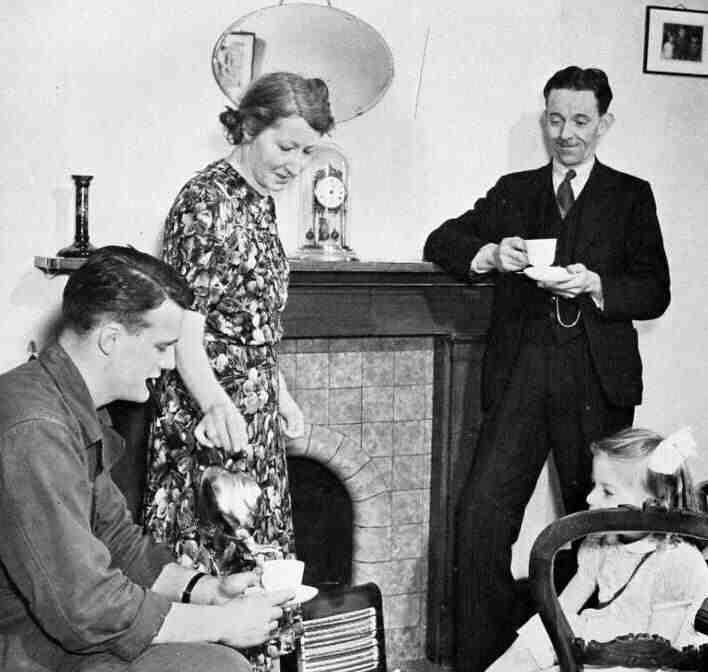
The Anglo-American alliance had a huge impact on the war. It was perhaps the most important alliance in human history. But something else very important occurred at the micro level. It brought Americans and Brits together together in large numbers for the first time since the Revolution. America had of course joined the Allies in World war I, by\ut the AEF went to France where the War on the Western Front was fought. Reklarively few American servicemen were stationed in Britain. This was not the case in Wirld War II. After Pear Harbor, large numbers of American servicemen were rushed to Britain. The powerful 8th Air Force was established in Bruitain aznd soon operatring from fields all over the country. The Army also built up in Britain. The first Army units were ciommitted to Operation Torch in North Africa (November 1942). But throughout 1943 and early 1944 men and material arrived in enormous quantities. It was here that the famous expression developed, "Over paid, over sexed, and over here." Probably the origin was the world War I song, "Over There" by Irving Berlin (1917). There were tensions, often among the higher ups. Here one of General Eisenhower's great achievements was how he managed the military alliance, with little help from commanders like Mobntgomery and Patton. For the most part the GI's and the British people hit it off. British children had seen Hollywood films and thought of both gangsters and cowbioys and Indians. Most met their first real American during the War. Most were enchanted by the optimistic, gum chewing GIs, and Yankee slang. The children sought out the GIs and the inevitable exchange of gum and Hershey bars. The GIs would show up at schools and children's centers to cheer up children, especially the children separated from their parents. The girls were also impressed and because most young men were in the services, the friendshio forms would lead to many GI marriages. Many British families invited the GIs into their homes. Some were billited with families. The GIs for their part weren't impressed with the food and weather, but liked the British people. A lot of Americans had anti-British attitudes before the War. After the War, the only major group with anti-British attitudes were Irish-Americans.
Sources
Roberts, Andrew. Masters and Commanders: How Four Commanders Won the War in the West (Harper Collins: New York, 2009), 674p.
Simpson, B. Mitchell. Admiral Harold R. Stark: Architect of Victory. 1939-45 (Columbia, South Carolina: 1989).
Soybel, Phyllis L. A Necessary Relationship The Development of Anglo-American Cooperation in Naval Intelligence (Praeger, 2005), 190p.
CIH -- WW II
Navigate the CIH World War II Section:
[Return to Main United Kingdom World War II page]
[Return to Main United States World War II page]
[Biographies] [Campaigns] [Children] [Countries] [Deciding factors] [Diplomacy] [Geo-political crisis] [Economics] [Home front] [Intelligence]
[POWs] [Resistance] [Race] [Refugees] [Technology] [Totalitarian powers]
[Bibliographies] [Contributions] [FAQs] [Images] [Links] [Registration] [Tools]
[Return to Main World War II page]
[Return to Main war essay page]
Created: 5:48 AM 4/1/2006
Last updated: 8:29 PM 11/3/2022