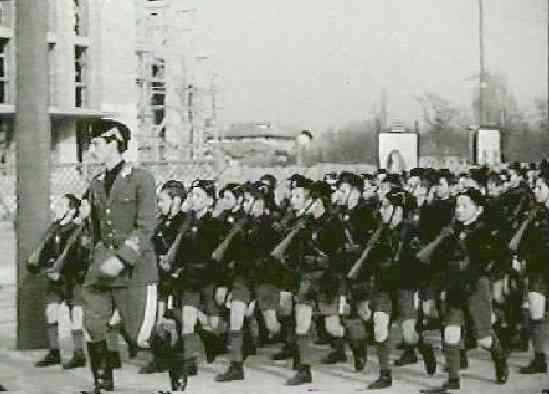
Figure 1.--The Italian youth movement had many of the same outward trappings of the Hitler Youth. They i not, however, have the same success in instilling a martial spirit in the boys. |

|
Fascism first developed in Italy during the period of economic dislocaion and social unrest which followed World War I. The Fascists coined the term Totalitarian and while Musollini may have expired toward that goal, he never created a truly totalitarian absolutist state, but rather a personal dictatorship and authoritarian state. Unlike other political movements, Fascism does not appear to have develoed out of any clearly discernable 19th century tradition. THe Fascists first appear after World War I in 1919 and led by Mussolini managed to seized power in 1922-25. The poltical orientation of Italian Fascism was initially on the Socialist left, but with a strong nationalistic strain. From the beginning the Fascists believd in using violence to achieve thir goals, but their were also elements of idealism and anti-materialism at least in the ideology. Fascists supported Italian colonialism, but initially supported Communist ideals such as opposition to imperialism and racism. Mussolini as il Duce shifted the party to the right in a series of practical and profitable compromises with the country's important institutions. Italian Fascists invented the term "totalitarian" for Fascist Italy, hoever, Mussolini never carried out a comprehensive Fascist revolution. Rather he ruled as an authoritarian leader in a state that some limited pluralist features. After Mussolini's elevation to power, Fascism began its development of a authoritarian form of social organization. Within a few years, representative democracy in Italy had been replaced by a centralized autocracy which at its apex was the absolute dictatorship of Mussolini in whom were concentrated all the principal functions of Government. Directly under him was the Grand Council of Fascism, constituting the political general staff of the regime and of the Fascist Party. The Fascist Party was legally identified with the state, and all other parties were outlawed.
The Italian nationalist movement is known as the "Risorgimento" (Resurgence) and resulted in unification. Italy was the source of the Renaissance which swept over Europe beginning in the 14th century. As a result of the Counter Reformation, however, Italy did not share in the Enligtenment that followed the Reformation. The Church effectively stifled scientific inquiry and other intelectual pursuirs. The country continued to be very traditional and the south virtually feudal. This began to change with the French Revolution when new poliical ideas and and modern concepts of nationalism were introduced to Italy. The great powers divided Italy following Napoleon's defeats in 1814-15 into the Papal States, Austrian duchies, the Kingdom of Sardinia, the Kingdom of the Two Sicilies, and several smaller principalities. . The Congress of Vienna sought to reinstate the conservative monrchial regime that had been almost overthrown by the French Revolution and Napoleon. The seeds of Italian national sentiment and the ideals of liberty had been sown in Italy as a result of the French invasion which brought with it the ideals of the French Revolution. Giuseppe Mazzini was a fervent Italian patriot who led the initial Italian national movement. He led the Liberal Movement and sought to create an Italian republic to govern a united Italy. It was to be te House of Savoy, however, that wouls succeed in unifying Italy. While conservative regimes were restored in Italy, Piedmont-Sardinia survived as a constitutional monarchy. King Victor Emanuel appointed Count Camillo di Cavour prime minister of the Kingdom of Sardinia (1852). Cavour was to play a major role in the unification. Under his leadership Italy would be unified under monarchial rule rather than the republic Mazzini so desired. Cavour was no revolutionary, he was, however, a swreud politican. Giuseppe Garibaldi was the nationlist military leader played a more flamboyant rtole and helped complete the unification of Italy.
Two of the major efforts of European liberals in the 19th century was the unification of Italy and Germany. These two countries were the last major European countries to achieve unification. Italy was finally unified in the 1860s. It was a contitutional monarchy with an elected parliament. Italy was, however, a very poor country. This was one of the principal reasons causing emigration to America and other countries. Conditions in the south in particular were still almost feudal. As in Germany, Italian Fascism did not come out of nowhere. There were no Fascist parties in Italy before World War I, but many of the threads which served as the basis for Fascism existed before the War. Two of these were imperialism to racism. Of course these were trends shared with other European countries. The difference in Italy was that achieving unification late, the Italians never built a major empire leaving many Italian nationalists to feel agrieved by the other European powers. Pverty was another especially serious problem in Italy.
Italy which was allied with Germany and Austria-Hungary decided to remain neutral when war broke out (1914). This was a critical decesssion as an Italian attack from the south might have been sufficient to have brought a German vicyory in the west. The followung year the Allies convinced Italy to join them, offering financial assistance and territorial concessions at the expense of Austria-Hungary. Italy declared war on May 23, 1915). Four indesivive battles on the Isonzo River followed with Austro-Hungary (June-December 1915). The Italian goal was to take Trieste, a largely Italian city on the Adriatic. The city was important to the Audstria because it was the Empire's only important port. Without Trieste, the Austro-Hungarian Empire was largely land-locked. The War proved to be much more costly than the Government expected. There were huge casualties and the the financial impact destabilized the Italian economy. And despite the losses and cost, Italy achieved only limited territorial gains.
Italian nationalists after the War are frustated that Italy did not receive all of its planned territorial gains after such an enormous sacrifice. Benito Mussolini, a former newspaper editor and veteran, is particularly disturbed and decides to enter politics. He believes tht Italy is not being respected as a great power. Mussolini launches the Fascist movement to make Italy a great power.
Fascism first developed in Italy during the period of economic dislocation and social unrest which followed World War I. In 1920, workers under the leadership principally of the Socialist Party, which had affiliated with the Communist International, began occupying factories in a number of industrial cities of northern Italy to enforce wage and other demands on their employers (1920). The government appeared powerless to halt the movement. World War I had brought down the Russian Government. It looked for a time that despite the fact that Italy as been a part of the victorious Allies, it seemed that Italy might follow Russia on the road to social revolution.
Mussolini was an Italian newspaper editor who led the Fascist movement and seized control of Italy. As a young man he was a Socialist and edited Avanti, a Milan newspaper. He rejected socialism durung World War I and fiunded a newspaper of hisown, Popolo d'Italia. He served in the Army duruing the War (1915-17) and was seriously wounded. After the War he organized fellow war venterans in the aggresively nationalistic Fascist Party. Strike and disorders gave him an excuse for organizing his Fascist March on Rome (1922). Mussolini did not create the Fascist, mananaged to gain control of it and install himself as the Duce (leader). Frightened at the demonstratioin, King Victor Emmanuel asked him to form a government. Using his position as Premier, Mussolini quickly transferred Italy unto a dictatorship. The turning point was the murder of Maztteotti (1924). By the following year, Mussolini was ruling Italy as a dictator. Mussolini replaced Italy's parlimnentary democracy with the Fascist Corporate State.
In this situation Benito Mussolini, who had founded the first Fascist
newspaper, Fasci di Comhattimento, in Milan in 1919, collaborated with Dino Grandi, Italo Balbo, and others in the organization of local squadristi ("squads") or fasici ("groups"). The fasci comprised principally youths and demobilized and discontented soldiers whose future, in the prevailing conditions, seemed to them to be hopeless, and who were attracted to Fascism by its promises of exciting adventures in recapturing the glories of the ancient Roman Empire and of a better life. They were armed with the complicity of the police and, sometimes, of the army. They wore black shirts and were called alternately Black Shirts (q.v.) and Fascist!. The formal name was the Milizia Volontaria per la Sicurezza Nazionale (Voluntary Militia for National Security--MVSN). With the frequent aid of the police, they engaged in attacks on the liberal, socialist, and labor movements. In 1921 and 1922 they killed and wounded hundreds of workers, burned and otherwise destroyed more than 600 union headquarters and other labor centers, broke up workers' and farmers' cooperatives, suppressed efforts by the peasantry to seize and divide large estates, and forcibly dissolved more than 900 socialist-administered local governments.
Mussolini is a well known historical figure. Other Italian Fascists unlike NAZI officials are less well known. Few people outside academia could name other Fascist fifures. We will list here some important historical figures during the Fascist era. We will include both Fascists officials and political theorists. Italy was only one country where Fascist ideas appeared in the 19th century. Only after Workld War I did these ideas begin to gain in popularity. We will also list here other important Italians durung the Fascist Era and World War II.
In the fall of 1921 Mussolini and his collaborators consolidated the Fascist bands into a national organization and
simultaneously established the Fascist Party, which had an initial membership of about 320,000 and took for its emblem the fasces of ancient Rome. The Fascist
Party was supported at this stage of its development principally by a number of large landowners and industrialists, high-ranking army officers, subordinate
government officials, and the bulk of the police. Opposed to the Fascist Party were liberals and democrats who, however, were impotent to cope with it, and the
labor movement, which because of internal dissension was rendered powerless to fight it. The new party grew rapidly. In 1922 its membership rose to approximately
480,000, but it was represented in the Italian parliament as a small minority, having less than ten percent of the total number of deputies. It proclaimed its contempt
for democratic institutions and its admiration for deeds of violence and military glory, and Mussolini defined its chief objective was to govern Italy.
The poltical orientation of Italian Fascism was initially on the Socialist left, but with a strong nationalistic strain. From the beginning the Fascists believd in using violence to achieve thir goals, but their were also elements of idealism and anti-materialism at leat in the ideology. Fascists supported Italian colonialism, but initially supported Communist ideals such as opposition to imperialism and racism. Mussolini as il Duce shifted the party to the right in a series of practical and profitable compromises with the country's important institutions.
The term Fascist comes from the Italian term "fascio". This meant a group of people, namely the Italian people. Various organizations used the term before Mussolini seized power. Fasces was the symbolic bundlle of rods and axes. The faces were used to symbolize the authority of Roman magistrates. With this claasical origins, the symbol was used in modern republics. Italian Fascists invented the term "totalitarian" for Fascist Italy. Today the term has evil connotations, but initially was created to refect the cincept of of the community or totality of the political community. Mussolini despite the term never carried out a comprehensive Fascist revolution. Rather he ruled as an authoritarian leader in a state that some limited pluralist features.
The Fascists by October 1922 possessed police headquarters, railway stations, telegraph offices, and other public buildings in northern Italy. And Mussolini was becoming impatient with parlimentary politics nd the difficulty in winning power through elections. Thousands of armed Fascists began to converge on Rome. Mussolini waited in Milan as a national crisis loomed. The Cabinent asked King Victor Emanuel III to proclaim martial law and order the Army to crush the Fascists. Instead the King, frightened by the armed Fascists, invited Mussolini to form a Government in which he would be elected premier. The country's parliamentary government thus collapsed at the first threat from Mussolini's Fascists. Italians of all social backgrounds flooded to join the Partito Nazionale Fascista.
Italian Fascism was unique among the radical forces produced by the early 20th century. It developing out of economic problems which followed Italy's costly involvement in World War I. Strangely it had no clear predecessor in the 19th entury. The Italain Fascist movement emerged in 1919, catapulting its leader, the journalist Benito Mussolini, into the premiership 3 years later in 1922. Mussolini and the Fascists used force to gain control of tghe Italian state. Yhey put an end free elections they might lose, free speech, and the free press. They intimidated, jailed, or killed their opponents. Mussolini's new government passed the Acerbo Law (June 1923).
This in essence transformed Italy into a single national community. It granted a two-thirds majority of the seats in Parliament to the party or group of parties that received at least 25 percent of the votes which the Fascists could muster. This law was used in the elections of April 6, 1924. The national alliance, made up of Fascists, the old Liberals and others, reportedly won 64 percent of the vote. The Fascists murdered Socialist leader Giacomo Matteotti after he openly denounced voting irregularities and Fascist violence during the 1924 elections. [Matteotti] Mussolini ordered the murder coveredup. Witnesses reported seeing the car that transported Matteotti's body parked outside Matteotti's residence, which linked Fascist thug Dumini to the murder.
The opposition parties responded weakly to Musolini's seizur of power. Many of the socialists, liberals, and moderates responded by boycotting Parliament in the Aventine Secession. They sought to force King Victor Emmanuel to dismiss Mussolini. The Black Shirt or Milizia Volontaria per la Sicurezza Nazionale (Voluntary Militia for National Security--MVSN) consuls met with Mussolini and demanded that he crush the opposition or that they would proceed ton do son without him (December 31, 1924). Fearing a revolt by his own Black Shirts and possible replacement, Mussolini decided to stop pretending that he was a democratic parlimentary leader. [Praxton] Mussolini a few days leader delivered a belicose speech before the Chamber of Deouties in which he took persional responsibility for squadristi (Black Shirt) violence, but did not specifically mention the murder of Matteotti January 3, 1925). [Mussolini, 'Discorso ...'] The Italian people, perghaps seeking order did not react to Mussolini's actions. Now Mussolini proceeded to create a political dictatorship.
The cental core of Fascism was glorification of the state and the leader. Thus nationalism and persional dictatorship was a component of Fascist government and political parties. The xenephobic nationalim persued by Fascists tended to view minority groups as outsiders and with hostility. The Fascist mindset, European antu-Semitism, and Hitler's personal hated led to the Holacaust. The level of anti-Semitism, however, varied among national Fascist parties. It was not at first particularly pronounced among Italian Fascists, but rose as the influence of the NAZIs increased. The Jews were the most extreme example of the persucution of minority groups. Many other groups were tatgeted, depending on the country. Ironically one of these groups wasthe Germans in the South Tyrol. Hitler never objected because he did not want to complicate the Axis Alliance. The glorification of the state is what fundamentally separates Fascism from liberal democracy in which the state is the servant of the individual. Notably both Fascism and Communism shared the concept of the individual serving the state which is why some authors disagree with the common perception of Fascism as polar opposites.
After Mussolini's elevation to power, Fascism began its development of a authoritarian form of social organization. Within a few years, representative democracy in Italy had been replaced by a centralized autocracy which at its apex was the absolute dictatorship of Mussolini in whom were concentrated all the principal functions of Government. Directly under him was the Grand Council of Fascism, constituting the political general staff of the regime and of the Fascist Party. The Fascist Party was legally identified with the state, and all other parties were outlawed. Italian Fascism while a police state, was not an absolutist dictarorship in the same sence of NAZI Germany or the Soviet Union. The reason for this was that Mussolini and his Fascists while dominating Italywere never the sole power center in the country. The Italian family was never penetrated to the extent that the NAZIs suceeded in Germany, effectively using the Hitler Youth. In addition the Church continued to be a influential factor in Italian life and an institution that the Fascists never were able to dominate. law promulgated in February, 1934, established the Corporations which comprised a part of the apparatus of state. They consisted of government-appointed representatives of employers, workers, the government, and the Fascist Party, the last-named acting in the capacity of representatives also of the public.
Italy was one of the important countries of Europe, but like Germany was a relatively new unified nation. Unlike the major western powers (Britain, France, and Germany), it did not have a large industrial base. The Italy Mussolini seized control of was still a largely agricultural country with percapita income levels subtantially below that of the major powers. Unlike its Allies in Worlkd War I (America, Britain, and France). Italy did not experience an ecomomic boom after the War, in large measure because of the weakness of the industrial sector. Mussolini launched a series of campaigns he called "Battles" to invigorate the Italian economy and to transform Italy into one of the Great Powers. Of course all the great western world powers share one common factor--an industrial sector created by free market capitalism. Mussolini while best known as the creator of Fascism came out of the world socialist movement. He thus had no appreciation of the importance of capitalism in creating a modern economy. Mussolini did not attack capitalism like Lennin and Stalin, but he did not base Fascist economic development on capitalism. He launched his great Fasict economic battles on his personal feelings rather than any sophisticated understanding of economics. Italy's Fascist contrilled media trumpeted glorious achievements. In fact, Fascist Italy made little significant progress in creating a modern economy. Mussolini would cap his economic falures by taking Italy to war against the great industrial western powers. Mussolini's three great economic battles were: 1) the Battle for Land, 2) the Battle of the Lira, and the 3) Battle for Grain.
Mussolini ended the isolation of the Vatican with the Lateran Treaty (1928). Most Italians were Csatholic. Thus working out a sollution to the impassed with the Papacy was an important achievement. The compromise was thst the Holy See would be allowed to set up a microstate in the middle of Rome.
Mussolin's Fascist regime initisated an extensive public works program. Aministry was established to oversee the projects. The public works projects were designed for a variety of reasons, to build prestige projects, spur economic development, provide employment, and to address a range of public needs. There were both construction projects as well as other projects related to archeology. Some of the projects were coordinated with major iniiatives. The Governmernt sponsored projects throughout the country. The first major project and the most widely publicized was draining the Pontine Marshes. It was an important part of the Battle for Grain. It was also something that Italian governments dating back ti the Roman Empire had attempted--dating back nearly two milenia. It was a pet project for Mussolini who took great pride in the fact that his Government had finally achieved it. On several occasions he was photographed without his shit, tool in hand, with workers and farmers. Eventually the Government created 5,000 new farms five new agricultural towns. Mussolini with the outbreak of the Depression adopted Keynesian economic policvies and public works spending became an important part of Government policy to stimulate the economy. The Government tripled spending (1929-34). Public eworks spoerndfing exceeeded defense spending. [Farrell, p. 233.] The actual long term impact of these projects has been questioned by modern economists. The public works projercts were sometimes combined with major projects like the "Battl;e for Graoin" and the Battle for Land.
There was even a publication (Opere Pubbliche to punlicize these projects. The monthly magazine lavishly praised the extensive public works projects, ranging from archeology to railroads.
Italy had seized areas of east Africa, areas of Somalia and Eritra. An sattempt to seized Ethiopia resulted in defesat. The only defeat experienced by a European Army in Africa. Iraly also seized Libya just before Eold War I (1911). A raging rebellion made it difficult to proceed with settlements for Italian farmers. Mussolini suppressed the rebellion in Libya. He later attacked Ethiopia to add it to other Italian colonies in East Africa (1935-36). He used poison gas in both camoaigns. The League of Natioins proved ineffectual in efforts to prevent the seizure of Ethiopia.
The democratic era ended in 1922-25 with the rise of Mussolini and his fascists. Mussolini was appointd premier in 1922 and he established a dictatorship in 1925. Italy was the first Fascist government in Europe. The Fascists were overthrown in 1943, but
the NAZIs occupied much of Italy and established a Fascist state in northern Italy under Mussolini as a puppet figurhead. The Fascists seized control of Italian education. Children wee subject to Fascist propaganda in every phse of their studies. Unlike Germany, however, the Fascist did not manage to completely control the country's education system. Children were exposed to Fascist symbols and taught to venerate Mussolini. The Church continued to be involved in the state schools and to operate many Catholic schools. We have no information about the academic effectiveness of Italian education at this time. Many reports suggest that in Germany the NAZIs significantly weakened the education system by replacing qualified educators with reliable party hacks. We are not sure to what extent this occurred in Italy. Another aspect of Italian education that we are not sure about. The propaganda aimed at the children was deigned to create a martial spirit to motivate Italian soldiers to create a new Italian empire. We know that NAZI education was very effective in preparing German boys for World War II. Italian education wouldseem to have been decidely unsuccessful. Of all the major combatant countries, Itlian soldiers seem to have been the least prepared to fight.
The 20th Century has seen the rise of two basic types of boys uniformed youth groups. The Scouts have been the most important. Totalitarian political movements in the 1920s, however, sought to cretate their own scout-like groups that they could use to indoctrinate virtually all young Italians in the principles of Fascism. When fascist and communist parties seized power, they often forced competing youth groups like the Scouts to close. Benito Muscolini's Italian Fascists seized power in 1922-25. They established a comprehensive youth movement for all ages from 8 years old on. I know little about this group or what the Fascist policy was toward Scouting groups. Hopefully Italian visitors to HBC will eventually provide us some insights. While the Fascists goverened Italy since 1922, the youth movement appears to have been much less effective than the NAZI Hitler Youth movement in Axis partner Germany. Unlike the HJ, the Balial failed to intill Italian youth with the same martial vigor as the Gemans.
Italy is of course noted for its art, most notably during the Renaissance. One interesting topic in Italian art history is Fascist art. Unfortuntely it is a topic we do not know much about. Hopefully a reader versed in art history will be able to offer us some insights. We note some common threads with the Getman NAZIs, a Fascist varriant. Mussolini unlike Hitler was not personally interested in art. He was interested in propaganda. We note the work of two Italian culptors. Ugo Guido and Antonio Ugo.
In the sphere of foreign policy Italian Fascism created nothing new. Extreme nationalism was the keynote of Fascist foreign policy. It involved diplomatic and political saberrattling and opposition to working-class revolution and to the Soviet Union. Its general aim was the establishment of Italy as a world power through territorial aggrandizement and war; as domestic implementation of this policy the Fascist regime militarized the economy of Italy and greatly enlarged the country's armed forces, thereby taking resources away from the economy and normal economic development. It also reduced the standard of living of the majority of the population. The Fascist foreign policy led to the conquest of Ethiopia (1935), the alliance with NAZI Germany (1936), armed support of the Fascist cause of Francisco Franco Falange in the Spanish Civil War (1936-39), annexation of Albania (1939), and, finally, entry into World War II as an ally of NAZI Germany (1940). Later in the year Italy with Germsny and Jsapasn formsalized the Axis alliance.
Italy was not as afversely affected by the Depression of the 1930s, largely because the country's industrial sector was relatibely small. And there was a strong domestic demand for the agricultural harvest. The economic doctrine of the Corporate State (Stato Corporativo) was formulated in the Labor Charter (Carta del Lavoro) was approved by the Fascist Great Council on April 21, 1927. The most important economist that collaborated with the Fascist regime was Alberto Beneduce (1877-1944). He was born in Caserta, near Naples, As a young man he joined the Socialist Party and became a deputy in Parliament. After 1922 he strictly collaborate with the Regime, but never joined the Fascist Party. He guided the Italian economy from 1926 and in the time of the Great Depression. Beneduce's concept of the Corporate State was influential among American New Dealers. That influence can best be seen in the National Recovery Act (NRA). The NRA blue eagle was seen in stores and businesses throughout the United States in the early years of the New Deal. The NRA was, however, struck down by the Supreme Court. Historians and ecomists differ about the Fascism corporate experience. Most contend that the experience miscarried because of the authoritarian nature of the Fascist regime. Here it is often difficult to separate antipathy to Fascism from purely economic assessments. We are unsure about unemolyment and industrial production trends in the 1930s. One reader suggests that the state bureaucracy was a problem. Mussolini invasion of Ethiopia (1935) brought about an international embargo, but not all countries complied. Mussolini's subsequent decession to join Germany in World War II (June 1940) oroved and unmitigated disaster. The Italian people who had not fulkly recovered from the Depression were plunged into poverty by the cost of the War and the military reverses which followed.
Italian Fascists when Hitler first seized power in Germny (1933) were concerned. Mussolini mobilized troops on the Austrian border to prevemy an Anchluss (1934). Hitler had watched Mussolini's seizure of power in Italy and admited his tactics. He thus sought out the Italian dictator as an ally. Mussolini was gradually brought within the NAZI orbit by late 1937. As a result, Mussolini began adopting NAZI-inspired racist legislation, including anti-Semetic measures. This had not initially been an ellement of Fascism in Italy. Jews had been accepted in the Fascist Party and many were active. Mussolini stopped, however, at deporting Italian Jews to the death camps in NAZI-occupied Poland.
The Italian Fascits were certainly not the friends of Jews. The Fascists issued anti-semitic laws in 1939, largely because of German prompting. The Holocaust in Italy was forced on Italy only after the NAZIs occupied Italy in late 1943 and Mussolini became a pawn of the NAZIs in late 1943 of the NAZIs. The deportations began in 1944, but the Itlaians were able to hide most of their Jews.
Mussolini ordered his own invassion in 1939 by seizing Albania. America and Britain tried to convince Mussolini to stay out of the War.Mussolini was a first cautious about joining Germany in World War II. Mussolini was dazzeled by the military success of the NAZIs in Poland (1939) and in the West (1940), Mussolini decided to join the War and invaded France. The War for Italy was a disaster. The Italian military reeled from one defeat to another. Even at the onset, Mussolini had to pask for German aid after invading the already virtually defeated French (1940). Britain seized the Italian colonies of Eritra and Ethiopia. Not only were the British able to prevail over the Italians in Libya, but the Greeks beat back at Italian attack in the Balkans. Several hindred thousand Italians were killed , wounded, or taken priosnor in North Africa. As the War developed, Mussolini and his Fascist regime became increasingly dependent for survival on the superior military and economic resources of Germany. As a result, the German government acquired control of the Italian government and army, and, in effect, Italy became a vassal of Germany. The loss of Sicily was the last straw for the Italian people, resulting in Mussolini's down fall and arrest in 1943.. When the Allies invaded Italy the Italian population turned against the Italian Fascist regime and its German overlord. he German resonse was to occupy Italy and install Mussolini as the leader of a new puppet Fascist-based Italian Social Republic. As part of the Italian campaign, a virtual civil war took place in Italy between Fascists and anti-Fascists. The Italian people finally rose in revolt in 1944-45, abolished the monarchy, and established a democratic republic. The Italian partisans shot about 13,000 Fascists in the final months of the War and immediately after the War. There was not, however, any de-Fascification program carried out in Italy as was the case in Germany where there was an extensive de-nazification program.
While little good can be said of the 12 years of NAZI rule in Germany, Italy is significantly different. Although it is not popular to say so, there were, along with the many negative aspects, possitive impacts of Missolini's Fascist movement. It is said that Mussolini made the trains run on time, but in fact there was much more to Fascist rule in Italy. Fascism was in fact a factor for modernization, especially for southern Italy which in the 1920s was still almost feudal. The excesses of the NAZIs were in part limited by the fact that Mussolini was not the homicidal maniac that Hitler was and the that the Italian Fascists were not as committed to the same racist doctrine that the NAZIs persued. Programs like eugenics, Lensensorn, euthenasia, and Eindeutschung, were never persued by the Itlalian Fascists.
Fascism was thoroughly tarnished by World War II. In reaction, the Italians came very close to electing a Communist Government in the post-War era. The Fascist mindset has never totally disappeared. One historian describes the Fascist Heritage in some detail. [Bosworth]
Bosworth, Richard. Mussolini's Italy : Life Under the Fascist Dictatorship, 1915-1945 (2006).
Farrell, Nicholas. Mussolini: A New Life (Sterling Publishing, 2005).
Ginsborg, Paul.
Matteotti, Giacomo. Speech of May 30, 1924.
Mussolini, Benito. 'D sul delitto Matteotti'.
Paxton, Robert. The Anatomy of Fascism (New York City: Alfred A. Knopf, 2004).

Navigate the Boys' Historical Clothing Web Site:
[Return to Main totalitarian page]
[Return to Main Fascism page]
[Return to Main World War II page]
[Return to Main Italian historypage]
[Biographies]
[Campaigns]
[Children]
[Countries]
[Deciding factors]
[Diplomacy]
[Geo-political crisis]
[Economics]
[Home front]
[Intelligence]
[POWs]
[Resistance]
[Race]
[Refugees]
[Technology]
[Totalitarian powers]
[Bibliographies]
[Contributions]
[FAQs]
[Images]
[Links]
[Registration]
[Tools]
[Return to Main World War II page]
[Return to Main war essay page]