|
The War of the Austrian Sucession (1740-48) might be seen as the first world war as fighting spread from Europe to the Americas. It was in may ways a prelude to the much larger Seven Years War, a truly worldwide conflict. Some European rulers refused to recognize the Pragmatic Sanction of 1713 and thus Maria Theresia's right to rule. These included Augustus III of Poland and Saxony and Charles Albert of Bavaria (later Emperor Charles VII). Both had married nieces of Charles VI and thus had dynastic claims to the Hapsburg lands. They and otheres, especially Frederick II (the Great) saw the opportunity to benefit from the succession of Maria who because she was a woman they assumed would be weak and inefectual. Britain and France wre drawn into the War as well. The French to distract the British supported another Scottish expedition. James III with French encouragement conceived a plan to seize the British throne from the ruling Hanoverians--George II. James obtained approval from the French for the plan and his son, Prince Charles, was to command French invasion forces. Charles went to France to assume command of the French forces. The French, however, cancelled the expedition due to bad weather and a British naval build up. Little further French assistance was forecoming. Prince Charles, however, relcklessly decided to go ahead with the expedition even without the anticipated French forces.
The War of the Austrian Sucession might be seen as the first world war as fighting spread from Europe to the Americas. It was in may ways a prelude to the much larger Seven Years War, a truly worldwide conflict. Some European rulers refused to recognize the Pragmatic Sanction of 1713 and thus Maria Theresia's right to rule. These included Augustus III of Poland and Saxony and Charles Albert of Bavaria (later Emperor Charles VII). Both had married nieces of Charles VI and thus had dynastic claims to the Hapsburg lands. They and otheres, especially Frederick II (the Great) saw the opportunity to benefit from the succession of Maria who because she was a woman they assumed would be weak and inefectual. Maria Theresa succeeded her father Emperor Charles VI as ruler of his Hapsburg dominions (1740). The war began with the invasion of Hapsburg Silesia by Frederick the Great of Prussia (1740). Within a year nearly all the powers of Europe were involved in the conflict. The hear of the War was the struggle between Prussia and Austria for Silesia. Battles were also fought in southwest Germany, the Low Countries and Italy. Major battles were also fought between Austria and France. France and Prussia were supported by Spain and Bavaria. Austria was supported by Britain and the Netherlands. Sardinia and Saxony also at times supported Austria. The war was ended by the peace of Aix-la-Chapelle (Aachen) (1748). It was embematic of the difficulties faced by continental powers. A huge amount of treasure and countless lives were expended and all that changed was the possession of Silesia--an important but hardly vital province. And Prussiae cistly wars to hold it. Today it is in Poland.
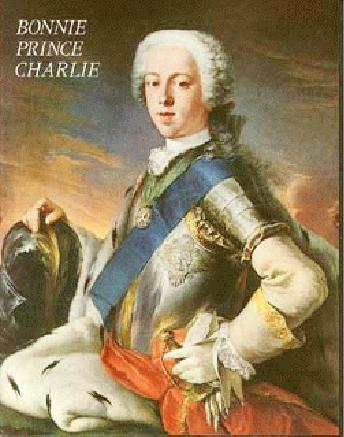
James III with French encouragement conceived a plan to seize the British throne from the ruling Hanoverians--George II. James obtained approval from the French for the plan and his son, Prince Charles, was to command French invasion forces. Charles went to France to assume command of the French forces. The French, however, cancelled the expedition due to bad weather and a British naval build up. Little further French assistance was forecoming. Prince Charles, however, relcklessly decided to go ahead with the expedition even without the anticipated French forces. Prince Charles in July 1745 sureptiously landed on the west coast of Scotland. He raised his standard at Glenfinnan on August 18, 1745. Little support was forth coming from the Lowlanders, but the Highlands was a different matter. The Prince succeeded in amassing a small, but dedicated force of Highlanders (about 2,500 men) for his Jacobite cause. At first not taken seriously, the Prince Charles by September occupied Edinburgh and destroyed the Hanoverian Government army of John Cope at Prestonpans outside Edinburgh. In November he crossed into England, his ranks swelling to almost 6,000 men and marched south to Derby. English Catholicsm however, did not rise to his Jacobite standard. The reenforcements he had anticipated from France never arrived. The English recalled forces from the Continent and began amassing a powerful force.
Confronted by the growing English forces, the Prince decided to withdrew back to Scotland. Much of his force deserted along the way. The final confrontation came at Culloden Moor. The Duke of Cumberland's modern, disciplined force on April 16, 1746 defeated the undisciplined Higlanders at Culloden Moor. The actual battle lasted little more than an hour, but the English and Lowland forces proceeded to massacre what ever Higlanders they could find. The massacre lasted until nightfall. The Duke instructed his spldiers to kill every surviving clansman on the field. Some of the wounded Highlanders were even buried alive with the dead. Cumberland for weeks afterwards carried out vicious reprisals on the feeing Highlanders. Several thousand Higlanders, including women and children, are believed to have been killed. Many of those killed had nothing to do with the battle or even the Jacobite cause. The British hunted Charles as a fugitive for 5 months. He somehow managed to evade the intense efforts by the British to track him down. Despite the dangers, the Highlanders never betrayed him. Charles finally managed to escape by ship to France. A Flora MacDonald on the Scottish island of Benbecula is credited with helping him finally escape. One artifact of the battle is the Cumberland Stone.
The Jacobite Rebellion of 1745 is often thought of another in the long series of conflicts between the Scots anf English. The actual circumstance are much more complicated. Some Highland Clans did assist Prince Charles Charles. Many others did not. In addition many Lowland Scots who looked on the Higland clans as little more than barbarians, actively supported the Hanovarian firces. There were more Scots figting with Cumverland's Government forces at Culloden than with the Prince's Jacobites. This thus was not a war between Scotland and England and it was not a religious war, as few of the Prince's higland forces had strong religious afiliation to Catholocism. Nor did he find support among English Catholics. The failure of the rebellion was the final end of the Stuart concept of absolute monarchy which had been ejected by the majority of both Scots and English half a century earlier.
The lasting effect of the Jaconite Rebellion Highlands clans was enormous. Despite the fact that many if not most Highland clansmen hadn't supported the Prince, Highland culture,
language, and dress was supressed for decades to come. The Highland clearances begun before Culloden, continued unabated, destroying the economic base of the clans.

Navigate the Children in History Website :
[Return to the Main kilt page]
[Return to the Main Bonnie Prince Charlie page]
[About Us]
[Introduction]
[Biographies]
[Chronology]
[Clothing]
[Disease and Health]
[Economics]
[Environmental issues]
[Feminism]
[Geography]
[History]
[Human Nature]
[Law]
[Nationalism]
[Presidents]
[Religion]
[Royalty]
[Science]
[Social Class]
[Bibliographies]
[Contributions]
[FAQs]
[Glossaries]
[Images]
[Index]
[Links]
[Registration]
[Search]
[Tools]
[Children in History Home]